Question 14 Marks
Read the following text carefully and answer the questions that follow :
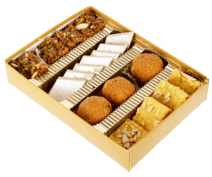
Naina is creative she wants to prepare a sweet box for Diwali at home. She took a square piece of cardboard of side $18 \ cm$ which is to be made into an open box, by cutting a square from each corner and folding up the flaps to form the box. She wants to cover the top of the box with some decorative paper. Naina is interested in maximizing the volume of the box.
$i$. Find the volume of the open box formed by folding up the cutting each corner with $x \ cm. (1)$
$ii$. Naina is interested in maximizing the volume of the box. So, what should be the side of the square to be cut off so that the volume of the box is maximum? $(1)$
$iii.$ Verify that volume of the box is maximum at $x = 3 \ cm$ by second derivative test? $(2)$
OR
Find the maximum volume of the box. $(2)$
Naina is creative she wants to prepare a sweet box for Diwali at home. She took a square piece of cardboard of side $18 \ cm$ which is to be made into an open box, by cutting a square from each corner and folding up the flaps to form the box. She wants to cover the top of the box with some decorative paper. Naina is interested in maximizing the volume of the box.
$i$. Find the volume of the open box formed by folding up the cutting each corner with $x \ cm. (1)$
$ii$. Naina is interested in maximizing the volume of the box. So, what should be the side of the square to be cut off so that the volume of the box is maximum? $(1)$
$iii.$ Verify that volume of the box is maximum at $x = 3 \ cm$ by second derivative test? $(2)$
OR
Find the maximum volume of the box. $(2)$
Answer
View full question & answer→i. Let the side of square to be cut off be $'x\ ' \ cm$.
then, the length and the breadth of the box will be $(18-2x) \ cm$ each and the height of the box is $'x' \ cm.$
The volume $V(x)$ of the box is given by $V(x)=x(18-x)^2$
$\text { ii. } V(x)=x(18-2 x)^2$
$\frac{d V(x)}{d x}=(18-2 x)^2-4 x(18-2 x)$
$\Rightarrow(18-2 x)[18-2 x-4 x]=0$
$\Rightarrow x=9 \text { or } x=3$
$\Rightarrow x=$ not possible
$\Rightarrow x=3 \ cm$
side of the square to be cut off so that the volume of the box is maximum is $x = 3 \ cm$
$iii.\ \frac{d V(x)}{d x}=(18-2 x )(18-6 x )$
$\frac{d^2 V(x)}{d x^2}=(18-6 x)(-2)+(18-2 x)(-6)$
$\Rightarrow \frac{d^2 V(x)}{d x^2}=-12[3- x +9- x ]=-24(6- x )$
$\left.\Rightarrow [\frac{d^2 V(x)}{d x^2}\right]_{x=3}=-72<0$
$\Rightarrow$ volume is maximum at $x =3$
OR
$V(x)=x(18-2 x)^2$
When $x=3$
$V(3)=3(18-2 \times 3)^2$
$\Rightarrow$ Volume $=3 \times 12 \times 12=432 \ cm^3$
then, the length and the breadth of the box will be $(18-2x) \ cm$ each and the height of the box is $'x' \ cm.$
The volume $V(x)$ of the box is given by $V(x)=x(18-x)^2$
$\text { ii. } V(x)=x(18-2 x)^2$
$\frac{d V(x)}{d x}=(18-2 x)^2-4 x(18-2 x)$
$\Rightarrow(18-2 x)[18-2 x-4 x]=0$
$\Rightarrow x=9 \text { or } x=3$
$\Rightarrow x=$ not possible
$\Rightarrow x=3 \ cm$
side of the square to be cut off so that the volume of the box is maximum is $x = 3 \ cm$
$iii.\ \frac{d V(x)}{d x}=(18-2 x )(18-6 x )$
$\frac{d^2 V(x)}{d x^2}=(18-6 x)(-2)+(18-2 x)(-6)$
$\Rightarrow \frac{d^2 V(x)}{d x^2}=-12[3- x +9- x ]=-24(6- x )$
$\left.\Rightarrow [\frac{d^2 V(x)}{d x^2}\right]_{x=3}=-72<0$
$\Rightarrow$ volume is maximum at $x =3$
OR
$V(x)=x(18-2 x)^2$
When $x=3$
$V(3)=3(18-2 \times 3)^2$
$\Rightarrow$ Volume $=3 \times 12 \times 12=432 \ cm^3$