Questions

2 Marks Questions

Take a timed test

7 questions · self-marked practice — reveal the answer and mark yourself.

Question 12 Marks
Prove that: $\int_0^{\pi / 2} \frac{d x}{(1+\sqrt{\tan x})}=\frac{\pi}{4}$
Answer
$\text { Let } y=\int_0^{\frac{\pi}{2}} \frac{d x}{(1+\sqrt{\tan x})}$
$y=\int_0^{\frac{\pi}{2}} \frac{1}{1+\sqrt{\frac{\sin x}{\cos x}} d x}$
$y=\int_0^{\pi / 2} \frac{\sqrt{\cos x}}{(\sqrt{\sin x}+\sqrt{\cos x})} ....(i)$
Using theorem of definite integral
$\int_a^b f(x) d x=\int_a^b f(a+b-x) d x$
$y=\int_0^{\pi / 2} \frac{\sqrt{\cos \left(\frac{\pi}{2}-x\right)}}{\left(\sqrt{\sin \left(\frac{\pi}{2}-x\right)}+\sqrt{\cos \left(\frac{\pi}{2}-x\right)}\right)} d x$
$y=\int_0^{\pi / 2} \frac{\sqrt{\sin x}}{(\sqrt{\cos x}+\sqrt{\sin x})} d x .....(ii)$
Adding eq .(i) and eq.(ii), we get
$2 y=\int_0^{\pi / 2} \frac{\sqrt{\cos x}}{(\sqrt{\sin x}+\sqrt{\cos x})} d x+\int_0^{\pi / 2} \frac{\sqrt{\sin x}}{(\sqrt{\cos x}+\sqrt{\sin x})} d x$
$2 y=\int_0^{\pi / 2} \frac{\sqrt{\sin x}+\sqrt{\cos x}}{(\sqrt{\sin x}+\sqrt{\cos x})} d x$
$2 y=\int_0^{\pi / 2} 1 d x$
$2 y=(x)_0^{\frac{\pi}{2}}$
$y=\frac{\pi}{4}$

View full question & answer
Question 22 Marks
Show that $f(x)=(x-1) e^x+1$ is an increasing function for all $x > 0$.
Answer
$\text { Given:- } f(x)=(x-1) e^x+1$
$\Rightarrow f^{\prime}(x)=\frac{d}{d x}\left((x-1) e^x+1\right)$
$=f^{\prime}(x)=e^x+(x-1) e^x$
$=f^{\prime}(x)=e^x(1+x-1)$
$=f^{\prime}(x)=x e^x$
as given
$x > 0$
$=e^x > 0$
$=x e^x > 0$
$=f^{\prime}(x) > 0$
Hence, the condition for $f(x)$ to be increasing
Thus, $f(x)$ is increasing for all $x > 0$
View full question & answer
Question 32 Marks
The volume of a sphere is increasing at the rate of $8 cm^3 / s$. Find the rate at which its surface area is increasing when the radius of the sphere is $12 \ cm .$
Answer
Let $r$ be the radius, $V$ be the volume and $S$ be the surface area of sphere
Then, we have $\frac{d V}{d t}=8 \ cm^3 / s$
To find $\frac{d S}{d t}$, when $r =12 \ cm$
Since, $V =\frac{4}{3} \pi r^3$
$\therefore \frac{d V}{d t}=\frac{4}{3} \pi 3 r^2 \frac{d r}{d t}$
$\Rightarrow 8=4 \pi \times r^2 \frac{d r}{d t}$
$\Rightarrow \frac{d r}{d t}=\frac{2}{-x^2} \ cm / s .....(i)$
Now, $S =4 \pi r^2$
$\therefore \frac{d S}{d t}=\frac{d}{d t}\left(4 \pi r^2\right)=4 \pi \times 2 r \cdot \frac{d r}{d t}$
$=8 \pi r \times \frac{2}{\pi r^2}[\text { From Eq(i) }]$
$=\frac{16}{r}$
$\Rightarrow \quad\left(\frac{d S}{d t}\right)_{r=12}=\frac{16}{12}=\frac{4}{3} \ cm^2 / s $
View full question & answer
Question 42 Marks
Find the intervals in which the function $f$ given by $f(x)=2 x^3-3 x^2-36 x+7$ is decreasing.
Answer
It is given that function $f(x)=2 x^3-3 x^2-36 x+7$
$\Rightarrow f^{\prime}(x)=6 x^2-6 x+36$
$\Rightarrow f^{\prime}(x)=6\left(x^2-x+6\right)$
$\Rightarrow f^{\prime}(x)=6(x+2)(x-3)$
If $f(x) = 0$ then we get,
$\Rightarrow x=-2,3$
So, the point $x=-2$ and $x=3$ divides the real line into two disjoint intervals, $(-\infty, 2),(-2,3)$ and $(3, \infty)$
Image
So, in interval $(-2, 3)$
$f'(x) = 6(x + 2)(x - 3) < 0$
Therefore, the given function $(f)$ is strictly decreasing in interval $(-2, 3).$
View full question & answer
Question 52 Marks
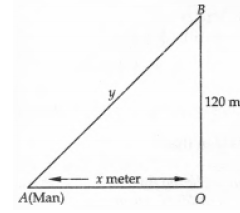
A man is walking at the rate of $6.5 \ km/hr$ towards the foot of a tower $120 m$ high. At what rate is he approaching the top of the tower when he is $50 m$ away from the tower
Answer
Let at any time t, the man be at distances of x and y metres from the foot and top of the tower respectively. Then,
$y^2=x^2+(120)^2 \ldots (i)$
$\Rightarrow 2 y \frac{d y}{d t}=2 x \frac{d x}{d t}$
$\Rightarrow \frac{d y}{d t}=\frac{x}{y} \frac{d x}{d t}$
given: $\frac{d x}{d t}=-6 \cdot 5 \ km / hr$ negative sign due to decreasing,
therefore;
$\frac{d y}{d t}=-\frac{6.5 x}{y} ...(ii)$
Putting $x =50$ in $(i)$ we get $y=\sqrt{50^2+120^2}=130$
Putting $x=50, y=130$ in $(ii)$, we get
$\frac{d y}{d t}=-\frac{6 \cdot 5 \times 50}{130}=-2 \cdot 5$
Thus, the man is approaching the top of the tower at the rate of $2.5 \ km/hr.$
Image
View full question & answer
Question 62 Marks
Find the value of $\sin \left[2 \cot ^{-1}\left(\frac{-5}{12}\right)\right]$
Answer
Let $\cot ^{-1}\left(\frac{-5}{12}\right)=y$
Then $\cot y=\frac{-5}{12}$
Now,
$\sin \left[2 \cot ^{-1}\left(\frac{-5}{12}\right)\right]=\sin 2 y$
$=2 \sin y \cos y=2\left(\frac{12}{13}\right)\left(\frac{-5}{13}\right) \quad\left[\text { since } \cot y<0, \text { so } y \in\left(\frac{\pi}{2}, \pi\right)\right]$
$=\frac{-120}{169}$
View full question & answer
Question 72 Marks
Write the value of $\sin ^{-1}\left(\frac{1}{3}\right)-\cos ^{-1}\left(-\frac{1}{3}\right)$
Answer
Given $\sin ^{-1}\left(\frac{1}{3}\right)-\cos ^{-1}\left(-\frac{1}{3}\right)$
We know that $\cos ^{-1}(-\theta)=\pi-\cos ^{-1} \theta$
$=\sin ^{-1}\left(\frac{1}{3}\right)-\left(\pi-\cos ^{-1}\left(\frac{1}{3}\right)\right)$
$=\sin ^{-1}\left(\frac{1}{3}\right)-\pi+\cos ^{-1}\left(\frac{1}{3}\right)$
$=\sin ^{-1}\left(\frac{1}{3}\right)+\cos ^{-1}\left(\frac{1}{3}\right)-\pi$
$=\frac{\pi}{2}-\pi$
$=-\frac{\pi}{2}$
Therefore we have,
$\sin ^{-1}\left(\frac{1}{3}\right)-\cos ^{-1}\left(-\frac{1}{3}\right)=-\frac{\pi}{2}$
View full question & answer
2 Marks Questions - MATHS STD 12 Science Questions - Vidyadip