Questions

3 Marks Question

Take a timed test

9 questions · self-marked practice — reveal the answer and mark yourself.

Question 13 Marks
Evaluate $\int_{-\pi}^\pi(\cos a x-\sin b x)^2 d x$.
Answer

$\text { Given, } I=\int_{-\pi}^\pi(\cos a x-\sin b x)^2 d x$
$=\int_{-\pi}^\pi\left(\cos ^2 a x+\sin ^2 b x-2 \cos a x \sin b x\right) d x$
$=\int_{-\pi}^\pi\left(\cos ^2 a x+\sin ^2 b x\right) d x-2 \int_{-\pi}^\pi \cos a x \sin b x d x$
$=I_1-I_2$
Let,
$I_1=\int_{-\pi}^\pi\left(\cos ^2 a x+\sin ^2 b x\right) d x \text { ( be an even function) }$
$=2 \int_0^\pi\left(\cos ^2 a x+\sin ^2 b x\right) d x$
$=2 \int_0^\pi\left(\frac{1+\cos 2 a x}{2}+\frac{1-\cos 2 b x}{2}\right) d x$
$=\int_0^\pi(1+\cos 2 a x+1-\cos 2 b x) d x$
$=\int_0^\pi(2+\cos 2 a x-\cos 2 b x) d x$
$=\left(2 x+\frac{\sin 2 a x}{2 a}-\frac{\sin 2 b x}{2 b}\right)_0^\pi$
$=\left(2 \pi+\frac{\sin 2 a \pi}{2 a}-\frac{\sin 2 b \pi}{2 b}\right)-0$
$=2 \pi+\frac{\sin 2 a \pi}{2 a}-\frac{\sin 2 b \pi}{2 b}$
$I_2=2 \int_{-\pi}^\pi(\cos a x \sin b x) d x \text { ( be a odd function) }$
$=0\binom{\because \int_{-a}^a f(x)=2 \int_0^a f(x) d x, \text { if } f(x) \text { is even }}{0, \text { if } f(x) \text { is odd }}$
$\therefore I=I_1-I_2=2 \pi+\frac{\sin 2 a \pi}{2 a}-\frac{\sin 2 b \pi}{2 b}$
View full question & answer
Question 23 Marks
If $e ^{ x }+ e ^{ y }= e ^{ x + y }$, prove that $\frac{d y}{d x}+ e ^{ y - x }=0$.
Answer
Given $e^{ x }+ e ^{ y }= e ^{ x + y }$
On dividing Eq(i) by $e ^{ x + y }$, we get,
$e^{-y}+e^{-x}=1 \ldots \text { (ii) }$
Therefore, on differentiating both sides of Eq(ii) w.r.t x, we get,
$e^{-y} \cdot\left(\frac{-d y}{d x}\right)+e^{-x}(-1)=0$
$\Rightarrow-e^{-y} \frac{d y}{d x}+e^{-x}(-1)=0$
$\Rightarrow-e^{-y} \frac{d y}{d x}=e^{-x}$
$\Rightarrow \frac{d y}{d x}=-\frac{e^{-x}}{e^{-y}}$
$\Rightarrow \frac{d y}{d x}=-e^{(y-x)}$
$\therefore \frac{d y}{d x}+e^{(y-x)}=0$
Hence Proved.
View full question & answer
Question 33 Marks
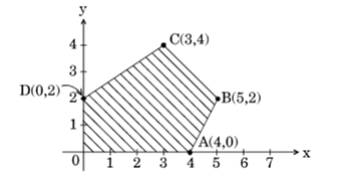
The corner points of the feasible region determined by the system of linear inequations are as shown below :
Image

Answer each of the following:
i. Let $z = 13x - 15y $ be the objective function. Find the maximum and minimum values of $z$ and also the
corresponding points at which the maximum and minimum values occur.
ii. Let $z = kx + y $ be the objective function. Find $k,$ if the value of $z$ at $A$ is same as the value of $z$ at $B$.
Answer
$i. z(A)=13(4)-15(0)=52$
$z(B)=13(5)-15(2)=35$
$z(C)=13(3)-15(4)=-21$
$z(D)=13(0)-15(2)=-30$
$z(0)=0$
$\therefore \operatorname{Max}(z)=52 $ at $ A(4,0), \operatorname{Min}(z)=-30$ at $(0,2)$
$ii. z ( A )= z ( B ) $
$\Rightarrow 4 k +0=5 k +2 $
$\Rightarrow k =-2$
View full question & answer
Question 43 Marks
Find a particular solution of the differential equation $\frac{d y}{d x}+2 y \tan x=\sin x$, given that $y =0$, when $x=\frac{\pi}{3}$.
Answer
We have,
$\frac{d y}{d x}+2 y \tan x=\sin x$
which is a linear differential equation of the form $\frac{d y}{d x}+P y=Q$.
Here, $P =2 \tan x$ and $Q =\sin x$
$\therefore \text { IF }=e^{\int P d x}=e^{2 \int \tan x d x}=e^{2 \log |\sec x|}$
$=e^{\log \sec ^2 x} \quad\left(\because m \log n=\log n^m 1\right.$
$=\sec ^2 x\left(\because e^{\log x}=x\right)$
The general solution is given by
$y \times I F=\int(Q \times I F) d x+C \ldots \text { (i) }$
$\Rightarrow y \sec ^2 x=\int\left(\sin x \cdot \sec ^2 x\right) d x+C$
$\Rightarrow y \sec ^2 x=\int \sin x \cdot \frac{1}{\cos ^2 x} d x+C$
$\Rightarrow y \sec ^2 x=\int \tan x \sec x d x+C$
$\Rightarrow y \sec ^2 x=\sec x+C .....(ii)$
Also, given that $y =0$, when $x=\frac{\pi}{3}$.
On putting $y =0$ and $x=\frac{\pi}{3}$ in Eq. $(ii),$ we get
$0 \times \sec ^2 \frac{\pi}{3}=\sec \frac{\pi}{3}+C$
$\Rightarrow 0=2+C \Rightarrow C=-2$
On putting the value of $C$ in Eq. $(ii)$, we get
$y \sec ^2 x=\sec x-2$
$\therefore y=\cos x-2 \cos ^2 x$
which is the required particular solution of the given differential equation
View full question & answer
Question 53 Marks
Evaluate the integral: $\int \frac{1}{x \sqrt{1+x^n}} d x$
Answer
Let the given integral be,
$I=\int \frac{d x}{x \sqrt{1+x^n}}$
$=\int \frac{x^{n-1} d x}{x^{n-1} x^1 \sqrt{1+x^n}}$
$=\int \frac{x^{n-1} d x}{x^n \sqrt{1+x^n}}$
Putting $x ^{ n }= t$$
\Rightarrow nx x^{n-1} dx=dt$
$\Rightarrow x^{n-1} dx=\frac{d t}{n}$
$\therefore I=\frac{1}{n} \int \frac{d t}{t \sqrt{1+t}}$
let $1+ t = p ^2$
$\Rightarrow dp=2 p dp$
$\therefore I=\frac{1}{n} \int \frac{2 pdp}{\left(p^2-1\right) p}$
$=\frac{2}{n} \int \frac{d p}{p^2-1^2}$
$=\frac{2}{n} \times \frac{1}{2} \log \left|\frac{p-1}{p+1}\right|+C$
$=\frac{1}{n} \log \left|\frac{\sqrt{1+t-1}}{\sqrt{1+t+1}}\right|+C$
$=\frac{1}{n} \log \left|\frac{\sqrt{1+x^n}-1}{\sqrt{1+x^n}+1}\right|+C$
View full question & answer
Question 63 Marks
$\left(x^2+y^2\right) d y=x y d x$. If $y(1)=1$ and $y\left(x_0\right)=e$, then find the value of $x_0$.
Answer
$\left(x^2+y^2\right) d y=x y d x$
$\Rightarrow \int \frac{x}{y} d y+\int \frac{y}{x} d y=\int d x$
$\Rightarrow x \log y+\frac{y^2}{2 x}=x+c$
Now, at $x =1 ; y = e$
$x \log y+\frac{y^2}{2 x}=x+c \Rightarrow x+\frac{e^2}{2}=x+c \Rightarrow c=\frac{e^2}{2}$
Now at $x=x_0 ; y=e$
$x_0 \log e+\frac{e^2}{2 x_0}=x_0+\frac{e^2}{2} \Rightarrow \frac{e^2}{2 x_0}=\frac{e^2}{2} \Rightarrow x_0=1$
View full question & answer
Question 73 Marks
Solve the following $\text{LPP}$ graphically:
Minimise $Z=5 x+10 y$
subject to the constraints $x+2 y \geq 120$
$x+y \geq 60, x-2 y \geq 0 \text { and } x, y \geq 0$
Answer
Our problem is to minimise the objective function $Z=5 x+10 y ... (i)$
Subject to constraints
$x+2 y \leq 120 ....(ii)$
$x+y \geq 60 ....(iii)$
$x-2 y \geq 0 ....(iv)$
$x \geq 0, y \geq 0 ($which is the non negative constraint which will restrict the feasible region to the first quadrant only$)$
Table of values for line $( ii) x+2 y=120$ are given below.
$x$ $0$ $120$
$y$ $60$ $0$
Replace $O(0,0)$ in the inequality $x+2 y \leq 120$, we get
$0+2 \times 0 \leq 120$
$\Rightarrow 0 \leq 120 \text { (which is true) }$
So, the half plane for the inequality of the line $( ii)$ is towards the origin which means that the origin $O (0,0)$ is a point in the feasible region of the inequality of the line $(ii).$
Secondly, draw the graph of the line $x+y=60$. Hence the table of values of the line $(iii)$ is given as follows.
$x$ $0$ $60$
$y$ $60$ $0$
On replacing $O(0,0)$ in the inequality $x+y \geq 60$, we get
$0+0 \geq 60 \Rightarrow 0 \geq 60 \text { (which is false) }$
So, the half plane for the inequality of the line $( iii)$ is away from the origin, which means that the origin is not a point on the feasible region.
Thirdly, draw the graph of the line $x-2 y=0$ and the table of values for $(iv)$ is given as follows.
On solving equations $x - 2y = 0$ and $x + y = 60$ we get $D(40, 20)$ and on solving equations $x - 2y = 0$ and  we get $C (60, 30)$
Feasible region is $\text{ABCDA}$, which is a bounded feasible region, the coordinates of the corner points of the feasible region are given as $A (60, 0), B (120, 0), C (60, 30)$ and $D (40, 20).$
Corner points $Z=5 x+10 y A (60, 0)Z = 300 ($ minimum $)B (120, 0)Z = 600C (60, 0)Z = 600D (40, 20)Z = 400$
The values of $Z$ at these points are as follows So, the minimum value of $Z$ is obtained as $300$ , which occurs at the point $(60, 0).$
View full question & answer
Question 83 Marks
A problem in mathematics is given to three students whose chances of solving it correctly are $1/2, 1/3$ and $1/4$ respectively. What is the probability that only one of them solves it correctly?
Answer
Let $A , B , C$ be the given students and let $E _1, E _2$ and $E _3$ be the events that the problem is solved by $A , B , C$ respectively. Then, $\bar{E}_1$, $\bar{E}_2$ and $\bar{E}_3$ are the events that the given problem is not solved by $A , B , C$ respectively.
Therefore, we have,
$P\left(E_1\right)=\frac{1}{2} ; P\left(E_2\right)=\frac{1}{3} ; P\left(E_3\right)=\frac{1}{4}$
$P\left(\bar{E}_1\right)=\left(1-\frac{1}{2}\right)=\frac{1}{2} ; P\left(\bar{E}_2\right)=\left(1-\frac{1}{3}\right)=\frac{2}{3} \text { and } P\left(\bar{E}_3\right)=\left(1-\frac{1}{4}\right)=\frac{3}{4}$
$P ($ exactly one of them solves the problem)
$=P\left(\left(E_1 \cap \bar{E}_2 \cap \bar{E}_3\right) \text { or }\left(\bar{E}_1 \cap E_2 \cap \bar{E}_3\right) \text { or }\left(\bar{E}_1 \cap \bar{E}_2 \cap E_3\right)\right)$
$=P\left(E_1 \cap \bar{E}_2 \cap \bar{E}_3\right)+P\left(\bar{E}_1 \cap E_2 \cap \bar{E}_3\right)+P\left(\bar{E}_1 \cap \bar{E}_2 \cap E_3\right)$
$=\left\{P\left(E_1\right) \times P\left(\bar{E}_2\right) \times P\left(\bar{E}_3\right)\right\}+\left(P\left(\bar{E}_1\right) \times P\left(E_2\right) \times P\left(\bar{E}_3\right)\right)
+\left(P\left(\bar{E}_1\right) \times P\left(\bar{E}_2\right) \times P\left(E_3\right)\right)$
$=\left(\frac{1}{2} \times \frac{2}{3} \times \frac{3}{4}\right)+\left(\frac{1}{2} \times \frac{1}{3} \times \frac{3}{4}\right)+\left(\frac{1}{2} \times \frac{2}{3} \times \frac{1}{4}\right)$
$=\left(\frac{1}{4}+\frac{1}{8}+\frac{1}{12}\right)=\frac{11}{24}$
View full question & answer
Question 93 Marks
Evaluate $\int \frac{\sin (x-a)}{\sin (x+a)} d x$
Answer
According to the question,$I=\int \frac{\sin (x-a)}{\sin (x+a)} d x$
$\text { Put } x+a=t \Rightarrow dx=dt$
$\therefore I=\int \frac{\sin (t-a-a)}{\sin t} d t=\int \frac{\sin (t-2 a)}{\sin t} d t$
$=\int \frac{\sin t \cos 2 a-\cos t \sin 2 a}{\sin t} d t$
${(\therefore \sin (A-B)=\sin A \cos B-\cos A \sin B)}$
$=\int \cos 2 a d t-\int \sin 2 a \cdot \cot t d t$
$=\cos 2 a(t)-\sin 2 a(\log |\sin t|)+C_1$
$=(x+a) \cos 2 a-\sin 2 a \log |\sin (x+a)|+C_1$
${(put t=x+a)}$
$=x \cos 2 a-\sin 2 a \log |\sin (x+a)|+C _1$
View full question & answer
3 Marks Question - MATHS STD 12 Science Questions - Vidyadip