Question 15 Marks
Show that the function $f : R _0 \rightarrow R _0$, defined as $f ( x )=\frac{1}{x}$, is one-one onto, where $R _0$ is the set non-zero real numbers.
Is the result true, if the domain $R _0$ is replaced by N with co-domain being same as $R _0$ ?
Is the result true, if the domain $R _0$ is replaced by N with co-domain being same as $R _0$ ?
Answer
View full question & answer→We observe the following properties of $f$.
Injectivity: Let $x, y \in R_0$ such that $f(x)=f(y)$. Then,
$f(x)=f(y) \Rightarrow \frac{1}{x}=\frac{1}{y} \Rightarrow x=y$
So, $f : R _0 \rightarrow R _0$ is one-one.
Surjectivity: Let $y$ be an arbitrary element of $R_0$ (co-domain) such that $f(x)=y$.Then,
$f(x)=y \Rightarrow \frac{1}{x}=y \Rightarrow x=\frac{1}{y}$
Clearly, $x=\frac{1}{y} \in R_0$ (domain) for all $y \in R _0$ (co-domain).
Thus, for each $y \in R _0$ (co-domain) there exits $x=\frac{1}{y} \in R_0$ (domain) such that $f(x)=\frac{1}{x}=y$
So, $f : R _0 \rightarrow R _0$ is onto.
Hence, $f : R _0 \rightarrow R _0$ is one-one onto.
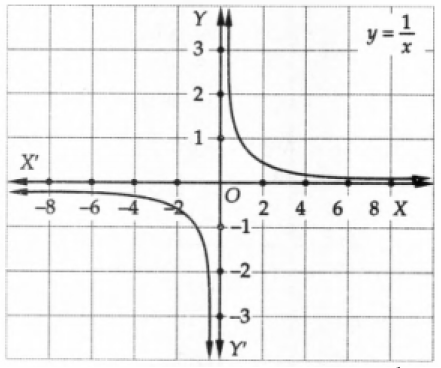
This is also evident from the graph of $f(x)$ as shown in fig.
Let us now consider $f : N \rightarrow R _0$ given by $f(x)=\frac{1}{x}$
For any $x, y \in N$, we find that
$f(x)=f(y) \Rightarrow \frac{1}{x}=\frac{1}{y} \Rightarrow x=y$
So, $f : N \rightarrow R _0$ is one-one.
We find that $\frac{2}{3}, \frac{3}{5}$ etc. in co-domain $R _0$ do not have their pre-image in domain N . So, f : $N \rightarrow R _0$ is not onto.
Thus, $f : N \rightarrow R _0$ is one-one but not onto.
Injectivity: Let $x, y \in R_0$ such that $f(x)=f(y)$. Then,
$f(x)=f(y) \Rightarrow \frac{1}{x}=\frac{1}{y} \Rightarrow x=y$
So, $f : R _0 \rightarrow R _0$ is one-one.
Surjectivity: Let $y$ be an arbitrary element of $R_0$ (co-domain) such that $f(x)=y$.Then,
$f(x)=y \Rightarrow \frac{1}{x}=y \Rightarrow x=\frac{1}{y}$
Clearly, $x=\frac{1}{y} \in R_0$ (domain) for all $y \in R _0$ (co-domain).
Thus, for each $y \in R _0$ (co-domain) there exits $x=\frac{1}{y} \in R_0$ (domain) such that $f(x)=\frac{1}{x}=y$
So, $f : R _0 \rightarrow R _0$ is onto.
Hence, $f : R _0 \rightarrow R _0$ is one-one onto.
This is also evident from the graph of $f(x)$ as shown in fig.
Let us now consider $f : N \rightarrow R _0$ given by $f(x)=\frac{1}{x}$
For any $x, y \in N$, we find that
$f(x)=f(y) \Rightarrow \frac{1}{x}=\frac{1}{y} \Rightarrow x=y$
So, $f : N \rightarrow R _0$ is one-one.
We find that $\frac{2}{3}, \frac{3}{5}$ etc. in co-domain $R _0$ do not have their pre-image in domain N . So, f : $N \rightarrow R _0$ is not onto.
Thus, $f : N \rightarrow R _0$ is one-one but not onto.