Questions

5 Marks Questions

Take a timed test

6 questions · self-marked practice — reveal the answer and mark yourself.

Question 15 Marks
Prove that the curves $y^2=4 x$ and $x^2=4 y$ divide the area of the square bounded by sides $x=0, x=4, y=4$ and $y$ $=0$ into three equal parts.
Answer
The given curves are $y^2=4 x$ and $x^2=4 y$
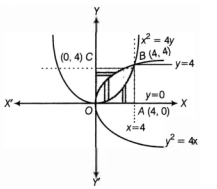
Let $\text{O A B C}$ be the square whose sides are represented by following equations
Equation of $O A$ is $y=0$
Equation of $AB$ is $x =4$
Equation of $BC$ is $y =4$
Equation of $CO$ is $x =0$
Image
On solving equations $y^2=4 x$ and $x^2=4 y$, we get $A(0,0)$ and $B(4,4)$ as their points of intersection.
The Area bounded by these curves
$=\int_0^4\left(y_{\left(\text {parabola } y^2=4 x\right)}-y_{\left(\text {parabola } x^2=4 y\right)}\right) d x$
$=\int_0^4\left(2 \sqrt{x}-\frac{x^2}{4}\right) d x$
$=\left(2 \cdot \frac{2}{3} x^{3 / 2}-\frac{x^3}{12}\right)_0^4$
$=\left(\frac{4}{3} x^{3 / 2}-\frac{x^3}{12}\right)_0^4$
$=\frac{4}{3} \cdot(4)^{3 / 2}-\frac{64}{12}$
$=\frac{4}{3} \cdot\left(2^2\right)^{3 / 2}-\frac{64}{12}$
$=\frac{4}{3} \cdot(2)^3-\frac{64}{12}$
$=\frac{32}{3}-\frac{16}{3}$
$=\frac{16}{3} \text { sq units }$
Hence, area bounded by curves $y^2=4 x$ and $x=4 y$ is $\frac{16}{3}$ sq units $\qquad$
Area bounded by curve $x^2=4 y$ and the lines $x=0, x=4$ and $X-$axis
$=\int_0^4 y_{\left(\text {parabola } x^2=4 y\right)} d x$
$=\int_0^4 \frac{x^2}{4} d x$
$=\left(\frac{x^3}{12}\right)_0^4$
$=\frac{64}{12}$
$=\frac{16}{3} \text { sq units ........(ii) }$
The area bounded by curve $y^2=4 x$, the lies $y=0, y=4$ and $Y$-axis
$=\int_0^4 x\left(\text { parabola } y^2=4 x\right)$
$=\int_0^4 \frac{y^2}{4} d y$
$=\left(\frac{y^3}{12}\right)_0^4$
$=\frac{64}{12}$
$=\frac{16}{3} \text { sq units .......(iii) }$
From Equations. $(i), (ii)$ and $(iii),$ area bounded by the parabolas $y^2=4 x$ and $x^2=4 y$ divides the area of square into three equal parts.
View full question & answer
Question 25 Marks
The sum of the surface areas of a cuboid with sides $x , 2 x$ and $\frac{x}{3}$ and a sphere is given to be constant. Prove that the sum of their volumes is minimum, if $x$ is equal of three times the radius of sphere. Also, find the minimum value of the sum of their volumes.
Answer
Let $r$ be the radius of the sphere and dimensions of cuboid are $x , 2 x$ and $\frac{x}{3}$.
$\therefore 4 \pi r^2+2\left(\frac{x}{3} \times x+x \times 2 x+2 x \times \frac{x}{3}\right)=k \text { (constant) (given) }$
$\Rightarrow 4 \pi r^2+6 x^2=k$
$\Rightarrow r^2=\frac{k-6 x^2}{4 \pi} \Rightarrow r=\sqrt{\frac{k-6 x^2}{4 \pi}} \ldots \ldots \text { (i) }$
Sum of the volumes, $V=\frac{4}{3} \pi r^3+\frac{x}{3} \times x \times 2 x$
$=\frac{4 \pi r^3}{3}+\frac{2}{3} x^3$
$\Rightarrow V=\frac{4}{3} \pi\left(\frac{k-6 x^2}{4 \pi}\right)^{\frac{3}{2}}+\frac{2}{3} x^3$
On differentiating both sides $\text{w.r.t}. \ x$, we get
$\frac{d V}{d x}=\frac{4}{3} \pi \times \frac{3}{2}\left(\frac{k-6 x^2}{4 \pi}\right)^{\frac{1}{2}}\left(\frac{-12 x}{4 \pi}\right)+\frac{2}{3} \times 3 x^2$
$=2 \pi \sqrt{\frac{k-6 x^2}{4 \pi}}\left(\frac{-3 x}{\pi}\right)+2 x^2$
$=(-6 x) \sqrt{\frac{k-6 x^2}{4 \pi}}+2 x^2$
For maxima or minima, put $\frac{d V}{d x}=0$
$\Rightarrow \quad(-6 x) \sqrt{\frac{k-6 x^2}{4 \pi}}+2 x^2=0$
$\Rightarrow 2 x^2=6 x \sqrt{\frac{k-6 x^2}{4 \pi}}$
$\Rightarrow x=3 \sqrt{\frac{k-6 x^2}{4 \pi}}$
$\Rightarrow x=3 r$
$($using Eq. $(i))$
Again, on differentiating $\frac{d V}{d x}\  \text{w.r.t.} \ x$, we get
$\frac{d^2 V}{d x^2}=-6 \frac{d}{d x}\left(x \sqrt{\frac{k-6 x^2}{4 \pi}}\right)+4 x$
$=-6\left(\sqrt{\frac{k-6 x^2}{4 \pi}}+x \cdot \frac{1}{2}+\frac{1}{\sqrt{\frac{k-6 x^2}{4}}}\left(\frac{-12 x}{4\pi}\right)\right)+4 x$
$=-6\left(r-\frac{3 x^2}{2 \pi r}\right)+4 x$
$=-6 r+\frac{9 x^2}{\pi r}+4 x$
Now,
$\left(\frac{d^2 r}{d z^2}\right)_{x=3 r}^{\pi r}=-6 r+\frac{9 \times 9 r^2}{\pi}+12 r=6 r+\frac{18 r}{\pi};0$
Hence$, V$ is minimum when $x$ is equal to three times the radius of the sphere.
Hence proved.
Now, on putting $r=\frac{x}{3}$ in Eq. $(ii),$ we get
$V_{\min }=\frac{4 \pi}{3}\left(\frac{x}{3}\right)^3+\frac{2}{3} x^3=\frac{4 \pi}{81} x^3+\frac{2}{3} x^3$
$=\frac{2}{3} x^2\left(\frac{2 \pi}{27}+1\right)=\frac{2}{3} x^3\left(\frac{44}{189}+1\right)$
$=\frac{2}{3} x^3\left(\frac{293}{189}\right)=\frac{466}{567} x^3$
View full question & answer
Question 35 Marks
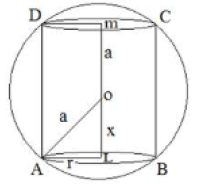
Show that the height of the cylinder of maximum volume that can be inscribed in a sphere of radius $R$ is $\frac{2 R}{\sqrt{3}}$ Also find the maximum volume.
Answer
Image
$V=\pi r^2 \cdot 2 x\ (\because O L=x, L M=2 x)$
$=\pi \cdot\left(a^2-x^2\right) \cdot 2 x$
$V=2 \pi\left(a^2 x-x^3\right)$
$\frac{d v}{d x}=2 \pi\left(a^2-3 x^2\right)$
$\frac{d^2 v}{d x^2}=2 \pi(0-6 x)$
$=-12 \pi x$
For maximum/minimum
$\frac{d v}{d x}=0$
$2 \pi\left[a^2-3 x^2\right]=0$
$a^2=3 x^2 $
$\Rightarrow \sqrt{\frac{a^2}{3}}=x$
$\Rightarrow x=\frac{a}{\sqrt{3}}$
$\left.\frac{d^2 v}{d x^2}\right]_{x=\frac{a}{\sqrt{3}}}=-12 \pi \cdot \frac{a}{\sqrt{3}}$
$=$ negative maximum
Volume is maximum at $x=\frac{a}{\sqrt{3}}$
Height of cylinder of maximum volume is
$=2 x$
$=2 \times \frac{a}{\sqrt{3}}$
$=\frac{2 a}{\sqrt{3}}$
View full question & answer
Question 45 Marks
Let R be a relation on $N \times N$, defined by $(a, b)\ R\ (c, d) \Leftrightarrow a + d = b + c$ for all $(a, b), (c, d) \in N \times N$. Show that $R$ is an equivalence relation.
Answer
Here $R$ is a relation on $N \times N$, defined by $(a, b)\ R\ ( c , d ) \Leftrightarrow a + d = b + c$ for all $(a, b), (c, d) \in N \times N$
We shall show that $R$ satisfies the following properties
$i.$ Reflexivity:
We know that $a + b = b + a$ for all $a , b \in N$.
$\therefore( a , b )\ R\ ( a , b )$ for all $( a , b ) \in(N \times N)$
So$, R$ is reflexive.
$i.$ Reflexivity:
We know that $a + b = b + a$ for all $a , b \in N$.
$\therefore( a , b ) R ( a , b )$ for all $( a , b ) \in(N \times N)$
So, $R$ is reflexive.
$ii.$ Symmetry:
Let $(a, b)\ R\ (c, d)$.
Then,
$(a, b) R(c, d)$
$ \Rightarrow a+d=b+c$
$\Rightarrow c+b=d+a$
$\Rightarrow(c, d)\ R\ (a, b)$
$\therefore( a , b )\ R\ ( c , d ) $
$\Rightarrow( c , d )\ R\ ( a , b )$ for all $( a , b ),( c , d ) \in N \times N$
This shows that $R$ is symmetric.
$iii.$ Transitivity:
Let $(a, b)\ R\ (c, d)$ and $(c, d)\ R\ (e, f).$
Then$, (a, b)\ R\ (c, d)$ and $(c, d)\ R\ (e, f)$
$\Rightarrow a+d=b+c$ and $ c+f=d+e$
$\Rightarrow a+d+c+f=b+c+d+e$
$\Rightarrow a+f=b+e$
$\Rightarrow(a, b)\ R\ (e, f)$
Thus$, (a, b) R (c, d)$ and $(c, d)\ R\ (e, f)$
$\Rightarrow( a , b )\ R\ ( e , f )$
This shows that $R$ is transitive.
$\therefore R$ is reflexive, symmetric and transitive
Hence$, R$ is an equivalence relation on $N \times N$
View full question & answer
Question 55 Marks
Let $A =(-1,1)$. Then, discuss whether the following functions defined on A are one$-$one, onto or bijective:
i. $f(x)=\frac{x}{2}$
ii. $g(x)=|x|$
iii. $h(x)=x|x|$
iv. $k(x)=x^2$
Answer
Given that $A =(-1,1)$
$i. f(x)=\frac{x}{2}$
Let $f\left(x_1\right)=f\left(x_2\right)$
$\Rightarrow \frac{x_1}{2}=\frac{x_2}{2} \Rightarrow x_1=x_2$
So, $f ( x )$ is one-one.
Now, let $y=\frac{x}{2}$
$\Rightarrow x=2 y \notin A, \forall y \in A$
As for $y=1 \in A, x=2 \notin A$
So, $f ( x )$ is not onto.
Also, $f(x)$ is not bijective as it is not onto.
$ii. g(x)=|x|$
Let $g \left( x _1\right)= g \left( x _2\right)$
$\Rightarrow\left|x_1\right|=\left|x_2\right| \Rightarrow x_1= \pm x_2$
So, $g ( x )$ is not one-one.
Now, $x = \pm y \notin A$ for all $y \in R$
So, $g(x)$ is not onto, also, $g(x)$ is not bijective.
$iii.h(x)=x|x|
$
$\Rightarrow x_1\left|x_1\right|=x_2\left|x_2\right| \Rightarrow x_1=x_2$
So, $h(x)$ is one-one
Now, let $y = x | x |$
$\Rightarrow y=x^2 \in A, \forall x \in A$
So, $h(x)$ is onto also, $h(x)$ is a bijective.
$iv. k(x)=x^2$
Let $k \left( x _1\right)= k \left( x _2\right)$
$\Rightarrow x_1^2=x_2^2 \Rightarrow x_1= \pm x_2$
Thus, $k ( x )$ is not one-one.
Now, let $y = x ^2$
$\Rightarrow x \sqrt{y} \notin A, \forall y \in A x=\sqrt{y} \notin A, \forall y \in A$
As for $y =-1, x=\sqrt{-1} \notin A$
Hence, $k(x)$ is neither one-one nor onto.
View full question & answer
Question 65 Marks
If $A=\left[\begin{array}{cc}0 & -\tan \frac{\alpha}{2} \\ \tan \frac{\alpha}{2} & 0\end{array}\right]$, Prove I $+ A =( I - A )\left[\begin{array}{cc}\cos \alpha & -\sin \alpha \\ \sin \alpha & \cos \alpha\end{array}\right]$
View full question & answer
5 Marks Questions - MATHS STD 12 Science Questions - Vidyadip