Questions

3 Marks Question

Take a timed test

9 questions · self-marked practice — reveal the answer and mark yourself.

Question 13 Marks
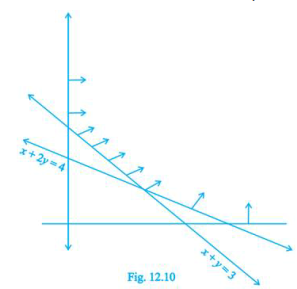
The feasible region for a LPP is shown in Figure. Evaluate Z = 4x + y at each of the corner points of this region. Find the minimum value of Z, if it exists.
Image
Answer
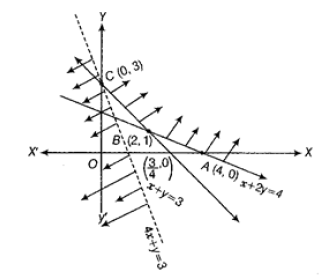
From the shaded region, it is clear that feasible region is unbounded with the corner points A(4, 0), B(2, 1) and C(0, 3). Also, we have Z = 4x + y
(Since, x + 2y = 4 and x + y = 3y =1 and x = 2)
Image
Corner PointsCorresponding value of Z
(4,0)16
(2, 1)9
(0, 3)3 (minimum)
Now, we see that 3 is the smallest value of Z at the corner point (0, 3). Note that here we see that the region is unbounded, therefore 3 may or may not be the minimum value of Z.
To decide this issue, we graph the inequality 4x + y < 3 and check whether the resulting open half plan has no point in common with feasible region otherwise, Z has no minimum value
From the shown graph above, it is clear that there is no point in common with feasible region and hence Z has minimum value of 3 at (0, 3).
View full question & answer
Question 23 Marks
Evaluate the integral: $\int(x+1) \sqrt{x^2+x+1} d x$
Answer
Let the given integral be,
$ I =\int(x+1) \sqrt{x^2+x+1} d x$
Also$, x +1=\lambda \frac{d}{d x}\left(x^2+x+1\right)+\mu$
$\Rightarrow x +1=\lambda(2 x +1)+\mu$
$\Rightarrow x +1=(2 \lambda) x +\lambda+\mu$
Eqyating coeffient of like terms
$2 \lambda=1$
$\Rightarrow \lambda=\frac{1}{2}$
And
$\lambda+\mu=1$
$\Rightarrow \frac{1}{2}+\mu=1$
$\therefore \mu=\frac{1}{2}$
$\therefore I =\frac{1}{2} \int(2 x+1) \sqrt{x^2+x+1} d x+\frac{1}{2} \int \sqrt{x^2+x+1} d x$
$=\frac{1}{2} \int(2 x+1) \sqrt{x^2+x+1} d x+\frac{1}{2} \int \sqrt{x^2+x+\left(\frac{1}{2}\right)^2-\left(\frac{1}{2}\right)^2+1} d x$
$=\frac{1}{2} \int(2 x+1) \sqrt{x^2+x+1} d x+\frac{1}{2} \int \sqrt{\left(x+\frac{1}{2}\right)^2+\left(\frac{\sqrt{3}}{2}\right)^2} d x$
Let $x ^2+ x +1= t$
$\Rightarrow(2 x +1) dx = dt$
Then,
$I=\frac{1}{2} \int \sqrt{t} d t+\frac{1}{2}\left[\frac{x+\frac{1}{2}}{2} \sqrt{\left(x+\frac{1}{2}\right)^2+\left(\frac{\sqrt{3}}{2}\right)^2}+\frac{3}{8} \log \left|\left(x+\frac{1}{2}\right)+\sqrt{\left(x+\frac{1}{2}\right)^2+\left(\frac{\sqrt{3}}{2}\right)^2}\right|\right]+C$
$=\frac{1}{2} \times \frac{2}{3} t^{\frac{3}{2}}+\frac{1}{2}\left[\left(\frac{2 x+1}{4}\right) \sqrt{x^2+x+1}+\frac{3}{8} \log \left|\left(x+\frac{1}{2}\right)+\sqrt{x^2+x+1}\right|\right]+C$
$=\frac{1}{3}\left(x^2+x+1\right)^{\frac{3}{2}}+\frac{1}{2}\left[\left(\frac{2 x+1}{4}\right) \sqrt{x^2+x+1}+\frac{3}{8} \log \left|\left(x+\frac{1}{2}\right)+\sqrt{x^2+x+1}\right|\right]+C$
View full question & answer
Question 33 Marks
Evaluate: $\int x \sin ^3 x \cos xdx$.
Answer
We can write it as $\int x \sin ^2 x \sin x \cos x d x$
We also know that $2 \sin x \cdot \cos x=\sin 2 x$
$\int x \sin ^2 x \sin x \cos x d x=\frac{1}{2} \int x \sin ^2 x \sin 2 x d x$
We also know that $\sin ^2 x=\frac{1-\cos 2 x}{2}$
$\frac{1}{2} \int x \sin ^2 x \sin 2 x d x=\frac{1}{2} \int x \cdot\left(\frac{1-\cos 2 x}{2}\right) \sin 2 x d x$
$=\frac{1}{2}\left[\left(\int \frac{x \sin 2 x}{2} d x-\int \frac{x \cos 2 x \sin 2 x}{2} d x\right)\right]$
Here $\operatorname{Sin} 4 x =2 \sin 2 x \cdot \cos 2 x$
$=\frac{1}{2}\left[\left(\int \frac{x \sin 2 x}{2} d x-\frac{1}{4} \int x \sin 4 x d x\right)\right]$
Using $\text{BY PART METHOD.}$
Here $x$ is first function and $\operatorname{Sin} 2 x$ and $\sin 4 x$ as the second function.
$\int \text { a.b.dx }=a \int b . dx-\int\left[\frac{d a}{d x} \cdot \int b d x\right] d x$
$=\frac{1}{2}\left[\left(\frac{1}{2}\left\{x \int \sin 2 xdx-\int\left(\frac{dx}{dx} \cdot \int \sin 2 xdx\right) dx\right\}\right)-\left(\frac{1}{4}\left\{x \int \sin 4 x-\int\left(\frac{dx}{dx} \cdot \int \sin 4 xdx\right) dx\right\}\right)\right]$
$=\frac{1}{2}\left[\left(\frac{1}{2}\left\{-x \frac{\cos 2 x}{2}+\int \frac{\cos 2 x}{2} d x\right\}\right)-\left(\frac{1}{4}\left\{-x \frac{\cos 4 x}{4}+\int \frac{\cos 4 x}{4} d x\right\}\right)\right]$
$=\frac{1}{2}\left[\left(\frac{1}{2}\left\{-x \frac{\cos 2 x}{2}+\frac{\sin 2 x}{4}\right\}\right)-\left(\frac{1}{4}\left\{-x \frac{\cos 4 x}{4}+\frac{\sin 4 x}{16}\right\}\right)\right]+c$
$=\frac{-x \cos 2 x}{8}+\frac{\sin 2 x}{16}+\frac{x \cos 4 x}{32}-\frac{\sin 4 x}{128}+c$
View full question & answer
Question 43 Marks
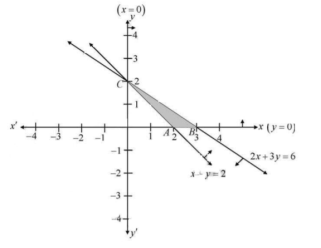
Find the maximum value of $Z=7 x+7 y$ subject to the constraints $x \geq 0, y \geq 0, x+y \geq 2$ and $2 x+3 y \leq 6$
View full question & answer
Question 53 Marks
If $x ^{ x }+ y ^{ x }=1$, prove that $\frac{d y}{d x}=-\left\{\frac{x^x(1+\log x)+y^x \cdot \log y}{x \cdot y^{(x-1)}}\right\}$
Answer
$\text { ATQ, } x^{x}+y^{x}=1$
$\Rightarrow e^{\log x^x}+e^{\log y^x}=1\left\{\text { As } e^{Log a}=a\right\}$
$\Rightarrow e^{x \log x}+e^{x \log y}=1$
Differentiating with respect to $x$ using chain rule,
$\frac{d}{d x}\left(e^{x \log x}\right)+\frac{d}{d x}\left(e^{x \log y}\right)=\frac{d}{d x}(1)$
$\Rightarrow e^{x \log x} \frac{d}{d x}(x \log x)+e^{x \log y} \frac{d}{d x}(x \log y)=0$
$\Rightarrow e^{x \log x}\left[x \frac{d}{d x}(\log x)+\log x \frac{d}{d x}(x)\right] e^{x \log x}+e^{\log y^x}\left[x \frac{d}{d x}(\log y)+\log y \frac{d}{d x}(x)\right]=0$
$\Rightarrow x^{x}\left[x\left(\frac{1}{x}\right)+\log x(1)\right]+y^{x}\left[x\left(\frac{1}{x}\right) \frac{d y}{d x}+\log y(1)\right]=0$
$\Rightarrow x^{x}[1+\log x]+y^{x}\left(\frac{d y}{d x}+\log y\right)=0$
$\Rightarrow y^x \times \frac{x}{y} \frac{d y}{d x}=-\left[x^{x}(1+\log x)+y^{x} \log y\right]$
$\Rightarrow\left(xy^{x-1}\right) \frac{d y}{d x}=-\left[x^{x}(1+\log x)+y^{x} \log y\right]$
$\Rightarrow \frac{d y}{d x}=-\left[\frac{x^x(1+\log x)+y^x \log y}{x y^{x-1}}\right]$
$\text{LHS = RHS}$
Hence Proved.
View full question & answer
Question 63 Marks
Solve the differential equation $\left(1+y^2\right)(1+\log x) d x+x d y=0$ given that when $x=1, y=1$
Answer
We have,
$\left(1+y^2\right)(1+\log x) d x+x d y=0$
$\Rightarrow(1+\log x )\left(1+ y ^2\right) dx =- x dy$
$\Rightarrow \frac{(1+\log x)}{x} d x=-\frac{1}{1+y^2} d y$
$\Rightarrow \int \frac{1+\log x}{x} d x=-\int \frac{1}{1+y^2} d y . \ ($Integrating both sides$)$
$\Rightarrow \int t d t=-\int \frac{1}{1+y^2} d y,$ where $1+\log x = t$
$\Rightarrow \frac{t^2}{2}=-\tan ^{-1} y + C$
$\Rightarrow \frac{1}{2}(1+\log x )^2=-\tan ^{-1} y + C $
It is given that when $x=1, y=1$.
So, putting $x=1, y=1$ in $(i)$, we obtain
$\frac{1}{2}(1+\log 1)^2=-\tan ^{-1} 1+C$
$\Rightarrow \frac{1}{2}=-\frac{\pi}{4}+C $
$\Rightarrow C=\frac{1}{2}+\frac{\pi}{4}$
Putting $C=\frac{1}{2}+\frac{\pi}{4}$ in $(i),$ we obtain
$\frac{1}{2}(1+\log x)^2=-\tan ^{-1} y+\frac{1}{2}+\frac{\pi}{4}$
$\Rightarrow \tan ^{-1} y=\frac{\pi}{4}+\frac{1}{2}-\frac{1}{2}(1+\log x)^2$
$\Rightarrow y=\tan \left\{\frac{\pi}{4}+\frac{1}{2}-\frac{1}{2}(1+\log x)^2\right\}$, which is the solution of the given differential equation.
View full question & answer
Question 73 Marks
A card from a pack of $52$ cards is lost. From the remaining cards of the pack, two cards are drawn and are found to be both diamonds. Find the probability of the lost card being a diamond
Answer
$E_1$ : lost card is diamond
$E_2$ ​​​​​​​: lost card is not diamond
let $A$ : two cards drawn from the remaining pack are diamonds.
$P\left(E_1\right)=\frac{13}{52}=\frac{1}{4}, P\left(E_2\right)=\frac{39}{52}=\frac{3}{4}$
$P\left(\frac{A}{E_1}\right)=\frac{12 C_2}{51 C_2}=\frac{12 \times 11}{51 \times 50}$
$P\left(\frac{A}{E_2}\right)=\frac{13 C_2}{51 C_2}=\frac{13 \times 12}{51 \times 50}$
$P\left(\frac{E_1}{A}\right)=\frac{P\left(E_1\right) P\left(\frac{A}{E_1}\right)}{P\left(E_1\right) P\left(\frac{A}{E_1}\right)+P\left(E_2\right) P\left(\frac{A}{E_2}\right)}$
$=\frac{\frac{13}{52} \times \frac{12 \times 11}{51 \times 50}}{\frac{13}{52} \times \frac{12 \times 11}{51 \times 50}+\frac{3}{4} \times \frac{13 \times 12}{51 \times 50}}$
$=\frac{11}{50}$
View full question & answer
Question 83 Marks
Evaluate: $\int \frac{(2 x+3)}{\sqrt{x^2+x+1}} d x$
Answer
Formula to be used $-\int \frac{d x}{\sqrt{x^2 \pm a^2}}=\log \left(x+\sqrt{x^2 \pm a^2}\right)+c$ where $c$ is the integrating constant
$\therefore \int \frac{(2 x+3)}{\sqrt{x^2+x+1}} d x$
$=\int \frac{(2 x+1)+2}{\sqrt{x^2+x+1}} d x$
$=\int \frac{(2 x+1)}{\sqrt{x^2+x+1}} d x+\int \frac{2}{\sqrt{x^2+x+1}} d x$
Put$, x ^2+ x +1= a ^2,(2 x +1) dx =2 ada$
$\therefore \int \frac{(2 x+1)}{\sqrt{x^2+x+1}} dx$
$=\int \frac{2 d a}{a}$
$=\int 2 da$
$=2 a + c _1$
$=2 \sqrt{x^2+x+1}+c_1$
For $2^{nd}$ part of integral.
$\therefore \int \frac{2}{\sqrt{x^2+x+1}} d x$
$=2 \int \frac{d x}{\sqrt{\left(x+\frac{1}{2}\right)^2+\left(\frac{\sqrt{3}}{2}\right)^2}}$
$=2 \log \left|\left(x+\frac{1}{2}\right)+\sqrt{ x ^2+ x +1}\right|+ c _2$
$\therefore \int \frac{(2 x +1)}{\sqrt{ x ^2+ x +1}} dx +\int \frac{2}{\sqrt{x^2+x+1}} d x$
$=2 \sqrt{x^2+x+1}+2 \log \left|\left(x+\frac{1}{2}\right)+\sqrt{x^2+x+1}\right|+c, c$ is the integrating constant 
View full question & answer
Question 93 Marks
The population of a village increases continuously at the rate proportional to the number of its inhabitants present at any time. If the population of the village was $20,000$ in $1999$ and $25000$ in the year $2004,$ what will be the population of the village in $2009$?
Answer
Let the population at any instant $(t)$ be $y.$
Now it is given that the rate of increase of population is proportional to the number of inhabitants at any instant.
$\therefore \frac{d y}{d t} \alpha y$
$\Rightarrow \frac{d y}{d t}=k y\ (k$ is constant$)$
$\Rightarrow \frac{d y}{y}=k d t$
Now, integrating both sides, we get,
$\log y=k t+C$
According to given conditions,
In the year $1999, t =0$ and $y =20000$
$\Rightarrow \log 20000=C$
Also, in the year $2004, t=5$ and $y=25000$
$\Rightarrow \log 25000=k \cdot 5+C$
$\Rightarrow \log 25000=5 k+\log 20000$
$\Rightarrow 5 k=\log \left(\frac{25000}{2000}\right)=\log \left(\frac{5}{4}\right)$
$\Rightarrow k=\frac{1}{5} \log \left(\frac{5}{4}\right) \ldots \ldots . \text { (iii) }$
Also, in the year $2009, t =10$
Now, substituting the values of $t , k$ and $c$ in equation $(i),$ we get
$\log y=10 \times \frac{1}{5} \log \left(\frac{5}{4}\right)+\log (20000)$
$\Rightarrow \log y=\log \left[20000 \times\left(\frac{5}{4}\right)^2\right]$
$\Rightarrow y=20000 \times \frac{5}{4} \times \frac{5}{4}$
$\Rightarrow y=31250$
Therefore, the population of the village in $2009$ will be $31250$ .
View full question & answer
3 Marks Question - MATHS STD 12 Science Questions - Vidyadip