Questions

2 Marks Questions

Take a timed test

7 questions · self-marked practice — reveal the answer and mark yourself.

Question 12 Marks
$\sec ^{-1}\left(\frac{2}{\sqrt{3}}\right)$
Answer
Let $ \sec ^{-1}\left(\frac{2}{\sqrt{3}}\right)=y$
$\Rightarrow \sec y=\frac{2}{\sqrt{3}}$
$\Rightarrow \sec y=\sec \frac{\pi}{6}$
Since, the principal value branch of $\sec ^{-1}$ is $(0, \pi)$.
Therefore, Principal value of $\sec ^{-1}\left(\frac{2}{\sqrt{3}}\right)$ is $\frac{\pi}{6}$.
View full question & answer
Question 22 Marks
Find the maximum or minimum values, if any, without using derivatives, of the function $f(x)=|\sin 4 x+3|$
Answer
Maximum value $= 4,$ Minimum value $= 2$
We know that
$-1 \leq \sin \theta \leq 1$
$\therefore-1 \leq \sin 4 x \leq 1$
Adding $3,$ on both sides, of above
We get
$-1+3 \leq \sin 4 x+3 \leq 1+3$
$2 \leq|\sin 4 x+3| \leq 4$
Hence $\min.$ Value is $2$ and $\text{max}$ value is $4$.
View full question & answer
Question 32 Marks
Evaluate : $\int \frac{\sin 2 x}{\sin 5 x \sin 3 x} \ d x$
Answer
Let $I =\int \frac{\sin 2 x}{\sin 5 x \sin 3 x} \ d x$.
Then, we have
$I=\int \frac{\sin (5 x-3 x)}{\sin 5 x \sin 3 x} \ d x$
$=\int \frac{\sin 5 x \cos 3 x-\cos 5 x \sin 3 x}{\sin 5 x \sin 3 x}\  d x$
$=\int \frac{\sin 5 x \cos 3 x}{\sin 5 x \sin 3 x} d x-\int \frac{\cos 5 x \sin 3 x}{\sin 5 x \sin 3 x} d x$
$=\int \frac{\cos 3 x}{\sin 3 x} d x-\int \frac{\cos 5 x}{\sin 5 x}\  d x$
$=\int \cot 3 x d x-\int \cot 5 x\  d x$
$=\frac{1}{3} \log |\sin 3 x|-\frac{1}{5} \log |\sin 5 x|+c$
$\therefore I=\frac{1}{3} \log |\sin 3 x|-\frac{1}{5} \log |\sin 5 x|+c$
View full question & answer
Question 42 Marks
Find two positive numbers whose sum is $14$ and the sum of whose squares is minimum.
Answer
Let the numbers be $x$ and $y$. Then,
$x + y = 14 ... (i)$
Let $S$ be the sum of the squares of $x$ and $y$.
Then,
$S=x^2+y^2$
$\Rightarrow S = x ^2+(14- x )^2$
$\Rightarrow S=2 x ^2-28 x +196$
$\Rightarrow \frac{d S}{d x}=4 x -28 $  and  $\frac{d^2 S}{d x^2}=4$
The critical points of $S$ are given by $\frac{d S}{d x}=0$.
$\because \frac{d S}{d x}=0 $
$\Rightarrow 4 x -28=0$
$ \Rightarrow x =7$
Clearly $\frac{d^2 S}{d x^2}=4 ;0$
Thus $, S$ is minimum when $x = 7$ Putting $x = 7$ in equation $(i),$ we obtain $y = 7$
Hence. the required numbers are both equal to $7$.
View full question & answer
Question 52 Marks
The volume of a cube increases at a constant rate. Prove that the increase in its surface area varies inversely as the length of the side.
Answer
Let the side of a cube be $x$ unit.
$\therefore$ Volume of cube $( V )=x^3$
On differentiating both side $\text{w.r.t. t ,} $ we get
$\frac{d V}{d t}=3 x^2 \frac{d x}{d t}=k \text { (constant) }$
$\Rightarrow \frac{d x}{d t}=\frac{k}{3 x^2} \ldots \text { (i) }$
Also, surface area of cube, $S=6 x^2$
On differentiating $\text{w.r.t. t,}$ we get
$\frac{d S}{d t}=12 x \cdot \frac{d x}{d t}$
$\Rightarrow \frac{d S}{d t}=12 x \cdot \frac{k}{3 x^2} \ ($using Eq. $(i))$
$\Rightarrow \frac{d S}{d t}=\frac{12 k}{3 x}=4\left(\frac{k}{x}\right)$
$\Rightarrow \frac{d S}{d t} \alpha \frac{1}{x}$
Hence, the surface area of the cube varies inversely as the length of the side.
View full question & answer
Question 62 Marks
Find the values of a for which the functionf $( x)= \sin x - ax + 4$ is increasing function on $R$.
Answer
Given : $f(x)=\sin x-a x+4$
$f(x)=\cos x-a$
Given : $F(x)$ is increasing on $R$
$\Rightarrow f^{\prime}(x);0$
$\Rightarrow \cos x-a;0$
$\Rightarrow \cos x;a$
We know
$\operatorname{Cos} x;-1, \forall x \in R$
$\therefore a<-1$
$\Rightarrow a \in(-\infty,-1)$
View full question & answer
Question 72 Marks
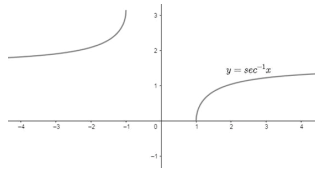
Write the interval for the principal value of function and draw its graph $\sec ^{-1} x$
Answer
Principal value branch of $\sec ^1 x$ is $\left(0, \frac{\pi}{2}\right) \cup\left(\frac{\pi}{2}, \pi\right)$ and its graph is shown below.
Image
View full question & answer
2 Marks Questions - MATHS STD 12 Science Questions - Vidyadip