Questions

3 Marks Question

Take a timed test

9 questions · self-marked practice — reveal the answer and mark yourself.

Question 13 Marks
Show that the differential equation $\left(x \cos \frac{y}{x}\right)( ydx + xdy )=\left(y \sin \frac{y}{x}\right)( xdy - ydx )$ s homogeneous and solve it.
Answer
We can write the given differential equation as,
$\left(\frac{y}{x}+y^2 \sin \frac{y}{x}\right) dx=\left(xy \sin \frac{y}{x}-x^2 \cos \frac{y}{x}\right) dy$
$\Rightarrow \frac{d y}{d x}=\frac{\left\{x y \cos \frac{y}{x}+y^2 \sin \frac{y}{z}\right\}}{\left\{x y \sin \frac{y}{x}-x^2 \cos \frac{y}{x}\right\}}$
$\Rightarrow \frac{d y}{d x}=\frac{\left(\frac{y}{x}\right) \cos \left(\frac{y}{x}\right)+\left(\frac{y}{z}\right)^2 \sin \left(\frac{y}{x}\right)}{\left(\frac{y}{x}\right) \sin \left(\frac{y}{x}\right)-\cos \left(\frac{y}{x}\right)}=f\left(\frac{y}{x}\right)$
Therefore, the given differential equation is homogeneous.
Put $y = vx$ and $\frac{d y}{d x}=v+x \frac{d v}{d x}$ in $(i),$
$\Rightarrow x \frac{d v}{d x}=\left\{\frac{\left(v \cos v+v^2 \sin v\right)}{(v \sin v-\cos v)}-v\right\}$
$\Rightarrow x \frac{d v}{d x}=\frac{2 v \cos v}{(v \sin v-\cos v)}$
$\Rightarrow \int \frac{(v \sin v-\cos v)}{v \cos v} d v=\int \frac{2}{x} d x$
$\Rightarrow \int \tan v d v -\int \frac{d v}{v}=\int \frac{2}{x} d x$
$\Rightarrow-\log |\cos v |-\log | v |-2 \log | x |=$ constant 
$\Rightarrow \log |\cos v |+\log | v |+2 \log | x |=\log \left| C _1\right|$
where $C _1$ is an arbitrary constant 
$\Rightarrow \log \left| x ^2 v \cos v \right|=\log \left| C _1\right|$
$\Rightarrow x ^2 v \cos v = \pm C _1= C ($say$)$
$\Rightarrow x y \cos \frac{y}{x}= C, $
which is the required solution $\left(\because v =\frac{y}{x}\right)$
View full question & answer
Question 23 Marks
Find $\int e^{-x} \sin 2 x \ d \ dx$. Hence show that $\int_{-\pi / 4}^{\pi / 4} e^{-x}|\sin 2 x| d x=\frac{1}{5}\left(4+e^{\pi / 4}-e^{-\pi / 4}\right)$
Answer
Let the given integral be, $I=\int e^{-x} \sin 2 x dx$.
Then, using integration by parts we have..
$I=\frac{1}{2} e^{-x} \cos 2 x-\int(-1) e^{-x} \times-\frac{1}{2} \cos 2 x d x$
$\Rightarrow I=-\frac{1}{2} e^{-x} \cos 2 x-\frac{1}{2} \int e^{-x} \cos 2 x d x$
$\Rightarrow I=-\frac{1}{2} e^{-x} \cos 2 x-\frac{1}{2}\left\{\frac{1}{2} e^{-x} \sin 2 x-\int(-1) e^{-x} \times \frac{1}{2} \sin 2 x d x\right\}$
$\Rightarrow I=-\frac{1}{2} e^{-x} \cos 2 x-\frac{1}{4} e^{-x} \sin 2 x-\frac{1}{4} \int e^{-x} \sin 2 x d x$
$\Rightarrow I=-\frac{1}{2} e^{-x} \cos 2 x-\frac{1}{4} e^{-x} \sin 2 x-\frac{1}{4} I$
$\Rightarrow \frac{5}{4} I=-\frac{1}{4} e^{-x}(2 \cos 2 x+\sin 2 x)$
$\Rightarrow I=-\frac{1}{5} e^{-x}(\sin 2 x+2 \cos 2 x)+C$
Now we have,
$I=\int_{-\pi / 4}^{\pi / 4} e^{-x}|\sin 2 x| d x=\int_{-\pi / 4}^0 e^{-x}|\sin 2 x| d x+\int_0^{\pi / 4} e^{-x}|\sin 2 x| d x$
$\Rightarrow I=-\int_{-\pi / 4}^0 e^{-x} \sin 2 x d x+\int_0^{\pi / 4} e^{-x} \sin 2 x d x$
$\Rightarrow I=-\left[-\frac{1}{5} e^{-x}(\sin 2 x+2 \cos 2 x)\right]_{-\pi / 4}^0+\left[-\frac{1}{5} e^{-x}(\sin 2 x+2 \cos 2 x]_0^{\pi / 4}\right.$
$\Rightarrow I=-\left[-\frac{2}{5}+\frac{1}{5} e^{\pi / 4}(-1)\right]+\left[-\frac{1}{5} e^{-\pi / 4}+\frac{2}{5}\right]$
$\Rightarrow I=\frac{4}{5}+\frac{1}{5}\left(e^{\pi / 4}-e^{-\pi / 4}\right)=\frac{1}{5}\left(4+e^{\pi / 4}-e^{-\pi / 4}\right)$
View full question & answer
Question 33 Marks
Solve the Linear Programming Problem graphically:
Maximize $Z = 7x + 10y$ Subject to
$x+y \leq 30000$
$y \leq 12000$
$x \geq 6000$
$x \geq y$
$x, y \geq 0$
Answer
We have to maximize $z = 7x + 10y$
First, we will convert the given inequations into equations, we obtain the following equations:
$x + y = 30000 y = 12000 x = 6000 x = y x = 0 $ and $y = 0$
Region represented by $x + y < = 30000$
The line $x + y = 30000$ meets the coordinate axes at $A(30000, 0)$ and $B(0, 30000)$ respectively.
By joining these points we obtain the line $x + y = 30000$ Clearly $(0, 0)$ satisfies the inequation $x + y < = 30000$
So, the region containing the origin represents the solution set of the inequationx$ y < = 30000$
The line $y = 12000$ is the line that passes through $C(0,12000)$ and parallel to $x-$axis.
The line $x = 6000$ is the line that passes through $(6000, 0)$ and parallel to $y-$axis.
Region represented by $x \geq y$ :
The line $x = y$ is the line that passes through the origin. The points to the right of the line $x = y$ satisfy the inequation $x \geq y$Like
by taking the point$ (-12000, 6000).$
Here, $6000 >- 12000$ which implies $y ; x$ Hence, the points to the left of line $x = y$ will not satisfy the given in equation $x \geq y$
Region represented by $x \geq 0$ and $y \geq 0$:
since, every point in the first quadrant satisfies these inequations.
So, the first quadrant is the region represented by the in equations $x x \geq 0$ and $y \geq 0$
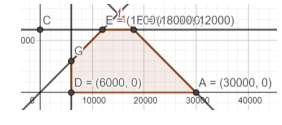
The feasible region determined by subject to the constraints are, $x + y x+y \leq 30000, y \leq 12000, x \geq 6000, x \geq y$,and non-negative restrictions, $x \geq 0$ and $y \geq 0$ are as follows:
Image
The corner points of the feasible region are $D(6000, 0), A(3000, 0), F(18000, 12000)$ and $E(12000, 12000).$
The values of objective function at the corner points are as follows:
Corner point $Z = 7x + 10y$
$D(6000, 0)$ $7 x 6000 + 100 = 42000$
$A(3000, 0)$ $7 x 3000 + 10 \times 021000$
$F(18000, 12000)$ $7 x 18000 + 10 \times 12000 - 246000$
$E(12000, 12000)$ $7 x 12000 + 10 \times 12000 - 204000$
We see that the maximum value of the objective function $Z$ is $246000$ which is at $F(18000,12000)$
that means at $x = 18000$ and $y = 12000$
Thus, the optimal value of objective function $z$ is $246000$
View full question & answer
Question 43 Marks
If $y =\tan ^{-1}\left(\frac{\sqrt{1+x^2}+\sqrt{1-x^2}}{\sqrt{1+x^2}-\sqrt{1-x^2}}\right), x^2 \leq 1$, then find $\frac{d y}{d x}$.
Answer
Given, $y =\tan ^{-1}\left(\frac{\sqrt{1+ x ^2}+\sqrt{1-x^2}}{\sqrt{1+x^2}-\sqrt{1-x^2}}\right)$
Put $x^2=\sin \theta \Rightarrow \theta=\sin ^{-1} x^2$
$\therefore y=\tan ^{-1}\left(\frac{\sqrt{1+\sin \theta}+\sqrt{1-\sin \theta}}{\sqrt{1+\sin \theta}-\sqrt{1-\sin \theta}}\right)$
$=\tan ^{-1}\left(\frac{\sqrt{\cos ^2 \frac{\theta}{2}+\sin ^2 \frac{\theta}{2}+2 \sin \frac{\theta}{2} \cos \frac{\theta}{2}}+\sqrt{\cos ^2 \frac{\theta}{2}+\sin ^2 \frac{\theta}{2}-2 \sin \frac{\theta}{2} \cos \frac{\theta}{2}}}{\sqrt{\cos ^2 \frac{\theta}{2}+\sin ^2 \frac{\theta}{2}+2 \sin \frac{\theta}{2} \cos \frac{\theta}{2}}-\sqrt{\cos ^2 \frac{\theta}{2}+\sin ^2 \frac{\theta}{2}-2 \sin \frac{\theta}{2} \cos \frac{\theta}{2}}}\right)$
$=\tan ^{-1}\left(\frac{\sqrt{\left(\cos \frac{\theta}{2}+\sin \frac{\theta}{2}\right)^2}+\sqrt{\left(\cos \frac{\theta}{2}-\sin \frac{\theta}{2}\right)^2}}{\sqrt{\left(\cos \frac{\theta}{2}+\sin \frac{\theta}{2}\right)^2}-\sqrt{\left(\cos \frac{\theta}{2}-\sin \frac{\theta}{2}\right)^2}}\right)$
$=\tan ^{-1}\left(\frac{\left(\cos \frac{\theta}{2}+\sin \frac{\theta}{2}\right)+\left(\cos \frac{\theta}{2}-\sin \frac{\theta}{2}\right)}{\left(\cos \frac{\theta}{2}+\sin \frac{\theta}{2}\right)-\left(\cos \frac{\theta}{2}-\sin \frac{\theta}{2}\right)}\right)$
$=\tan ^{-1}\left(\frac{2 \cos \frac{\theta}{2}}{2 \sin \frac{\theta}{2}}\right)$
$=\tan ^{-1}\left(\cot \frac{\theta}{2}\right)$
$=\tan ^{-1}\left(\tan \left(\frac{\pi}{2}-\frac{\theta}{2}\right)\right)$
$=\frac{\pi}{2}-\frac{\theta}{2}$
$\Rightarrow y=\frac{\pi}{2}-\frac{1}{2} \sin ^{-1} x^2$
Therefore, on differentiating both sides $\text{w.r.t x}$ , we get,
$\frac{d y}{d x}=-\frac{1}{2} \frac{1}{\sqrt{1-\left(x^2\right)^2}}(2 x)$
$=\frac{-x}{\sqrt{1-x^4}}$
View full question & answer
Question 53 Marks
Solve the Linear Programming Problem graphically:
Minimize $Z = 30x + 20y$
Subject to
$x+y \leq 8$
$x+4 y \geq 12$
$5 x+8 y=20$
$x, y \geq 0$
Answer
First, we will convert the given inequations into equations, we obtain the following equations:
$x + y = 8 x + 4 y = 12 x = 0$ and $y = 0$
$5x + 8 y = 20$ is already an equation.
Region represented by $x+y \leq 8$ The line $x+y=8$ meets the coordinate axes at $A(8,0)$ and $B(0,8)$ respectively.
By joining these points we obtain the line $x+y=8$.
Clearly $(0,0)$ satisfies the inequation $x+y \leq 8.50$, the region in $x y$ plane which contain the origin represents the solution set of the inequation $x+y \leq 8$.
Region represented by $x+4 y \geq 12$ :
The line $x+4 y=12$ meets the coordinate axes at $C(12,0)$ and $D(0,3)$ respectively.
By joining these points we obtain the line $x+ 4 y=12$.
Clearly $(0,0)$ satisfies the inequation $x+4 y \geq 12$.
So, the region in $x y$ plane which does not contain the origin represents the solution set of the inequation $x+4 y \geq 12$.
The line $5 x +8 y =20$ is the line that passes through $E (4,0)$ and $F\left(0, \frac{5}{2}\right)$
Region represented by $x \geq 0$ and $y \geq 0$ : since, every point in the first quadrant satisfies these inequations.
So, the first quadrant is the region represented by the inequations $x \geq 0$ and $y \geq 0$.
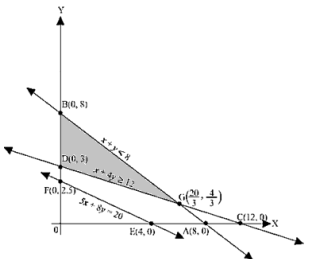
The feasible region determined by subject to the constraints are $x +y \leq 8, x+4 y \geq 12,5 x+8 y=20$ and the non$-$negative restrictions, $x \geq 0$ and $y \geq 0$ are as follows.
Image
The corner points of the feasible region are $B(0, 8) \ D(0, 3) \ G\left(\frac{20}{3}, \frac{4}{3}\right)$
The values of objective function at corner points are as follows:
Corner point: $Z = 30x + 20y$
$B(0, 8) 160$
$D(0, 3) : 60$
$G\left(\frac{20}{3}, \frac{4}{3}\right): 266.66$
Therefore, the minimum value of objective function $Z$ is $60$ at the point $D(0, 3)$
Hence$, x = 0$ and $y = 3$ is the optimal solution of
the given $\text{LPP}.$
Thus, the optimal value of objective function $Z$ is $60$.
View full question & answer
Question 63 Marks
In the differential equation show that it is homogeneous and solve it $y^2+\left( x ^2- xy \right) \frac{d y}{d x}=0$.
Answer
The given differential equation is,
$ y ^2+\left( x ^2- xy \right) \frac{d y}{d x}=0$
$\frac{d x}{d y}=\frac{x y-x^2}{y^2}=\frac{x}{y}-\left(\frac{x}{y}\right)^2$
$\Rightarrow \frac{d x}{d y}=f\left(\frac{x}{y}\right)$
$\Rightarrow$the given differential equation is a homogenous equation.
The solution of the given differential equation is:
Put $x = vy$
$\Rightarrow \frac{ dx }{ dy }= v + y \frac{ dv }{ dy }$
$\Rightarrow v+y \frac{d v}{d y}=\frac{v y}{y}-\left(\frac{v y}{y}\right)^2$
$\Rightarrow y \frac{d v}{d y}= v - v ^2- v$
$\Rightarrow y \frac{d v}{d y}=- v ^2$
$\Rightarrow \frac{ dv }{ v ^2}=-\frac{ dv }{ y }$
Integratin both the sides we get
$\Rightarrow \int \frac{ dv }{ v ^2}=-\int \frac{ dy }{ y }+ c$
$\Rightarrow \frac{-1}{v}=-\ln | y |+ c$
$\Rightarrow \frac{y}{x}=-(\ln | y |+ c )$
$\Rightarrow y =- x (\ln | y |+ c )$
 
View full question & answer
Question 73 Marks
Evaluate: $\int_0^a \sqrt{a^2-x^2} d x$
Answer
Let $x=a \sin \theta$
Differentiating $\text{w.r.t. x}$, we get
$d x=a \cos \theta d \theta$
Now,
$x=0 \Rightarrow \theta=0$
$x=a \Rightarrow \theta=\frac{\pi}{2}$
$\therefore \int_0^2 \sqrt{a^2-x^2} d x$
$=\int_0^{\frac{\pi}{2}} \sqrt{a^2\left(1-\sin ^2 \theta\right)} a \cos \theta d \theta$
$=a^2 \int_0^{\frac{\pi}{2}} \cos ^2 \theta d \theta$
$=\frac{a^2}{2} \int_0^{\frac{\pi}{2}}(1+\cos 2 \theta) d \theta \text { (using } \cos ^2 \theta=\frac{(1+\cos 2 \theta)}{2} \text { ) }$
$=\frac{a^2}{2}\left(\theta+\frac{\sin 2 \theta}{2}\right)_0^{\frac{\pi}{2}}$
$=\frac{a^2}{2}\left(\frac{\pi}{2}+0-0-0\right)$
$=\frac{\pi a^2}{4}$
$\therefore \int_0^2 \sqrt{a^2-x^2} d x=\frac{\pi a^2}{4}$
View full question & answer
Question 83 Marks
For $A, B$ and $C$ the chances of being selected as the manager of a firm are in the ratio $4:1:2$ respectively. The respective probabilities for them to introduce a radical change in marketing strategy are $0.3, 0.8$ and $0.5$. If the change does take place, find the probability that it is due to the appointment of $B$ or $C$
Answer
Let $A , E _1, E _2$ and $E _3$ denote the events that the change takes place, $A$ is selected, $B$ is selected and $C$ is selected, respectively.
Therefore, we have,
$ P \left( E _1\right)=\frac{4}{7}$
$P \left( E _2\right)=\frac{1}{7}$
$P \left( E _3\right)=\frac{2}{7}$
Now, we have,
$ P \left(\frac{A}{E_1}\right)=0.3$
$P \left(\frac{A}{E_2}\right)=0.8$
$P \left(\frac{A}{E_3}\right)=0.5$
Using Bayes' theorem, we have,
$=P\left(\frac{E_1}{A}\right)=\frac{P\left(E_1\right) P\left(A / E_1\right)}{P\left(E_1\right) P\left(A / E_1\right)+P\left(E_2\right) P\left(A / E_2\right)+P\left(E_3\right) P\left(A / E_3\right)}$
$=\frac{\frac{4}{7} \times 0.3}{\frac{4}{7} \times 0.3+\frac{1}{7} \times 0.8+\frac{2}{7} \times 0.5}$
$=\frac{1.2}{1.2+0.8+1}=\frac{1.2}{3}=\frac{12}{30}=\frac{2}{5}$
$\therefore$ Required probability $=1- P \left(\frac{A}{E_1}\right)=1-\frac{2}{5}$
View full question & answer
Question 93 Marks
Evaluate $I=\int \frac{\log \left(1+\frac{1}{x}\right)}{x(1+x)} d x$
Answer
Let $I=\int \frac{\log \left(1+\frac{1}{x}\right)}{x(1+x)} d x$.
Let $\log \left(1+\frac{1}{x}\right)= t$ then,
$d\left(\log \left(1+\frac{1}{x}\right)\right)= dt$
$\Rightarrow \quad \frac{1}{1+\frac{1}{x}} \times \frac{-1}{x^2} dx = dt$
$\Rightarrow \quad \frac{1}{\frac{x+1}{x}} \times \frac{-1}{x^2} dx = dt$
$\Rightarrow \quad \frac{-x}{x^2(x+1)} dx = dt$
$\Rightarrow \quad \frac{d x}{x(x+1)}=- dt$
Putting $\log \left(1+\frac{1}{x}\right)= t$ and $\frac{d x}{x(x+1)}=- dt$ in equation (i), we get
$I=-\int t d t$
$=-\frac{t^2}{2}+c$
$=-\frac{1}{2}\left(\log \left(1+\frac{1}{x}\right)\right)^2+c$
$\therefore I=-\frac{1}{2}\left(\log \left(1+\frac{1}{x}\right)\right)^2+c$
View full question & answer
3 Marks Question - MATHS STD 12 Science Questions - Vidyadip