Questions

Case study (4 Marks)

Take a timed test

3 questions · self-marked practice — reveal the answer and mark yourself.

Question 14 Marks
Read the following text carefully and answer the questions that follow:
The relation between the height of the plant $(y\ in \ cm)$ with respect to exposure to sunlight is governed by the following equation $y=4 x-\frac{1}{2} x^2$ where $x$ is the number of days exposed to sunlight.
Image
$i.$ Find the rate of growth of the plant with respect to sunlight. $(1)$
$ii.$ What is the number of days it will take for the plant to grow to the maximum height? $(1)$
$iii.$ Verify that height of the plant is maximum after four days by second derivative test and find the maximum height of plant. $(2)$
$OR$
What will be the height of the plant after $2$ days? $(2)$
Answer
$i.$ The rate of growth $=\frac{d y}{d x}$
$=\frac{d\left(4 x-\frac{1}{2} x^2\right)}{d x}$
$=4-x$
$ii.$ For the height to be maximum or minimum
$\frac{d y}{d x}=0$
$\Rightarrow \frac{d y}{d x}=\frac{d\left(4 x-\frac{1}{2} x^2\right)}{d x}$
$=4-\frac{1}{2} \cdot 2 x=0$
$\frac{d y}{d x}=4-x=0$
$\Rightarrow x=4$
$\therefore$ Number of required days $=4$
$iii. \frac{d y}{d x}=4- x$
$\Rightarrow \frac{d^2 y}{d x^2}=-1<0$
$\Rightarrow$ Function attains maximum value at $x=4$
We have
$y=4 x-\frac{1}{2} x^2$
$\therefore$ when $x=4$ the height of the plant will be maximum which is $y=4 \times 4-\frac{1}{2} \times(4)^2=16-8=8 \ cm$
$OR$
We have, $y =4 x -\frac{1}{2} x^2$
$\therefore$ When $x=4$ the height of the plant will be maximum which is
$y=4 \times 4-\frac{1}{2} \times(4)^2$
$=8-2=6 \ cm$
View full question & answer
Question 24 Marks
Read the following text carefully and answer the questions that follow:
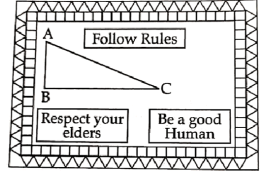
The slogans on chart papers are to be placed on a school bulletin board at the points $A, B$ and $C$ displaying $A ($follow Rules$), B ($Respect your elders$)$ and $C ($Be a good human$)$. The coordinates of these points are $(1, 4, 2), (3, -3, -2)$ and $(-2, 2, 6),$ respectively.
Image
$i.$ If $\vec{a}, \vec{b}$ and $\vec{c}$ be the position vectors of points $A, B, C,$ respectively, then find $|\vec{a}+\vec{b}+\vec{c}|$.
$ii.$ If $\vec{a}=4 \hat{i}+6 \hat{j}+12 \hat{k}$, then find the unit vector in direction of $\vec{a}. (1)$
$iii.$ Find area of $\triangle ABC. (2)$
OR
Write the triangle law of addition for $\triangle ABC$. Suppose, if the given slogans are to be placed on a straight line, then the value of $|\vec{a} \times \vec{b}+\vec{b} \times \vec{c}+\vec{c} \times \vec{a}|. (2)$
Answer
$i.$ Here,
Position vector of $A$ is $\vec{a}=\hat{i}+4 \hat{j}+2 \hat{k}$
Position vector of $B$ is $\vec{b}=3 \hat{i}-3 \hat{j}-2 \hat{k}$
Position vector of $C$ is $\vec{c}=-2 \hat{i}+2 \hat{j}+6 \hat{k}$
$\therefore \vec{a}+\vec{b}+\vec{c}=(1+3-2) \hat{i}+(4-3+2) \hat{j}+(2-2+6) \hat{k}$
$=2 \hat{i}+3 \hat{j}+6 \hat{k}$
Thus, $|\vec{a}+\vec{b}+\vec{c}|=\left|\sqrt{(2)^2+(3)^2+(6)^2}\right|$
$=|\sqrt{4+9+16}|$
$=\sqrt{29}$
$ii.$ Given, $\vec{a}=4 \hat{i}+6 \hat{j}+12 \hat{k}$,
$|\vec{a}|=\sqrt{4^2+6^2+12^2}=14$
Therefore, the unit vector in direction of $\vec{a}$ is given by
$\hat{a}=\frac{\vec{a}}{|\vec{a}|}=\frac{4 \hat{i}+6 \hat{j}+12 \hat{k}}{14}$
$=\frac{4}{14} \hat{i}+\frac{6}{14} \hat{j}+\frac{12}{14} \hat{k}$
$=\frac{2}{7} \hat{i}+\frac{3}{7} \hat{j}+\frac{6}{7} \hat{k}$
$iii.$ We have, $A (1,4,2), B (3,-3,-2)$ and $C (-2,2,6)$
Now, $\overrightarrow{A B}=\vec{b}-\vec{a}=2 \hat{i}-7 \hat{j}-4 \hat{k}$
and $\overrightarrow{A C}=\vec{c}-\vec{a}=-3 \hat{i}-2 \hat{j}+4 \hat{k}$
$\therefore \overrightarrow{A B} \times \overrightarrow{A C}=\left|\begin{array}{ccc}\hat{i} & \hat{j} & \hat{k} \\ 2 & -7 & -4 \\ -3 & -2 & 4\end{array}\right|$
$=\hat{i}(-28-8)-\hat{j}(8-12)+\hat{k}(-4-21)$
$=-36 \hat{i}+4 \hat{j}-25 \hat{k}$
$\text { Now, }|\overrightarrow{A B} \times \overrightarrow{A C}|=\sqrt{(-36)^2+4^2+(-25)^2}$
$=|\sqrt{1296+16+625}|=\sqrt{1937}$
$\therefore \text { Area of } \triangle ABC =\frac{1}{2}|\overrightarrow{A B} \times \overrightarrow{A C}|$
$=\frac{1}{2} \sqrt{1937} \text { sq. units }$
OR
Triangle law of addition for $\triangle ABC$ is given by
$\overrightarrow{A B}+\overrightarrow{B C}+\overrightarrow{C A}=\overrightarrow{0}$
If the given points lie on the straight line, then the points will be collinear and so area of $\triangle ABC=0$
Then, $|\vec{a} \times \vec{b}+\vec{b} \times \vec{c}+\vec{c} \times \vec{a}|=0$.
Also, if a, b, c are the position vector of the three vertices $A, B$ and $C$ of, $\triangle ABC$ then area of triangle is
$\frac{1}{2}|\vec{a} \times \vec{b}+\vec{b} \times \vec{c}+\vec{c} \times \vec{a}|$
View full question & answer
Question 34 Marks
Read the following text carefully and answer the questions that follow :
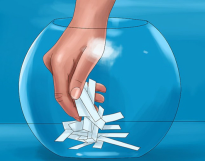
To teach the application of probability a maths teacher arranged a surprise game for $5$ of his students namely Govind, Girish, Vinod, Abhishek and Ankit. He took a bowl containing tickets numbered $1$ to $50$ and told the students go one by one and draw two tickets simultaneously from the bowl and replace it after noting the numbers.
Image
i. Teacher ask Govind, what is the probability that tickets are drawn by Abhishek, shows a prime number on one ticket and a multiple of $4$ on other ticket? $(1)$
ii. Teacher ask Girish, what is the probability that tickets drawn by Ankit, shows an even number on first ticket and an odd number on second ticket? $(1)$
iii. Teacher asks Abhishek, what is the probability that tickets drawn by Vinod, shows a multiple of $4$ on one ticket and a multiple $5$ on other ticket? $(2)$
OR
Teacher asks Vinod, what is the probability that both tickets drawn by Girish shows odd number? $(2)$
Answer
$i$. Required probability $= P\ ($one ticket with prime number and other ticket with a multiple of $4)$
$=2\left(\frac{15}{50} \times \frac{12}{49}\right)=\frac{36}{245}$
$ii. P\ ($First ticket shows an even number and second ticket shows an odd number$)$
$=\frac{25}{50} \times \frac{25}{49}=\frac{25}{98}$
$iii.$ Required probability $= P\ ($one number is a multiple of $4$ and other is a multiple of $5) $
$= P\ ($multiple of $5$ on first ticket and multiple of $4$ on second ticket$) \ + P\ ($multiple of $4$ on first ticket and multiple of $5$ on second ticket$)$
$=\frac{10}{50} \times \frac{12}{49}+\frac{12}{50} \times \frac{10}{49}$
$=\frac{12}{245}+\frac{12}{245}$
$=\frac{25}{245}$
$=\frac{5}{49}$
OR
Probability that both tickets drawn by Girish shows odd number
$=\frac{25}{50} \times \frac{24}{49}$
$=\frac{12}{49}$
View full question & answer
Case study (4 Marks) - MATHS STD 12 Science Questions - Vidyadip