Question 11 Mark
The linear programming problem minimize Z = 3x + 2y subject to constraints $s x+y \geq 8,3 x+5 y \leq 15, x \geq 0$ and $y \geq 0$, has
Answer(a) no feasible solution
Explanation: Table for equation x + y = 8 isTable for equation 3x = 5y = 15 is| x | 0 | 5 |
| $y =\frac{15-3 x}{5}$ | 3 | 0 |
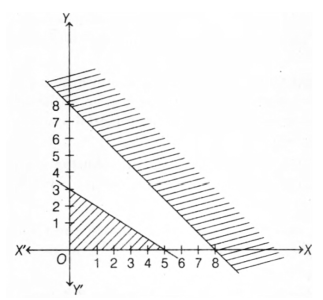
It can be concluded from the graph, that there is no point, which can satisfy all the constraints simultaneously. Therefore, the problem has no feasible solution. View full question & answer→Question 21 Mark
If $f(x)=x^2+4 x-5$ and $A=\left|\begin{array}{ll}1 & 2 \\ 4 & -3\end{array}\right|$, then $f(A)$ is equal to
Answer (a) $\left|\begin{array}{ll}8 & 4 \\ 8 & 0\end{array}\right|$
Explanation:
$A =\left|\begin{array}{ll}1 & 2 \\ 4 & -3\end{array}\right|, A ^2=\left|\begin{array}{ll}1 & 2 \\ 4 & -3\end{array}\right|\left|\begin{array}{ll}1 & 2 \\ 4 & -3\end{array}\right|=\left|\begin{array}{ll}9 & -4 \\ -8 & 17\end{array}\right|$
$f(x)=x^2+4 x-5$
$\because f(A)=A^2+4 A-5 I=\left|\begin{array}{ll}9 & -4 \\ -8 & 17\end{array}\right|+\left|\begin{array}{ll}4 & 8 \\ 16 & -12\end{array}\right|+\left|\begin{array}{ll}-5 & 0 \\ 0 & -5\end{array}\right|=\left|\begin{array}{ll}8 & 4 \\ 8 & 0\end{array}\right|$
View full question & answer→Question 31 Mark
For any $2 \times 2$ matrix, If $A(\operatorname{adj} A)=\left[\begin{array}{ll}10 & 0 \\ 0 & 10\end{array}\right]$, then $|A|$ is equal to
Answer$(b)\ 10$
We known that
$A \times \operatorname{adj} A =| A | I _{ nxn }$,where I is the unit matrix of order nxn.$------(1)$
$A(\operatorname{adj} A)=\left[\begin{array}{cc}10 & 0 \\ 0 & 10\end{array}\right]$Using the above property of matrices $(1),$we get
$A(\operatorname{adj} A)=10\left[\begin{array}{ll}1 & 0 \\ 0 & 1\end{array}\right]$
$ A (\operatorname{adj} A )=(10) I _{2 \times 2}$
$|A| I _{2 \times 2}=10 I _{2 \times 2}$
$|A|=10$
View full question & answer→Question 41 Mark
A line passes through the point $A (5,-2.4)$ and it is parallel to the vector $(2 \hat{i}-\hat{j}+3 \hat{k})$. The vector equation of the line is
Answer(c) $\vec{r}=(5 \hat{i}-2 \hat{j}+4 \hat{k})+\lambda(2 \hat{i}-\hat{j}+3 \hat{k})$
Explanation: Fixed point is $5 \hat{i}-2 \hat{j}+4 \hat{k}$ and parallel vector is $2 \hat{\imath}-\hat{\jmath}+3 \hat{ k }$
Equation $\vec{r}=5 \hat{\imath}-2 \hat{\jmath}+4 \hat{k}+\lambda(2 \hat{\imath}-\hat{\jmath}+3 \hat{k})$
View full question & answer→Question 51 Mark
The solution of the differential equation $=x d x+y d y=x^2 y d y-y^2 x d x$ is
Answer$(d)\ x^2-1=C\left(1+y^2\right)$
Explanation: We have,
$x d x+y d y=x^2 y d y-y^2 x d x$
$x d x+y^2 x d x=x^2 y d y-y d y$
$x\left(1+y^2\right) d x=y\left(x^2-1\right) d y$
$\frac{x d x}{x^2-1}=\frac{y d y}{1+y^2}$
$\int \frac{x d x}{x^2-1}=\int \frac{y d y}{1+y^2}$
$\frac{1}{2} \int \frac{2 x d x}{x^2-1}=\frac{1}{2} \int \frac{2 y d y}{1+y^2}$
$\frac{1}{2} \log \left(x^2-1\right)=\frac{1}{2} \log \left(1+y^2\right)+\log c$
$\log \left(x^2-1\right)=\log \left(1+y^2\right)+\log c$
$x^2-1=\left(1+y^2\right) c$
View full question & answer→Question 61 Mark
If $y=\sin ^{-1} x$, then $\left(1-x^2\right) y_2$ is equal to
Answer(b) $x y_1$
Explanation: $y=\sin ^{-1} x$
$\frac{d y}{d x}=\frac{1}{\sqrt{1-x^2}} \Rightarrow \sqrt{1-x^2} \cdot \frac{d y}{d x}=1$
Again, differentiating both sides w.r.to $x$, we get
$\sqrt{1-x^2} \cdot \frac{d^2 y}{d x^2}+\frac{d y}{d x} \cdot\left(\frac{-2 x}{2 \sqrt{1-x^2}}\right)=0$
Simplifying, we get $\left(1-x^2\right) y_2=x y_1$
View full question & answer→Question 71 Mark
If $\beta$ is perpendicular to both $\alpha$ and $\gamma$, where $\alpha=\hat{k}$ and $\gamma=\gamma=2 \hat{i}+3 \hat{j}+4 \hat{k}$, then what is $\beta$ equal to?
Answer$(d) -3 \hat{i}+2 \hat{j}$
Explanation: Given that, $\alpha=\hat{k}$
and $\gamma=2 \hat{i}+3 \hat{j}+4 \hat{k}$
Since, $\beta$ is perpendicular to both $\alpha$ and $\gamma$.
i.e., $\beta= \pm(\alpha \times \gamma)= \pm\left|\begin{array}{ccc}\hat{i} & \hat{j} & \hat{k} \\ 0 & 0 & 1 \\ 2 & 3 & 4\end{array}\right|$
$= \pm \hat{i}(0-3)-\hat{j}(0-2)+\hat{k}(0-0)$
$= \pm(-3 \hat{i}+2 \hat{j})$
View full question & answer→Question 81 Mark
In a certain town, $40\%$ persons have brown hair, $25\%$ have brown eyes, and $15\%$ have both. If a person selected at random has brown hair, the chance that a person selected at random with brown hair is with brown eyes
Answer$(c) \frac{3}{8}$
Let $A$ be the event that a person has brown hair, B be the event that a person has brown eyes. Then,
$ P ( A )=\frac{40}{100}, P ( B )=\frac{25}{100}, P(A \cap B)=\frac{15}{100}$
Required probability $=P\left(\frac{B}{A}\right)=\frac{P(A \cap B)}{P(A)}=\frac{\frac{15}{100}}{\frac{40}{100}}=\frac{3}{8}$
View full question & answer→Question 91 Mark
The existence of the unique solution of the system of equations:
$x+y+z=\lambda$
$5 x-y+\mu z=10$
$2 x+3 y-z=6 \text { depends on }$
Answer$\mu$ only
Explanation: The given system of linear equation :-
$x+y+z=\lambda$
$5 x-y+\mu z=10$
$2 x+3 y-z=6$
The matrix equation corresponding to the above system is:
$\left[\begin{array}{ccc}1 & 1 & 1 \\ 5 & -1 & \mu \\ 2 & 3 & -1\end{array}\right]\left[\begin{array}{l} x \\ y \\ z \end{array}\right]=\left[\begin{array}{c}\lambda \\ 10 \\ 6\end{array}\right]$
Suppose $A =\left[\begin{array}{ccc}1 & 1 & 1 \\ 5 & -1 & \mu \\ 2 & 3 & -1\end{array}\right]$
$\therefore|A|=\left|\begin{array}{ccc}1 & 1 & 1 \\ 5 & -1 & \mu \\ 2 & 3 & -1\end{array}\right|=1(1-3 \mu)-1(-5-2 \mu)+1(15+2)$
$=1-3 \mu+5+2 \mu+17=23-\mu$
For the existence of the unique solution, the value of $A$ must not be equal to $0.$
Therefore, the existence of the unique solution merely depends on the value of $µ$.
Which is the required solution.
View full question & answer→Question 101 Mark
If $\vec{a}=(\hat{i}+2 \hat{j}-3 \hat{k})$ and $\vec{b}=(3 \hat{i}-\hat{j}+2 \hat{k})$ then the angle between $(\vec{a}+\vec{b})$ and $(\vec{a}-\vec{b})$ is
Answer(a) $\frac{\pi}{2}$
Explanation: Given vectors $\vec{a}=\hat{i}+2 \hat{j}-3 \hat{k}$ and $\vec{b}=3 \hat{i}-2 \hat{j}+2 \hat{k}$
Now, $\vec{a}+\vec{b}=4 \hat{i}+\hat{j}-\hat{k}$ and $\vec{a}-\vec{b}=-2 \hat{i}+3 \hat{j}-5 \hat{k}$
let $\theta$ be the angle between the vectors $\vec{a}+\vec{b}$ and $\vec{a}-\vec{b}$
$\Rightarrow \cos \theta=\frac{-8+3+5}{\sqrt{16+1++} \times \sqrt{4+9+25}}=0=\frac{\pi}{2}$
View full question & answer→Question 111 Mark
$\int \frac{\sin x}{(1+\sin x)} d x=?$
Answer$(b)\ x+\frac{2}{\tan \frac{x}{2}+1}+c$
Explanation: Given
$\int \frac{\sin x}{1+\sin x} d x$
$=\int d x-\int \frac{d x}{1+\sin x}$
$=x-\int \frac{d x}{\sin ^2 \frac{x}{2}+\cos ^2 \frac{x}{2}+2 \sin \frac{x}{2} \cos \frac{x}{2}}$
$=x-\int \frac{d x}{\left(\sin \frac{x}{2}+\cos \frac{x}{2}\right)^2}$
$=x-\int \frac{\sec ^2 \frac{x}{2} d x}{\left(\tan \frac{x}{2}+1\right)^2}$
Let, $\tan \frac{x}{2}+1=z$
$\Rightarrow \frac{1}{2} \sec ^2 \frac{x}{2} d x=d z$
So,
$x-\int \frac{2 d z}{z^2}$
$=x+\frac{2}{z}+c$
$=x+\frac{2}{\tan \frac{x}{2}+1}+c$
where c is the integrating constant.
View full question & answer→Question 121 Mark
For what value of x, the matrix $A=\left[\begin{array}{rrr}0 & 1 & -2 \\ -1 & 0 & 3 \\ x & -3 & 0\end{array}\right]$ is skew-symmetric matrix?
View full question & answer→Question 131 Mark
$\vec{a}+\vec{b}+\vec{c}=0$ such that $|\vec{a}|=3,|\vec{b}|=5$ and $|\vec{c}|=7$.
What is the angle between $\vec{a}$ and $\vec{b}$ ?
Answer(a) $\frac{\pi}{3}$
Explanation: $\frac{\pi}{3}$
View full question & answer→Question 141 Mark
Which of the following statements is correct?
a. Every LPP admits an optimal selection.
b. A LPP admits unique optimal solution.
c. If a LPP admits two optimal solutions it has an infinite solution.
d. The set of all feasible solutions of a LPP is not a convex set.
Answer(d) Option (c)
Explanation: If a LPP admits two optimal solutions it has an infinite solution.
View full question & answer→Question 151 Mark
Which of the following is the integrating factor of $( x \log x ) \frac{d y}{d x}+ y =2 \log x ?$
Answer$(c)\ \log x$
We have,
$(x \log x) \frac{d y}{d x}+y=2 \log x$
$\Rightarrow \frac{d y}{d x}+\frac{1}{x \log x} y=\frac{2}{x}$
Comparing with $\frac{d y}{d x}= Py = Q$
$P=\frac{1}{x \log x}, Q=\frac{2}{x}$
$\text { I.F. }=\int \frac{1}{x \log x} d x=e^{\log (\log x)}$
$=\log x$
View full question & answer→Question 161 Mark
If a line makes angles $\frac{\pi}{4}, \frac{3 \pi}{4}$ with $X -$axis and $Y -$axis respectively, then the angle which it makes with $Z -$axis is
Answer$(b) \frac{\pi}{2}$
We have,
$\cos ^2 \frac{\pi}{4}+\cos ^2 \frac{3 \pi}{4}+\cos ^2 \gamma=1$
$\Rightarrow \frac{1}{2}+\frac{1}{2}+\cos ^2 \gamma=1$
$\Rightarrow \cos \gamma=0$
$\Rightarrow \gamma=\frac{\pi}{2}$
View full question & answer→Question 171 Mark
If $f(x)=|x|+|x-2|$, then
Answer(b) $f(x)$ is continuous at $x=0$ and at $x=2$
Explanation: $f ( x )$ is continuous at $x =0$ and at $x =2$
View full question & answer→Question 181 Mark
If $A$ is a $3 -$rowed square matrix and $I A I=4$ then $\operatorname{adj}(\operatorname{adj} A)=$ ?
AnswerThe property states that
$\operatorname{adj}(\operatorname{adj} A )=|A|^{ n -2} \cdot A$
$\text {Here } n =2$
$\operatorname{adj}(\operatorname{adj} A)=|4|^{3-2} \cdot A$
$=4 A$
View full question & answer→