Questions · Page 3 of 4

3 Marks Question

Question 1013 Marks
If a leap year is selected at random, what is the chance that it will contain 53 tuesdays?
Answer
Leap year contains 366 days.
$\therefore$ there are 52 complete weeks and two days other. the following are the possibilities for these two 'over' day:
  1. Sanday and Monday
  2. Monday and Tuesday
  3. Tuesday and Wednesday
  4. Wednesday and Thursday
  5. Thursday and Friday
  6. Friday and Saturday
  7. Saturday and sunday.
Now there will be 53 Tuesdays in a leap year when one of the two over days is a Tuesday.
$\therefore$ out of 7 possibilities, two are favourable to this event.
$\therefore$ required probability $=\frac{2}{7}.$
View full question & answer
Question 1023 Marks
If P(A) = 0.4, P(B) = 0.3 and $\text{P}\Big(\frac{\text{B}}{\text{A}}\Big)=0.5$ find $\text{P}(\text{A}\cap\text{B})$ and $\text{P}\Big(\frac{\text{A}}{\text{B}}\Big).$
Answer
Given,
P(A) = 0.4, P(B) = 0.3 and $\text{P}\Big(\frac{\text{B}}{\text{A}}\Big)=0.5$
We know that,
$\text{P}\Big(\frac{\text{B}}{\text{A}}\Big)=\frac{\text{P}(\text{A}\cap\text{B})}{\text{P(A)}}$
$=0.5=\frac{\text{P}(\text{A}\cap\text{B})}{0.4}$
$\text{P}(\text{A}\cap\text{B})=0.2$
$\text{P}\Big(\frac{\text{A}}{\text{B}}\Big)=\frac{\text{P}(\text{A}\cap\text{B})}{\text{P(B)}}$
$=\frac{0.2}{0.3}$
$\text{P}\Big(\frac{\text{A}}{\text{B}}\Big)=\frac{2}{3}$
View full question & answer
Question 1033 Marks
A pair of dice is thrown. Find the probability of getting 7 as the sum if it is known that the second die always exhibits a prime number.
Answer
Consider the given events
A = A prime number appears on second die.
B = The sum of the numbers on two dice is 7.
Clearly,
A = {(1, 2), (1, 3), (1, 5),
(2, 2), (2, 3), (2, 5),
(3, 2), (3, 3), (3, 5),
(4, 2), (4, 3), (4, 5),
(5, 2), (5, 3), (5, 5),
(6, 2), (6, 3), (6, 5)}
B = {(2, 5), (5, 2), (3, 4), (4, 3), (1, 6), (6, 1)}
Now,
$\text{A}\cap\text{B}=\{(2, 5), (5, 2), (4, 3)\}$
$\therefore\ \text{Required probability}=\text{P}\Big(\frac{\text{B}}{\text{A}}\Big)=\frac{\text{n}(\text{A}\cap\text{B})}{\text{n}(\text{A})}=\frac{3}{18}=\frac{1}{6}$
View full question & answer
Question 1043 Marks
Find the probability distribution of
number of heads in two tosses of a coin.
Answer
$\text{S}=\left\{\text{T},\ \text{H}\right\}\ \ \Rightarrow\ \ \text{n}(\text{S})=2$
Let A represents head $\Rightarrow\ \ \ \ \text{n}(\text{A})=1$
$\therefore\ \ \ \ \text{P}(\text{A})=\frac{\text{n}(\text{A})}{\text{n}(\text{S})}=\frac{1}{2}\ \text{and}\ \text{P}(\overline{\text{A}})=1-\frac{1}{2}=\frac{1}{2}$
n = 2, r = 0, 1, 2
$\text{P}(\text{X}=0)=\text{P}(\overline{\text{A}}).\text{P}(\overline{\text{A}})=\frac{1}{2}\times\frac{1}{2}=\frac{1}{4}$
$\text{P}(\text{X}=1)=2\ \text{P}(\text{A})\ \text{P}(\overline{\text{A}})=2\times\frac{1}{2}\times\frac{1}{2}=\frac{2}{4}$
$\text{P}(\text{X}=2)=\text{P}(\text{A}).\text{P}({\text{A}})=\frac{1}{2}\times\frac{1}{2}=\frac{1}{4}$
Probability distribution
$\text{X}_i$ $0$ $1$ $2$
$\text{P}_i$ $\frac{1}{4}$ $\frac{2}{4}$ $\frac{1}{4}$
View full question & answer
Question 1053 Marks
A pair of dice is thrown. Find the probability of getting 7 as the sum, if it is known that the second die always exhibits an odd number.
Answer
Here two dice are thrown
A = Getting 7 as sum on two dice
A {(1, 6), (2, 5), (3, 4), (4, 3), (5, 2), (6, 1)}
B = Second die exhibits an odd number
B = {(1,1), (2, 1), (3, 1), (4, 1), (5, 1), (6, 1)
(1, 3), (2, 3), (3, 3), (4, 3), (5, 3), (6, 3)
(1, 5), (2, 5), (3, 5), (4, 5), (5, 5), (5, 5)}
$(\text{A}\cap\text{B})=\{(2, 5), (4, 3), (6, 1)\}$
$\text{P}\Big(\frac{\text{A}}{\text{B}}\Big)=\frac{\text{n}(\text{A}\cap\text{B})}{\text{n}(\text{B})}$
$=\frac{3}{18}$
$=\frac{1}{6}$
Hence, Required probability $=\frac{1}{6}$
View full question & answer
Question 1063 Marks
Find the probability distribution of white balls drawn in a random draw of 3 balls without replacement, from a bag containing 4 white and 6 red balls.
Answer
Given bag have 4 white balls and 6 red balls. Let X denote the number of white balls out of 3 balls drawn without replacement.
So, X = 0, 1, 2, 3.
P(No white balls)
$=\frac{\text{}^6\text{C}_3}{\text{}^{10}\text{C}_3}$
$=\frac{6\times5\times4}{3\times2}\times\frac{3\times2}{10\times9\times8}$
$=\frac{5}{30}$
P(One white balls)
$=\frac{\text{}^4\text{C}_1\times\text{}^6\text{C}_2}{\text{}^{10}\text{C}_3}$
$=\frac{4\times6\times5}{2}\times\frac{3\times2}{10\times9\times8}$
$=\frac{15}{30}$
P(Two white balls)
$=\frac{\text{}^4\text{C}_2\times\text{}^6\text{C}_1}{\text{}^{10}\text{C}_3}$
$=\frac{4\times3}{2}\times\frac{6\times3\times2}{10\times9\times8}$
$=\frac{9}{30}$
P(Three white balls)
$=\frac{\text{}^4\text{C}_3}{\text{}^{10}\text{C}_3}$
$=\frac{4\times3\times2\times1}{10\times9\times8}$
$=\frac{1}{30}$
So,
Required probability distribution is
$\text{X}:$
$0$
$1$
$2$
$3$
$\text{P}(\text{X}):$
$\frac{5}{30}$
$\frac{15}{30}$
$\frac{9}{30}$
$\frac{1}{30}$
View full question & answer
Question 1073 Marks
A bag consists of 10 balls each marked with one of the digits 0 to 9. If four balls are drawn successively with replacement from the bag, what is the probability that none is marked with the digit 0?
Answer
Let X denote the number of balls marked with the digit 0 among the 4 balls drawn. Since the balls are drawn with replacement, the trials are Bernoulli trials.
X has a binomial distribution with n = 4 and $\text{p}=\frac{1}{10}$
$\therefore\ \text{q}=1-\text{p}=1-\frac{1}{10}=\frac{9}{10}$
$\therefore\ \text{P}(\text{X=x})=\ ^\text{n}\text{C}_\text{x}\text{q}^\text{n-x}.\text{p}^\text{x},\ \text{x}=1,\ 2,\ ...\text{n}$
$=\ ^4\text{C}_\text{x}\bigg(\frac{9}{10}\bigg)^{4-\text{x}}.\bigg(\frac{1}{10}\bigg)^\text{x}$
P(none marked with 0) = P (X = 0)
$=\ ^4\text{C}_{0}\bigg(\frac{9}{10}\bigg)^{4}.\bigg(\frac{1}{10}\bigg)^0$
$=1.\Big(\frac{9}{10}\Big)^4$
$=\Big(\frac{9}{10}\Big)^4$
View full question & answer
Question 1083 Marks
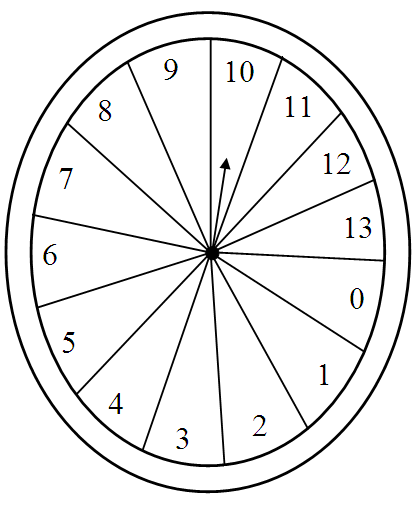
In roulette, Figure, the wheel has 13 numbers 0, 1, 2,...., 12 maked on equally spaced slots. A player sets Rs 10 on a given number. He recieves Rs 100 from the organiser of the game if the ball comes to rest in this slot; otherwise he gets nothing. If X denotes the players net gain/loss, Find E(X).
Answer
$\text{P}(\text{win})=\frac{1}{13}\Rightarrow\text{P}(\text{lose})=\frac{12}{13}$
He gains Rs 90 if he wins and loses Rs 10 if his number does not appear.
Let X denote tptal loss or gain, so,
$\text{X}:$ $90$ $-10$
$\text{P}(\text{X}):$ $\frac{1}{13}$ $\frac{12}{13}$
$\text{XP}:$ $\frac{90}{13}$ $\frac{-120}{13}$
$\text{E}(\text{X})=\sum\text{XP}$
$=\frac{90}{13}-\frac{120}{13}$
$\text{E}(\text{X})=-\frac{30}{13}$
View full question & answer
Question 1093 Marks
Determine P(E|F) : A coin is tossed three times.
E : at least two heads, F : at most two heads.
Answer
E : at least two heads
$\text{E}=(\text{HHT, HTH, THH, HHH})$$\ \ \ \ \ \ \ \ \ \ \Rightarrow\ \ \ \ \ \text{n}(\text{E})=4$
$\text{P}\left(\text{E}\right)=\frac{\text{n}\left(\text{E}\right)}{\text{n}\left(\text{S}\right)}=\frac{4}{8}=\frac{1}{2}$
F : at most two heads
$\text{F}=(\text{TTT, HTT, THT, TTH, HHT, HTH, THH})$$\ \ \ \ \ \ \ \Rightarrow\ \ \ \ \ \ \text{n}(\text{F})=7$
$\text{P}\left(\text{F}\right)=\frac{\text{n}\left(\text{F}\right)}{\text{n}\left(\text{S}\right)}=\frac{7}{8}$
$ \therefore\ \ \ \ \ \ \text{E}\cap\text{F}=\left(\text{HHT, HTH, THH}\right)\ \ \ \ \ \ \ \ \Rightarrow\ \ \ \ \text{n}\left(\text{E}\cap\text{F}\right)=3$
$\therefore\ \ \ \ \ \ \text{P}\left(\text{E}\cap\text{F}\right)=\frac{\text{n}\left(\text{E}\cap\text{F}\right)}{\text{n}\left(\text{S}\right)}=\frac{3}{8}$
$\text{And}\ \ \ \text{P}\left(\text{E}|\text{F}\right)=\frac{\text{P}\left(\text{E}\cap\text{F}\right)}{\text{P}\left(\text{F}\right)}=\frac{\frac{3}{8}}{\frac{7}{8}}=\frac{3}{7}$
View full question & answer
Question 1103 Marks
Suppose that 90% of people are right-handed. What is the probability that at most 6 of a random sample of 10 people are right-handed?
Answer
Let X be the number of people that are right-handed in the sample of 10 people.
X follows a binomial distribution with n = 10,
p = 90% = 0.9 and q = 1 - p = 0.1
$\text{P}(\text{X = r})=\text{ }^{10}\text{C}_{\text{r}}(0.9)^{\text{r}}(0.1)^{10-\text{r}}$
Probability that at most 6 are right-handed $=\text{P}(\text{X}\leq6)$
$=\text{P}(\text{X}=0)+\text{P}(\text{X}=1)+\text{P}(\text{X}=2)$
$+\text{P}(\text{X}=3)+\text{P}(\text{X}=4)+\text{P}(\text{X}=5)+\text{P}(\text{X}=6)$
$=1-\big\{\text{P}(\text{X}=7)+\text{P}(\text{X}=8)+\text{P}(\text{X}=9)+\text{P}(\text{X}=10)\big\}$
$=1-\sum\limits_{\text{r}=7}^{10}\text{ }^{10}\text{C}_\text{r}(0.9)^{\text{r}}(0.1)^{10-\text{r}}$
View full question & answer
Question 1113 Marks
Determine P(E|F) in Exercises.
Two coins are tossed once, where
E : tail appears on one coin, F : one coin shows head.
Answer
$\text{S}=\left(\text{HH, TH, HT, TT}\right)\ \ \ \ \ \Rightarrow \ \ \ \text{n}\left(\text{S}\right)=4$E : tail appears on one coin
$\text{E}=\left(\text{TH, HT}\right)\ \ \ \ \ \Rightarrow \ \ \ \text{n}\left(\text{E}\right)=2$$\text{P}\left(\text{E}\right)=\frac{\text{n}\left(\text{E}\right)}{\text{n}\left(\text{S}\right)}=\frac{2}{4}=\frac{1}{2}$
F : one coin shows head
$\text{F}=\left(\text{TH, HT}\right)\ \ \ \ \ \Rightarrow \ \ \ \text{n}\left(\text{F}\right)=2$
$\text{P}\left(\text{F}\right)=\frac{\text{n}\left(\text{F}\right)}{\text{n}\left(\text{S}\right)}=\frac{2}{4}=\frac{1}{2}$ $\therefore\ \ \ \ \ \ \ \text{E}\cap\text{F}=\left(\text{TH, HT}\right)\ \ \ \Rightarrow\ \ \ \text{n}\left(\text{E}\cap\text{F}\right)=2$ $ \therefore\ \ \ \ \ \ \ \text{P}\left(\text{E}\cap\text{F}\right)=\frac{\text{n}\left(\text{E}\cap\text{F}\right)}{\text{n}\left(\text{S}\right)}=\frac{2}{4}=\frac{1}{2}$$ \text{And}\ \ \ \text{P}\left(\text{E}|\text{F}\right)=\frac{\text{P}\left(\text{E}\cap\text{F}\right)}{\text{P}\left(\text{F}\right)}=\frac{\frac{1}{2}}{\frac{1}{2}}=1$
 
View full question & answer
Question 1123 Marks
From a deck of cards, three cards are drawn on by one without replacement. Find the probability that each time it is a card of spade.
Answer
Consider the events,
A = An ace in the first draw
B = An ace in the second draw
C = Getting an ace in the third draw
Now,
$\text{P(A)}=\frac{13}{52}=\frac{1}{4}$
$\text{P}\Big(\frac{\text{B}}{\text{A}}\Big)=\frac{12}{51}=\frac{4}{17}$
$\text{P}\Big(\frac{\text{C}}{\text{A}\cap\text{B}}\Big)=\frac{11}{50}$
$\therefore\ \text{Required probability} = \text{P}(\text{A}\cap\text{B}\cap\text{C})$
$=\text{P(A)}\times\text{P}\Big(\frac{\text{B}}{\text{A}}\Big)\times\text{P}\Big(\frac{\text{C}}{\text{A}\cap\text{B}}\Big)$
$=\frac{1}{4}\times\frac{4}{17}\times\frac{11}{50}$
$=\frac{11}{850}$
View full question & answer
Question 1133 Marks
The mathematics department has 8 graduate assistants who are assigned to the same office. Each assistant is just as likely to study at home as in office. How many desks must there be in the office so that each assistant has a desk at least 90% of the time?
Answer
Let K be the number of decks and X be the number of gradute assistans in the office.
therefore, $\text{X}=8,\text{p}=\frac{1}{2},\text{q}=\frac{1}{2}$
According to the given condition,
$\text{P(X}\leq\text{k})>90\%$
$\Rightarrow\text{P(X}\leq\text{k})>0.90$
$\Rightarrow\text{P(X}>\text{k})<0.10$
$\Rightarrow\text{P(X = k}+1,\text{k}+2,\dots8)<0.10$
Therefore, $\text{P(X > 6) = P(X = 7 or X = 8})$
$\text{ }^8\text{C}_7\big(\frac{1}{2}\big)^8+\text{ }^8\text{C}_8\big(\frac{1}{2}\big)^8=0.04$
Now, $\text{P(X > 5) = P(X = 6, X = 7 or X = 8)}=0.15$
$\text{P(X > 6})<0.10$
So, if there are 6 deske then there is at least 90% chance for every graduate to get a desk.
View full question & answer
Question 1143 Marks
Find the probability distribution of Y in two throws of two dice, where Y represents the number of times a total of 9 appears.
Answer
It is given that Y denotes the number of times a total of 9 appears on throwing the pair of dice.
When the dice is thrown 2 times, the possibility of getting a total of 9 is possible only for the given combination:
(3, 6) (4, 5) (5, 4) (6, 3)
So, the total number of outcomes is 36 and the total number of favourable outcomes is 4.
Probability of getting a total of $9=\frac{4}{36}=\frac{1}{9}$
Probability of not getting a total of $9=1-\frac{1}{9}=\frac{8}{9}$
If Y takes the values 0, 1 and 2. Then,
$\text{P}(\text{Y}=0)=\frac{8}{9}\times\frac{8}{9}=\frac{64}{81}$
$\text{P}(\text{Y}=1)=\frac{1}{9}\times\frac{8}{9}+\frac{8}{9}\times\frac{1}{9}=\frac{16}{81}$
$\text{P}(\text{Y}=2)=\frac{1}{9}\times\frac{1}{9}=\frac{1}{81}$
Thus, the probability distribution of X is given by
$\text{Y}$
$0$
$1$
$2$
$\text{P}(\text{Y})$
$\frac{64}{81}$
$\frac{16}{81}$
$\frac{1}{81}$
View full question & answer
Question 1153 Marks
A can hit a target 3 times in 6 shots, B : 2 times in 6 shots and C : 4 times in 4 shots. They fix a volley. What is the probability that at least 2 shots hit?
Answer
P (A hits the target) $=\frac{3}{6}$
P (B hits the target) $=\frac{2}{6}$
P (C hits the target) $=\frac{3}{6}=1$
P (At least 2 shots hit) = P(Exactly 2 shots hit) + P(all 3 shots hit)
$=\frac{3}{6}\Big(1-\frac{2}{6}\Big)+\frac{2}{6}\Big(1-\frac{3}{6}\Big)+\frac{3}{6}\times\frac{2}{6}\times1$
(Here, the probability of C hitting the target is 1. So, it will always hit. When exaxtly 2 shots are hit, then either A hits or B hits.)
$=\frac{3}{6}\times\frac{4}{6}+\frac{2}{6}\times\frac{3}{6}+\frac{6}{36}$
$=\frac{12+6+6}{36}$
$=\frac{24}{36}$
$=\frac{2}{3}$
View full question & answer
Question 1163 Marks
Suppose $X$ has a binomial distribution $\text{B}\Big(6,\frac{1}{2}\Big).$ Show that $X = 3$ is the most likely outcome.
$($Hint : $P(X = 3)$ is the maximum among all $P(x_i), x_i = 0, 1, 2, 3, 4, 5, 6)$
Answer
$X$ is the random variable whose binomial distribution is $\text{B}\Big(6,\frac{1}{2}\Big).$
Therefore, $n = 6$ and $\text{p}=\frac{1}{2}$
$\therefore\ \text{q}=1-\text{p}=1-\frac{1}{2}=\frac{1}{2}$
$\text{Then}\ \text{P}(\text{X=x})=\ ^\text{n}\text{C}_\text{x}\text{q}^\text{n-x}\text{p}^\text{x}$
$=\ ^6\text{C}_\text{x}\bigg(\frac{1}{2}\bigg)^{6-\text{x}}.\bigg(\frac{1}{2}\bigg)^\text{x}$
$=\ ^6\text{C}_\text{x}\bigg(\frac{1}{2}\bigg)^{6}$
It can be seen that $P(X = x)$ will be maximum, if $ ^6\text{C}_\text{x}$ will be maximum.
$\text{Then},\ ^6\text{C}_{0}=\ ^6\text{C}_{6}=\frac{6!}{0!\cdot6!}=1$
$\ ^6\text{C}_{1}=\ ^6\text{C}_{5}=\frac{6!}{1!\cdot5!}=6$.
$\ ^6\text{C}_{2}=\ ^6\text{C}_{4}=\frac{6!}{2!\cdot4!}=15$
$\ ^6\text{C}_{3}=\frac{6!}{3!\cdot3!}=20$
The value of $ ^6\text{C}_{3}$ is maximum.
Therefore, for $x = 3, P(X = x)$ is maximum.
Thus, $X = 3$ is the most likely outcome.
View full question & answer
Question 1173 Marks
In a family, the husband tells a lie in 30% cases and the wife in 35% cases. Find the probability that both contradict each other on the same fact.
Answer
Given,
In a family Husband (H) tells a lie in 30% cases and wife (W) tells a lie in 35%
$\text{P(H)}= 30\%, \text{P}(\overline{\text{H}})=70\%$
$\text{P(W)}= 35\%, \text{P}(\overline{\text{W}})=65\%$
P(Both contradict each other)
$=\text{P}\big[(\text{H}\cap\overline{\text{W}})\cup(\overline{\text{H}}\cap\text{W})\big]$
$=\text{P}(\text{H}\cap\overline{\text{W}})+\text{P}(\overline{\text{H}}\cap\text{W})$
$=\text{P(H)}\text{ P}(\overline{\text{W}})+\text{P}(\overline{\text{H}})\text{ P(W)}$
$=\frac{30}{100}\times\frac{65}{100}\times\frac{70}{100}\times\frac{35}{100}$
$=\frac{1950+2450}{10000}$
$=\frac{4400}{10000}$
$=0.44$
Required probability = 0.44
View full question & answer
Question 1183 Marks
Find the probability distribution of
number of tails in the simultaneous tosses of three coins.
Answer
Three coins tossed once = one coin tossed three times
$\therefore\ \text{S}=\{\text{T},\ \text{H}\}\ \ \Rightarrow\ \ \text{n}(\text{S})=2$
$\therefore\ \text{P}(\text{A})=\frac{\text{n}(\text{A})}{\text{n}(\text{S})}=\frac{1}{2}\ \text{and}\ \text{P}(\overline{\text{A}})=1-\frac{1}{2}=\frac{1}{2}$
n = 3, r = 0, 1, 2, 3
$\text{P}(\text{X}=0)=\text{P}(\overline{\text{A}}).\text{P}(\overline{\text{A}}).\text{P}(\text{A})=\frac{1}{2}\times\frac{1}{2}\times\frac{1}{2}=\frac{1}{8}$
$\text{P}(\text{X}=1)=3\ \text{P}(\text{A}).\text{P}(\overline{\text{A}}).\text{P}(\overline{\text{A}})=3\times\frac{1}{2}\times\frac{1}{2}\times\frac{1}{2}=\frac{3}{8}$
$\text{P}(\text{X}=2)=3\ \text{P}(\text{A}).\text{P}(\text{A}).\text{P}(\overline{\text{A}})=3\times\frac{1}{2}\times\frac{1}{2}\times\frac{1}{2}=\frac{3}{8}$
$\text{P}(\text{X}=3)=\text{P}(\text{A}).\text{P}(\text{A}).\text{P}(\text{A})=\frac{1}{2}\times\frac{1}{2}\times\frac{1}{2}=\frac{1}{8}$
Probability distribution
$\text{X}_i$ $0$ $1$ $2$ $3$
$\text{P}_i$ $\frac{1}{8}$ $\frac{3}{8}$ $\frac{3}{8}$ $\frac{1}{8}$
View full question & answer
Question 1193 Marks
Let X represents the difference between the number of heads and the number of tails when a coin is tossed 6 times. What are possible values of X?
Answer
Given: X = Number of heads - Number of tails
Number of heads
Number of heads
Number of heads - Number of tails
0
6
-6
1
5
-4
2
4
-2
3
3
0
4
2
2
5
1
4
6
0
6
Therefore, the possible values of X are:
-6, -4, -2, 0, 2, 4, 6.
View full question & answer
Question 1203 Marks
Two dice are thrown and it is known that the first die shows a 6. Find the probability that the sum of the numbers showing on two dice is 7.
Answer
Two dice are thrown
A = Sun of the numbers showing on the dice is 7
A = {(1, 6), (2, 5), (3, 4), (4, 3), (5, 2), (6, 1)}
B = First dies shows a 6
= {(6, 1), (6, 2), (6, 3), (6, 4), (6, 5), (6, 6)
$(\text{A}\cap\text{B})=\{(6, 1)\}$
$\text{P}\Big(\frac{\text{A}}{\text{B}}\Big)=\frac{\text{n}(\text{A}\cap\text{B})}{\text{n}(\text{B})}$
$=\frac{1}{6}$
Required probability $=\frac{1}{6}$
View full question & answer
Question 1213 Marks
If a machine is correctly set up it produces $90\%$ acceptable items. If it is incorrectly set up it produces only $40\%$ acceptable item. Past experience shows that $80\%$ of the setups are correctly done. If after a certain set up, the machine produces $2$ acceptable items, find the probability that the machine is correctly set up.
Answer
Let A be the event that the machine produces two acceptable items.
Also, let $E_1$ represent the event that the machine is correctly set up and $E_2$ represent the event that the machine is incorrectly set up
$\therefore\ \text{P}(\text{E}_1)=0.8$
$\text{P}(\text{E}_2)=0.2$
Now,
$\text{P}\Big(\frac{\text{A}}{\text{E}_1}\Big)=0.9\times0.9=0.81$
$\text{P}\Big(\frac{\text{A}}{\text{E}_2}\Big)=0.40\times0.40=0.16$
Using Bayes, theorem, we get
Required probability $=\text{P}\Big(\frac{\text{E}_1}{\text{A}}\Big)=\frac{\text{P}(\text{E}_1)\text{P}\Big(\frac{\text{A}}{\text{E}_1}\Big)}{\text{P}(\text{E}_1)\text{P}\Big(\frac{\text{A}}{\text{E}_1}\Big)+\text{P}(\text{E}_2)\text{P}\Big(\frac{\text{A}}{\text{E}_2}\Big)}$
$=\frac{0.8\times0.81}{0.8\times0.81+0.2\times0.61}$
$=\frac{81}{85}$
View full question & answer
Question 1223 Marks
Tickets are numbered from 1 to 10. Two tickets are drawn one after the other at random. Find the probability that the number on one of the tickets is a multiple of 5 and on the other a multiple of 4.
Answer
Tickers are numbered from 1 to 10.
Two tickets are drawn.
Consider, A = Multiple of 5
B = Multiple of 4
$\text{P(A)}=\frac{2}{10}$
[Since 5, 10 are multiple of 5]
$\text{P(A)}=\frac{1}{5}$
$\text{P(B)}=\frac{2}{10}$
$\text{P(B)}=\frac{1}{5}$
[Since 4, 8 are multiple of 4]
P (One number multiple of 5 and other multiple of 4)
$=\text{P}\big[(\text{A}\cap\text{B})\cup(\text{B}\cap\text{A)}\big]$
$=\text{P}(\text{A}\cap\text{B})+\text{P}(\text{B}\cap\text{A)}$
$=\text{P(A) }\text{P}\Big(\frac{\text{B}}{\text{A}}\Big)+\text{P(B) P}\Big(\frac{\text{A}}{\text{B}}\Big)$
$=\frac{1}{5}\times\frac{2}{9}+\frac{1}{5}\times\frac{2}{9}$
$=\frac{4}{45}$
Required probability $=\frac{4}{45}$
View full question & answer
Question 1233 Marks
Determine P(E|F) in Exercises.
Two coins are tossed once, where
E : no tail appears, F : no head appears.
Answer
E : no tail appears
$\text{E}=(\text{HH})\ \ \ \ \ \ \ \ \ \ \ \ \ \Rightarrow\ \ \ \ \ \text{n}(\text{E})=1$
$\text{P}\left(\text{E}\right)=\frac{\text{n}\left(\text{E}\right)}{\text{n}\left(\text{S}\right)}=\frac{1}{4}$
F : no head appears
$\text{F}=(\text{TT})\ \ \ \ \ \ \ \ \ \ \ \ \ \Rightarrow\ \ \ \ \ \text{n}(\text{F})=1$
$\text{P}\left(\text{F}\right)=\frac{\text{n}\left(\text{F}\right)}{\text{n}\left(\text{S}\right)}=\frac{1}{4}$
$\therefore\ \ \ \ \ \ \ \text{E}\cap\text{F}=\phi\ \ \ \ \ \Rightarrow\ \ \ \ \text{n}\left(\text{E}\cap\text{F}\right)=0$
$\therefore\ \ \ \ \ \ \ \text{P}\left(\text{E}\cap\text{F}\right)=\frac{\text{n}\left(\text{E}\cap\text{F}\right)}{\text{n}\left(\text{S}\right)}=\frac{0}{4}=0$
$\text{And}\ \ \ \text{P}\left(\text{E}|\text{F}\right)=\frac{\text{P}\left(\text{E}\cap\text{F}\right)}{\text{P}\left(\text{F}\right)}=\frac{0}{\frac{1}{4}}=0$
View full question & answer
Question 1243 Marks
In a school there are 1000 students, out of which 430 are girls. It is known that out of 430, 10% of the girls study in class XII. What is the probability that a student chosen randomly studies in class XII given that the chosen student is a girl?
Answer
Suppose S represents a student chosen randomlu studying in class XII and G represents a female student chosen randomly.
We have.
$\text{P}(\text{G})=\frac{430}{1000}$
$\text{P}\Big(\frac{\text{S}}{\text{G}}\Big)=\frac{43}{1000}$
Now,
$\text{P}\Big(\frac{\text{S}}{\text{G}}\Big)=\frac{\frac{43}{1000}}{\frac{430}{1000}}=\frac{1}{10}$
View full question & answer
Question 1253 Marks
A coin is biased so that the head is 3 times as likely to occur as tail. If the coin is tossed twice, find the probability distribution of number of tails.
Answer
Let p represents the appearance of tail and q represents the appearance of head. Now $\text{q}=3\text{p}$ Since p + q = 1 ⇒ p + 3p = 1 $\Rightarrow\ \text{P}=\frac{1}{4}\ \text{and}\ \text{q}=1-\frac{1}{4}=\frac{3}{4}$ $\text{P}(\text{X}=0)=\ ^2\text{C}_0(\text{q})^2=\bigg(\frac{3}{4}\bigg)^2=\frac{9}{16}$ $\text{P}(\text{X}=1)=\ ^2\text{C}_1\text{q}.\text{p}=2\times\frac{3}{4}\times\frac{1}{4}=\frac{6}{16}$ $\text{P}(\text{X}=2)=\ ^2\text{C}_2\text{p}^2=\bigg(\frac{1}{4}\bigg)^2=\frac{1}{16}$ Probability distribution:
$\text{x}_i$ $0$ $1$ $2$
$\text{p}_i$ $\frac{9}{16}$ $\frac{6}{16}$ $\frac{1}{16}$
 
View full question & answer
Question 1263 Marks
A card is drawn from a well-shuffled deck of 52 cards and then a second card is drawn. Find the probability that the first card is a heart and the second card is a diamond if the first card is not replaced.
Answer
Consider the given events.
A = A heart in the first draw
B = A diamond in the second draw
Now,
$\text{P(A)}=\frac{13}{52}=\frac{1}{4}$
$\text{P}\Big(\frac{\text{B}}{\text{A}}\Big)=\frac{13}{51}$
$\therefore\text{Required probability}=\text{P}(\text{A}\cap\text{B})=\text{P(A)}\times\text{P}\Big(\frac{\text{B}}{\text{A}}\Big)$
$=\frac{1}{4}\times\frac{13}{51}=\frac{13}{204}$
View full question & answer
Question 1273 Marks
If the mean and variance of a binomial distribution are 4 and 3, respectively, find the probability of no success.
Answer
$\text{Mean (np)}=4$
$\text{Variance (npq)}=3$
$\Rightarrow\text{q}=\frac{3}{4}$
Hence, $\text{p}=1-\frac{3}{4}=\frac{1}{4}$
and $\text{n}=\frac{\text{Mean}}{\text{p}}=4\times4=16$
Therefore, the binomial distribution is given by
$\text{P(X = r})=\text{ }^{16}\text{C}_{\text{r}}\big(\frac{1}{4}\big)^{\text{r}}\big(\frac{3}{4}\big)^{16-\text{r}},\text{r}=0,1,2,\dots\text{r}$
Probability of no success $=\text{ }^{16}\text{C}_0\big(\frac{1}{4}\big)^{0}\big(\frac{3}{4}\big)^{16-0}=\big(\frac{3}{4}\big)^{16}$
View full question & answer
Question 1283 Marks
For what value of $k$ the following distribution is a probability distributioin?
$X = x_i$ $0$ $1$ $2$ $3$
$P(X = x_i)$ $2k^4$ $3k^2 - 5k^3$ $2k - 3k^2$ $3k - 1$
Answer
We know that the sum of the probabilities in a probability distribution is always $1.$
Therefore,
$P(X = 0) + P(X = 1) + P(X = 2) + P(X = 3) = 1$
$\Rightarrow 2k^4 + 3k^2 - 5k^3 + 2k - 3k^2 + 3k - 1 = 1$
$\Rightarrow 2k^4 -5k^3 + 5k = 2$
$\Rightarrow 2k^4 -5k^3 + 5k - 2 = 0$
$\Rightarrow (k - 1)(k - 2)(2k2 + k - 1) = 0$
$\Rightarrow (k - 1)(k - 2)(2k - 1)(k + 1) = 0$
$\Rightarrow\text{k}=-1,\frac{1}{2},1,2$
$($Negleting $-1, 1$ and $2$ as they give the value of probability negative or greater than $1)$
$\therefore\ \text{k}=\frac{1}{2}.$
View full question & answer
Question 1293 Marks
If getting 5 or 6 in a throw of an unbiased die is a success and the random variable X denotes the number of successes in six throws of the die, find $\text{P}(\text{X}\geq4).$
Answer
Let X denote the number of successes, i.e. of getting 5 or 6 in a throw of die in 6 throws.
Then, X follows a binomial distribution with n = 6;
P = of getting 5 or 6 $=\frac{1}{6}+\frac{1}{6}=\frac{1}{3};\text{q}=1-\text{p}=\frac{2}{3};$
$\text{P}(\text{X = r})=\text{ }^6\text{C}_{\text{r}}\big(\frac{1}{3}\big)^{\text{r}}\big(\frac{2}{3}\big)^{6-\text{r}}$
$\text{P}(\text{X}\geq4)=\text{P}(\text{X}=4)+\text{P}(\text{X}=5)+\text{P}(\text{X}=6)$
$=\text{ }^6\text{C}_4\big(\frac{1}{3}\big)^4\big(\frac{2}{3}\big)^{6-4}+\text{ }^6\text{C}_5\big(\frac{1}{5}\big)^5\big(\frac{2}{3}\big)^{6-5}+\text{ }^6\text{C}_6\big(\frac{1}{3}\big)^6\big(\frac{2}{3}\big)^{6-6}$
$=\frac{1}{3^6}(60+12+1)$
$=\frac{73}{729}$
View full question & answer
Question 1303 Marks
A dice is thrown thrice. A success is 1 or 6 in a throw. Find the mean and variance of the number of successes.
Answer
Let p be the probability of success, so
$\text{p}=\frac{2}{6}$ [Since success in occurance of 1 or 6 on the die]
$\text{p}=\frac{1}{3}$
Given, $\text{n}=3$
$\text{q}=1-\text{p}$ [Since p + q = 1]
$=1-\frac{1}{3}$
$\text{q}=\frac{2}{3}$
$\text{Mean = np}$
$=3\big(\frac{1}{3}\big)$
$=1$
$\text{Variance = npq}$
$=3\times\big(\frac{1}{3}\big)\big(\frac{2}{3}\big)$
$=\frac{2}{3}$
$\text{Mean}=1$
$\text{Variance}=\frac{2}{3}$
View full question & answer
Question 1313 Marks
An urn contains $10$ white and $3$ black balls. Another urn contains $3$ white and $5$ black balls. Two are drawn from first urn and put into the second urn and then a ball is drawn from the latter. Find the probability that its is a white ball.
Answer
A white ball can be drawn in three mutually exclusive ways:
  1. By transferring two black balls from first to second urn, then drawing a white ball.
  2. By transferring two white balls from first to second urn, then drawing a white ball.
  3. By transferring a white and a black ball from first to second urn, then drawing a white ball.
Let $E_1, E_2, E_{3 }$ and $A$ be the events as defined below:
$E_1 =$ Two black balls are transferred from first to second bag
$E_{2 }=$ Two white balls are transferred from first to second bag
$E_{2 }= A$ white and a black ball is transferred from first to second bag
$A = A$ white ball is drawn
$\therefore\ \text{P}(\text{E}_1)=\frac{^{3}\text{C}_2}{^{13}\text{C}_2}=\frac{3}{78}$
$\text{P}(\text{E}_2)=\frac{^{10}\text{C}_2}{^{13}\text{C}_2}=\frac{45}{78}$
$\text{P}(\text{E}_3)=\frac{^{10}\text{C}_2\times^{3}\text{C}_1}{^{13}\text{C}_2}=\frac{30}{78}$
Now,
$\text{P}\Big(\frac{\text{A}}{\text{E}_1}\Big)=\frac{3}{10}$
$\text{P}\Big(\frac{\text{A}}{\text{E}_2}\Big)=\frac{5}{10}$
$\text{P}\Big(\frac{\text{A}}{\text{E}_3}\Big)=\frac{4}{10}$
Using the law of total probability, we get
Required probability $=\text{P(A)}=\text{P}(\text{E}_1)\text{ P}\Big(\frac{\text{A}}{\text{E}_1}\Big)+\text{P}(\text{E}_2)\text{ P}\Big(\frac{\text{A}}{\text{E}_2}\Big)+\text{P}(\text{E}_3)\text{ P}\Big(\frac{\text{A}}{\text{E}_3}\Big)$
$=\frac{3}{78}\times\frac{3}{10}+\frac{45}{78}\times\frac{5}{10}+\frac{30}{78}\times\frac{4}{10}$
$=\frac{9}{780}+\frac{225}{780}+\frac{120}{780}$
$=\frac{354}{780}=\frac{59}{130}$
View full question & answer
Question 1323 Marks
An electronic assembly consists of two subsystems, say, A and B. From previous testing procedures, the following probabilities are assumed to be known:
P(A fails) = 0.2
P(B fails alone) = 0.15
P(A and B fail) = 0.15
Evaluate the following probabilities:
  1. P(A fails|B has failed)
  2. P(A fails alone)
Answer
Consider the following events: E : A fails F : B fails. Now P(A fails) = 0.2 ⇒ P(E) = 0.2 And P(A and B fails) = 0.15 $\Rightarrow\ \text{P}(\text{E}\cap\text{F})= 0.15$ Also P(B fails alone) = 0.15 $\Rightarrow\ \text{P}(\overrightarrow{\text{E}}\cap\text{F})=0.15$ $\Rightarrow\ \text{P}(\text{F})-\text{P}({\text{E}}\cap\text{F})=0.15$ $\Rightarrow\ \text{P}(\text{F})-\text{P}({\text{E}}\cap\text{F})+0.15$ ⇒ P(F) = 0.15 + 0.15 = 0.30
  1. P(Afails| B has failed) $=\text{P}(\text{E|F})=\frac{\text{P}({\text{E}}\cap\text{F})}{\text{P}(\text{F})}= \frac{0.15}{0.30}=\frac{15}{30}=\frac{1}{2}$
  2. P(A fails alone) $=\text{P}(\text{E}\cap\overrightarrow{\text{F}})=\text{P}(\text{E})-\text{P}(\text{E}\cap\text{F})$
= 0.2 - 0.15 = 0.05
 
View full question & answer
Question 1333 Marks
Find the probability distribution of the number of doublets in 4 throws of a pair of dice.
Also, Find the mean and variance of this distribution.
Answer
Let X be the number of doublets in 4 throws of a pair of dice.
X follows a binomial distribution with n = 4,
$\text{p}=\text{No of getting}(1, 1)(2, 2)\dots(6,6)=\frac{6}{36}=\frac{1}{6}$
$\text{q}=1-\text{p}=\frac{5}{6}$
$\text{P}(\text{X = r})=\text{ }^4\text{C}_{\text{r}}\big(\frac{1}{6}\big)^{\text{r}}\big(\frac{5}{6}\big)^{4-\text{r}},\text{r}=0,1,2,3,4$
$\text{P}(\text{X}=0)=\text{ }^4\text{C}_0\big(\frac{1}{6}\big)^0\big(\frac{5}{6}\big)^{4-0}$
$\text{P}(\text{X}=1)=\text{ }^4\text{C}_1\big(\frac{1}{6}\big)^1\big(\frac{5}{6}\big)^{4-1}$
$\text{P}(\text{X}=2)=\text{ }^4\text{C}_2\big(\frac{1}{6}\big)^2\big(\frac{5}{6}\big)^{4-2}$
$\text{P}(\text{X}=3)=\text{ }^4\text{C}_3\big(\frac{1}{6}\big)^3\big(\frac{5}{6}\big)^{4-3}$
$\text{P}(\text{X}=4)=\text{ }^4\text{C}_4\big(\frac{1}{6}\big)^4\big(\frac{5}{6}\big)^{4-4}$
The distribution is as follows
$\text{X}$ $0$ $1$ $2$ $3$ $4$
$\text{P(X)}$ $\frac{625}{1296}$ $\frac{500}{1296}$ $\frac{150}{1296}$ $\frac{20}{1296}$ $\frac{1}{1296}$
View full question & answer
Question 1343 Marks
A bag contains $4$ white, $7$ black and $5$ red balls. $4$ balls are drawn with replacement. What is the probability that at least two are white$?$
Answer
Number of white balls $= 4$
Number of black balls $= 7$
Number of red balls $= 5$
Total balls $= 16$
Number of ways in which $4$ balls can be drawn from $16$ balls $=\ ^{16}C_4$
Let $A =$ getting at least two white ball $=$ Getting $2, 3, 4$ white balls
Number of ways of choosing $2$ white balls $=\ ^4C_2 \times\ ^{12}C_2$
Number of ways of chossing $3$ white balls $=\ ^4C_3 \times\ ^{12}C_1$
Number of ways of choosing $4$ white balls $=\ ^4C_4 \times\ ^{12}C_0$
$\therefore\ \text{P(A)}=\frac{^{4}\text{C}_2\times ^{12}\text{C}_2 + ^{4}\text{C}_3\times ^{12}\text{C}_1+^{4}\text{C}_1\times ^{12}\text{C}_0}{^{16}\text{C}_4}=\frac{67}{256}$
View full question & answer
Question 1353 Marks
If A and B are two independent events such that $\text{P}(\text{A}\cap\text{B})=0.60$ and P(A) = 0.2, find P(B).
Answer
$\text{P}(\text{A}\cup\text{B})=\text{P(A)}+\text{P(B)}-\text{P}(\text{A}\cap\text{B})$
$\text{P}(\text{A}\cup\text{B})=\text{P(A)}+\text{P(B)}-\text{P}(\text{A})\times(\text{B})$
[$\because$ A and B are independent events]
$\Rightarrow\ 0.6=0.2+\text{P(B)}=0.2\times\text{P(B)}$
$\Rightarrow\ 0.6-0.2=\text{P(B)}(1-0.2)$
$\Rightarrow\ \text{P(B)}=\frac{0.6-0.2}{1-0.2}$
$\Rightarrow\ \text{P(B)}=\frac{0.4}{0.8}$
$\Rightarrow\ \text{P(B)}=\frac{1}{2}$
$\Rightarrow\ \text{P(B)}=0.5$
View full question & answer
Question 1363 Marks
A coin is tossed 5 times. What is the probability that head appears an even number of times?
Answer
Let X be the number of heads that apper when a coin is tossed 5 times.
X follow a binomial distribution with $\text{n}=5$ and $\text{p = q}=\frac{1}{2}$
$\text{P}(\text{X = r})=\text{ }^5\text{C}_{\text{r}}\big(\frac{1}{2}\big)^{\text{r}}\big(\frac{1}{2}\big)^{5-\text{r}}$
$=\text{ }^5\text{C}_{\text{r}}\big(\frac{1}{2}\big)^5$
P (head apperars an even number of times) = P(X = 0) + P(X = 2) + P(X = 4)
$=\text{ }^5\text{C}_0\big(\frac{1}{5}\big)^5+\text{ }^5\text{C}_2\big(\frac{1}{2}\big)^5+\text{ }^5\text{C}_4\big(\frac{1}{2}\big)^5$
$=\frac{1+10+5}{2^5}$
$=\frac{16}{32}$
$=\frac{1}{2}$
View full question & answer
Question 1373 Marks
The probability of student A passing an examination is $\frac{2}{9}$ and of student B passing is $\frac{5}{9}$. Assuming the two events: 'A passes', 'B passes' as independent, find the probability of:
Only one of them passing the examination.
Answer
Given,
The probability of A passing exam $=\frac{2}{9}$
The probability of B passing exam $=\frac{5}{9}$
$\Rightarrow\ \text{P(A)}=\frac{2}{9},\text{P(B)}=\frac{5}{9}$
P (Only one of them passing exam)
$=\text{P}\big((\text{A}\cap\overline{\text{B}})\cup(\overline{\text{A}}\cap\text{B})\big)$
$=\text{P}(\text{A}\cap\overline{\text{B}})+\text{P}(\overline{\text{A}}\cap\text{B})$
$=\text{P}(\text{A})\text{ P}(\overline{\text{B}})+\text{P}(\overline{\text{A}})\text{ P}(\text{B})$
$=\text{P(A)}(1-\text{P(B)})+(1-\text{P(A)})\text{P(B)}$
$=\frac{2}{9}\Big(1-\frac{5}{9}\Big)+\Big(1-\frac{2}{9}\Big)\frac{5}{9}$
$=\frac{2}{9}\times\frac{4}{9}+\frac{7}{9}\times\frac{5}{9}$
$=\frac{8}{81}+\frac{35}{81}$
$=\frac{43}{81}$
Required probability $=\frac{43}{81}$
View full question & answer
Question 1383 Marks
A factory has two machines $A$ and $B.$ Past records show that the machine A produced $60\%$ of the items of output and machine $B$ produced $40\%$ of the items. Further $2\%$ of the items produced by machine A were defective and $1\%$ produced by machine $B$ were defective. If an item is drawn at random, what is the probability that it is defective$?$
Answer
Let $E_1, E_2$ A be defined as,
$E_1 =$ Item produced by machine $A$
$E_2 =$ Item produced by machine $B$
$A =$ The item drawn is defective
$\text{P}(\text{E}_1)=60\%$
$=\frac{60}{100}$
$\text{P}(\text{E}_2)=40\%$
$=\frac{40}{100}$
$\text{P}(\text{A}|\text{E}_1)=\text{P} [$Defective item from machine $A]$
$=2\%$
$=\frac{2}{100}$
$\text{P}\Big(\frac{\text{A}}{\text{E}_2}\Big)=\text{P}[$Defective item from machine $B]$
$=1\%$
$=\frac{1}{100}$
BY law of total probability,
$\text{P(A)}=\text{P}(\text{E}_1)\text{ P}\Big({\text{A}}|{\text{E}_1}\Big)+\text{P}(\text{E}_2)\text{ P}\Big(\frac{\text{A}}{\text{E}_2}\Big)$
$=\frac{60}{100}\times\frac{2}{100}+\frac{40}{100}\times\frac{1}{100}$
$=\frac{120+40}{10000}$
$=\frac{160}{10000}$
$=0.016$
Required probability $= 0.016$
View full question & answer
Question 1393 Marks
A die is thrown again and again until three sixes are obtained. Find the probability of obtaining the third six in the sixth throw of the die.
Answer
A die is thrown again and again.
Probability of getting a six in a throw $=\frac{1}{6}$
Probability of not getting a six in a throw $=1-\frac{1}{6}=\frac{5}{6}$
Since third six is in sixth throw 
$\therefore\ $ there are two sixes in first five throws and one six in the sixth throw.
Probability of getting two sixes in 5 throws $=\ ^5\text{C}_2\bigg(\frac{5}{6}\bigg)^3\bigg(\frac{1}{6}\bigg)^2$
$\bigg[\therefore\ \text{n}=5,\ \text{p}=\frac{1}{6},\ \text{q}=\frac{5}{6}\bigg]$
Probability of getting a six in sixth in a throw $=\frac{1}{6}$
$\therefore$ Probability of getting a third six in the sixth throw
$=\ ^5\text{C}_2\bigg(\frac{5}{6}\bigg)^3\bigg(\frac{1}{6}\bigg)^2\times\frac{1}{6}=\frac{5\times4}{1\times2}\times\frac{125}{6^6}=\frac{1250}{46656}=\frac{625}{23328}.$
View full question & answer
Question 1403 Marks
Assume that each child born is equally likely to be a boy or a girl. If a family has two children, what is the conditional probability that both are girls given that (i) the youngest is a girl, (ii) at least one is a girl?
Answer
Let first and second girl are denoted by $\text{G}_1$ and $\text{G}_2$ and boys $\text{B}_1$ and $\text{B}_2.$$\therefore\ \ \ \ \ \ \ \ \ \text{S}=\{(\text{G}_1\text{G}_2),\ (\text{G}_1\text{B}_2),\ (\text{G}_2\text{B}_1),\ (\text{B}_1\text{B}_2)\}$
Let A = Both the children are girls $=(\text{G}_1\text{G}_2)$
B = Youngest child is girl $=\{(\text{G}_1\text{G}_2),\ (\text{B}_1\text{G}_2)\}$
C = At least one is a girl $=\{(\text{G}_1\text{B}_2),\ (\text{G}_1\text{G}_2),\ (\text{B}_1\text{G}_2)\}$
$\text{A}\cap\text{B}=(\text{G}_1\text{G}_2)\ \Rightarrow\ \ \ \ \text{P}(\text{A}\cap\text{B})=\frac{1}{4}$ $\text{A}\cap\text{C}=(\text{G}_1\text{G}_2) \Rightarrow\ \ \ \ \text{P}(\text{A}\cap\text{C})=\frac{1}{4}$ $\text{P}(\text{B})=\frac{2}{4}\ \text{and}\ \text{P}\ (\text{C})=\frac{3}{4}$
  1. $\text{P}(\text{A}|\text{B})=\frac{\text{P}(\text{A}\cap\text{B})}{\text{P}(\text{B})}=\frac{\frac{1}{4}}{\frac{2}{4}}=\frac{1}{2}$
  2. $\text{P}(\text{A}|\text{C})=\frac{\text{P}(\text{A}\cap\text{C})}{\text{P}(\text{C})}=\frac{\frac{1}{4}}{\frac{3}{4}}=\frac{1}{3}$
View full question & answer
Question 1413 Marks
Four cards are drawn simultaneously from a well shuffled pack of 52 playing cards. Find the probability distribution of the number of aces.
Answer
Let X denote number of aces in a sample of 4 cards drawn from a well shuffled pack of 52 playing cards. Then, X can take values 0, 1, 2, 3 and 4.
Now,
$\text{P}(\text{X}=0)=\text{P}(\text{no ace})=\frac{\text{}^{48}\text{C}_4}{\text{}^{52}\text{C}_4}$
$\text{P}(\text{X}=1)=\text{P}(\text{1 ace})=\frac{\text{}^{4}\text{C}_1\times\text{}^{48}\text{C}_3}{\text{}^{52}\text{C}_4}$
$\text{P}(\text{X}=2)=\text{P}(\text{2 aces})=\frac{\text{}^{4}\text{C}_2\times\text{}^{48}\text{C}_2}{\text{}^{52}\text{C}_4}$
$\text{P}(\text{X}=3)=\text{P}(\text{3 aces})=\frac{\text{}^{4}\text{C}_3\times\text{}^{48}\text{C}_1}{\text{}^{52}\text{C}_4}$
$\text{P}(\text{X}=4)=\text{P}(\text{4 aces})=\frac{\text{}^{4}\text{C}_4}{\text{}^{52}\text{C}_4}$
Thus, the probability distribution of X is given by
$\text{X}$ $\text{P}(\text{X})$
$0$ $\frac{\text{}^{48}\text{C}_4}{\text{}^{52}\text{C}_4}$
$1$ $\frac{\text{}^{4}\text{C}_1\times\text{}^{48}\text{C}_3}{\text{}^{52}\text{C}_4}$
$2$ $\frac{\text{}^{4}\text{C}_2\times\text{}^{48}\text{C}_2}{\text{}^{52}\text{C}_4}$
$3$ $\frac{\text{}^{4}\text{C}_3\times\text{}^{48}\text{C}_1}{\text{}^{52}\text{C}_4}$
$4$ $\frac{\text{}^{4}\text{C}_4}{\text{}^{52}\text{C}_4}$
View full question & answer
Question 1423 Marks
A die is thrown twice and the sum of the numbers appearing is observed to be 8. What is the conditional probability that the number 5 has appeared at least once?
Answer
Consider the given events.
A = 5 appears on the die at least once
B = The sum of the numbers on two dice is 8.
Clearly,
A = {(1, 5), (2, 5), (3, 5), (4, 5), (5, 5), (6, 5), (5, 1), (5, 2), (5, 3), (5, 4), (5, 6)}
B = {(2, 6), (3, 5), (4, 4), (5, 3), (6, 2)}
Now,
$\text{A}\cap\text{B}=\{(3, 5), (5, 3)\}$
$\therefore\ \text{Required probability}=\text{P}\Big(\frac{\text{A}}{\text{B}}\Big)=\frac{\text{n}(\text{A}\cap\text{B})}{\text{n(B)}}=\frac{2}{5}$
View full question & answer
Question 1433 Marks
Compute $\text{P}\Big(\frac{\text{A}}{\text{B}}\Big),$ if P(B) = 0.5 and $\text{P}(\text{A}\cap\text{B})=0.32$
Answer
Given,
$\text{P(B)}=0.5,\text{P}(\text{A}\cap\text{B})=0.32$
We know that,
$\text{P}\Big(\frac{\text{A}}{\text{B}}\Big)=\frac{\text{n}(\text{A}\cap\text{B})}{\text{n}(\text{B})}$
$=\frac{0.32}{0.5}$
$=\frac{32}{50}$
$=\frac{16}{25}$
$\text{P}\Big(\frac{\text{A}}{\text{B}}\Big)=\frac{16}{25}$
View full question & answer
Question 1443 Marks
Two cards are drawn successively without replacement from a well-shuffled deck of 52 cards. Find the probability of exactly one ace.
Answer
Two cards are drawn without replacement.
There are total 4 ace.
A = Getting Ace
P (Exactly one ace out of 2 cards)
$=\text{P}\big((\text{A}\cap\overline{\text{A}})\cup(\overline{\text{A}}\cap\text{A})\big)$
$=\text{P(A)P}\Big(\frac{\overline{\text{A}}}{\text{A}}\big)=\text{P}(\overline{\text{A}})\text{P}\Big(\frac{\text{A}}{\overline{\text{A}}}\Big)$
$=\frac{4}{52}\times\frac{48}{51}+\frac{48}{52}\times\frac{4}{51}$
$=\frac{96}{663}$
$=\frac{32}{221}$
required probability $=\frac{32}{221}$
View full question & answer
Question 1453 Marks
An urn contains 5 red and 5 black balls. A ball is drawn at random, its colour is noted and is returned to the urn. Moreover, 2 additional balls of the colour drawn are put in the urn and then a ball is drawn at random. What is the probability that the second ball is red?
Answer
Number of red balls = 5 Number of black balls = 5 $\therefore$ total number of balls = 10 Let A be the event that second drawn ball is red, and B be the event of drawing first ball as red and adding two red balls to urn.Required probability $=\text{P}(\text{A})=\text{P}(\text{B})\ \text{P}(\text{A}|\text{B})+\text{P}(\text{B}')\ \text{P}(\text{A}|\text{B}')$
= P(a red ball is drawn and returned along with 2 red balls and then a red ball is drawn) + P(a black ball is drawn and returned along with 2 black balls and then a red ball is drawn)$=\frac{5}{10}\times\frac{7}{12}+\frac{5}{10}\times\frac{5}{12}=\frac{35+25}{120}=\frac{60}{120}=\frac{1}{2}.$
View full question & answer
Question 1463 Marks
A coin is tossed three times. Find $\text{P}\Big(\frac{\text{A}}{\text{B}}\Big)$ in each of the following:
A = Heads on third toss,
B = Heads on first two tosses.
Answer
Sample space for three coins is given by
{HHH, HTH, THH, TTH, HHT, HTT, THT, TTT}
A = Head on third toss
A = {HHH, HTH, THH, TTH}
B = Head on first two toss
B = {HHH, HHT}
$(\text{A}\cap\text{B})=\{\text{HHH}\}$
$\text{P}\Big(\frac{\text{A}}{\text{B}}\Big)=\frac{\text{n}(\text{A}\cap\text{B})}{\text{n}(\text{B})}$
$\text{P}\Big(\frac{\text{A}}{\text{B}}\Big)=\frac{1}{2}$
Hence, $\text{P}\Big(\frac{\text{A}}{\text{B}}\Big)=\frac{1}{2}$
View full question & answer
Question 1473 Marks
A bag contains $1$ white and $6$ red balls, and a second bag contains $4$ white and $3$ red balls. One of the bags is picked up at random and a ball is randomly drawn from it, and is found to be white in colour. Find the probability that the drawn ball was from the first bag.
Answer
Let $A, E_1$ and $E_2$ denote the events that the ball is white, bag $I$ is chosen and bag $II$ is chosen, respectively.
$\therefore\text{P}(\text{E}_1)=\frac{1}{2}$
$\text{P}(\text{E}_2)=\frac{1}{2}$
Now,
$\text{P}\Big(\frac{\text{A}}{\text{E}_1}\Big)=\frac{1}{7}$
$\text{P}\Big(\frac{\text{A}}{\text{E}_2}\Big)=\frac{4}{7}$
Using Baye's therorem, we get
Required probability $=\text{P}\Big(\frac{\text{E}_1}{\text{A}}\Big)=\frac{\text{P}(\text{E}_1)\text{P}\Big(\frac{\text{A}}{\text{E}_1}\Big)}{\text{P}(\text{E}_1)\text{P}\Big(\frac{\text{A}}{\text{E}_1}\Big)+\text{P}(\text{E}_2)\text{P}\Big(\frac{\text{A}}{\text{E}_2}\Big)}$
$=\frac{\frac{1}{2}\times\frac{1}{7}}{\frac{1}{2}\times\frac{1}{7}+\frac{1}{2}\times\frac{4}{7}}$
$=\frac{1}{1+4}=\frac{1}{5}$
View full question & answer
Question 1483 Marks
A bag contains 7 green, 4 white and 5 red balls. If four balls are drawn one by one with replacement, what is the probability that one is red?
Answer
Let X denote the number of red balls drawn form 16 balls with replacement.
X follws a binimial distribution with $\text{n}=4,\text{p}=\frac{5}{16},\text{q}=1-\text{p}=\frac{11}{16}$
$\text{P}(\text{X = r})=\text{ }^4\text{C}_{\text{r}}\big(\frac{5}{16}\big)^{\text{r}}\big(\frac{11}{16}\big)^{4-\text{r}}$
$\text{P(one ball is red)}=\text{P}(\text{X}=1)$
$=\text{ }^4\text{C}_1\big(\frac{5}{16}\big)^1\big(\frac{11}{16}\big)^{4-1}$
$=4\big(\frac{5}{16}\big)\big(\frac{11}{16}\big)^3$
$=\frac{5}{4}\big(\frac{11}{16}\big)^3$
View full question & answer
Question 1493 Marks
If a random variable X follows a binomial distribution with mean 3 and variance 3/2, find P (X ≤ 5).
Answer
$\text{Mean(np)}=3$ and $\text{Variance(npq)}=\frac{3}2{}$
$\therefore\text{q}=\frac{1}{2}$
and $\text{p}=1-\frac{1}{2}$
$\text{n}=\frac{\text{Mean}}{\text{p}}$
$\Rightarrow\text{n}=6$
Hence, the distribution is given by
$\text{P(X = r})=\text{ }^{6}\text{C}_{\text{r}}\big(\frac{1}{2}\big)^{\text{r}}\big(\frac{1}{2}\big)^{6-\text{r}},\text{r}=0,1,2\dots6$
$=\frac{\text{ }^6\text{C}_{\text{r}}}{2^6}$
$\therefore\text{P(X}\leq5)=1-\text{P(X}=6)$
$=1-\frac{1}{64}$
$=\frac{63}{64}$
View full question & answer
Question 1503 Marks
A box contains 13 bulbs, out of which 5 are defective. 3 bulbs are randomly drawn, one by one without replacement, from the box. Find the probability distribution of the number of defective bulbs.
Answer
Let X denote the number of defective bulbs in a sample of 3 bulbs drawn from a bag containing 13 bulbs. 5 bulbs in the bag turn out to be defective. Then, X can take the values 0, 1, 2 and 3.
Now,
P(X = 0) = P(no defective bulb) $=\frac{\text{}^{8}\text{C}_3}{\text{}^{13}\text{C}_3}=\frac{56}{286}=\frac{28}{143}$
P(X = 1) = P(1 defective bulb) $=\frac{\text{}^{5}\text{C}_1\times\text{}^{8}\text{C}_2}{\text{}^{13}\text{C}_3}=\frac{140}{286}=\frac{70}{143}$
P(X = 2) = P(2 defecive bulbs) $=\frac{\text{}^{5}\text{C}_1\times\text{}^{8}\text{C}_1}{\text{}^{13}\text{C}_3}=\frac{80}{286}=\frac{40}{143}$
P(X = 2) = P(2 defecive bulbs) $=\frac{\text{}^5\text{C}_3}{\text{}^{13}\text{C}_3}=\frac{10}{286}=\frac{5}{143}$
Thus, the probability distribution of X is given by
$\text{X}$
$0$
$1$
$2$
$3$
$\text{P}(\text{X})$
$\frac{28}{143}$
$\frac{70}{143}$
$\frac{40}{143}$
$\frac{5}{143}$
View full question & answer
3 Marks Question - Page 3 - MATHS STD 12 Science Questions - Vidyadip