Questions · Page 4 of 6

5 Marks Questions

Question 1515 Marks
Two natural numbers r, s are drawn one at a time, without replacement from the set S = {1, 2, 3, ......., n}. Find $\text{P}\big[\text{r}\leq\text{p}|\text{s}\leq\text{p}\big],$ where $\text{p }\epsilon\text{ S.}$
Answer
$\because$ set S = {1, 2, 3, ......., n}
$\therefore\text{P}\big(\text{r}\leq\text{p}|\text{s}\leq\text{p})=\frac{\text{P}(\text{p}\cap\text{S})}{\text{P}(\text{S})}$
$=\frac{\text{p}-1}{\text{n}}\times\frac{\text{n}}{\text{n}-1}=\frac{\text{p}-1}{\text{n}-1}$
View full question & answer
Question 1525 Marks
The probability that a student entering a university will graduate is 0.4. Find the probability that out of 3 students of the university.
  1. none will graduate.
  2. only one will graduate.
  3. all will graduate.
Answer
Let X be the number of students that gradute from among 3 students.
Let p = probability that a student entering a university will garduate.
Here, n = 3, p = 0.4 and q = 0.6
Hence, the distribution is given by
$\text{P(X = r})=\text{ }^3\text{C}_{\text{r}}(0.4)^{\text{r}}(0.6)^{3-\text{r}},\text{r}=0,1,2,3$
  1. $\text{P(X}=0)=\text{q}^3=0.216$
  2. $\text{P(X}=1)=3(0.4)(0.36)=0.432$
  3. $\text{P(X}=3)=\text{p}^3=0.064$
View full question & answer
Question 1535 Marks
A die is thrown thrice. Find the probability of getting an odd number at least once.
Answer
P(getting an odd number in one throw) $=\frac{1}{2}$
Here, getting an odd number in three throws refers to 3 independent events.
$\text{P(A)}=\text{P{B}}=\text{P(C)}=\frac{1}{2}$
$\text{P}(\text{A}\cup\text{B}\cup\text{C})=\text{P(A)}+\text{P(B)}+\text{P(C)} \\ -[\text{P}(\text{A}\cap\text{B})+(\text{B}\cap\text{C})+(\text{C}\cap\text{A})]+\text{P}(\text{A}\cap\text{B}\cap\text{C})$
$=\frac{1}{2}+\frac{1}{2}+\frac{1}{2}-\Big[\frac{1}{2}\times\frac{1}{2}+\frac{1}{2}\times\frac{1}{2}+\frac{1}{2}\times\frac{1}{2}\Big] \\ +\frac{1}{2}\times\frac{1}{2}\times\frac{1}{2}$
$=\frac{3}{2}-\frac{3}{4}+\frac{1}{8}$
$=\frac{12-6+1}{8}$
$=\frac{7}{8}$
View full question & answer
Question 1545 Marks
Find the probability distribution of the maximum of the two scores obtained when a die is thrown twice. Determine also the mean of the distribution.
Answer
Let X is the random variable score obtained when a die is thrown twice.
$\therefore$ X = 1, 2, 3, 4, 5, 6
n(S) = 36 [as(1, 1)]
$\therefore\text{P}(\text{X}=1)=\frac{1}{36}$ [as (1, 1)] 
$\text{P}(\text{X}=2)=\frac{3}{36}$ [as (1, 2), (2, 1), (2, 2)]
 $\text{P}(\text{X}=3)=\frac{5}{36}$ [as (1, 3), (2, 3), (3, 1), (3, 2), (3, 3)]
Similarly, $\text{P}(\text{X}=4)=\frac{7}{36},\text{P}(\text{X}=5)=\frac{9}{36},\text{P}(\text{X}=6)=\frac{11}{36}$
So, the required distribution is,
$\text{X}$ $1$ $2$ $3$ $4$ $5$ $6$
$\text{P}(\text{X})$ $\frac{1}{36}$ $\frac{3}{36}$ $\frac{5}{36}$ $\frac{7}{36}$ $\frac{9}{36}$ $\frac{11}{36}$
 $\therefore$ Mean $\left\{\text{E}(\text{X})\right\}=\sum\text{XP}(\text{X})$
$=\frac{1}{36}+\frac{6}{36}+\frac{15}{36}+\frac{28}{36}+\frac{45}{36}+\frac{66}{36}$
$=\frac{161}{36}$
View full question & answer
Question 1555 Marks
From a lot containing 25 items, 5 of which are defective, 4 are choosen at random. Let X be the number of defective found. Obtain the probability distribution of X if the item are chosen without replacement.
Answer
Let X denote the number of defective item in a sample of 4 items drawn from a bag containing 5 defective items and 20 good items. Then, X can take values 0, 1, 2, 3 and 4.
Now,
P(X = 0)
= P(no defective item)
$=\frac{\text{}^{20}\text{C}_4}{\text{}^{25}\text{C}_4}$
$=\frac{4845}{12650}$
$=\frac{969}{2530}$
P(X = 1)
= P(1 defective item)
$=\frac{\text{}^5\text{C}_1\times\text{}^{20}\text{C}_3}{\text{}^{25}\text{C}_4}$
$=\frac{5700}{12650}$
$=\frac{114}{253}$
P(X = 2)
= P(2 defective item)
$=\frac{\text{}^5\text{C}_2\times\text{}^{20}\text{C}_2}{\text{}^{25}\text{C}_4}$
$=\frac{1900}{12650}$
$=\frac{38}{253}$
P(X = 3)
= P(3 defective item)
$=\frac{\text{}^5\text{C}_3\times\text{}^{20}\text{C}_1}{\text{}^{25}\text{C}_4}$
$=\frac{200}{12650}$
$=\frac{4}{253}$
P(X = 4)
= P(4 defective item)
$=\frac{\text{}^5\text{C}_4}{\text{}^{25}\text{C}_4}$
$=\frac{5}{12650}$
$=\frac{1}{2530}$
Thus, the probability distribution of X is given by
$\text{X}$
$0$
$1$
$2$
$3$
$4$
$\text{P}(\text{X})$
$\frac{969}{2530}$
$\frac{114}{253}$
$\frac{38}{253}$
$\frac{4}{253}$
$\frac{1}{2530}$
View full question & answer
Question 1565 Marks
Two groups are competing for the positions of the Board of Directors of a Corporation. The probabilities that the first and the second groups will win are $0.6$ and $0.4$ respectively. Further, if the first group wins, the probability of introducing a new product is $0.7$ and the corresponding probability is $0.3$ if the second group wins. Find the probability that the new product introduced was by the second group.
Answer
Let $E_1$ and $E_2$ denote the events that the first group and the second group win the competition, respectively.
Let $A$ be the event of introducing a new product.
$P(E_1) =$ Probability that the first group wins the competition $= 0.6$
$P(E_2) =$ Probability that the second group wins the competition $= 0.4$
$\text{P}\Big(\frac{\text{A}}{\text{E}_1}\Big)=$ Probability of introducing a new product if the first group wins $= 0.7$
$\text{P}\Big(\frac{\text{A}}{\text{E}_2}\Big)=$ Probability of introducing a new product if the second group wins $= 0.3$
The probability that the new product is introduced by the second group is given by $\text{P}\Big(\frac{\text{E}_2}{\text{A}}\Big).$
Using Bayes' theorem, we get
Required probability $=\text{P}\Big(\frac{\text{E}_2}{\text{A}}\Big)=\frac{\text{P}(\text{E}_2)\text{P}\Big(\frac{\text{A}}{\text{E}_2}\Big)}{\text{P}(\text{E}_1)\text{P}\Big(\frac{\text{A}}{\text{E}_1}\Big)+\text{P}(\text{E}_2)\text{ P}\Big(\frac{\text{A}}{\text{E}_2}\Big)}$
$=\frac{0.4\times0.3}{0.6\times0.7+0.4\times0.3}$
$=\frac{0.12}{0.54}=\frac{2}{9}$
View full question & answer
Question 1575 Marks
If A and B are two events such that,
$\text{P(A)}=\frac{7}{13},\text{P(B)}=\frac{9}{13}$ and $\text{P}(\text{A}\cap\text{B})=\frac{4}{13},$ then find $\text{P}(\overline{\text{A}}|\text{B}).$
Answer
We have,
$\text{P(A)}=\frac{7}{13},\text{P(B)}=\frac{9}{13}$ and $\text{P}(\text{A}\cap\text{B})=\frac{4}{13},$
As, $\text{P}(\overline{\text{A}}\cap\text{B})=\text{P(B)}-\text{P}(\text{A}\cap\text{B})$
$\Rightarrow\ \text{P}(\overline{\text{A}}\cap\text{B})=\frac{9}{13}-\frac{4}{13}$
$\Rightarrow\ \text{P}(\overline{\text{A}}\cap\text{B})=\frac{9-4}{13}$
$\Rightarrow\ \text{P}(\overline{\text{A}}\cap\text{B})=\frac{5}{13}$
Now,
$\text{P}(\overline{\text{A}}|\text{B})=\frac{\text{P}(\overline{\text{A}}\cap\text{B})}{\text{P(B)}}=\frac{\Big(\frac{5}{13}\Big)}{\Big(\frac{9}{13}\Big)}=\frac{5}{9}$
View full question & answer
Question 1585 Marks
A bag contains $(2n + 1)$ coins. It is known that $n$ of these coins have a head on both sides where as the rest of the coins are fair. A coin is picked up at random from the bag and is tossed. If the probability that the toss results in a head is $\frac{31}{42},$ determine the value of $n.$
Answer
Given, $n$ coin have head on both sides and $(n + 1)$ coins are fair coins.
Let $E_1 =$ Event that an unfair coin is selected.
$E_2 =$ Event that a fair coin is selected.
$E =$ Event that the toss results in a head.
$\therefore\text{P}(\text{E}_1)=\frac{\text{n}}{2\text{n}+1}$ and $\text{P}(\text{E}_2)=\frac{\text{n}-1}{2\text{n}+1}$
Also, $\text{P}\Big(\frac{\text{E}}{\text{E}_1}\Big)=1$ and $\text{P}\Big(\frac{\text{E}}{\text{E}_2}\Big)=\frac{1}{2}$
$\therefore\text{P}(\text{E})=\text{P}(\text{E}_1)\cdot\text{P}\Big(\frac{\text{E}}{\text{E}_1}\Big)+\text{P}(\text{E}_2)\cdot\text{P}\Big(\frac{\text{E}}{\text{E}_2}\Big)$
$=\frac{\text{n}}{2\text{n}+1}\cdot1+\frac{\text{n}+1}{2\text{n}+1}\cdot\frac{1}{2}$
$\Rightarrow\frac{31}{42}=\frac{2\text{n}+\text{n}+1}{2(2\text{n}+1)}$
$\Rightarrow\frac{31}{42}=\frac{3\text{n}+1}{4\text{n}+2}$
$\Rightarrow124\text{n}+62=126\text{n}+42$
$\Rightarrow2\text{n}=20$
$\Rightarrow\text{n}=10$
View full question & answer
Question 1595 Marks
Five bad oranges are accidently mixed with 20 good ones. If four oranges are drawn one by one successively with replacement, then find the probability distribution of number of bad oranges drawn. Hence find the mean and variance of the distribution.
Answer
Let X be the random variable denoting the number of bad oranges drawn.
P (getting a good orange) $=\frac{20}{25}=\frac{4}{5}$
P (getting a bad orange) $=\frac{5}{25}=\frac{1}{5}$
The probability distribution of X is given by
$\text{X}$ $0$ $1$ $2$ $3$ $4$
$\text{P(X)}$ $\big(\frac{4}{5}\big)^4=\frac{256}{625}$ $\text{ }^4\text{C}_1\big(\frac{4}{3}\big)^3\big(\frac{1}{5}\big)=\frac{256}{625}$ $\text{ }^4\text{C}_2\big(\frac{4}{5}\big)^2\big(\frac{1}{5}\big)^2=\frac{96}{625}$ $\text{ }^4\text{C}_3\big(\frac{4}{5}\big)\big(\frac{1}{5}\big)^3=\frac{16}{625}$ $\big(\frac{1}{5}\big)^4=\frac{1}{625}$
Mean of X is given by
$\overline{\text{X}}=\sum\text{P}_{\text{i}}\text{X}_{\text{i}}$
$=0\times\frac{256}{625}+1\times\frac{256}{625}+2\times\frac{96}{625}+3\times\frac{16}{625}+4\times\frac{1}{625}$
$=\frac{1}{625}(256+192+48+4)$
$=\frac{4}{5}$
Variance of X given by
$\text{Var (X)}=\sum\text{P}_{\text{i}}\text{X}_{\text{i}}^2-\big(\sum\text{P}_{\text{i}}\text{X}_{\text{i}}\big)^2$
$=0\times\frac{256}{625}+1\times\frac{256}{625}+4\times\frac{96}{625}+9\times\frac{16}{625}+16\times\frac{1}{625}-\big(\frac{4}{5}\big)^2$
$=\frac{1}{625}(256+384+144+16)-\frac{16}{25}$
$=\frac{800}{625}-\frac{16}{25}$
$=\frac{400}{625}$
$=\frac{16}{25}$
Thus, the mean and vairance of the distribution are $\frac{4}{5}$ and $\frac{16}{25},$ respectively.
View full question & answer
Question 1605 Marks
There are three urns $A, B,$ and $C.$ Urn A contains $4$ red balls and $3$ black balls. urn $B$ contains $5$ red balls and $4$ black balls. Urn $C$ contains $4$ red and $4$ black balls. One ball is drawn from each of these urns. What is the probability that $3$ balls drawn consists of $2$ red balls and a black ball?
Answer
Urn $A$ contains $4$ red $(R_1)$ and $3$ black $(B_1)$ balls
Urn $B$ contains $5$ red $(R_2)$ and $4$ black $(B_2)$ balls
Urn $C$ contains $4$ red $(R_3)$ and $4$ balck $(B_3)$ balls.
$P (3$ balls drawn consists or $2$ red and a black ball$)$
$=\text{P}\big[(\text{R}_1\cap\text{R}_2\cap\text{R}_3)\cup(\text{R}_1\cap\text{B}_2\cap\text{R}_3)\cap(\text{B}_1\cap\text{R}_2\cap\text{R}_3)\big]$
$=\text{P}(\text{R}_1\cap\text{R}_2\cap\text{R}_3)+\text{P}(\text{R}_1\cap\text{B}_2\cap\text{R}_3)+\text{P}(\text{B}_1\cap\text{R}_2\cap\text{R}_3)$
$=\text{P}(\text{R}_1)\text{P}(\text{R}_2)\text{P}(\text{R}_3)+\text{P}(\text{R}_1)\text{P}(\text{B}_2)\text{P}(\text{R}_3)+\text{P}(\text{B}_1)\text{P}(\text{R}_2)\text{P}(\text{R}_3)$
$=\frac{4}{7}\times\frac{5}{9}\times\frac{4}{8}+\frac{4}{7}\times\frac{4}{9}\times\frac{4}{8}+\frac{3}{7}\times\frac{5}{9}\times\frac{4}{8}$
$=\frac{80+64+60}{504}$
$=\frac{204}{504}$
$=\frac{17}{42}$
Required probability $=\frac{17}{42}$
View full question & answer
Question 1615 Marks
Two bad eggs are accidently mixed up with ten good ones. Three eggs are drawn at random with replacement from this lot. Compute the mean for the number of bad eggs drawn.
Answer
Let X denote the number of bad eggs in a sample of 3 eggs drawn from a lot containing 2 bad eggs and 10 good eggs. Then, X can take the values 0, 1 and 2. P(X = 0) = P(no bad egg) $=\frac{\text{}^{10}\text{C}_3}{\text{}^{12}\text{C}_3}$ $=\frac{120}{220}$ $=\frac{6}{11}$ P(X = 1) = P(1 bad egg) $=\frac{\text{}^{2}\text{C}_1\times\text{}^{10}\text{C}_2}{\text{}^{12}\text{C}_3}$ $=\frac{90}{220}$ $=\frac{9}{22}$ P(X = 2) = P(2 bad eggs) $=\frac{\text{}^{2}\text{C}_2\times\text{}^{10}\text{C}_1}{\text{}^{12}\text{C}_3}$ $=\frac{10}{220}$ $=\frac{1}{22}$ Thus, the probability distribution of X is given by
$\text{X}$ $\text{P}(\text{X})$
$0$ $\frac{6}{11}$
$1$ $\frac{9}{22}$
$2$ $\frac{1}{22}$
Computation of mean
$\text{x}_\text{i}$ $\text{p}_\text{i}$ $\text{x}_\text{i}\text{p}_\text{i}$
$0$ $\frac{6}{11}$ $0$
$1$ $\frac{9}{22}$ $\frac{9}{22}$
$2$ $\frac{1}{22}$ $\frac{1}{11}$
    $\sum\text{p}_\text{i}\text{x}_\text{i}=\frac{1}{2}$
Mean $=\sum\text{p}_\text{i}\text{x}_\text{i}=\frac{1}{2}$
View full question & answer
Question 1625 Marks
In a group of $400$ people, $160$ are smokers and non$-$vegetarian, $100$ are smokers and vegetarian and the remaining are non$-$smokers and vegetarian. The probabilities of getting a special chest disease are $35\%, 20\%$ and $10\%$ respectively. $A$ person is chosen from the group at random and is found to be suffering from the disease. What is the probability that the selected person is a smoker and non$-$vegetarian?
Answer
Let $E_1, E_2, E_3$ be the events that the people are smokers and non$-$vegetarian, skokers and vegetarian, and non$-$smokers and vegetarian respectively.
$\text{P}(\text{E}_1)=\frac{2}{5},\text{P}(\text{E}_2)=\frac{1}{4},\text{P}(\text{E}_1)=\frac{7}{20}$
Let A denote the event that the person has the special chest disease. It is given that
$\text{P}\Big(\frac{\text{A}}{\text{E}_1}\Big)=0.35,\text{P}\Big(\frac{\text{A}}{\text{E}_2}\Big)=020,\text{P}\Big(\frac{\text{A}}{\text{E}_3}\Big)=0.10$
We have to find $\text{P}\Big(\frac{\text{E}_1}{\text{A}}\Big)$
By Baye's theorem,
$\text{P}\Big(\frac{\text{E}_1}{\text{A}}\Big)=\frac{\text{P}(\text{E}_1)\text{P}\Big(\frac{\text{A}}{\text{E}_1}\Big)}{\text{P}(\text{E}_1)\text{P}\Big(\frac{\text{A}}{\text{E}_1}\Big)+\text{P}(\text{E}_2)\text{P}\Big(\frac{\text{A}}{\text{E}_2}\Big)+\text{P}(\text{E}_3)\text{P}\Big(\frac{\text{A}}{\text{E}_3}\Big)}$
$=\frac{\frac{2}{5}(0.35)}{\frac{2}{5}(0.35)+\frac{1}{4}(0.20)+\frac{7}{20}(0.10)}=\frac{\frac{7}{50}}{\Big(\frac{7}{50}\Big)+\Big(\frac{1}{20}\Big)+\Big(\frac{7}{200}\Big)}$
$=\frac{\frac{7}{50}}{\frac{9}{40}}=\frac{28}{45}$
View full question & answer
Question 1635 Marks
Find the mean, variance and standard deviation of the number of tails in three tosses of a coin.
Answer
Let X denotes the number of tails in three tosses of a coin. Then, X can take the values 0, 1, 2 and 3. P(X = 0) = P(HHH) $=\frac{1}{8},$ P(X = 1) = P(THH or HHT or HTH) $=\frac{3}{8}$ P(X = 2) = P(TTH or THT or HTT) $=\frac{3}{8},$ P(X = 3) = P(TTT) $=\frac{1}{8}$ Thus, the probability distribution of X is given by
$0$ $\frac{1}{8}$
$1$ $\frac{3}{8}$
$2$ $\frac{3}{8}$
$3$ $\frac{3}{8}$
Computation of mean and step deviation
$\text{x}_\text{i}$ $\text{p}_\text{i}$ $\text{p}_\text{i}\text{x}_\text{i}$ $\text{p}_\text{i}\text{x}_\text{i}^2$
$0$ $\frac{1}{8}$ $0$ $0$
$1$ $\frac{3}{8}$ $\frac{3}{8}$ $\frac{32}{221}$
$2$ $\frac{3}{8}$ $\frac{6}{8}$ $\frac{4}{221}$
$3$ $\frac{1}{8}$ $\frac{3}{8}$  
    $\sum\text{p}_\text{i}\text{x}_\text{i}=\frac{3}{2}$ $\sum\text{p}_\text{i}\text{x}_\text{i}^2=3$
Mean $=\sum\text{p}_\text{i}\text{x}_\text{i}=\frac{3}{2}$ Mean $=\frac{34}{221}$ Variance $=\sum\text{p}_\text{i}\text{x}_\text{i}^2-(\text{Mean})^2$ $3-\Big(\frac{3}{2}\Big)^2$ $=\frac{3}{4}$Step Deviation $=\sqrt{\text{Variance}}$
$=\sqrt{\frac{3}{4}}$
$=0.87$
View full question & answer
Question 1645 Marks
For the following probability distribution determine standard deviation of the
random variable $X.$
$X$ $2$ $3$ $4$
$P(X)$ $0.2$ $0.5$ $0.3$
Answer
We have
$X$ $2$ $3$ $4$
$P(X)$ $0.2$ $0.5$ $0.3$
$XP(X)$ $0.4$ $1.5$ $1.2$
$X^2P(X)$ $0.8$ $4.5$ $4.8$
We know that, standard deviation of $\text{X}=\sqrt{\text{Var}(\text{X})}$
Where, $\text{var}(\text{X})=\text{E}(\text{X}^2)-\big[\text{E}(\text{X})\big]^2$
$=\sum_\limits{\text{i}=1}^\text{n}\text{x}^2_1\text{P}(\text{X}_1)-\Bigg[\sum_\limits{\text{i}=1}^\text{n}\text{x}_\text{i}\text{P}_{\text{i}}^2\Bigg]$
$\therefore\text{Var}(\text{X})=[0.8+4.5+4.8]-[0.4+1.5+1.2]^2$
$=10.1-(3.1)^2=10.1-9.61$
$=0.49$
$\therefore$ Standard deviation of $\text{X}=\sqrt{\text{Var}\text{X}}$
$=\sqrt{0.49}=0.7$
View full question & answer
Question 1655 Marks
Three cards are cdrawn successively with replacement from a well shffled deck of 52 cards. A random variable X denotes the number of hearts in the three cards drawn. Determine the probability distribution of X.
Answer
Three cards are thrown with replacement. Let X denote the numbers of hearts if three cards are drawn.
So, X has values 0, 1, 2, 3
$\text{P}(\text{X}=0)=\text{P}\big(\overline{\text{H}}_1\big)\times\text{P}\big(\overline{\text{H}}_2\big)\times\text{P}\big(\overline{\text{H}}_3\big)$
$=\frac{39}{52}\times\frac{39}{52}\times\frac{39}{52}$
$=\frac{27}{26}$
$\text{P}(\text{X}=1)=\text{P}(\text{H}_1)\text{P}\big(\overline{\text{H}}_2\big)\text{P}\big(\overline{\text{H}}_3\big)+\text{P}\big(\overline{\text{H}}_1\big)\text{P}(\text{H}_2)\text{P}\big(\overline{\text{H}}_3\big)+\text{P}\big(\overline{\text{H}}_1\big)\text{P}\big(\overline{\text{H}}_2\big)\text{P}(\text{H}_3)$
$=\frac{13}{52}\times\frac{39}{52}\times\frac{39}{52}+\frac{39}{52}\times\frac{13}{52}\times\frac{39}{52}+\frac{39}{52}\times\frac{13}{52}$
$=\frac{27}{26}$
$\text{P}(\text{X}=2)=\text{P}(\text{H}_1)\text{P}(\text{H}_2)\text{P}\big(\overline{\text{H}}_3\big)+\text{P}(\text{H}_1)\text{P}\big(\overline{\text{H}}_2\big)\text{P}(\text{H}_3)+\text{P}\big(\overline{\text{H}}_1\big)\text{P}(\text{H}_2)\text{P}(\text{H}_3)$
$=\frac{13}{52}\times\frac{13}{52}\times\frac{39}{52}+\frac{13}{52}\times\frac{39}{52}\times\frac{13}{52}+\frac{13}{52}\times\frac{13}{52}\times\frac{13}{52}$
$=\frac{9}{64}$
$\text{P}(\text{X}=3)=\text{P}(\text{H}_1)\text{P}(\text{H}_2)\text{P}(\text{H}_3)$
$=\frac{13}{52}\times\frac{13}{52}\times\frac{13}{52}$
$=\frac{1}{64}$
So,
Required probability distribution is
$\text{X}:$
$0$
$1$
$2$
$3$
$\text{P}(\text{X}):$
$\frac{27}{64}$
$\frac{27}{64}$
$\frac{9}{64}$
$\frac{1}{64}$
View full question & answer
Question 1665 Marks
Two balls are drawn at random with replacement from a box containing 10 black and 8 red balls. Find the probability that,
  1. Both balls are red,
  2. First ball is black and second is red,
  3. One of them is black and other is red.
Answer
The Box contains 10 black balls and 8 red balls. Then $\text{P(Black ball)}=\frac{10}{18}$ $\text{P(red ball)}=\frac{8}{18}$
  1. P(Both ballls are red) $=\frac{8}{18}\times\frac{8}{18}=\frac{16}{81}$
  2. P (First ball is black and second is red) $=\frac{10}{18}\times\frac{8}{18}=\frac{20}{81}$
  3. P (One of them is black and other is red)
$=\frac{10}{18}\times\frac{8}{18}+\frac{8}{18}\times\frac{10}{18}$
$=2\Big(\frac{20}{81}\Big)$
$=\frac{40}{81}$
View full question & answer
Question 1675 Marks
Three persons $A, B$ and $C$ apply for a job of Manager in a Private Company. Chances of their selection $(A, B $ and $C)$ are in the ratio $1 : 2 : 4.$ The probabilities that $A, B$ and $C$ can introduce changes to improve profits of the company are $0.8, 0.5$ and $0.3,$ respectively. If the change does not take place, find the probability that it is due to the appointment of $C.$
Answer
Let $E_1, E_2$ and $E_3$ be the events denoting the selecting of $A, B$ and $C$ as managers, respectively.
$P(E_1) =$ Ptobability of selection of $A =\frac{1}{7}$
$P(E_2) =$ Probability of selection of $B =\frac{2}{7}$
$P(E_3) =$ Probability of selection of $C =\frac{4}{7}$
Let be the event denoting the change not taking place.
$\text{P}\Big(\frac{\text{A}}{\text{E}_1}\Big)=$ Probability that $A$ does not introduce change $= 0.2$
$\text{P}\Big(\frac{\text{A}}{\text{E}_2}\Big)=$ Probability that $B$ does not introduce change $= 0.5$
$\text{P}\Big(\frac{\text{A}}{\text{E}_3}\Big)=$ Probability that $C$ does not introduce change $= 0.7$
$\therefore$ Required probability $=\text{P}\Big(\frac{\text{E}_1}{\text{A}}\Big)$
By Baye's theorem, we have
$\text{P}\Big(\frac{\text{E}_3}{\text{A}}\Big)=\frac{\text{P}(\text{E}_3)\text{P}\Big(\frac{\text{A}}{\text{E}_3}\Big)}{\text{P}(\text{E}_1)\text{P}\Big(\frac{\text{A}}{\text{E}_1}\Big)+\text{P}(\text{E}_2)\text{P}\Big(\frac{\text{A}}{\text{E}_2}\Big)+\text{P}(\text{E}_3)\text{P}\Big(\frac{\text{A}}{\text{E}_3}\Big)}$
$=\frac{\frac{4}{7}\times0.7}{\frac{1}{7}\times0.2+\frac{2}{7}\times0.5+\frac{4}{7}\times0.7}$
$=\frac{2.8}{0.2+1+2.8}$
$=\frac{2.8}{4}$
$=0.7$
View full question & answer
Question 1685 Marks
In a factory, machine $A$ produces $30\%$ of the total output, machine $B$ produces $25\%$ and the machine $C$ produces the remaining output. If defective items produced by machines $A, B$ and $C$ are $1\%, 1.2\%, 2\%$ respectively. Three machines working together produce $10000$ items in a day. An item is drawn at random from a day's output and found to be defective. Find the probability that it was produced by machine $B$?
Answer
Consider events $E_1, E_2, E_3$ and Aas:
$E_1 =$ Selecting product from machine $A$
$E_2 =$ Selecting product from machine $B$
$E_3 =$ Selecting product from machine $C$
$A =$ Selecting a standard quality product
$\text{P}(\text{E}_1)=\frac{30}{100}$
$\text{P}(\text{E}_2)=\frac{25}{100}$
$\text{P}(\text{E}_3)=\frac{45}{100}$
$P(A|E_1) = P($Selecting defective product from machine $A)$
$=\frac{1}{100}$
$\text{P}\Big(\frac{\text{A}}{\text{E}_2}\Big)=\text{P}$ (Selecting defective prodcut from machine $B)$
$=\frac{1.2}{100}$
$\text{P}\Big(\frac{\text{A}}{\text{E}_3}\Big)=\text{P}$ (Selecting defective product from machine $C)$
$=\frac{2}{100}$
To find, $P($Selecting defective product is produced by machine $B)$
By baye's theorem,
$\text{P}\Big(\frac{\text{E}_2}{\text{A}}\Big)=\frac{\text{P}(\text{E}_2)\text{ P}\Big(\frac{\text{A}}{\text{E}_2}\Big)}{\text{P}(\text{E}_1)\text{ P}\Big(\frac{\text{A}}{\text{E}_1}\Big)+\text{P}(\text{E}_2)\text{ P}\Big(\frac{\text{A}}{\text{E}_2}\Big)+\text{P}(\text{E}_3)\text{ P}\Big(\frac{\text{A}}{\text{E}_3}\Big)}$
$=\frac{\frac{25}{100}\times\frac{12}{1000}}{\frac{30}{100}\times\frac{1}{100}+\frac{25}{100}\times\frac{12}{1000}+\frac{45}{100}\times\frac{2}{100}}$
$=\frac{300}{300+300+900}$
$=\frac{300}{1500}$
$=\frac{1}{5}$
Required probability $=\frac{1}{5}$
View full question & answer
Question 1695 Marks
Suppose $5$ men out of $100$ and $25$ women out of $1000$ are good orators. An orator is chosen at random. Find the probability that a male person is selected. Assume that there are equal number of men and women.
Answer
Given,
$5$ man out of $100$ and $25$ women out of $1000$ are good orators.
Consider $E_1, E_2$ and $A$ events as:
$E_1 =$ Selected persom is male
$E_2 =$ Selected person is famale
$E_3 =$ Selected person is an orator
$\text{P}(\text{E}_1)=\frac{1}{2}$
$\text{P}(\text{E}_2)=\frac{1}{2}$
$[$Since number of ,ales and females are equal$]$
$P(A|E_1) = P($Selecting a male orator$)$
$=\frac{5}{100}$
$=\frac{1}{20}$
$\text{P}\Big(\frac{\text{A}}{\text{E}_2}\Big)=\text{P} ($Selecting a female orator$)$
$=\frac{25}{1000}$
$=\frac{1}{40}$
To find, $P($Prator selected is a male $)=\text{P}\Big(\frac{\text{E}_1}{\text{A}}\Big)$
By baye's theorem,
$\text{P}\Big(\frac{\text{E}_1}{\text{A}}\Big)=\frac{\text{P}(\text{E}_1)\text{ P}\Big(\frac{\text{A}}{\text{E}_1}\Big)}{\text{P}(\text{E}_1)\text{ P}\Big(\frac{\text{A}}{\text{E}_1}\Big)+\text{P}(\text{E}_2)\text{ P}\Big(\frac{\text{A}}{\text{E}_2}\Big)}$
$=\frac{\frac{1}{2}\times\frac{1}{20}}{\frac{1}{2}\times\frac{1}{20}+\frac{1}{2}\times\frac{1}{40}}$
$=\frac{\frac{1}{40}}{\frac{1}{40}+\frac{1}{80}}$
$=\frac{1}{40}\times\frac{80}{3}$
$=\frac{2}{3}$
Required probability $=\frac{2}{3}.$
View full question & answer
Question 1705 Marks
A bag contains $4$ white and $5$ black balls and another bag contains $3$ white and $4$ black balls. A ball is taken out from the first bag and without seeing its colour is put in the second bag. A ball is taken out from the latter. Find the probability that the ball drawn is white.
Answer
There are two bags.
Bag $(1)$ contain $4$ white and $5$ black balls.
Bag $(2)$ contain $4$ white and $4$ black balls.
A ball is taken from bag $(i)$ and without seeing its colout is put in second bag.
Then a ball is drawn from bag $2$ and is white in colour.
$A ($White ball from bag $1) =\frac{4}{9}$
$\text{P}(\text{W}_1)=\frac{4}{9}$
$P($Black ball from bag $1) =\frac{5}{9}$
$\text{P}(\text{B}_1)=\frac{5}{9}$
$P($white ball from bag $2$ given $B_1$ transfer$)$
$\text{P}\Big(\frac{\text{W}_2}{\text{B}_1}\Big)=\frac{3}{8}$
$P($White from bag $2$ given $W_1$ transfer$)$
$\text{P}\Big(\frac{\text{W}_2}{\text{W}_2}\Big)=\frac{4}{8}=\frac{1}{2}$
$P($white from bag $2)$
$=\text{P}(\text{B}_1)\text{P}\Big(\frac{\text{W}_2}{\text{B}_1}\Big)+\text{P}(\text{W}_1)\text{P}\Big(\frac{\text{W}_2}{\text{W}_1}\Big)$
$=\frac{5}{8}\times\frac{3}{8}+\frac{4}{9}\times\frac{1}{2}$
$=\frac{15}{72}+\frac{4}{18}$
$=\frac{31}{72}$
Required probability $=\frac{31}{72}$
View full question & answer
Question 1715 Marks
A and B throw a pair of dice alternately. A wins the game if he gets a total of 6 and B wins if she gets a total of 7. It A starts the game, find the probability of winning the game by A in third throw of the pair of dice.
Answer
A and B throw a pair of dice alternately.
A wins if he gets a total of 6
A = {(2, 4), (1, 5), (5, 1), (4, 2), (3, 3)}
B wins if she gets a total of 7
B = {(2, 5), (1, 6) (6, 1), (5, 2), (3, 4), (4,3)} 
Let P(A) is the probability, if A wins in a throw
$\Rightarrow\text{P}(\text{A})=\frac{5}{36}$
And P(B) is the probability, if B wins in a throw
$\Rightarrow\text{P}(\text{B})=\frac{1}{6}$
$\therefore$ Probability of winning the game by A in third throw
$=\text{P}(\bar{\text{A}})\cdot\text{P}(\bar{\text{B}})\cdot\text{P}(\text{A})$
$=\frac{31}{36}\cdot\frac{5}{6}\cdot\frac{5}{36}$
$=\frac{775}{216\cdot36}$
$=\frac{775}{7776}$
View full question & answer
Question 1725 Marks
The probability that a certain person will buy a shirt is 0.2, the probability that he will buy a trouser is 0.3, and the probability that he will buy a shirt given that he buys a trouser is 0.4. Find the probability that he will buy both a shirt and a trouser. Find also the probability that he will buy a trouser given that he buys a shirt.
Answer
Given,
Probability that a person buys a shirt (S) = P(S) = 0.2
Probability that he buys a trouser (T) = P(T) = 0.3
$\text{P}\Big(\frac{\text{S}}{\text{T}}\Big)=0.4$
We know that,
$\text{P}\Big(\frac{\text{S}}{\text{T}}\Big)=\frac{\text{P}(\text{S}\cap\text{T})}{\text{P}(\text{T})}$
$0.4=\frac{\text{P}(\text{S}\cap\text{T})}{0.3}$
$\text{P}(\text{S}\cap\text{T})=0.4\times0.3$
$\text{P}(\text{S}\cap\text{T})=0.12$
Probability that he buys a shirt and a trouser both = 0.12
$\text{P}\Big(\frac{\text{T}}{\text{S}}\Big)=\frac{\text{P}(\text{S}\cap\text{T})}{\text{P}(\text{S})}$
$=\frac{0.12}{0.2}$
$\text{P}\Big(\frac{\text{T}}{\text{S}}\Big)=\frac{12}{20}$
$=\frac{3}{5}$
$=0.6$
Probability that he buys a trouser given that he buys a shirt = 0.6
View full question & answer
Question 1735 Marks
A random variable X takes the values 0, 1, 2 and 3 such that:
P(X = 0) = P(X > 0) = P(X < 0); P(X = -3) = P(X = -2) = P(X = -1); P(X = 1) = P(X = 2) = P(X = 3).
Obtain the probability distribution of X.
Answer
Let P(X = 0) = k. Then,
P(X = 0) = P(X > 0) = P(X < 0)
⇒ P(X > 0) = k
P(X < 0) = k
$\therefore$ P(X = 0) + P(X > 0) + P(X < 0) = 1
⇒ k + k + k = 1
$\Rightarrow\text{k}=\frac{1}{3}$
Now,
P(X < 0) = k
⇒ P(X = -1) + P(X = -2) + P(X = -3) = k
⇒ 3P(X = -1) = k $[\because$ P(X = -1) = P(X = -2) = P(X = -3)$]$
$\Rightarrow\text{P}(\text{X}-1)=\frac{\text{k}}{3}$
$\Rightarrow\text{P}(\text{X}=-1)=\frac{1}{3}\times\frac{1}{3}=\frac{1}{9}$
$\therefore\ \text{P}(\text{X}=-1)=\text{P}(\text{X}=-2)=\text{P}(\text{X}=-3)=\frac{1}{9}$
Similarly,
P(X > 0) = k
$\Rightarrow\text{P}(\text{X}=1)=\text{P}(\text{X}=2)=\text{P}(\text{X}=3)=\frac{1}{9}$
Thus, the probability distribution is given by
$\text{X}_\text{i}$ $\text{P}_\text{i}$
$-3$ $\frac{1}{9}$
$-2$ $\frac{1}{9}$
$-1$ $\frac{1}{9}$
$1$ $\frac{1}{9}$
$2$ $\frac{1}{9}$
$3$ $\frac{1}{9}$
View full question & answer
Question 1745 Marks
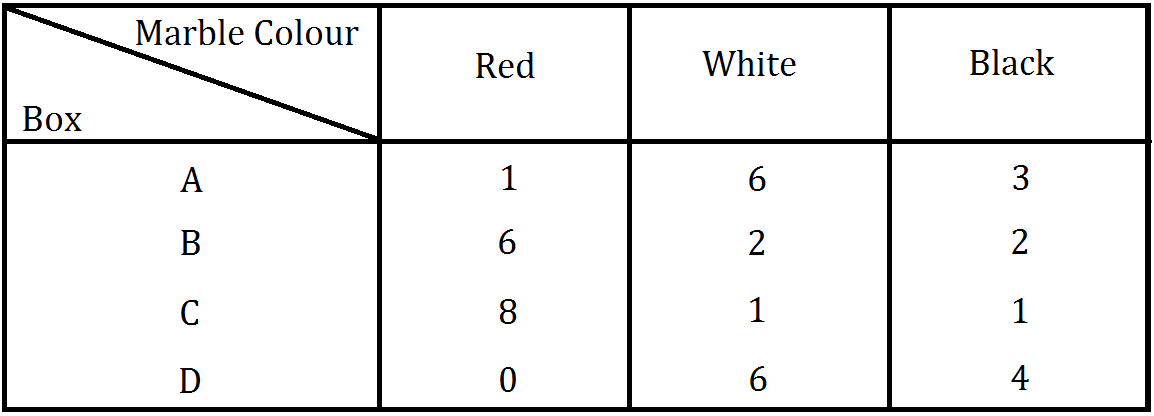
Suppose we have four boxes A, B, C, D containing coloured marbles as given below:
One of the boxes has been selected at random and a single marble is drawn from it. If the marble is red, what is the probability that it was drawn from,
  1. Box A?
  2. Box B?
  3. Box C?
Answer
$\text{P}\Big(\frac{\text{A}}{\text{Red}}\Big),\text{P}\Big(\frac{\text{B}}{\text{Red}}\Big),\text{P}\Big(\frac{\text{C}}{\text{Red}}\Big)$
Now,
$\text{P}\Big(\frac{\text{A}}{\text{Red}}\Big)=\frac{\text{P}\Big(\frac{\text{A}}{\text{Red}}\Big)\text{P(A)}}{\text{P}\Big(\frac{\text{A}}{\text{Red}}\Big)\text{P(A)}+\text{P}\Big(\frac{\text{B}}{\text{Red}}\Big)\text{P(B)}+\text{P}\Big(\frac{\text{C}}{\text{Red}}\Big)\text{P(C)}+\text{P}\Big(\frac{\text{D}}{\text{Red}}\Big)\text{P(D)}}$
$=\frac{\frac{1}{10}\times\frac{1}{4}}{\frac{1}{10}\times\frac{1}{4}+\frac{6}{10}\times\frac{1}{4}+\frac{8}{10}\times\frac{1}{4}+0}$
$=\frac{1}{1+6+8}=\frac{1}{15}$
Similarly,
$\text{P}\Big(\frac{\text{B}}{\text{Red}}\Big)=\frac{6}{15}$
$\text{P}\Big(\frac{\text{C}}{\text{Red}}\Big)=\frac{8}{15}$
View full question & answer
Question 1755 Marks
Find the probability of 4 turning up at least once in two tosses of a fair die.
Answer
Let p denote the 4 turning up in a toss of a fair die, So
$\text{p}=\frac{1}{6}$
$\text{q}=1-\frac{1}{6}$
$\text{q}=\frac{5}{6}$ [Since p + q = 1]
Let X denote the variable showing the number of turning 4 up in 2 tosses of die.
Probability of getting 4, r times in n tosses of a die is given by
$\text{p}(\text{X = r})=\text{ }^{\text{n}}\text{c}_\text{r}\text{p}^\text{r}\text{q}^{\text{n}-\text{r}}$
$=\text{ }^2\text{c}_\text{r}\big(\frac{1}{6}\big)^2\big(\frac{5}{6}\big)^{2-\text{r}}\dots(1)$
Probability of getting 4 at least once in tow tosses of a fair die
$=\text{P}(\text{X}=1)+\text{P}(\text{X}=2)$
$=1-\text{P}(\text{X}=0)$
$=1-\Big[\text{ }^2\text{c}_0\big(\frac{1}{6}\big)^0\big(\frac{5}{6}\big)^{2-0}\Big]$ [Using (1)]
$=1-\Big[1.1.\big(\frac{5}{6}\big)^2\Big]$
$=1-\Big[\frac{25}{36}\Big]$
$=\frac{36-25}{36}$
$=\frac{11}{36}$
So,
Required probability $=\frac{11}{36}$
View full question & answer
Question 1765 Marks
The odds against a certain event are 5 to 2 and the odds in favour of another event, independent to the former are 6 to 5. Find the probability that,
  1. At least one of the events will occur,
  2. None of the events will occur.
Answer
Given, The adds against a certain event (say, A) are 5 to 2 $\Rightarrow\ \text{P}(\overline{\text{A}})=\frac{5}{5+2}$ $\text{P}(\overline{\text{A}})=\frac{5}{7}$ The odds in favour of another event (say, B) are 6 to 5 $\Rightarrow\ \text{P(B)}=\frac{6}{5+6}$ $\text{P(B)}=\frac{6}{11}$ $\text{P}(\overline{\text{B}})=1-\frac{6}{11}$ $\text{P}(\overline{\text{B}})=\frac{5}{11}$
  1. P (At least one of the events will occur)
= 1 - P (None of events occur)
$=1-\text{P}(\overline{\text{A}}\cap\overline{\text{B}})$
$=1-\text{P}(\overline{\text{A}})\text{ P}(\overline{\text{B}})$
[Since events are independent]
$=1-\frac{5}{7}\times\frac{5}{11}$
$=1-\frac{25}{77}$
$=\frac{52}{77}$
Required probability $=\frac{52}{77}$
  1. P (None of the events will occur)
$=\text{P}(\overline{\text{A}}\cap\overline{\text{B}})$
$=\text{P}(\overline{\text{A}})\text{ P}(\overline{\text{B}})$
$=\frac{5}{7}\times\frac{5}{11}$
$=\frac{25}{77}$
Required probability $=\frac{25}{77}$
View full question & answer
Question 1775 Marks
Three cards are drawn at random (without replacement) from a well shuffled pack of 52 cards. Find the probability distribution of number of red cards. Hence, find the mean of the distribution.
Answer
Let 'X' be the random variable which can assume values from 0 to 3.
P(X = 0)
$=\frac{\text{}^{26}\text{C}_3}{\text{}^{52}\text{C}_3}=\frac{2600}{22100}=\frac{2}{17}$
P(X = 1)
$=\frac{\text{}^{26}\text{C}_1\times\text{}^{26}\text{C}_2}{\text{}^{52}\text{C}_3}=\frac{8450}{22100}=\frac{13}{17}$
P(X = 2)
$=\frac{\text{}^{26}\text{C}_2\times\text{}^{26}\text{C}_1}{\text{}^{52}\text{C}_3}=\frac{8450}{22100}=\frac{13}{17}$
P(X = 3)
$=\frac{\text{}^{26}\text{C}_3}{\text{}^{52}\text{C}_3}=\frac{2600}{22100}=\frac{2}{17}$
Probability distribution of X:
$\text{X}=\text{x}_\text{i}$
$0$
$1$
$2$
$3$
$\text{P}(\text{X} =\text{x}_\text{i})$
$\frac{2}{17}$
$\frac{13}{34}$ 
$\frac{13}{34}$
$\frac{2}{17}$
$=\sum\limits_{\text{i=0}}^3(\text{x}_\text{i}\times\text{p}_\text{i})$
$=\text{x}_0\text{p}_0+\text{x}_1\text{p}_1+\text{x}_2\text{p}_2+\text{x}_3\text{p}_3$
$=0\times\frac{2}{17}+1\times\frac{13}{34}+2\times\frac{13}{34}+3\times\frac{2}{17}$
$=\frac{13+26+12}{34}$
$=\frac{51}{34}$
$=\frac{3}{2}$
$=1.5$
View full question & answer
Question 1785 Marks
Ten coins are tossed. What is the probability of getting at least 8 heads?
Answer
Let X is the random variable for getting a head.
Now $\text{P}(\text{X}=\text{r})={^\text{n}\text{C}_\text{r}}\text{p}^{\text{r}}\text{q}^{\text{n}-\text{r}} $ 
$\therefore\text{P}(\text{X}=\text{r})=\text{P}(\text{r}-8)+\text{P}(\text{r}-9)+\text{P}(\text{r}-10)$
$={^{10}}\text{C}_8\Big(\frac{1}{2}\Big)^{8}\Big(\frac{1}{2}\Big)^{10-8}+{^{10}}\text{C}_9\Big(\frac{1}{2}\Big)^{9}\Big(\frac{1}{2}\Big)^{10-9}+{^{10}}\text{C}_{10}\Big(\frac{1}{2}\Big)^{10}\Big(\frac{1}{2}\Big)^{10-10}$
$=\frac{10!}{8!2!}\cdot\Big(\frac{1}{2}\Big)^{10}+10\cdot\Big(\frac{1}{2}\Big)^{10}+1\cdot\Big(\frac{1}{2}\Big)^{10}$
$=\Big(\frac{1}{2}\Big)^{10}\Big[\frac{10\times9}{2}+10+1\Big]$
$=56\cdot\Big(\frac{1}{2}\Big)^{10}=\frac{7}{128}$
View full question & answer
Question 1795 Marks
A die is thrown 5 times. Find the probability that an odd number will come up exactly three times.
Answer
Let geting an odd number be a success in trial.
We have,
p = probability of getting an odd number in a trial $=\frac{3}{6}=\frac{1}{2}$
Also, $\text{q}=1-\text{p}=1-\frac{1}{2}=\frac{1}{2}$
Let X denote the number of success in a sample of 5 trials. Then,
X follows binomial distribution with parameters n = 5 and $\text{p = q}=\frac{1}{2}$
$\therefore\text{P(X = r})=\text{ }^{5}\text{C}_{\text{r}}\text{p}^{\text{r}}\text{q}^{(5-\text{r})}=\text{ }^5\text{C}_{\text{r}}\big(\frac{1}{2}\big)^{\text{r}}\big(\frac{1}{2}\big)^{(5-\text{r})}=\text{ }^5\text{C}_{\text{r}}\big(\frac{1}{2}\big)^5,$ wher r = 0, 1, 2, 3, 4, 5
Now,
Required probability = P(X = 3)
$=\text{ }^5\text{C}_3\big(\frac{1}{2}\big)^5$
$=\frac{10}{32}$
$=\frac{5}{16}$
View full question & answer
Question 1805 Marks
If A and B are two events such that,
$\text{P(A)}=\frac{1}{3},\text{P(B)}=\frac{1}{4}$ and $\text{P}(\text{A}\cap\text{B})=\frac{5}{12},$ then find P(A|B) and P(B|A).
Answer
We have,
$\text{P(A)}=\frac{1}{3},\text{P(B)}=\frac{1}{4}$ and $\text{P}(\text{A}\cup\text{B})=\frac{5}{12}$
As, $\text{P}(\text{A}\cup\text{B})=\text{P(A)}+\text{P(B)}=\text{P}(\text{A}\cap\text{B})$
$\Rightarrow\ \text{P}(\text{A}\cap\text{B})=\text{P(A)}+\text{P}(\text{B})-\text{P}(\text{A}\cap\text{B})$
$\Rightarrow\ \text{P}(\text{A}\cap\text{B})=\frac{1}{3}+\frac{1}{4}-\frac{5}{12}$
$\Rightarrow\ \text{P}(\text{A}\cap\text{B})=\frac{2}{12}$
$\Rightarrow\ \text{P}(\text{A}\cap\text{B})=\frac{1}{6}$
Now,
$\text{P}(\text{A}|\text{B})=\frac{\text{P}(\text{A}\cap\text{B})}{\text{P(B)}}=\frac{\Big(\frac{1}{6}\Big)}{\Big(\frac{1}{4}\Big)}=\frac{4}{6}=\frac{2}{3}$ and
$\text{P}(\text{B}|\text{A})=\frac{\text{P}(\text{A}\cap\text{B})}{\text{P(A)}}=\frac{\Big(\frac{1}{6}\Big)}{\Big(\frac{1}{3}\Big)}=\frac{3}{6}=\frac{1}{2}$
View full question & answer
Question 1815 Marks
$A$ purse contains $2$ silver and $4$ copper coins. $A$ second purse contains $4$ silver and $3$ copper coins. If a coin is pulled at random from one of the two purses, what is the probability that it is a silver coin?
Answer
Purse $(I)$ contains $(2)$ silver and $4$ copper coins
Purse $(II)$ contains $4$ silver and $3$ copper coins
Let $E_1, E_2$ and $A$ are defined as
$E_1 =$ Selecting purse $ I$ 
$E_2 =$ Selectin purse $II$
$A =$ Drawinf a silver coin
$\text{P}(\text{E}_1)=\frac{1}{2}$
$\text{P}(\text{E}_2)=\frac{1}{2}$
$[$Since, there are only $2$ purses$]$
$P(A|E_1) = P(A|$ silver coin from purse $I)$
$=\frac{2}{6}$
$​​=\frac{1}{3}$
$\text{P}\Big(\frac{\text{A}}{\text{E}_2}\Big)=\text{P} (A|$ silver coin from purse $II)$
By the law of total probability,
$\text{P(A)}=\text{P}(\text{E}_1)\text{P}(\text{A}|\text{E}_1)+\text{P}(\text{E}_2)\text{P}\Big(\frac{\text{A}}{\text{E}_2}\Big)$
$=\frac{1}{2}\times\frac{1}{3}+\frac{1}{2}\times\frac{4}{7}$
$=\frac{1}{6}+\frac{4}{14}$
$=\frac{7+12}{42}$
$=\frac{19}{42}$
Required probability $=\frac{19}{42}$
View full question & answer
Question 1825 Marks
$A$ and $B$ take turns in throwing two dice, the first to throw $10$ being awarded the prize, show that if $A$ has the first throw, their chance of winning are in the ratio $12 : 11$.
Answer
Let $E$ be the events of throwing $10$ on a pair of dice,
$E = {(4, 6), (5, 5), (6, 4)}$
$\text{P(E)}=\frac{3}{37}$
$\text{P(E)}=\frac{1}{12}$
$\text{P}(\overline{\text{E}})=\frac{11}{12}$
$A$ wins the game in first or $3^{rd}$ or $5^{th}$ throw $, .....$
Probability that $A$ wins in first throw $\text{P(E)}=\frac{1}{12}$
Probability that $A$ wins in $3^{rd}$ throw
$=\text{P}(\overline{\text{E}})\text{P}(\overline{\text{E}})\text{P(E)}$
$=\Big(\frac{11}{12}\Big)^2\Big(\frac{1}{12}\Big)$
Probability that $A$ wins in $5^{th}$ throw
$=\text{P}(\overline{\text{E}})\text{P}(\overline{\text{E}})\text{P}(\overline{\text{E}})\text{P}(\overline{\text{E}})\text{P(E)}$
$=\Big(\frac{11}{12}\Big)^4\Big(\frac{1}{12}\Big)$
Hence,
Probability of winning $A$
$=\frac{1}{12}+\Big(\frac{11}{12}\Big)^2\Big(\frac{1}{12}\Big)+\Big(\frac{11}{12}\Big)^4\Big(\frac{1}{12}\Big)$
$=\frac{1}{12}\Big[1+\Big(\frac{11}{12}\Big)^2+\Big(\frac{11}{12}\Big)^4+\ .....\Big]$
$=\frac{1}{12}\bigg[\frac{1}{1-\big(\frac{11}{12}\big)^2}\bigg]\Big[$ Since $S{\infty}=\frac{\text{a}}{1-\text{r}}$ for ${G. P.}\Big]$
$=\frac{1}{12}\bigg[\frac{1}{1-\frac{121}{144}}\bigg]$
$=\frac{1}{12}\times\frac{144}{23}$
$=\frac{12}{23}$
Probability of winning $B$
$= 1 - P($Winning $A)$
$=1-\frac{12}{23}$
$=\frac{11}{23}$
Chances of winning $A$ and $B$ are $\frac{12}{23}$ and $\frac{11}{23}$ respectively or in $12 : 11$.
View full question & answer
Question 1835 Marks
The probability that a student selected at random from a class will pass in Mathematics is $\frac{4}{5}$, and the probability that he/ she passes in Mathematics and Computer Science is $\frac{1}{2}$. What is the probability that he/ she will pass in Computer Science if it is known that he/ she has passed in Mathematics?
Answer
Given,
Probability to pass mathen atics (M)
$\text{P(M)}=\frac{4}{5}$
Probability to pass in mathematics (M) and computer Science (C)
$\text{P}(\text{M}\cap\text{C})=\frac{1}{2}$
To find, $\text{P}\Big(\frac{\text{C}}{\text{M}}\Big)$
We know tht,
$\text{P}\Big(\frac{\text{C}}{\text{M}}\Big)=\frac{\text{P}(\text{M}\cap\text{C})}{\text{P(M)}}$
$=\frac{\frac{1}{2}}{\frac{4}{5}}$
$=\frac{1}{2}\times\frac{5}{4}$
$=\frac{8}{5}$
Required probability $=\frac{8}{5}$
View full question & answer
Question 1845 Marks
If A and B are two events such that $2\text{P(A)}=\text{P(B)}=\frac{5}{13}$ and $\text{P}\Big(\frac{\text{A}}{\text{B}}\Big)=\frac{2}{5}$ find $\text{P}(\text{A}\cap\text{B}).$
Answer
Given,
$2\text{P(A)}=\text{P(B)}=\frac{5}{13}$
$2\text{P(A)}=\frac{5}{13}$
$\Rightarrow \text{P(A)}=\frac{5}{26}$
$\text{P}\Big(\frac{\text{A}}{\text{B}}\Big)=\frac{\text{P}(\text{A}\cap\text{B})}{\text{P(B)}}$
$\frac{2}{5}=\frac{\text{P}(\text{A}\cap\text{B})}{\frac{5}{13}}$
$\text{P}(\text{A}\cap\text{B})=\frac{2}{5}\times\frac{5}{13}$
$\text{P}(\text{A}\cap\text{B})=\frac{2}{13}$
We know that,
$\text{P}(\text{A}\cap\text{B})=\text{P}(\text{A})+\text{P(B)}-\text{P}(\text{A}\cap\text{B})$
$=\frac{5}{26}+\frac{5}{13}-\frac{2}{13}$
$=\frac{5+10-4}{26}$
$=\frac{11}{26}$
$\text{P}(\text{A}\cap\text{B})=\frac{11}{26}$
View full question & answer
Question 1855 Marks
Determine the binomial distribution whose mean is 9 and variance $\frac{9}{4}.$
Answer
Let X denote the variance with parameters n and p $\text{p + q}=1$ $\text{q}=1-\text{p}$Given,
$\text{Mean = np} =9\dots(1)$ $\text{variance = npq}=\frac{9}{4}\dots(2)$ $\frac{\text{npq}}{\text{np}}=\frac{\frac{9}{4}}{9}$ [By diving (1) by (2)] $\text{q}=\frac{1}{4}$ So, $\text{p}=1-\text{q}$ $=1-\frac{1}{4}$ $\text{p}=\frac{3}{4}$ Put p in equation (1), $\text{n}\big(\frac{3}{4}\big)=9$ $\Rightarrow\text{n}=\frac{36}{3}$ So, $\text{n}=12$ The distribution is given by $=\text{ }^{\text{n}}\text{c}_{\text{r}}\text{p}^{\text{r}}(\text{q})^{\text{n}-\text{r}}$ $\text{P(X = r})=\text{ }^{12}\text{c}_{\text{r}}\big(\frac{3}{4}\big)^{\text{r}}\big(\frac{1}{4}\big)^{12-\text{r}}$ $\text{for r}=0,1,2,\dots12$
View full question & answer
Question 1865 Marks
If A and B are two events such that,
$\text{P(A)}=\frac{6}{11},\text{P(B)}=\frac{5}{11}$ and $\text{P}(\text{A}\cap\text{B})=\frac{7}{11},$ then find $\text{P}(\text{A}\cap\text{B}),$ P(A|B) and P(B|A).
Answer
We have,
$\text{P(A)}=\frac{6}{11},\text{P(B)}=\frac{5}{11}$ and $\text{P}(\text{A}\cup\text{B})=\frac{7}{11}$
As, $\text{P}(\text{A}\cap\text{B})=\text{P(A)}+\text{P(B)}-\text{P}(\text{A}\cap\text{B})$
$\Rightarrow\ \text{P}(\text{A}\cap\text{B})=\text{P(A)}+\text{P(B)}-\text{P}(\text{A}\cap\text{B})$
$\Rightarrow\ \text{P}(\text{A}\cap\text{B})=\frac{6}{11}+\frac{5}{11}-\frac{7}{11}$
$\Rightarrow\ \text{P}(\text{A}\cap\text{B})=\frac{6+5-7}{11}$
$\Rightarrow\ \text{P}(\text{A}\cap\text{B})=\frac{4}{11}$
Now,
$\text{P}(\text{A}|\text{B})=\frac{\text{P}(\text{A}\cap\text{B})}{\text{P}(\text{b})}=\frac{\Big(\frac{4}{11}\Big)}{\Big(\frac{5}{11}\Big)}=\frac{4}{5}$ and
$\text{P}(\text{B}|\text{A})=\frac{\text{P}(\text{A}\cap\text{B})}{\text{P}(\text{A})}=\frac{\Big(\frac{4}{11}\Big)}{\Big(\frac{6}{11}\Big)}=\frac{4}{6}=\frac{2}{3}$
View full question & answer
Question 1875 Marks
A pair of fair dice is thrown. Let X be the random variable which denotes the minimum of the two numbers which appear. Find the probability distribution, mean and variance of X.
Answer
A pair of fair dice is thrown. And X denote minimum of the two number appeared. So, X can values 2, 3, 4, 5, 6. $\text{P}(\text{X}=1)=\frac{11}{36}$ [Possible pairs: (1, 1), (1, 2), (1, 3), (1, 4), (1, 5), (1, 6), (2, 1), (3, 1), (4, 1), (5, 1), (6, 1)] $\text{P}(\text{X}=2)=\frac{9}{36}$ [Possible pairs: (2, 2), (2, 3), (2, 4), (2, 5), (2, 6), (3, 2), (4, 2), (5, 2), (6, 2)] $\text{P}(\text{X}=3)=\frac{7}{36}$ [Possible pairs: (3, 3), (3, 4), (3, 5), (3, 6), (4, 3), (5, 3), (6, 3)] $\text{P}(\text{X}=4)=\frac{5}{36}$ [Possible pairs: (4, 4), (4, 5), (4, 6), (5, 4), (6, 4)] $\text{P}(\text{X}=5)=\frac{3}{36}$ [Possible pairs: (4, 4), (5, 5), (5, 6)5, (6, 5)] $\text{P}(\text{X}=6)=\frac{1}{36}$ [Possible pairs: (6, 6)]
$\text{x}_\text{i}$ $\text{p}_\text{i}$ $\text{x}_\text{i}\text{p}_\text{i}$ $\text{x}_\text{i}^2\text{p}_\text{i}$
$1$ $\frac{11}{36}$ $\frac{11}{36}$ $\frac{11}{36}$
$2$ $\frac{9}{36}$ $\frac{18}{36}$ $\frac{36}{36}$
$3$ $\frac{7}{36}$ $\frac{21}{36}$ $\frac{63}{36}$
$4$ $\frac{5}{36}$ $\frac{20}{36}$ $\frac{80}{36}$
$5$ $\frac{3}{36}$ $\frac{15}{36}$ $\frac{75}{36}$
$6$ $\frac{1}{36}$ $\frac{6}{36}$ $\frac{36}{36}$
    $\sum\text{xp}=\frac{91}{36}$ $\sum\text{x}^2\text{p}=\frac{301}{36}$
Mean $=\sum\text{xp}$ Mean $=\frac{91}{36}$ Variance $=\sum\text{x}^2\text{p}-(\text{mean})^2$ $=\frac{301}{36}-\Big(\frac{91}{36}\Big)^2$ $=\frac{10836-8281}{1296}$ $=\frac{2555}{1296}$ Variance = 1.97 Probability distribution is
$\text{x}:$
$1$
$2$
$3$
$4$
$5$
$6$
$\text{p}(\text{x}):$
$\frac{11}{36}$
$\frac{9}{36}$
$\frac{7}{36}$
$\frac{5}{36}$
$\frac{3}{36}$
$\frac{1}{36}$
View full question & answer
Question 1885 Marks
Find the mean and variance of the number of tails in three tosses of a coin.
Answer
We know that in a throw of a coin. $\text{P}(\text{H})=\frac{1}{2},\text{P}(\text{T})=\frac{1}{2}$ Let X denote the number of heads in three tosses of a coin. So, X = 0, 1, 2, 3 P(X = 0) = P(T)P(T)P(T) $=\frac{1}{2}\times\frac{1}{2}\times\frac{1}{2}$ $=\frac{1}{8}$ P(X = 1) = P(H)P(T)P(T) + P(T)P(H)P(T) + P(T)P(T)P(H) $=\frac{1}{2}\times\frac{1}{2}\times\frac{1}{2}+\frac{1}{2}\times\frac{1}{2}\times\frac{1}{2}+\frac{1}{2}\times\frac{1}{2}\times\frac{1}{2}$ $=\frac{3}{8}$ P(X = 2) = P(H)P(H)P(T) + P(H)P(T)P(H) + P(T)P(H)P(H) $=\frac{1}{2}\times\frac{1}{2}\times\frac{1}{2}+\frac{1}{2}\times\frac{1}{2}\times\frac{1}{2}+\frac{1}{2}\times\frac{1}{2}\times\frac{1}{2}$ $=\frac{3}{8}$ P(X = 3) = P(H)P(H)P(H) $=\frac{1}{2}\times\frac{1}{2}\times\frac{1}{2}$ $=\frac{1}{8}$ So,
$\text{x}_\text{i}$ $\text{p}_\text{i}$ $\text{x}_\text{i}\text{p}_\text{i}$ $\text{x}_\text{i}^2\text{p}_\text{i}$
$0$ $\frac{1}{8}$ $0$ $0$
$1$ $\frac{3}{8}$ $\frac{3}{8}$ $\frac{3}{8}$
$2$ $\frac{3}{8}$ $\frac{6}{8}$ $\frac{12}{8}$
$3$ $\frac{1}{8}$ $\frac{1}{8}$ $\frac{9}{8}$
    $\sum\text{xp}=\frac{3}{2}$ $\sum\text{x}^2\text{p}$
Mean $=\sum\text{xp}=\frac{3}{2}$ Variance $=\sum\text{x}^2\text{p}-(\text{Mean})^2$ $=3-\frac{9}{4}=\frac{3}{4}$
View full question & answer
Question 1895 Marks
An urn contains $m$ white and $n$ black balls. A ball is drawn at random and is put back into the urn along with $k$ additional balls of the same colour as that of the ball drawn. A ball is again drawn at random. Show that the probability of drawing a white ball now does not depend on $k.$
Answer
Let Event, $E_1 =$ First ball drawn of white colour
Event, $E_2 =$ First ball drawn of black colour
And Events, $E =$ Second ball drawn of white colour
$\therefore\text{P}(\text{E}_1)=\frac{\text{m}}{\text{m}+\text{n}}$ and $\text{P}(\text{E}_2)=\frac{\text{n}}{\text{m}+\text{n}}$
Also, $\text{P}\Big(\frac{\text{E}}{\text{E}_1}\Big)=\frac{\text{m}+\text{k}}{\text{m}+\text{n}+\text{k}}$ and $\text{P}\Big(\frac{\text{E}}{\text{E}_2}\Big)=\frac{\text{m}}{\text{m}+\text{n}+\text{k}}$
$\therefore$ Using total probability theorem,
$\text{P}(\text{E})=\text{P}(\text{E}_1)\cdot\text{P}\Big(\frac{\text{E}}{\text{E}_1}\Big)+\text{P}(\text{E}_2)\cdot\text{P}\Big(\frac{\text{E}}{\text{E}_2}\Big)$
$=\frac{\text{m}}{\text{m}+\text{n}}\cdot\frac{\text{m}+\text{k}}{\text{m}+\text{n}+\text{k}}+\frac{\text{n}}{\text{m}+\text{n}}\cdot\frac{\text{m}}{\text{m}+\text{n}+\text{k}}$
$=\frac{\text{m}(\text{m}+\text{k})+\text{nm}}{(\text{m}+\text{n}+\text{k})(\text{m}+\text{n})}$
$=\frac{\text{m}(\text{m}+\text{k}+\text{n})}{(\text{m}+\text{n}+\text{k})(\text{m}+\text{n})}$
$=\frac{\text{m}}{\text{m}+\text{n}}$
Hence, the probability of drawing a white ball does not depend on $k.$
View full question & answer
Question 1905 Marks
Suppose 10,000 tickets are sold in a lottery each for Rs. 1. First prize is of Rs. 3000 and the second prize is of Rs. 2000. There are three third prizes of Rs. 500 each. If you buy one ticket, what is your expectation.
Answer
Let x is the random variable for the prize.
$\text{X}$ $0$ $500$ $2000$ $3000$
$\text{P}(\text{X})$ $\frac{9995}{10000}$ $\frac{3}{10000}$ $\frac{1}{10000}$ $\frac{1}{10000}$
Since, $\text{E}(\text{X})=\sum\text{X}\ \text{P}(\text{X})$
$\therefore\text{E}(\text{X})=0\times\frac{9995}{10000}+\frac{1500}{10000}+\frac{2000}{10000}+\frac{3000}{10000}$
$=\frac{1500+2000+3000}{10000}$
$=\frac{6500}{10000}=\frac{13}{20}$
$=\text{Rs.}0.65$
View full question & answer
Question 1915 Marks
In a dice game, a player pays a stake of Rs. 1 for each throw of a die. She receives Rs. 5 if the die shows a 3, Rs. 2 if the die shows a 1 or 6, and nothing otherwise. What is the player’s expected profit per throw over a long series of throws?
Answer
Let X is the random variable of profit per throw.
$\text{X}$ $-1$ $1$ $4$
$\text{P}(\text{X})$ $\frac{1}{2}$ $\frac{1}{3}$ $\frac{1}{6}$
Since, she loses Rs. 1 On getting any of 2, 4 or 5.
So, at X = -1, $\text{P}(\text{X})=\frac{1}{6}+\frac{1}{6}+\frac{1}{6}=\frac{3}{6}=\frac{1}{2}$
Similarly, at X = 1, $\text{P}(\text{X})=\frac{1}{6}+\frac{1}{6}=\frac{1}{3}$ [if die shows of either 1 or 6]
and at X = 4, $\text{P}(\text{X})=\frac{1}{6}$ [if die shows a 3]
$\therefore$ Player's expected profit $=\sum(\text{X})=\sum\text{X}\text{P}(\text{X})$
$=-1\times\frac{1}{2}+1\times\frac{1}{3}+4\times\frac{1}{6}$
$=\frac{-3+2+4}{6}=\frac{1}{2}=\text{Rs.}0.50$
View full question & answer
Question 1925 Marks
Two dice are thrown together and the total score is noted. The event E, F and G are "a total of 4", "a total of 9 or more", and "a total divisible by 5", respectively. Calculate P(E), P(F) and P(G) and decide which pairs of events, if any, are independent.
Answer
$\text{S}=\begin{Bmatrix} (1,1),(1,2), (1, 3), (1, 4), (1, 5), (1, 6), \\ (2, 1), (2, 2), (2, 3), (2, 4), (2, 5), (2, 6), \\ (3, 1), (3, 2), (3, 3), (3, 4), (3, 5), (3, 6),\$4,1), (4,2), (4,3), (4,4), (4,5), (4, 6), \$5, 1),(5,2), (5,3), (5,4), (5,5), (5,6),\$6,1), (6,2), (6,3), (6,4), (6,5), (6,6)\end{Bmatrix}$n(S)=36
E be the event of geting a total of 4.
E = {(1, 3), (3, 1), (2, 2)}
n(E) = 3
$\text{P(E)}=\frac{\text{n(E)}}{\text{n(S)}}=\frac{3}{36}=\frac{1}{12}$
F be event of geting a total of 9 or more.
F = {(3, 6), (6, 3), (4, 5), (5, 4), (4, 6), (6, 4), (5, 5), (5, 6), (6, 5), (6, 6)}
n(F) = 10
$\text{P(F)}=\frac{\text{n(F)}}{\text{n(S)}}=\frac{10}{36}=\frac{5}{18}$
G be the event of getting a total divisible by 5.
G = {(1, 4), (4, 1), (2, 3), (3, 2), (4, 6), (6, 4), (5, 5)}
n(G) = 7
$\text{P(G)}=\frac{\text{n(G)}}{\text{n(S)}}=\frac{7}{36}$
No pair is independent.
View full question & answer
Question 1935 Marks
Suppose you have two coins which appear identical in your pocket. You know that one is fair and one is $2-$headed. If you take one out, toss it and get a head, what is the probability that it was a fair coin?
Answer
Let $E_1=$ Event that a fair coin is drawn
$E_2=$ Event that two headed coin is drawn
$E =$ Event that tossed coin get a head
$\therefore\text{P}(\text{E}_1)$
$=\frac{1}{2},\text{P}(\text{E}_2)=\frac{1}{2},\text{P}\Big(\frac{\text{E}}{\text{E}_1}\Big)$
$=\frac{1}{2}$ and $\text{P}\Big(\frac{\text{E}}{\text{E}_2}\Big)=1$
Now using Baye’s theorem $\text{P}\Big(\frac{\text{E}_1}{\text{E}}\Big)=\frac{\text{P}(\text{E}_1)\cdot\Big(\frac{\text{E}}{\text{E}_1}\Big)}{\text{P}(\text{E}_1)\cdot\Big(\frac{\text{E}}{\text{E}_1}\Big)\cdot\text{P}(\text{E}_2)\cdot\Big(\frac{\text{E}}{\text{E}_2}\Big)}$
$=\frac{\frac{1}{2}\cdot\frac{1}{2}}{\frac{1}{2}\cdot\frac{1}{2}+\frac{1}{2}\cdot1}=\frac{\frac{1}{4}}{\frac{1}{4}+\frac{1}{2}}$
$=\frac{\frac{1}{4}}{\frac{3}{4}}=\frac{1}{3}$
View full question & answer
Question 1945 Marks
Two dice are drawn together and the number appearing on them noted. X denotes the sum of the two numbers. Assuming that the 36 outcomes are equally likely, what is the probability distribution of X?
Answer
Let X denote numbers on two die. Then, X can take the values 2, 3, 4, 5, 6, 7 , 8, 9, 10, and 12.
Sample space:
{(1, 1), (1, 2), (1, 3), (1, 4), (1, 5), (1, 6)
(2, 1), (2, 2), (2, 3), (2, 4), (2, 5), (2, 6)
(3, 1), (3, 2), (3, 3), (3, 4), (3, 5), (3, 6)
(4, 1), (4, 2), (4, 3), (4, 4), (4, 5), (4, 6)
(5, 1), (5, 2), (5, 3), (5, 4), (5, 5), (5, 6)
(6, 1), (6, 2), (6, 3), (6, 4), (6, 5), (6, 6)}
Now,
$\text{P}(\text{x}=2)=\frac{1}{36}$
$\text{P}(\text{x}=3)=\frac{2}{36}$
$\text{P}(\text{x}=4)=\frac{3}{36}$
$\text{P}(\text{x}=5)=\frac{4}{36}$
$\text{P}(\text{x}=6)=\frac{5}{36}$
$\text{P}(\text{x}=7)=\frac{6}{36}$
$\text{P}(\text{x}=8)=\frac{5}{36}$
$\text{P}(\text{x}=9)=\frac{4}{36}$
$\text{P}(\text{x}=10)=\frac{3}{36}$
$\text{P}(\text{x}=11)=\frac{2}{36}$
$\text{X}$
$2$
$3$
$4$
$5$
$6$
$7$
$8$
$9$
$10$
$11$
$12$
$\text{P}(\text{X})$
$\frac{1}{36}$
$\frac{2}{36}$
$\frac{3}{36}$
$\frac{4}{36}$
$\frac{5}{36}$
$\frac{6}{36}$
$\frac{5}{36}$
$\frac{4}{36}$
$\frac{3}{36}$
$\frac{2}{36}$
$\frac{1}{36}$
View full question & answer
Question 1955 Marks
There are 5% defective items in a large bulk of items. What is the probability that a sample of 10 items will include not more than one defective item?
Answer
Let X denote the number of defective items in a sample of 10 items drawn successively. Since the drawing is done with replacement, the trials are Bernoulli trials.
$\Rightarrow\ \text{p}=\frac{5}{100}=\frac{1}{20}$
$\therefore\ \text{q}=1-\frac{1}{20}=\frac{19}{20}$
X has a binomial distribution with n = 10 and $\text{p}=\frac{1}{20}$
$\text{P}(\text{X=x})=\ ^n\text{C}_\text{x}\text{q}^\text{n-x}\text{p}^\text{x},\ \text{where x}=0,\ 1,\ 2,\ ...\text{n} $
$=\ ^{10}\text{C}_\text{x}\Bigg (\frac{19}{20}\Bigg)^{{10}-\text{x}}.\Bigg(\frac{1}{20}\Bigg)^\text{x}$
P(not more than 1 defective item) = P(X ≤ 1)
$=\text{P}(\text{X}=0)+\text{P}(\text{X}=1)$
$=\ ^{10}\text{C}_{0}\Bigg (\frac{19}{20}\Bigg)^{10}.\Bigg(\frac{1}{20}\Bigg)^{0}+\ ^{10}\text{C}_1\Bigg(\frac{19}{20}\Bigg)^9.\Bigg(\frac{1}{20}\Bigg)^1$
$=\Bigg (\frac{19}{20}\Bigg)^{10}+10\Bigg(\frac{19}{20}\Bigg)^{9}.\Bigg(\frac{1}{20}\Bigg)^1$
$=\Bigg (\frac{19}{20}\Bigg)^{9}.\Bigg[\frac{19}{20}+\frac{10}{20}\Bigg]$
$=\Bigg (\frac{19}{20}\Bigg)^{9}.\Bigg(\frac{29}{20}\Bigg)$
$=\Bigg (\frac{29}{20}\Bigg).\Bigg(\frac{19}{20}\Bigg)^9$
View full question & answer
Question 1965 Marks
If P(A) = 0.4, P(B) = 0.8, $\text{P}\Big(\frac{\text{B}}{\text{A}}\Big)=0.6$. Find $\text{P}\Big(\frac{\text{A}}{\text{B}}\Big)$ and $\text{P}(\text{A}\cap\text{B}).$
Answer
Given:
P(A) = 0.4, P(B) = 0.8, $\text{P}\Big(\frac{\text{B}}{\text{A}}\Big)=0.6$
We know that,
$\text{P}\Big(\frac{\text{B}}{\text{A}}\Big)=\frac{\text{P}(\text{A}\cap\text{B})}{\text{P(A)}}$
$0.6=\frac{\text{P}(\text{A}\cap\text{P})}{0.4}$
$\text{P}(\text{A}\cap\text{B})=0.6\times0.4$
$\text{P}(\text{A}\cap\text{B})=0.24$
Now,
$\text{P}\Big(\frac{\text{A}}{\text{B}}\Big)=\frac{\text{P}(\text{A}\cap\text{B})}{\text{P(B)}}$
$=\frac{0.24}{0.8}$
$\text{P}\Big(\frac{\text{A}}{\text{B}}\Big)=0.3$
$\text{P}(\text{A}\cap\text{B})=\text{P(A)}+\text{P(B)}-\text{P}(\text{A}\cap\text{B})$
$=0.4+0.8-0.24$
$\text{P}(\text{A}\cap\text{B})=0.96$
$\text{P}\Big(\frac{\text{A}}{\text{B}}\Big)=0.3, \text{P}(\text{A}\cap\text{B})=0.96$
View full question & answer
Question 1975 Marks
Find the mean number of heads in three tosses of a fair coin.
Answer
S {H, T} ⇒ n(S) = 2 Let A denotes the appearance of head on a toss. A = {h} ⇒ n(A) = 1 $\therefore\ \text{P}=\frac{\text{n}(\text{A})}{\text{n}(\text{S})}=\frac{1}{2}\ \text{and}\ \text{q}=1-\text{p}=1-\frac{1}{2}=\frac{1}{2}$ n = 3, r = 0, 1, 2, 3 $\text{P}(\text{X}=0)=\text{q}^3=\bigg(\frac{1}{2}\bigg)^3=\frac{1}{8}$ $\text{P}(\text{X}=1)=3\text{q}^2\text{p}=3\bigg(\frac{1}{2}\bigg)^2\bigg(\frac{1}{2}\bigg)=\frac{3}{8}$ $\text{P}(\text{X}=2)=3\text{q}\text{p}^2=3\bigg(\frac{1}{2}\bigg)\bigg(\frac{1}{2}\bigg)^2=\frac{3}{8}$ $\text{P}(\text{X}=3)=\text{p}^3=\bigg(\frac{1}{2}\bigg)^3=\frac{1}{8}$ Probability distribution:
$\text{X}_i$ $0$ $1$ $2$ $3$
$\text{P}_i$ $\frac{1}{8}$ $\frac{3}{8}$ $\frac{3}{8}$ $\frac{1}{8}$
$\text{Mean}=\sum\text{p}_i\text{x}_i=0\times\frac{1}{8}+1\times\frac{3}{8}+2\times\frac{3}{8}+3\times\frac{1}{8}=\frac{12}{8}=\frac{3}{2}$ 
View full question & answer
Question 1985 Marks
An urn contains 4 red and 7 black balls. Two balls are drawn at random with replacement. Find the probability of getting,
  1. 2 red balls,
  2. 2 blue balls,
  3. One red and one blue ball.
Answer
Given, Urn contains 4 red and 7 black balls. Two balls drawn at random with replacement. Consider, R = Getting one red ball from urn. $\text{P(R)}=\frac{4}{11}$ B = Getting one blue ball from urn. $\text{P(B)}=\frac{7}{11}$
  1. P(Getting 2 red balls)
= P(R) P(R)
$=\frac{4}{11}\times\frac{4}{11}$
$=\frac{16}{121}$
Required probability $=\frac{16}{121}$
  1. P(Getting two blue balls)
= P(B) P(B)
$=\frac{7}{11}\times\frac{7}{11}$
$=\frac{49}{121}$
Required probability $=\frac{49}{121}$
  1. P(Getting one red and one blue ball)
= P(R) P(B) + P(B) P(R)
$=\frac{4}{11}\times\frac{7}{11}+\frac{7}{11}\times\frac{4}{11}$
$=\frac{28}{121}+\frac{28}{121}$
$=\frac{56}{121}$
View full question & answer
Question 1995 Marks
Mother, father and son line up at random for a family picture. If A and B are two events given by A = Son on one end, B = Father in the middle, find P (A/B) and P (B/A).
Answer
Consider the given events.
A = Getting 4 on third throw
B = Getting 6 on first throw and and 5 on second throw
Clearly,
A = {(1, 1, 4), (1, 2, 4), (1, 3, 4), (1, 4, 4), (1, 5, 4), (1, 6, 4), (2, 1, 4), (2, 2, 4), (2, 3, 4), (2, 4, 4), (2, 5, 4), (2, 6, 4), ...... (6, 1, 4), (6, 2 4), (6, 3, 4), (6, 4, 4), (6, 5, 4), (6, 6, 4)}
B = {(6, 5, 1), (6, 5, 2), (6, 5, 3), (6, 5, 4), (6, 5, 5), (6, 5, 6)}
Now,
$(\text{A}\cap\text{B})=\{(6, 5, 4)\}$
$\therefore\ \text{Required probability} = \text{P}\Big(\frac{\text{A}}{\text{B}}\Big)=\frac{\text{n}(\text{A}\cap\text{B})}{\text{n}(\text{B})}=\frac{1}{6}$
$\therefore\ \text{Required probability} = \text{P}\Big(\frac{\text{B}}{\text{A}}\Big)=\frac{\text{n}(\text{A}\cap\text{B})}{\text{n}(\text{A})}=\frac{1}{36}$
View full question & answer
Question 2005 Marks
A pair of dice is thrown. Let E be the event that the sum is greater than or equal to 10 and F be the event "5 appears on the first-die". Find $\text{P}\Big(\frac{\text{E}}{\text{F}}\Big)$. If F is the event "5 appears on at least one die", find $\text{P}\Big(\frac{\text{E}}{\text{F}}\Big)$.
Answer
A pair of die is thrown E = Sum is greater than or equal to 10 = {(4, 6), (5, 5), (6, 4), (5, 6), (6, 6)}Case I:
F = 5 appears on first die = {(5, 1), (5, 2), (5, 3), (5, 4), (5, 5), (5, 6)} $\text{E}\cap\text{F}=\{(5, 5), (5, 6)\}$ $\text{P}\Big(\frac{\text{E}}{\text{F}}\Big)=\frac{\text{n}(\text{E}\cap\text{F})}{\text{n}(\text{F})}$ $\text{P}\Big(\frac{\text{E}}{\text{F}}\Big)=\frac{1}{3}$Case: II
F = 5 appears on at least one die = {(1, 5), (2, 5), (3, 5), (4, 5), (6, 5), (5, 1), (5, 2), (5, 3), (5, 4), (5, 5), (5, 6)} $\text{E}\cap\text{F}=\{(5,5), (5, 6), (6, 5)\}$ $\text{P}\Big(\frac{\text{E}}{\text{F}}\Big)=\frac{\text{n}(\text{E}\cap\text{F})}{\text{n}(\text{F})}$ $=\frac{3}{11}$ $\text{P}\Big(\frac{\text{E}}{\text{F}}\Big)=\frac{3}{11}$
View full question & answer
5 Marks Questions - Page 4 - MATHS STD 12 Science Questions - Vidyadip