Questions · Page 1 of 4

M.C.Q (1 Marks)

🎯

Test yourself on this topic

50 questions · timed · auto-graded

Question 11 Mark
If A and B are two independent events with $\text{P(A)}=\frac{1}{3}$ and $\text{P(B)}=\frac{1}{4},$ then P(B'|A) is equal to:
  1. $\frac{1}{4}$
  2. $\frac{1}{3}$
  3. $\frac{3}{4}$
  4. $1$
Answer
  1. $\frac{3}{4}$
Solution:
$\text{P(A)}=\frac{1}{3},\text{ P(B)}=\frac{1}{4},\text{ P}\Big(\frac{\text{B}'}{\text{A}}\Big)=?$
$\text{P}(\text{A}\cap\text{B})=\text{P(A)}\times\text{P(B)}$
$\text{P}\Big(\frac{\text{B}'}{\text{A}}\Big)=\text{P}\frac{(\text{A}\cap\text{B}')}{\text{P(A)}}$
$\text{P}(\text{B}')=1-\frac{1}{4}=\frac{3}{4}$
$\therefore\text{P}\Big(\frac{\text{B}'}{\text{A}}\Big)=\frac{\text{P(A)}\times\text{P(B})'}{\text{P(A)}}$
$=\text{P(B}')=\frac{3}{4}$
View full question & answer
Question 21 Mark
If P(A) + P(B) = 1; then which of the following option explains the event A and B correctly?
  1. Event A and B are mutually exclusive, exhaustive and complementary events.
  2. Event A and B are mutually exclusive and exhaustive events.
  3. Event A and B are mutually exclusive and complementary events.
  4. Event A and B are exhaustive and complementary events.
Answer
  1. Event A and B are mutually exclusive, exhaustive and complementary events.
Solution:
Since P(A) + P(B) = 1
$\therefore\text{A}\cap\text{B}=0.$
Thus, event A and B are mutually exclusive, exhaustive and complementary events.
View full question & answer
MCQ 31 Mark
Choose the correct answer from the given four options.
$\text{X}$ $1$ $2$ $3$ $4$
$\text{P}(\text{X})$ $\frac{1}{10}$ $\frac{1}{5}$ $\frac{3}{10}$ $\frac{2}{5}$
For the following probability distribution $E(X^2)$ is equal to:
  • A
    $3.$
  • B
    $5.$
  • C
    $7.$
  • $10.$
Answer
Correct option: D.
$10.$

$\text{E}(\text{X}^2)=\sum\text{X}^2\text{P}(\text{X})$
$=1\cdot\frac{1}{10}+4\cdot\frac{1}{5}+9\cdot\frac{3}{10}+16\cdot\frac{2}{5}$
$=\frac{1}{10}+\frac{4}{5}+\frac{27}{10}+\frac{32}{5}$
$=\frac{1+8+27+64}{10}=10$

View full question & answer
Question 41 Mark
Choose the correct answer from the given four options.
If A and B are two independent events with $\text{P}(\text{A})=\frac{3}{5}$ and $\text{P}(\text{A})=\frac{4}{9},$ then $\text{P}(\text{A'}\cap\text{B'})$ equals:
  1. $\frac{4}{15}$
  2. $\frac{8}{45}$
  3. $\frac{1}{3}$
  4. $\frac{2}{9}$
Answer
  1. $\frac{2}{9}$
Solution:
Since A and B are independent events, A' And B' are aslo independent.
$\therefore\text{P}(\text{A}'\cap\text{B}')=\text{P}(\text{A})\cdot\text{P}(\text{B})$
$=\big[1-\text{P}(\text{A})\big]\big[1-\text{P}(\text{B})\big]$
$=\Big(1-\frac{3}{5}\Big)\Big(1-\frac{4}{9}\Big)$
$=\frac{2}{5}\cdot\frac{5}{9}=\frac{2}{9}$
View full question & answer
Question 51 Mark
Choose the correct answer from the given four options.
X
-4
-3
-2
-1
0
P(X)
0.1
0.2
0.3
0.2
0.2
For the following probability distribution E(X) is equal to:
  1. 0
  2. -1
  3. -2
  4. -1.8
Answer
  1. -1.8
Solution:
$\text{E}(\text{X})=\sum\text{P}(\text{X})$
$= -4\times(0.1)+(-3 \times0.2)+(-2\times0.3)+(-1\times0.2)+(0\times0.2)$
$=-0.4-0.6-0.6-0.2=-1.8$
View full question & answer
Question 61 Mark
If A and B are two events such that $\text{P(A)}=\frac{3}{8},\text{P(B)}=\frac{5}{4}.$ and $\text{P}(\text{A}|\text{B})\times\text{P}(\overline{\text{A}}\cap\text{B})$ is equals to.
  1. $\frac{2}{5}$
  2. $\frac{3}{8}$
  3. $\frac{3}{20}$
  4. $\frac{6}{25}$
Answer
  1. $\frac{6}{25}$
Solution:
$\text{P(A)}=\frac{3}{8},\text{P(B)}=\frac{5}{8},\text{P}\Big({\text{A}}\cup{\text{B}}\Big)=\frac{3}{4}$
$\text{P}(\text{A}\cap\text{B})=\text{P(A)}+\text{P(B)}-\text{P}(\text{A}\cap\text{B})$
$\Rightarrow\ \frac{3}{4}=\frac{3}{8}+\frac{5}{8}-\text{P}(\text{A}\cap\text{B})$
$\Rightarrow\ \text{P}(\text{A}\cap\text{B})=\frac{1}{4}$
$\text{P}\Big(\frac{\text{A}}{\text{B}}\Big)\text{ P}\Big(\frac{\overline{\text{A}}}{\text{B}}\Big)=\frac{\text{P}(\text{A}\cap\text{B})}{\text{P(B)}}\times\frac{\text{P}(\overline{\text{A}}\cap\text{B})}{\text{P(B)}}$
$\text{P}\Big(\frac{\text{A}}{\text{B}}\Big)\text{ P}\Big(\frac{\overline{\text{A}}}{\text{B}}\Big)=\frac{\text{P}(\text{A}\cap\text{B})}{\text{P(B)}}\times\frac{\text{P(B)}-\text{P}(\text{A}\cap\text{B})}{\text{P(B)}}$
$\text{P}\Big(\frac{\text{A}}{\text{B}}\Big)\text{ P}\Big(\frac{\overline{\text{A}}}{\text{B}}\Big)=\frac{\frac{1}{4}}{\frac{5}{8}}\times\frac{\big(\frac{5}{8}-\frac{1}{4}\big)}{\frac{5}{8}}$
$\text{P}\Big(\frac{\text{A}}{\text{B}}\Big)\text{ P}\Big(\frac{\overline{\text{A}}}{\text{B}}\Big)=\frac{6}{25}$
View full question & answer
Question 71 Mark
Choose the correct answer from the given four options.
If the events A and B are independent, then $\text{P}(\text{A}\cap\text{B})$ is equal to:
  1. $\text{P}(\text{A})+\text{P}(\text{B})$
  2. $\text{P}(\text{A})-\text{P}(\text{B})$
  3. $\text{P}(\text{A})\cdot\text{P}(\text{B})$
  4. $\frac{\text{P}(\text{A})}{\text{P}(\text{B})}$
Answer
  1. $\text{P}(\text{A})-\text{P}(\text{B})$
Solution:
If A and B are independent, then $\text{P}(\text{A}\cap\text{B})=\text{P}(\text{A})\cdot\text{P}(\text{B})$
View full question & answer
Question 81 Mark
10 persons are seated around a round table. What is the probability that 4 particular persons are always seated together?
  1. $\frac{1}{20}$
  2. $\frac{4}{10}$
  3. $\frac{1}{21}$
  4. $\frac{3}{20}$
Answer
  1. $\frac{1}{21}$
Solution:
10 persons can sit around a table in 9! ways.
Consider the particular four persons as one unit.
Now, the entities are 6 + 1 = 7
These 7 entities can be arranged in 6! ways.
In the entities itself they can be arranged in 4! ways.
The required number of arrangements = 6!4!
Probability $= \text{nm}​ = \frac{!6!4}{9!} ​= \frac1{21}​$
View full question & answer
Question 91 Mark
An urn contains 9 balls two of which are red, three blue and four black. Three balls are drawn at random. The probability that they are of the same colour is,
  1. $\frac{5}{84}$
  2. $\frac{3}{9}$
  3. $\frac{3}{7}$
  4. $\frac{7}{17}$
Answer
  1. $\frac{5}{84}$
Solution:
Given:
Red balls = 2
Blue balls = 3
Black balls = 4
P(All three balls are of same colour) = P(all three are blue) + P(all three are black)
$=\frac{3}{9}\times\frac{2}{8}\times\frac{1}{7}+\frac{4}{9}\times\frac{3}{8}\times\frac{2}{7}$
$=\frac{1}{84}+\frac{4}{84}$
$=\frac{5}{84}$
View full question & answer
Question 101 Mark
A four - digit number is formed by using the digits 1, 2, 4, 8 and 9 without repitition. If one number is selected from those numbers, then what is the probability that it will be an odd number?
  1. $\frac{1}{5}$
  2. $\frac{2}{5}$
  3. $\frac{3}{5}$
  4. $\frac{4}{5}$
Answer
  1. $\frac{2}{5}$
Solution:
Total number of outcomes = 5 × 4 × 3 × 2 = 120
he number of favourable cases = 2 (4 × 3 × 2) - = 48 (i.e., odd numbers)
herefore,Required probability $=\frac{48}{120}=\frac{2}{5}.$
View full question & answer
Question 111 Mark
A bag contains 12 balls out of which x are white. If one ball is drawn at random, what is the probability it will be a white ball?
  1. $\frac{\text{x}}{2}$
  2. $\frac{\text{x}}{12}$
  3. $\frac{\text{x}}{10}$
  4. $\frac{12}{\text{x}}$
Answer
  1. $\frac{\text{x}}{12}$
Solution:
Total number of balls = 12
Number of white balls = x
P (white ball) $=\frac{\text{x}}{12}$
View full question & answer
Question 121 Mark
Choose the correct answer from the given four options.
A and B are events such that P(A) = 0.4, P(B) = 0.3 and $\text{P}(\text{A}\cup\text{B})=0.5,$ Then $\text{P}(\text{B}'\cap\text{A})$ equals:
  1. $\frac{2}{3}$
  2. $\frac{1}{2}$
  3. $\frac{3}{10}$
  4. $\frac{1}{5}$
Answer
  1. $\frac{1}{5}$
Solution:
Here, $\text{P}(\text{A}) = 0.4,\text{P}(\text{B}) = 0.3$ and $\text{P}(\text{A}\cup\text{B})=0.5$
$\because\text{P}(\text{A}\cup\text{B})=\text{P}(\text{A})+\text{P}(\text{B})-\text{P}(\text{A}\cap\text{B})$
$\Rightarrow\text{P}(\text{A}\cap\text{B})=0.4+0.3-0.5=0.2$
$\because\text{P}(\text{B}'\cap\text{A})=\text{P}(\text{A})-\text{P}(\text{A}\cap\text{B})$
$=0.4-0.2=0.2=\frac{1}{5}$
View full question & answer
Question 131 Mark
A person writes 4 letters and addresses 4 envelopes. If the letters are placed in the envelopes at random, then the probability that all letters are not placed in the right envelopes, is
  1. $\frac{1}{4}$
  2. $\frac{11}{14}$
  3. $\frac{15}{24}$
  4. $\frac{23}{24}$
Answer
  1. $\frac{23}{24}$
Soluction:
4 letter can be placed in 4 envelopes in 4! ways = 24ways
Now, there is only one method, by which all the letters are placed in the right envelope.
P(all letters are placed in the envelopes) $=\frac{1}{24}$
P(all letters are not placed in the right envelopes) = 1 - P(all letters are placed in the right envelopes)
$=1-\frac{1}{24}=\frac{23}{24}$
View full question & answer
Question 141 Mark
Two dice are thrown. If it is known that the sun of the numbers on the dice was less than 6, than the probability of gettinga sum 3, is
  1. $\frac{1}{18}$
  2. $\frac{5}{18}$
  3. $\frac{1}{5}$
  4. $\frac{2}{5}$
Answer
  1. $\frac{1}{5}$
Solution:
$\text{S}=\begin{Bmatrix} (1, 1),(1, 2),(1, 3),(1, 4),(1, 5),(1, 6),\$2, 1),(2, 2),(2, 3),(2, 4),(2, 5),(2, 6),\$3, 1),(3, 2),(3, 3),(3, 4),(3, 5),(3, 6),\$4, 1),(4, 2),(4, 3),(4, 4),(4, 5),(4, 6),\$5, 1),(5, 2),(5, 3),(5, 4),(5, 5),(5, 6),\$6, 1),(6, 2),(6, 3),(6, 4),(6, 5),(6, 6) \end{Bmatrix}$
$\text{n(S)}=36$
Let A be the event that sum of the numbers on dice was less than 6.
$\text{A} =\{(1, 1), (1, 2), (1, 3), (1, 4), (2, 1), (2, 2), (2, 3), (3, 1), (3, 2), (4, 1)\}$
$\text{n(A)} = 10$
Let B be the event that getting sum 3.
$\text{B}=\{(1, 2), (2, 1)\}\Rightarrow\text{n(B)}=2$
$\text{A}\cap\text{B}=\{(1,2),(2,1)\}\Rightarrow\text{n}(\text{A}\cap\text{B})=2$
$\text{P}\Big(\frac{\text{A}}{\text{B}}\Big)=\frac{\text{n}(\text{A}\cap\text{B})}{\text{n}(\text{B})}$
$\Rightarrow\text{P}\Big(\frac{\text{A}}{\text{B}}\Big)=\frac{2}{10}=\frac{1}{5}$
View full question & answer
Question 151 Mark
If $\text{P(A)}=\frac{2}{5},\text{P(B)}=\frac{3}{10}$ and $\text{P}(\text{A}\cap\text{B})=\frac{1}{5},$ then, $\text{P}(\overline{\text{A}}|\overline{\text{B}}) \text{ P}(\overline{\text{B}}|\overline{\text{A}})$ is equal to
  1. $\frac{5}{6}$
  2. $\frac{5}{7}$
  3. $\frac{25}{42}$
  4. $1$
Answer
  1. $\frac{25}{42}$
Solution:
$\text{P(A)}=\frac{2}{5},\text{P(B)}=\frac{3}{10}$ and $\text{P}(\text{A}\cap\text{B})=\frac{1}{5}$
$\text{P}(\text{A}\cap\text{B})=\frac{1}{5}$
$\text{P(A)}+\text{P(B)}-\text{P}(\text{A}\cup\text{B})=\frac{1}{5}$
$\frac{2}{5}+\frac{3}{10}-\text{P}(\text{A}\cup\text{B})=\frac{1}{5}$
$\text{P}(\text{A}\cup\text{B})=\frac{1}{2}$
$\text{P}\Big(\frac{\overline{\text{A}}}{\overline{\text{B}}}\Big)\text{ P}\Big(\frac{\overline{\text{B}}}{\overline{\text{A}}}\Big)=\frac{\text{P}(\overline{\text{A}}\cap\overline{\text{B}})}{\text{P}(\overline{\text{B}})}\frac{\text{P}(\overline{\text{A}}\cap\overline{\text{B}})}{\text{P}(\overline{\text{A}})}$
$\text{P}\Big(\frac{\overline{\text{A}}}{\overline{\text{B}}}\Big)\text{ P}\Big(\frac{\overline{\text{B}}}{\overline{\text{A}}}\Big)=\frac{\big[\text{P}(\overline{\text{A}\cup\text{B}})\big]^2}{\text{P}(\overline{\text{B}})\text{ P}(\overline{\text{A}})}$
$\text{P}\Big(\frac{\overline{\text{A}}}{\overline{\text{B}}}\Big)\text{ P}\Big(\frac{\overline{\text{B}}}{\overline{\text{A}}}\Big)=\frac{\big[1-\text{P}(\text{A}\cup\text{B})\big]^2}{\text{P}(\overline{\text{B}})\text{ P}(\overline{\text{A}})}$
$\text{P}\Big(\frac{\overline{\text{A}}}{\overline{\text{B}}}\Big)\text{ P}\Big(\frac{\overline{\text{B}}}{\overline{\text{A}}}\Big)=\frac{\Big[1-\frac{1}{2}\Big]^2}{\frac{7}{10}\times\frac{3}{5}}$
$\text{P}\Big(\frac{\overline{\text{A}}}{\overline{\text{B}}}\Big)\text{ P}\Big(\frac{\overline{\text{B}}}{\overline{\text{A}}}\Big)=\frac{25}{42}$
View full question & answer
Question 161 Mark
The probablity of selecting a male or a female is same. If the probability that in an office of n persons (n - 1) males being selected is $\frac{3}{2^{10}},$ the value of n is:
  1. 5
  2. 3
  3. 10
  4. 12
Answer
  1. 12
Solution:
X represents number of males.
$\text{p = q}=\frac{1}{2}$
$\text{p(n}-1)=\frac{3}{2^{10}}$
$\text{ }^{\text{n}}\text{C}_{\text{n}-1}\text{p}^{\text{n}-1}\text{q}=\frac{3}{2^{10}}$
$\text{n}\big(\frac{1}{2}\big)^{\text{n}-1}\big(\frac{1}{2}\big)^{\text{n}}=\frac{3}{2^{10}}$
$\text{n}\big(\frac{1}{2}\big)^{\text{n}}=\frac{1}{4}\times\frac{3\times4}{2^{10}}$
$\text{n}\big(\frac{1}{2}\big)^{\text{n}}=12\big(\frac{1}{2}\big)^{12}$
$\Rightarrow\text{n}=12$
View full question & answer
Question 171 Mark
Choose the correct answer from the given four options.
If $\text{P}(\text{A})=\frac{3}{10},\text{P}(\text{B})=\frac{2}{5}$ and $\text{P}(\text{A}\cup\text{B})=\frac{3}{5},$ then $\text{P}\Big(\frac{\text{B}}{\text{A}}\Big)+\text{P}\Big(\frac{\text{A}}{\text{B}}\Big)$ equas:
  1. $\frac{1}{4}$
  2. $\frac{1}{3}$
  3. $\frac{15}{12}$
  4. $\frac{7}{2}$
Answer
  1. $\frac{7}{12}$
Solution:
We have, $\text{P}(\text{A})=\frac{3}{10},\text{P}(\text{B})=\frac{2}{5}$ and $\text{P}(\text{A}\cup\text{B})=\frac{3}{5}$
$\text{P}(\text{A}\cup\text{B})=\text{P}(\text{A})+\text{P}(\text{B})-\text{P}(\text{A}\cap\text{B})$
$\therefore\frac{3}{5}=\frac{3}{10}+\frac{2}{5}-\text{P}(\text{A}\cap\text{B})$
$\therefore\text{P}(\text{A}\cap\text{B})=\frac{1}{10}$
$\text{P}\Big(\frac{\text{B}}{\text{A}}\Big)+\text{P}\Big(\frac{\text{A}}{\text{B}}\Big)=\frac{\text{P}(\text{B}\cap\text{A})}{\text{P}(\text{A})}+\frac{\text{P}(\text{A}\cap\text{B})}{\text{P}(\text{B})}$
$=\frac{\frac{1}{10}}{\frac{3}{10}}+\frac{\frac{1}{10}}{\frac{2}{5}}$
$=\frac{1}{3}+\frac{1}{4}=\frac{7}{12}$
View full question & answer
Question 181 Mark
Choose the correct answer in each of the following:
The mean of the numbers obtained on throwing a die having written 1 on three faces, 2 on two faces and 5 on one face is
  1. 1
  2. 2
  3. 5
  4. $\frac{8}{3}$
Answer
$\text{x}_i$ $\text{p}_i$ $\text{p}_i\text{x}_i$
$1$
$2$
$5$
$\frac{3}{6}$
$\frac{2}{6}$
$\frac{1}{6}$
$\frac{3}{6}$
$\frac{4}{6}$
$\frac{5}{6}$
    $\sum\text{p}_i\text{x}_i=\frac{12}{6}=2$
Therefore, option (B) is correct.
View full question & answer
Question 191 Mark
A bag contains 5 brown and 4 white socks. A man pulls out two socks. The probability that these are of the sane colour is.
  1. $\frac{5}{108}$
  2. $\frac{18}{108}$
  3. $\frac{30}{108}$
  4. $\frac{48}{108}$
Answer
  1. $\frac{48}{108}$
Solution:
Total number of balls = 5brown + 4white = 9
Required probability $=\frac{5}{9}\times\frac{4}{8}+\frac{4}{9}\times\frac{3}{8}=\frac{4}{9}$
$\Rightarrow\ \frac{4\times12}{9\times12}=\frac{48}{108}$
View full question & answer
Question 201 Mark
Three persons, A, B and C fine a target in turn starting with A. Their probability of hitting the target are 0.4, 0.2 and 0.2, respectively. The probability of two hits is
  1. 0.024
  2. 0.452
  3. 0.336
  4. 0.188
Answer
  1. 0.188
Solution:
Let:
A be the event of hitting the target by the person A,
B be the event of hitting the target by the person B and
C be the event of hitting the target by the person C
We have,
P(A) = 0.4, P(B) = 0.3 and P(C) = 0.2
Also,
$\text{P}(\overline{\text{A}})=1-\text{P(A)}=1-0.4=-0.6,$
$\text{P}(\overline{\text{B}})=1-0.3=0.7$ and
$\text{P}(\overline{\text{C}})=1-0.2=0.8$
Now,
$\text{P(Two hits)}=\text{P}(\text{AB}\overline{\text{C}})+\text{P}(\text{A}\overline{\text{B}}\text{C})+\text{P}(\overline{\text{A}}\text{BC})$
$=\text{P(A)}\times\text{P(B)}\times\text{P}(\overline{\text{C}})+\text{P(A)}\times(\overline{\text{B}})\times\text{P(C)}\\+\text{P}(\overline{\text{A}})\times\text{P(B)}\times\text{P(C)}$
$=0.4\times0.3\times0.8+0.4\times0.7\times0.2+0.6\times0.3\times0.2$
$=0.096+0.056+0.036$
$=0.188$
Hence, the correct alternative is option (d).
View full question & answer
Question 211 Mark
Difference between sample space and subset of sample space is considered as:
  1. Numerical complementary events.
  2. Equal compulsory events.
  3. Complementary events.
  4. Compulsory events.
Answer
  1. Complementary events.
Solution:
The set of all the possible outcomes is called the sample space of the experiment and is usually denoted by S. 
Any subset E of the sample space S
Difference between sample space and subset of sample space is considered as complementary events.
View full question & answer
Question 221 Mark
Choose the correct answer from the given four options.
A flashlight has 8 batteries out of which 3 are dead. If two batteries are selected without replacement and tested, the probability that both are dead is:
  1. $\frac{33}{56}$
  2. $\frac{9}{64}$
  3. $\frac{1}{14}$
  4. $\frac{3}{28}$
Answer
  1. $\frac{3}{28}$
Solution:
Required probability $=\text{P}_{\text{D}}\cdot\text{P}_{\text{D}}$
$=\frac{3}{8}\cdot\frac{2}{7}=\frac{3}{28}$
View full question & answer
Question 231 Mark
If a vowel is selected at random from the English alphabet then what is the probability that it is U?
  1. $\frac{1}{26}$
  2. $\frac{1}{5}$
  3. $\frac{5}{26}$
  4. $\frac{3}{26}$
Answer
  1. $\frac{1}{5}$
Solution:
Total number of vowels in English alphabet = 5 which are a, e, i, o, u
So, probability of u when a vowel is selected $=\frac{\text{Number of favourable outcomes}}{\text{Total number of outcomes}}=\frac15$
View full question & answer
Question 241 Mark
Mark the correct alternative in the following question:
Suppose a random variable X follows the binomial distribution with parameters n and p, where 0 < p < 1. If $\frac{\text{P(X = r})}{\text{P(X = n} -\text{r})}$ is independent of n and r, then p equals:
  1. $\frac{1}{2}$
  2. $\frac{1}{3}$
  3. $\frac{1}{5}$
  4. $\frac{1}{7}$
Answer
  1. $\frac{1}{2}$
Solution:
Consider,
$\text{P(X = r) = kP(X = n}-\text{r})$
Using $\text{ }^{\text{n}}\text{C}_{\text{r}}=\text{ }^{\text{n}}\text{C}_{\text{n}-\text{r}},\text{q}=1-\text{p}$
$\text{p}^{\text{r}}\text{q}^{\text{n}-\text{r}}=\text{kp}^{\text{n}-\text{r}}\text{q}^{\text{r}}$
$\text{p}^{\text{r}}(1-\text{p})^{\text{n}-\text{r}}=\text{kp}^{\text{n}-\text{r}}(1-\text{p})^{\text{r}}$
$\text{p}^{2\text{r}-\text{n}}=\text{k}(1-\text{p})^{\text{2r}-\text{n}}$
$\big(\frac{\text{p}}{\text{q}}\big)^{\text{2r}-\text{n}}=\text{k}$
when p = q then k = 1
$\Rightarrow\text{p = q}=\frac{1}{2}$
View full question & answer
MCQ 251 Mark
A bag $A$ contains $4$ green and $6$ red balls. Another bag $B$ contains $3$ green and $4$ red balls. If one ball is drawn from each bag, find the probability that both are green:
  • A
    $\frac{13}{70}$
  • B
    $\frac{1}{4}$
  • $\frac{6}{35}$
  • D
    $\frac{8}{35}$
Answer
Correct option: C.
$\frac{6}{35}$

Bag $A$ has $4$ green balls and $6$ red balls
$\Rightarrow $ probability of choosing green ball from $A$ is $p($green $A​) = \frac4{10}$
​Bag $A$ has $3$ green balls and $4$ red balls
$\Rightarrow $ probability of choosing green ball from $B$ is $p($green $B​) =\frac37$
​On choosing one ball from each bag probability that both are green $= p($green$_A​) \times p($green$_B​)$
$=\frac4{10}\times\frac37=\frac{6}{35}$

View full question & answer
Question 261 Mark
In a college 30% students fail in Physics, 25% fail in Mathenatics and 10% fail in both. One student is chosen at random. The probability that she fails in Physics if she failed in Mathematics is.
  1. $\frac{1}{10}$
  2. $\frac{1}{3}$
  3. $\frac{2}{5}$
  4. $\frac{9}{20}$
Answer
  1. $\frac{2}{5}$
Solution:
Let A be the event that students failed in Physics. B be the event that students failed in Mathematics.
Given that, $\text{P(A)}=30\%=\frac{30}{100}$
$\text{P(B)}=25\%=\frac{25}{100}$
$\text{P}(\text{A}\cap\text{B})=10\%=\frac{10}{100}$
Required probability is given by $\text{P}\Big(\frac{\text{A}}{\text{B}}\Big)$
$\Rightarrow\ \text{P}\Big(\frac{\text{A}}{\text{B}}\Big)=\frac{\text{P}(\text{A}\cap\text{B})}{\text{P(B)}}=\frac{\frac{10}{100}}{\frac{25}{100}}=\frac{2}{5}$
View full question & answer
Question 271 Mark
One ticket is drawn from a bag containing 70 tickets numbered 1 to 70 Find the probability that it is a multiple of 5 or 7:
  1. $\frac{1}{10}$
  2. $\frac{1}{70}$
  3. $\frac{6}{70}$
  4. $\frac{11}{35}$
Answer
  1. $\frac{11}{35}$
Solution:
Out of the 70 numbers, numbers that are a multiple of 5 or 7 are 5, 7, 10, 14, 15, 20, 21, 25, 28, 30, 35, 40, 42, 45, 49, 50, 55, 56, 60, 63, 65, 70
So, probability that the number is even $=\frac{22}{70}=\frac{22}{70}=\frac{11}{35}$
View full question & answer
Question 281 Mark
If $\text{P}(\text{A}\cup\text{B})=0.8$ and $\text{P}(\text{A}\cap\text{B})=0.3$ then $\text{P}(\overline{\text{A}})=\text{P}(\overline{\text{B}})=$
  1. 0.3
  2. 0.5
  3. 0.7
  4. 0.9
Answer
  1. 0.9
Solution:
If $\text{P}(\text{A}\cup\text{B})=0.8\text{ P}(\text{A}\cap\text{B})=0.3,$
$\text{P}(\text{A}\cup\text{B})=\text{P(A)}+\text{P(B)}-\text{P}(\text{A}\cap\text{B})$
$\Rightarrow\ \text{P(A)}+\text{P(B)}=\text{P}(\text{A}\cup\text{B})-\text{P}(\text{A}\cap\text{B})$
$\Rightarrow\ \text{P(A)}+\text{P(B)}=1.1$
$\Rightarrow\ \text{P}(\overline{\text{A}})+\text{P}(\overline{\text{B}})=1-\text{P(A)}+1-\text{P(B)}$
$\Rightarrow\ \text{P}(\overline{\text{A}})+\text{P}(\overline{\text{B}})=\big[\text{P(A)}+\text{P(B)}\big]$
$\Rightarrow\ \text{P}(\overline{\text{A}})+\text{P}(\overline{\text{B}})=2-1.1$
$\Rightarrow\ \text{P}(\overline{\text{A}})+\text{P}(\overline{\text{B}})=0.9$
View full question & answer
MCQ 291 Mark
A bag $X$ contains $2$ white and $3$ black balls and another bag $Y$ contains $4$ white and $2$ black balls. One bag is selected at random and a ball is drawn from it. Then, the probability chosen to be white is,
  • A
    $\frac{2}{15}$
  • B
    $\frac{7}{15}$
  • C
    $\frac{8}{15}$
  • $\frac{14}{15}$
Answer
Correct option: D.
$\frac{14}{15}$

A white ball can be drawn in two mutually exclusive ways:

  1. Selecting bag $X$ and then drawing a white ball from it.
  2. Selecting bag $Y$ ane then drawing a white ball from it.
Let $E_1, E_2$ and $A$ be the three evenes as defined below:
$E_1 =$ Selecting abg $X$
$E_2 =$ Selecting bag $Y$
$A =$ Drawing a white ball
We know that one bag is selected randomly.
View full question & answer
Question 301 Mark
One hundred idential coins, each with probability p of showing heads are tossed once. If 0 < p < 1 and the probability of heads showing on 50 coins is equal to that of heads showing on 51 coins, the value of p is:
  1. $\frac{1}{2}$
  2. $\frac{51}{101}$
  3. $\frac{49}{101}$
  4. $\text{None of these}$
Answer
  1. $\frac{51}{101}$
Solution:
Let X denote the number of coins showing head.
Therefore, X follows a binomial distribution with p and n as parameters.
Given that $\text{P(X}=50)=\text{P(X}=51)$
$\Rightarrow\text{ }^{100}\text{C}_{50}\text{p}^{50}\text{q}^{50}=\text{ }^{100}\text{C}_{51}\text{p}^{51}\text{q}^{49}$
on simplifying we get,
$\frac{51}{50}=\frac{\text{p}}{\text{q}}$
$\Rightarrow\frac{51}{50}=\frac{\text{p}}{1-\text{p}}$ (Since p + q = 1)
$\Rightarrow\text{p}=\frac{51}{101}$
View full question & answer
Question 311 Mark
If A and B are two events, then $\text{P}(\overline{\text{A}}\cap\text{B})=$
  1. $\text{P}(\overline{\text{A}})\text{ P}(\overline{\text{B}})$
  2. $1-\text{P}(\text{A})-\text{P}(\text{B})$
  3. $\text{P}(\text{A})+\text{P}(\text{B})-\text{P}(\text{A}\cap\text{B})$
  4. $\text{P}(\text{B})-\text{P}(\text{A}\cap\text{B})$
Answer
  1. $\text{P}(\text{B})-\text{P}(\text{A}\cap\text{B})$
Solution:

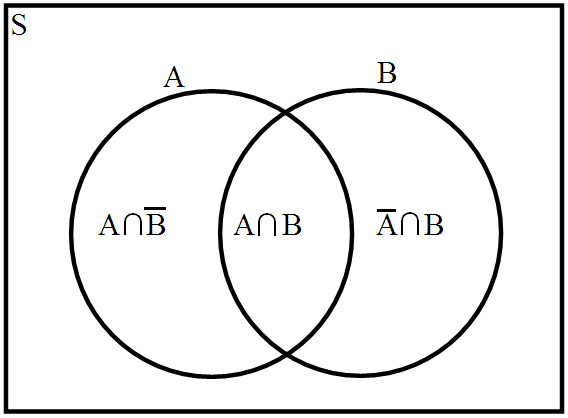
From the diagram, we get $\text{A}\cap\text{B}$ and $\overline{\text{A}}\cap\text{B}$ are mutually exclusive events such that $(\text{A}\cap\text{B})\cup(\overline{\text{A}}\cap\text{B})=\text{B}.$ therefore by
$\text{P}(\text{A}\cap\text{B})+\text{P}(\overline{\text{A}}\cap\text{B})=\text{P(B)}$
$\therefore\ \text{P}(\overline{\text{A}}\cap\text{B})=\text{P(B)}-\text{P}(\text{A}\cap\text{B})$
View full question & answer
MCQ 321 Mark
The probability that in a year of $22^{nd}$ century chosen at random, there will be $53$ Sunday, is
  • A
    $\frac{3}{28}$
  • B
    $\frac{2}{28}$
  • C
    $\frac{7}{28}$
  • $\frac{5}{28}$
Answer
Correct option: D.
$\frac{5}{28}$

We know a leap year is fallen within $4$ years,
So its probability is $\frac{25}{100}=\frac{1}{4}$
53rd Sunday leap year $=\frac{1}{4}\times\frac{2}{7}=\frac{2}{28}$
Similarly probability of $53rd$ Sunday in a non leap year $=\frac{75}{100}\times\frac{1}{7}=\frac{3}{4}\times\frac{1}{7}=\frac{3}{28}$
Required probability $=\frac{2}{28}+\frac{3}{28}=\frac{5}{28}$.

View full question & answer
MCQ 331 Mark
Choose the correct answer from the given four options.
$A$ and $B$ are two students. Their chances of solving a problem correctly are $\frac{1}{3}$ and $\frac{1}{4},$respectively. If the probability of their making a common error is, $\frac{1}{20}$ and they obtain the same answer, then the probability of their answer to be correct is:
  • A
    $\frac{1}{12}$
  • B
    $\frac{1}{40}$
  • C
    $\frac{13}{120}$
  • $\frac{10}{13}$
Answer
Correct option: D.
$\frac{10}{13}$

Let $E_{1 }=$ Event that both $A$ and $B$ solve the problem
$\therefore\text{P}(\text{E}_1)=\frac{1}{3}\times\frac{1}{4}=\frac{1}{12}$
Let $E_2 =$ Event that both $A$ and $B$ got incorrect solution of the problem
$\therefore\text{P}(\text{E}_2)=\frac{2}{3}\times\frac{3}{4}=\frac{1}{2}$
Here, $\text{P}\Big(\frac{\text{E}_1}{\text{E}}\Big)=1,\text{P}\Big(\frac{\text{E}}{\text{E}_2}\Big)=\frac{1}{20}$
 $\therefore\text{P}\Big(\frac{\text{E}_1}{\text{E}}\Big)=\frac{\text{P}(\text{E}_1\cap\text{E})}{\text{P}(\text{E})}=\frac{\text{P}(\text{E}_1)\cdot\text{P}\Big(\frac{\text{E}_1}{\text{E}}\Big)}{\text{P}(\text{E}_1)\cdot\text{P}\Big(\frac{\text{E}_1}{\text{E}}\Big)+\text{P}(\text{E}_2)\cdot\text{P}\Big(\frac{\text{E}_1}{\text{E}}\Big)} $
$=\frac{\frac{1}{12}\times1}{\frac{1}{12}\times1+\frac{1}{2}\times\frac{1}{20}}=\frac{10}{30}$

View full question & answer
Question 341 Mark
Choose the correct answer from the given four options.
If A and B are two events such that $\text{P}(\text{A})=\frac{1}{2},\text{P}(\text{B})=\frac{1}{3},$ $\text{P}\Big(\frac{\text{A}}{\text{B}}\Big)=\frac{1}{4},$ then $\text{P}(\text{A}'\cap\text{B}')$ equals:
  1. $\frac{1}{12}$
  2. $\frac{3}{4}$
  3. $\frac{1}{4}$
  4. $\frac{3}{16}$
Answer
  1. $\frac{1}{4}$
Solution:
We have, $\text{P}(\text{A})=\frac{1}{2},\text{P}(\text{B})=\frac{1}{3}$ and $\text{P}\Big(\frac{\text{A}}{\text{B}}\Big)=\frac{1}{4}$
$\Rightarrow\text{P}(\text{A}\cap\text{B})=\text{P}\Big(\frac{\text{A}}{\text{B}}\Big)\cdot\text{P}(\text{B})$
$=\frac{1}{4}\cdot\frac{1}{3}=\frac{1}{12}$
Now, $\text{P} ({\text{A}'}\cap{\text{B}'})=1-\text{P}(\text{A}\cup{\text{B}})$
$=1-\big[\text{P}(\text{A})+\text{P}(\text{B})-\text{P}(\text{A}\cap\text{B})\big]$
$=1-\Big[\frac{1}{2}+\frac{1}{3}-\frac{1}{12}\Big]=1-\frac{9}{12}$
$=\frac{3}{12}=\frac{1}{4}$
View full question & answer
Question 351 Mark
A biased coin with probabilty p, 0 < p < 1, of heads is tossed until a head appears for the first time. If the probability that the number of tosses required is even is $\frac{2}{5},$ then p equals:
  1. $\frac{1}{3}$
  2. $\frac{2}{3}$
  3. $\frac{2}{5}$
  4. $\frac{3}{5}$
Answer
  1. $\frac{1}{3}$
Solution:
p is the probability of getting head.
q = 1 - p is the probability of getting tail.
The number of tosses required is even.
$\Rightarrow\text{qp+q}^3\text{p+q}^5\text{p+q}^7\text{p+q}^9\text{p}\dots$
$\Rightarrow\text{qp}\Big(\frac{1}{1-\text{q}^2}\Big)$
$\Rightarrow\frac{(1-\text{p})\text{p}}{1-(1-\text{p})^2}$
$\Rightarrow\frac{(1-\text{p})\text{p}}{1-(1-2\text{p + p}^2)}$
$\Rightarrow\frac{1-\text{p}}{2-\text{p}}$
Given $\frac{1-\text{p}}{2-\text{p}}=\frac{2}{5}$
$\Rightarrow\text{p}=\frac{1}{3}$
View full question & answer
Question 361 Mark
Choose the correct answer from the given four options.
If A and B are two events and $\text{A}\neq\phi,\text{B}\neq\phi,$ then:
  1. $\text{P}\Big(\frac{\text{A}}{\text{B}}\Big)=\text{P}(\text{A})\cdot\text{P}(\text{B})$
  2. $\text{P}\Big(\frac{\text{A}}{\text{B}}\Big)=\frac{\text{P}(\text{A}\cap\text{B})}{\text{P}(\text{B})}$
  3. $\text{P}\Big(\frac{\text{A}}{\text{B}}\Big)\cdot\text{P}\Big(\frac{\text{B}}{\text{A}}\Big)=1$
  4. $\text{P}\Big(\frac{\text{A}}{\text{B}}\Big)=\text{P}\Big(\frac{\text{A}}{\text{B}}\Big)$
Answer
  1. $\text{P}\Big(\frac{\text{A}}{\text{B}}\Big)=\frac{\text{P}(\text{A}\cap\text{B})}{\text{P}(\text{B})}$
Solution:
If $\text{A}\neq\phi,\text{B}\neq\phi,$ then $\text{P}\Big(\frac{\text{A}}{\text{B}}\Big)=\frac{\text{P}(\text{A}\cap\text{B})}{\text{P}(\text{B})}$
View full question & answer
Question 371 Mark
If X follows a binomial distribution with parameter $\text{n}=100$ and $\text{p}=\frac{1}{3},$ then P(X = r) is maximum when r = 
  1. 32
  2. 34
  3. 33
  4. 31
Answer
  1. 33
Solution:
$\text{n}=100,\text{p}=\frac{1}{3}\Rightarrow\text{q}=\frac{2}{3}$
$\text{np}=\frac{100}{3}=33+\frac{1}{3}$
⇒ Probability is maximum at 33.
View full question & answer
Question 381 Mark
A pack of playing cards was found to contain only 51 cards. If the first 13 cards which are examined are all red, then the probability thatthe missing card is black, is:
  1. $\frac13$
  2. $\frac23$
  3. $\frac12$
  4. $\frac{^{25}{\text{C}_{13}}}{^{51}{\text{C}_{13}}}$
Answer
  1. $\frac23$
Solution:
Total number of cards = 52
Number of lost cards = 1
13 cards are surley red therfore, from the remaining 39 cards 26 are black and 13 are red.
So probabilityof lost card being black $=\frac{(261)}{(391)}=\frac{26}{39}=\frac{2}{3}$
View full question & answer
Question 391 Mark
If in a binomial distribution $\text{n}=4,\text{P(X}=0)=\frac{16}{81},$ then $\text{P(X}=4)$ equals:
  1. $\frac{1}{16}$
  2. $\frac{1}{81}$
  3. $\frac{1}{27}$
  4. $\frac{1}{8}$
Answer
  1. $\frac{1}{81}$
Solution:
Given $\text{n}=4,\text{P(X}=0)=\frac{16}{81}$
$\text{P(X}=0)=\frac{16}{81}$
$\text{ }^5\text{C}_0\text{p}^0\text{q}^4=\frac{16}{81}$
$\text{q}^4=\frac{16}{81}$
$\text{q}=\frac{2}{3}\Rightarrow\text{p}=\frac{1}{3}$
$\Rightarrow\text{P(X}=4)=\text{ }^5\text{C}_4\big(\frac{1}{4}\big)^4=\frac{1}{81}$
View full question & answer
Question 401 Mark
A fair coin is tossed a fixed number of times. If the probability of getting seven heads is equal to that of getting nine heads, the probability of getting two heads is:
  1. $\frac{15}{2^8}$
  2. $\frac{2}{15}$
  3. $\frac{15}{2^{13}}$
  4. $\text{None of these}$
Answer
  1. $\frac{15}{2^{13}}$
Solution:
Let X be the number of heads.
$\text{p}=\frac{1}{2}\Rightarrow\text{q}=\frac{1}{2}\dots(1)$
$\text{P(X}=7)=\text{P(X}=9)$
$\text{ }^{\text{n}}\text{C}_7\text{p}^7\text{q}^{\text{n}-7}=\text{ }^{\text{n}}\text{C}_9\text{p}^9\text{q}^{\text{n}-9}$
$\frac{\text{ }^{\text{n}}\text{C}_7}{\text{ }^{\text{n}}\text{C}_9}=\frac{\text{q}^{\text{n}-9}}{\text{q}^{\text{n}-7}}\times\frac{\text{p}^9}{\text{p}^7}$
$\frac{\frac{\text{n}!}{7!(\text{n}-7)!}}{\frac{\text{n}!}{9!(\text{n}-9)!}}=\text{q}^{-2}\text{p}^2$
$\frac{9!(\text{n}-9)!}{7!(\text{n}-7)!}=\frac{\text{p}^2}{\text{q}^2}$
$\frac{9\times8\times7!(\text{n}-9)!}{7!(\text{n}-7)(\text{n}-8)(\text{n}-9)!}=1\dots\big[\because\text{from (1)}\big]$
$9\times8=(\text{n}-7)(\text{n}-8)$
Comparing both sides,
$\text{n}-7=9\Rightarrow\text{n}=16$
$\Rightarrow\text{P(X}=2)=\text{ }^{16}\text{C}_2\times0.5^2\times0.5^{14}$
$\Rightarrow\text{P(X}=2)=\frac{15}{2^{13}}$
View full question & answer
Question 411 Mark
If A and B are two independent events with $\text{P(A)}=\frac{3}{5}$ and $\text{P(B)}=\frac{4}{9},$ then $\text{P}(\overline{\text{A}}\cap\overline{\text{B}})$ equals,
  1. $\frac{4}{15}$
  2. $\frac{8}{45}$
  3. $\frac{1}{3}$
  4. $\frac{2}{9}$
Answer
  1. $\frac{2}{9}$
Solution:
$\text{P(A)}=\frac{3}{5},\text{P(B)}=\frac{4}{9}$
$\text{P}(\overline{\text{A}}\cap\overline{\text{B}})=\text{P}(\overline{\text{A}\cup\text{B}})$
$\text{P}(\overline{\text{A}}\cap\overline{\text{B}})=1-\text{P}(\text{A}\cup\text{B})$
$\text{P}(\overline{\text{A}}\cap\overline{\text{B}})=1-\big[\text{P(A)}+\text{P(B)}-\text{P}(\text{A}\cap\text{B})\big]$
$\text{P}(\overline{\text{A}}\cap\overline{\text{B}})=1-\Big[\frac{3}{5}+\frac{4}{9}-\frac{3}{5}\times\frac{4}{9}\Big]$
($\because$ A and B are independent)
$\text{P}(\overline{\text{A}}\cap\overline{\text{B}})=1-\frac{7}{9}$
$\text{P}(\overline{\text{A}}\cap\overline{\text{B}})=\frac{2}{9}$
View full question & answer
Question 421 Mark
The probability that a leap year will have 53 fridays or 53 Saturdays is.
  1. $\frac{2}{7}$
  2. $\frac{3}{7}$
  3. $\frac{4}{7}$
  4. $\frac{1}{7}$
Answer
  1. $\frac{3}{7}$
Soluction:
Non-leap year has 365 days = 52 weeks + 1
366 days in leap year.
We want to find probability of 53 Fridays or 53 Saturday.
Favourable cases = {(Thursday, Friday), (Friday, Saturday), (Saturday, Sunday)}
Required probability $=\frac{3}{7}$
View full question & answer
Question 431 Mark
Choose the correct answer from the given four options. A bag contains 5 red and 3 blue balls. If 3 balls are drawn at random without replacement the probability of getting exactly one red ball is:
  1. $\frac{45}{196}$
  2. $\frac{135}{392}$
  3. $\frac{15}{56}$
  4. $\frac{15}{29}$
Answer
  1. $\frac{15}{56}$
Solution:
Probability of getting exactly one red (R) ball
$=\text{P}_{\text{R}}\cdot\text{P}_{\bar{\text{R}}}\cdot\text{P}_{\bar{\text{R}}}+\text{P}_{\bar{\text{R}}}\cdot\text{P}_{\text{R}}\cdot\text{P}_{\bar{\text{R}}}+\text{P}_{\bar{\text{R}}}\cdot\text{P}_{\bar{\text{R}}}\cdot\text{P}_{\text{R}}$
$=\frac{5}{8}\cdot\frac{3}{7}\cdot\frac{2}{6}+\frac{3}{8}\cdot\frac{5}{7}\cdot\frac{2}{7}+\frac{3}{8}\cdot\frac{2}{7}\cdot\frac{5}{6}$
$=\frac{15}{4\cdot7\cdot6}+\frac{15}{4\cdot7\cdot6}+\frac{15}{4\cdot7\cdot6}$
$=\frac{5}{56}+\frac{5}{56}+\frac{5}{56}=\frac{15}{56}$
View full question & answer
Question 441 Mark
Choose the correct answer from the given four options. If $\text{P}(\text{B})=\frac{3}{5},\text{P}\Big(\frac{\text{A}}{\text{B}}\Big)=\frac{1}{2}$ and $\text{P}(\text{A}\cup\text{B})=\frac{4}{5},$ then $\text{P}(\text{A}\cup\text{B})'+\text{P}(\text{A}'\cup\text{B})=$
  1. $\frac{1}{5}$
  2. $\frac{4}{5}$
  3. $\frac{1}{2}$
  4. $1.$
Answer
  1. $1.$
Solution:
We have, $\text{P}(\text{B})=\frac{3}{5},\text{P}\Big(\frac{\text{A}}{\text{B}}\Big)=\frac{1}{2}$
$\therefore\text{P}(\text{A}\cap\text{B})=\text{P}\Big(\frac{\text{A}}{\text{B}}\Big)\cdot\text{P}(\text{B})$
$=\frac{1}{2}\cdot\frac{3}{5}=\frac{3}{10}$
Now, $\text{P}(\text{A}\cup\text{B})=\text{P}(\text{A})+\text{P}(\text{B})-\text{P}(\text{A}\cap\text{B})$
$\Rightarrow\text{P}(\text{A})=\frac{4}{5}-\frac{3}{5}+\frac{3}{10}=\frac{1}{2}$
$\therefore\text{P}(\text{A}\cup\text{B})'=1-\text{P}(\text{A}\cup\text{B})$
$=1-\frac{4}{5}=\frac{1}{5}$
And $\text{P}(\text{A}'\cap\text{B})=1-\text{P}(\text{A}-\text{B})$
$=1-\big[\text{P}(\text{A})-\text{P}(\text{A}\cap\text{B})\big]$
$=1-\Big(\frac{1}{2}-\frac{3}{10}\Big)=\frac{4}{5}$
$\Rightarrow\text{P}(\text{A}\cup\text{B})'+\text{P}(\text{A}'\cup\text{B})$
$=\frac{1}{5}+\frac{4}{5}=1$
View full question & answer
MCQ 451 Mark
Choose the correct answer from the given four options.
The probability that exactly two of the three balls were red, the first ball being red, is:
  • A
    $\frac{1}{3}$
  • $\frac{4}{7}$
  • C
    $\frac{15}{28}$
  • D
    $\frac{5}{28}$
Answer
Correct option: B.
$\frac{4}{7}$
Let $E_1=$ Event that first ball being red
And $E_2 =$ Event that exactly two of three balls being red
$\therefore\text{P}(\text{E}_1)=\text{P}_{\text{R}}\cdot\text{P}_{\text{R}}\cdot\text{P}_{\text{R}}+\text{P}_{\text{R}}\cdot\text{P}_{\text{R}}\cdot\text{P}{_\bar{\text{R}}}+\text{P}_{\text{R}}\cdot\text{P}{_\bar{\text{R}}}\cdot\text{P}_{\text{R}}+\text{P}_{\text{R}}\cdot\text{P}{_\bar{\text{R}}}\cdot\text{P}{_\bar{\text{R}}}$
$=\frac{5}{8}\cdot\frac{4}{7}\cdot\frac{3}{6}+\frac{5}{8}\cdot\frac{4}{7}\cdot\frac{3}{6}+\frac{5}{8}\cdot\frac{3}{7}\cdot\frac{4}{6}+\frac{5}{8}\cdot\frac{3}{7}\cdot\frac{2}{6}$
$=\frac{60+60+60+30}{336}=\frac{210}{336}$
$\text{P}(\text{E}_1\cap\text{E}_2)=\text{P}{_\text{R}}\cdot\text{P}{_\bar{\text{R}}}\cdot\text{P}{_\text{R}}+\text{P}{_\text{R}}\cdot\text{P}{_\text{R}}\cdot\text{P}{_\bar{\text{R}}}$
$=\frac{5}{8}\cdot\frac{3}{7}\cdot\frac{4}{6}+\frac{5}{8}\cdot\frac{4}{7}\cdot\frac{3}{6}=\frac{120}{336}$
$\therefore\text{P}\Big(\frac{\text{E}_2}{\text{E}_1}\Big)=\frac{\text{P}(\text{E}_1\cap\text{E}_2)}{\text{P}(\text{E}_1)}$
$=\frac{\frac{120}{336}}{\frac{210}{336}}=\frac{4}{7}$
View full question & answer
Question 461 Mark
If P(A) + P(B) = 1; then which of the following option explains the event A and B correctly?
  1. Event A and B are mutually exclusive, exhaustive and complementary events.
  2. Event A and B are mutually exclusive and exhaustive events.
  3. Event A and B are mutually exclusive and complementary events.
  4. Event A and B are exhaustive and complementary events.
Answer
  1. Event A and B are mutually exclusive, exhaustive and complementary events.
Solution:
Since P(A) + P(B) = 1
$∴ \text{A ∩ B} =0.$
Thus, event A and B are mutually exclusive, exhaustive and complementary events.
View full question & answer
Question 471 Mark
If S is the samle space and $\text{P(A)}=\frac{1}{3}, \text{P(B)}$ and $\text{S}=\text{A}\cup\text{B,}$ where A and B are tow mutually exclusive events, then P(A) =
  1. $\frac{1}{4}$
  2. $\frac{1}{2}$
  3. $\frac{3}{4}$
  4. $\frac{3}{8}$
Answer
  1. $\frac{1}{4}$
Solution:
$\text{P(A)}=\frac{1}{3}\text{P(A)}$
$\Rightarrow\ \text{P(B)}=3\text{P(A)}\ .....(\text{i})$
A and B are mutually exclusive events.
$\Rightarrow\ \text{P}(\text{A}\cap\text{B}) = 0$
Now,
$\text{P}(\text{A}\cup\text{B})=\text{P(A)}+\text{P(B)}=\text{P(S)}$
$\Rightarrow\ \text{P(A)}+\text{P(B)}=1$
$\Rightarrow\ \text{P(A)}+3\text{P(A)}=1$ [From (i)]
$\Rightarrow\ 4\text{P(A)}=1$
$\Rightarrow\ \text{P(A)}=\frac{1}{4}$
View full question & answer
Question 481 Mark
Choose the correct answer from the given four options.
$\text{P}\Big(\frac{\text{B}}{\text{A}}\Big)$ is equal to:
  1. $\frac{1}{5}$
  2. $\frac{3}{10}$
  3. $\frac{1}{2}$
  4. $\frac{3}{5}$
Answer
  1. $\frac{3}{5}$
Solution:
$\text{P}\Big(\frac{\text{B}}{\text{A}'}\Big)=\frac{\text{P}(\text{B}\cap\text{A}')}{\text{P}(\text{A}')}$
$=\frac{\text{P}(\text{B})-\text{P}(\text{B}\cap\text{A})}{1-\text{P}(\text{A})}$
$=\frac{\frac{3}{5}-\frac{3}{10}}{1-\frac{1}{2}}=\frac{\frac{6-3}{10}}{\frac{1}{2}}$
$=\frac{6}{10}=\frac{3}{5}$
View full question & answer
MCQ 491 Mark
Assume that in a family, each chold is equally likely to be a boy or a girl. A family with tree cgildren is chosen at random. Tere probability that the eldest child is a girl given that the family has at least oe girl.
  • A
    $\frac{1}{2}$
  • B
    $\frac{1}{3}$
  • C
    $\frac{2}{3}$
  • $\frac{4}{7}$
Answer
Correct option: D.
$\frac{4}{7}$

$S = \{GBB, GGB, GBG, GGG, BGG, BGB, BBG, BBB\}$
Let $E_1$ be the event that choosing a family with a girl as eldest child.
$E_2$ be the event that choosing a family with at least one girl.
$E_1 = \{GBB, GGB, GBG, GGG\}$
$E_2 = \{GBB, GGB, GBG, GGG, BGG, BGB, BBG\}$
$\text{n}(\text{E}_1)=4,\text{n}(\text{E}_2)=7,\text{n}(\text{A}\cap\text{B})=4$
$\Rightarrow\ \text{P}\Big(\frac{\text{A}}{\text{B}}\Big)=\frac{\text{n}(\text{A}\cap\text{B})}{\text{n(B)}}=\frac{4}{7}$

View full question & answer
Question 501 Mark
If A and B are two events such that $\text{A}\neq\phi,\text{B}=\phi,$ then,
  1. $\text{P}\Big(\frac{\text{A}}{\text{B}}\Big)=\frac{\text{P}(\text{A}\cap\text{B})}{\text{P(B)}}$
  2. $\text{P}\Big(\frac{\text{A}}{\text{B}}\Big)=\text{P(A)}\text{ P(B)}$
  3. $\text{P}\Big(\frac{\text{A}}{\text{B}}\Big)=\text{P}\Big(\frac{\text{B}}{\text{A}}\Big)=1$
  4. $\text{P}\Big(\frac{\text{A}}{\text{B}}\Big)=\frac{\text{P(A)}}{\text{P(B)}}$
Answer
  1. $\text{P}\Big(\frac{\text{A}}{\text{B}}\Big)=\frac{\text{P}(\text{A}\cap\text{B})}{\text{P(B)}}$
Solution:
If A and B are two events such that $\text{A}\neq\phi, \text{B}=\phi$ then,
$\text{P}\Big(\frac{\text{A}}{\text{B}}\Big)=\frac{\text{P}(\text{A}\cap\text{B})}{\text{P(B)}}$
View full question & answer