Questions · Page 1 of 2

M.C.Q (1 Marks)

Take a timed test

50 questions · 7 auto-graded MCQ + 43 self-marked written.

Question 11 Mark
Out of 30 consecutive integers, 2 are chosen at random. The probability that their sum is odd, is
  1. $\frac{14}{29}$
  2. $\frac{16}{29}$
  3. $\frac{15}{29}$
  4. $\frac{10}{29}$
Answer
  1. $\frac{15}{29}$
Solution:
For sum of two integers to be odd, one integer should be even and the other should be odd. In 30 consecutive integers, 15 are even and 15 are odd.
P(Sum is odd) = P(first integer is odd and second is even) + P(first integer is even and second integer is odd)
$=\frac{15}{30}\times\frac{15}{29}+\frac{15}{30}\times\frac{15}{29}$
$=\frac{450}{30\times29}$
$=\frac{15}{29}$
View full question & answer
Question 21 Mark
If A and B are two events such that $\text{P(A)}=\frac{3}{8},\text{P(B)}=\frac{5}{4}.$ and $\text{P}(\text{A}|\text{B})\times\text{P}(\overline{\text{A}}\cap\text{B})$ is equals to.
  1. $\frac{2}{5}$
  2. $\frac{3}{8}$
  3. $\frac{3}{20}$
  4. $\frac{6}{25}$
Answer
  1. $\frac{6}{25}$
Solution:
$\text{P(A)}=\frac{3}{8},\text{P(B)}=\frac{5}{8},\text{P}\Big({\text{A}}\cup{\text{B}}\Big)=\frac{3}{4}$
$\text{P}(\text{A}\cap\text{B})=\text{P(A)}+\text{P(B)}-\text{P}(\text{A}\cap\text{B})$
$\Rightarrow\ \frac{3}{4}=\frac{3}{8}+\frac{5}{8}-\text{P}(\text{A}\cap\text{B})$
$\Rightarrow\ \text{P}(\text{A}\cap\text{B})=\frac{1}{4}$
$\text{P}\Big(\frac{\text{A}}{\text{B}}\Big)\text{ P}\Big(\frac{\overline{\text{A}}}{\text{B}}\Big)=\frac{\text{P}(\text{A}\cap\text{B})}{\text{P(B)}}\times\frac{\text{P}(\overline{\text{A}}\cap\text{B})}{\text{P(B)}}$
$\text{P}\Big(\frac{\text{A}}{\text{B}}\Big)\text{ P}\Big(\frac{\overline{\text{A}}}{\text{B}}\Big)=\frac{\text{P}(\text{A}\cap\text{B})}{\text{P(B)}}\times\frac{\text{P(B)}-\text{P}(\text{A}\cap\text{B})}{\text{P(B)}}$
$\text{P}\Big(\frac{\text{A}}{\text{B}}\Big)\text{ P}\Big(\frac{\overline{\text{A}}}{\text{B}}\Big)=\frac{\frac{1}{4}}{\frac{5}{8}}\times\frac{\big(\frac{5}{8}-\frac{1}{4}\big)}{\frac{5}{8}}$
$\text{P}\Big(\frac{\text{A}}{\text{B}}\Big)\text{ P}\Big(\frac{\overline{\text{A}}}{\text{B}}\Big)=\frac{6}{25}$
View full question & answer
Question 31 Mark
A bag contains 5 brown and 4 white socks. A man pulls out two socks. The probability that these are of the sane colour is.
  1. $\frac{5}{108}$
  2. $\frac{18}{108}$
  3. $\frac{30}{108}$
  4. $\frac{48}{108}$
Answer
  1. $\frac{48}{108}$
Solution:
Total number of balls = 5brown + 4white = 9
Required probability $=\frac{5}{9}\times\frac{4}{8}+\frac{4}{9}\times\frac{3}{8}=\frac{4}{9}$
$\Rightarrow\ \frac{4\times12}{9\times12}=\frac{48}{108}$
View full question & answer
Question 41 Mark
An urn contains 9 balls two of which are red, three blue and four black. Three balls are drawn at random. The probability that they are of the same colour is,
  1. $\frac{5}{84}$
  2. $\frac{3}{9}$
  3. $\frac{3}{7}$
  4. $\frac{7}{17}$
Answer
  1. $\frac{5}{84}$
Solution:
Given:
Red balls = 2
Blue balls = 3
Black balls = 4
P(All three balls are of same colour) = P(all three are blue) + P(all three are black)
$=\frac{3}{9}\times\frac{2}{8}\times\frac{1}{7}+\frac{4}{9}\times\frac{3}{8}\times\frac{2}{7}$
$=\frac{1}{84}+\frac{4}{84}$
$=\frac{5}{84}$
View full question & answer
MCQ 51 Mark
A die is thrown and a card is selected ar random from a deck pf $52$ playing cards. The probability of getting an even number of the die and a spade card is
  • A
    $\frac{1}{2}$
  • B
    $\frac{1}{4}$
  • $\frac{1}{8}$
  • D
    $\frac{3}{4}$
Answer
Correct option: C.
$\frac{1}{8}$

A Sample space when a die is thrown,
$S_1 = \{1, 2, 3, 4, 5, 6\} $
$\Rightarrow n(S_1) = 6$
Let $A$ be the event that getting even number.
$A = \{2, 4, 6\} $
$\Rightarrow n(A) = 3$
$\Rightarrow\ \text{P(A)}=\frac{3}{6}=\frac{1}{2}$
$A$ card is selected from a deck of $52$ cards.
$\text{n}(\text{S}_2)= {^{52}}\text{C}_2=52$
Let $B$ be the event that getting spade card.
$\text{n(B)}= {^{13}}\text{C}_2=13$
​​​​​​​$\Rightarrow\ \text{P(B)}=\frac{13}{52}=\frac{1}{4}$
Required probability $= P(A) \times P(B)$
$=\frac{1}{2}\times\frac{1}{4}=\frac{1}{8}$

View full question & answer
MCQ 61 Mark
Five persone entered the lift cabin on the ground floor of an $8$ floor house. Suppose that each of them independently and with equal probability can leave the cabin at any flor beginning with the first, then the probability of all $5$ persons leaving at different floors is,
  • $\frac{^{7}\text{P}_5}{7_5}$
  • B
    $\frac{7_5}{^{7}\text{P}_5}$
  • C
    $\frac{6}{^{6}\text{P}_5}$
  • D
    $\frac{^{5}\text{P}_5}{5}$
Answer
Correct option: A.
$\frac{^{7}\text{P}_5}{7_5}$

Five persons can leave different floors
By $^7P_5$ ways.
Possible ways of leavinf the lift $= 7^5$
Required probability $=\frac{^{7}\text{P}_5}{7^5}$

View full question & answer
Question 71 Mark
If two events are independent, then.
  1. They must be mutually exclusive.
  2. The sum of their probabilities must be equal to 1.
  3. (a) and (b) both are correct.
  4. None of the above is correctIf two. events are independent, then.
Answer
  1. None of the above is correctIf two. events are independent, then.
Solution:
Let A and B are two independent events, Then,
$\text{P}(\text{A}\cap\text{B})=\text{P(A)}\times\text{P(B)}$
As, $\text{P}(\text{A}\cap\text{B})\neq0\text{ or }\text{P(A)}+\text{P(B)}\neq1$
So, both are neither mutually exclisive nor their sum of probability is 1.
Hence, the correct alternative is option (d).
View full question & answer
Question 81 Mark
In a college 30% students fail in Physics, 25% fail in Mathenatics and 10% fail in both. One student is chosen at random. The probability that she fails in Physics if she failed in Mathematics is.
  1. $\frac{1}{10}$
  2. $\frac{1}{3}$
  3. $\frac{2}{5}$
  4. $\frac{9}{20}$
Answer
  1. $\frac{2}{5}$
Solution:
Let A be the event that students failed in Physics. B be the event that students failed in Mathematics.
Given that, $\text{P(A)}=30\%=\frac{30}{100}$
$\text{P(B)}=25\%=\frac{25}{100}$
$\text{P}(\text{A}\cap\text{B})=10\%=\frac{10}{100}$
Required probability is given by $\text{P}\Big(\frac{\text{A}}{\text{B}}\Big)$
$\Rightarrow\ \text{P}\Big(\frac{\text{A}}{\text{B}}\Big)=\frac{\text{P}(\text{A}\cap\text{B})}{\text{P(B)}}=\frac{\frac{10}{100}}{\frac{25}{100}}=\frac{2}{5}$
View full question & answer
Question 91 Mark
If $\text{P(B)}=\frac{3}{5},\text{P}(\text{A}|\text{B})=\frac{1}{2}$ and $\text{P}(\text{A}\cup\text{B})=\frac{4}{5},$ then $\text{P}(\overline{\text{A}\cap\text{B}})+\text{P}(\overline{\text{A}}\cap\text{B})=$
  1. $\frac{1}{5}$
  2. $\frac{4}{5}$
  3. $\frac{1}{2}$
  4. $1$
Answer
  1. 1
Solution:
$\text{P(B)}=\frac{3}{5},\text{P}\Big(\frac{\text{A}}{\text{B}}\Big)=\frac{1}{2},\text{P}\Big({\text{A}}\cup{\text{B}}\Big)=\frac{4}{5}$
Consider,
$\text{P}\Big(\frac{\text{A}}{\text{B}}\Big)=\frac{1}{2}$
$\Rightarrow\ \frac{\text{P}(\text{A}\cap\text{B})}{\text{P(B)}}=\frac{1}{2}$
$\Rightarrow\ \frac{\text{P}(\text{A}\cap\text{B})}{\frac{3}{5}}=\frac{1}{2}$
$\Rightarrow\ \text{P}(\text{A}\cap\text{B})=\frac{3}{10}$
$\text{P}(\overline{\text{A}\cup\text{B}})+\text{P}(\overline{\text{A}}\cap\text{B})$
$=1-\text{P}(\text{A}\cap\text{B})+\text{P(B)}-\text{P}(\text{A}\cap\text{B})$
$=1-\frac{3}{10}+\frac{3}{5}-\frac{3}{10}$
$=1$
View full question & answer
MCQ 101 Mark
Two persons $A$ and $B$ take turns in throwing a pair of dice.The first person to throw $9$ from both dice will be awarded the prize. If $A$ throws first, then the probability that $B$ wins the game is.
  • A
    $\frac{9}{17}$
  • $\frac{8}{17}$
  • C
    $\frac{8}{9}$
  • D
    $\frac{1}{9}$
Answer
Correct option: B.
$\frac{8}{17}$

$9$ can be obtained from throw of two dice in only $4$ cases as given below:
$\{(3, 6), (4, 5), (5, 4), (6, 3)\}$
$\Rightarrow\ \text{P(getting }9)=\frac{4}{36}=\frac{1}{9}$
$\text{P(not getting }9)=\frac{32}{36}=\frac{8}{9}$
Now,
$P(B$ is winning$) = P($getting $9$ in $2^{nd}$ throw$) + P($getting $p$ in $4^{th}$ throw$) + P($getting $9$ in $6^{th}$ throw$) + .....$
$=\frac{8}{9}\times\frac{1}{9}+\frac{8}{9}\times\frac{8}{9}\times\frac{8}{9}\times\frac{1}{9}+\ .....$
$=\frac{8}{81}\Big[1+\frac{64}{81}+\Big(\frac{64}{81}\Big)^2+\ ......\Big]$
$=\frac{8}{81}\times\frac{1}{1-\frac{64}{81}}$
$=\frac{8}{81}\times\frac{81}{17}$
$=\frac{8}{17}$

View full question & answer
Question 111 Mark
If $\text{P}(\text{A}\cup\text{B})=0.8$ and $\text{P}(\text{A}\cap\text{B})=0.3$ then $\text{P}(\overline{\text{A}})=\text{P}(\overline{\text{B}})=$
  1. 0.3
  2. 0.5
  3. 0.7
  4. 0.9
Answer
  1. 0.9
Solution:
If $\text{P}(\text{A}\cup\text{B})=0.8\text{ P}(\text{A}\cap\text{B})=0.3,$
$\text{P}(\text{A}\cup\text{B})=\text{P(A)}+\text{P(B)}-\text{P}(\text{A}\cap\text{B})$
$\Rightarrow\ \text{P(A)}+\text{P(B)}=\text{P}(\text{A}\cup\text{B})-\text{P}(\text{A}\cap\text{B})$
$\Rightarrow\ \text{P(A)}+\text{P(B)}=1.1$
$\Rightarrow\ \text{P}(\overline{\text{A}})+\text{P}(\overline{\text{B}})=1-\text{P(A)}+1-\text{P(B)}$
$\Rightarrow\ \text{P}(\overline{\text{A}})+\text{P}(\overline{\text{B}})=\big[\text{P(A)}+\text{P(B)}\big]$
$\Rightarrow\ \text{P}(\overline{\text{A}})+\text{P}(\overline{\text{B}})=2-1.1$
$\Rightarrow\ \text{P}(\overline{\text{A}})+\text{P}(\overline{\text{B}})=0.9$
View full question & answer
MCQ 121 Mark
A bag $X$ contains $2$ white and $3$ black balls and another bag $Y$ contains $4$ white and $2$ black balls. One bag is selected at random and a ball is drawn from it. Then, the probability chosen to be white is,
  • A
    $\frac{2}{15}$
  • B
    $\frac{7}{15}$
  • C
    $\frac{8}{15}$
  • $\frac{14}{15}$
Answer
Correct option: D.
$\frac{14}{15}$

A white ball can be drawn in two mutually exclusive ways:

  1. Selecting bag $X$ and then drawing a white ball from it.
  2. Selecting bag $Y$ ane then drawing a white ball from it.
Let $E_1, E_2$ and $A$ be the three evenes as defined below:
$E_1 =$ Selecting abg $X$
$E_2 =$ Selecting bag $Y$
$A =$ Drawing a white ball
We know that one bag is selected randomly.
View full question & answer
Question 131 Mark
Let A and B be two events such that P(A) = 0.6, P(B) = 0.2, P(A|B) = 0.5. Then $\text{P}(\overline{\text{A}}|\overline{\text{B}})$ equals.
  1. $\frac{1}{10}$
  2. $\frac{3}{10}$
  3. $\frac{3}{8}$
  4. $\frac{6}{7}$
Answer
  1. $\frac{3}{8}$
Solution:
Given that,
$\text{P(A)}=0.6,\text{P(B)}=0.2,\text{P}\Big(\frac{\text{A}}{\text{B}}\Big)=0.5$
Consider,
$\text{P}\Big(\frac{\text{A}}{\text{B}}\Big)=0.5$
$\Rightarrow\frac{\text{P}(\text{A}\cap\text{B})}{\text{P(B)}}=0.5$
$\Rightarrow\frac{\text{P}(\text{A}\cap\text{B})}{0.2}=0.5$
$\Rightarrow \text{P}(\text{A}\cap\text{B})=0.1$
$\Rightarrow \text{P(A)}+\text{P(B)}-\text{P}(\text{A}\cup\text{B})=0.1$
$\Rightarrow \text{P}(\text{A}\cup\text{B})=\text{P(A)}+\text{P(B)}-0.1$
$\Rightarrow\text{P}(\text{A}\cup\text{B})=0.7$
Now, $\text{P}(\overline{\text{A}}\cap\overline{\text{B}})=\text{P}(\overline{\text{A}\cup\text{B}})$
$\text{P}(\overline{\text{A}}\cap\overline{\text{B}})=1-\text{P}(\text{A}\cup\text{B})$
$\Rightarrow \text{P}(\overline{\text{A}}\cap\overline{\text{B}})=0.3$
To find
$\text{P}\Big(\frac{\overline{\text{A}}}{\overline{\text{B}}}\Big)=\frac{\text{P}(\overline{\text{A}\cap\text{B}})}{\text{P}(\overline{\text{B}})}$
$\text{P}\Big(\frac{\overline{\text{A}}}{\overline{\text{B}}}\Big)=\frac{0.3}{0.8}$
$\text{P}\Big(\frac{\overline{\text{A}}}{\overline{\text{B}}}\Big)=\frac{3}{8}$
View full question & answer
Question 141 Mark
Three persons, A, B and C fine a target in turn starting with A. Their probability of hitting the target are 0.4, 0.2 and 0.2, respectively. The probability of two hits is
  1. 0.024
  2. 0.452
  3. 0.336
  4. 0.188
Answer
  1. 0.188
Solution:
Let:
A be the event of hitting the target by the person A,
B be the event of hitting the target by the person B and
C be the event of hitting the target by the person C
We have,
P(A) = 0.4, P(B) = 0.3 and P(C) = 0.2
Also,
$\text{P}(\overline{\text{A}})=1-\text{P(A)}=1-0.4=-0.6,$
$\text{P}(\overline{\text{B}})=1-0.3=0.7$ and
$\text{P}(\overline{\text{C}})=1-0.2=0.8$
Now,
$\text{P(Two hits)}=\text{P}(\text{AB}\overline{\text{C}})+\text{P}(\text{A}\overline{\text{B}}\text{C})+\text{P}(\overline{\text{A}}\text{BC})$
$=\text{P(A)}\times\text{P(B)}\times\text{P}(\overline{\text{C}})+\text{P(A)}\times(\overline{\text{B}})\times\text{P(C)}\\+\text{P}(\overline{\text{A}})\times\text{P(B)}\times\text{P(C)}$
$=0.4\times0.3\times0.8+0.4\times0.7\times0.2+0.6\times0.3\times0.2$
$=0.096+0.056+0.036$
$=0.188$
Hence, the correct alternative is option (d).
View full question & answer
Question 151 Mark
If A and B are two events, then $\text{P}(\overline{\text{A}}\cap\text{B})=$
  1. $\text{P}(\overline{\text{A}})\text{ P}(\overline{\text{B}})$
  2. $1-\text{P}(\text{A})-\text{P}(\text{B})$
  3. $\text{P}(\text{A})+\text{P}(\text{B})-\text{P}(\text{A}\cap\text{B})$
  4. $\text{P}(\text{B})-\text{P}(\text{A}\cap\text{B})$
Answer
  1. $\text{P}(\text{B})-\text{P}(\text{A}\cap\text{B})$
Solution:

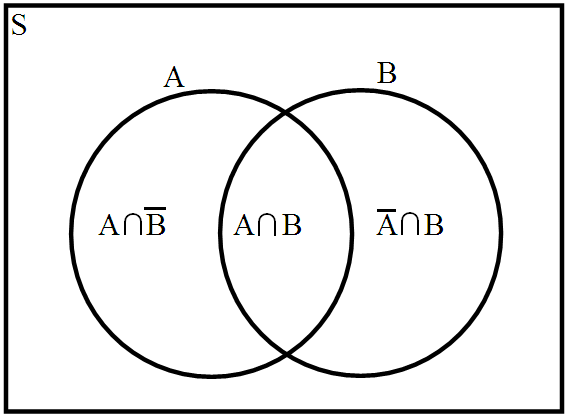
From the diagram, we get $\text{A}\cap\text{B}$ and $\overline{\text{A}}\cap\text{B}$ are mutually exclusive events such that $(\text{A}\cap\text{B})\cup(\overline{\text{A}}\cap\text{B})=\text{B}.$ therefore by
$\text{P}(\text{A}\cap\text{B})+\text{P}(\overline{\text{A}}\cap\text{B})=\text{P(B)}$
$\therefore\ \text{P}(\overline{\text{A}}\cap\text{B})=\text{P(B)}-\text{P}(\text{A}\cap\text{B})$
View full question & answer
MCQ 161 Mark
The probability that in a year of $22^{nd}$ century chosen at random, there will be $53$ Sunday, is
  • A
    $\frac{3}{28}$
  • B
    $\frac{2}{28}$
  • $\frac{7}{28}$
  • D
    $\frac{5}{28}$
Answer
Correct option: C.
$\frac{7}{28}$

We know a leap year is fallen within $4$ years,
So its probability is $\frac{25}{100}=\frac{1}{4}$
$53^{rd}$ Sunday leap year $=\frac{1}{4}\times\frac{2}{7}=\frac{2}{28}$
Similarly probability of $53^{rd}$ Sunday in a non leap year 
$=\frac{75}{100}\times\frac{1}{7}=\frac{3}{4}\times\frac{1}{7}=\frac{3}{28}$
Required probability $=\frac{2}{28}+\frac{3}{28}=\frac{5}{28}$.

View full question & answer
Question 171 Mark
India play two matches each with West indies and Australia. In any match the probability of india getting 0,1 and 2 points are 0.45, 0.05 and 0.50 respectively. Assuming that the outcomes are indepecdent, the probability of india getting at least 7 points is.
  1. 0.0875
  2. $\frac{1}{16}$
  3. 0.1125
  4. None of these.
Answer
  1. 0.0875
Solution:
Here, there are total 5 ways by which India can get at least 7 points.
  1. 2 points + 2 points + 2 points + 2 points = (0.5 × 0.5 × 0.5 × 0.5)
  2. 1 points + 2 points + 2 points + 2 points = (0.05 × 0.5 × 0.5 × 0.5)
  3. 2 points + 1 points + 2 points + 2 points = (0.5 × 0.05 × 0.5 × 0.5)
  4. 2 points + 2 points + 1 points + 2 points = (0.5 × 0.5 × 0.05 × 0.5)
  5. 2 points + 2 points + 2 points + 1 points = (0.5 × 0.5 × 0.5 × 0.05)
View full question & answer
Question 181 Mark
A box contains 3 orange balls, 3 green balls and 2 blue balls. Three balls are drawn at random from the box without replacement. The probability of drawing 22 green balls and one blue ball is
  1. $\frac{167}{168}$
  2. $\frac{1}{28}$
  3. $\frac{2}{21}$
  4. $\frac{3}{28}$
Answer
  1. $\frac{3}{28}$
Solution:
Total balls in a box - 3orange + 3green + 2blue = 8
Three balls are drawn at random from the box then samplw space $\text{n(S)}= {^{8}}\text{C}_3=\frac{8\times7\times6}{3\times2\times1}=56$
Let A be the event that drawing 2 green and one blue ball.
$\text{n(A)}={^{3}}\text{C}_2\times{^{2}}\text{C}_2=6$
$\text{P(A)}=\frac{6}{56}=\frac{3}{28}$
View full question & answer
Question 191 Mark
A box contains 6 nails and 10 nuts. Half of the nails and half of the nuts are rusted. If one iten is chosen ar random, the probability that it is rusted or is nail is
  1. $\frac{3}{16}$
  2. $\frac{5}{16}$
  3. $\frac{11}{16}$
  4. $\frac{14}{16}$
Answer
  1. $\frac{11}{16}$
Solution:
Rusted items = 3 + 5 = 8
Rusted nails = 3
Total nails = 6
P(getting a rusted item or a nail) = P(getting a rusted item) + P(getting a nail) - P(getting a rusted item and a nail)
$=\frac{8}{16}+\frac{6}{16}-\frac{3}{16}$
$=\frac{8+6-3}{16}$
$=\frac{11}{16}$
View full question & answer
Question 201 Mark
If the events A and B are independent, then $\text{P}(\text{A}\cap\text{B})$ is equal to,
  1. P(A) + P(B)
  2. P(A) - P(B)
  3. P(A) P(B)
  4. $\frac{\text{P(A)}}{\text{P(B)}}$
Answer
  1. P(A) P(B)
Solution:
$\text{P}(\text{A}\cap\text{B})=\text{P(A)} \text{ P(B)}$ for independent events.
View full question & answer
Question 211 Mark
If A and B are two events associated to a random experiment such that $\text{P}(\text{A}\cap\text{B})=\frac{7}{10}$ and $\text{P(B)}=\frac{17}{20}$, then P(A|B) =
  1. $\frac{14}{17}$
  2. $\frac{17}{20}$
  3. $\frac{7}{8}$
  4. $\frac{1}{8}$
Answer
  1. $\frac{14}{17}$
Solution:
$\text{P}(\text{A}\cap\text{B})=-\frac{7}{10},\text{P(B)}=\frac{17}{20}$
$\text{P}\Big(\frac{\text{A}}{\text{B}}\Big)=\frac{\text{P}(\text{A}\cap\text{B})}{\text{P(B)}}$
$\text{P}\Big(\frac{\text{A}}{\text{B}}\Big)=\frac{\frac{7}{10}}{\frac{17}{20}}=\frac{14}{17}$
View full question & answer
Question 221 Mark
If A and B are two events such that $\text{P(A)}\neq0$ and $\text{P(B)}\neq1,$ then $\text{P}(\overline{\text{A}}|\overline{\text{B}})=$
  1. $1-\text{P}(\text{A}|\text{B})$
  2. $1-\text{P}(\overline{\text{A}}|\text{B})$
  3. $\frac{1-\text{P}(\text{A}\cup\text{B})}{\text{P}(\overline{\text{B}})}$
  4. $=\frac{\text{P}(\overline{\text{A}})}{\text{P}(\overline{\text{B}})}$
Answer
  1. $\frac{1-\text{P}(\text{A}\cup\text{B})}{\text{P}(\overline{\text{B}})}$
Solution:
We have,
$\text{P(A)}\neq0$ and $\text{P(B)}\neq1$
Now,
$\text{P}(\overline{\text{A}}|\overline{\text{B}})=\frac{\text{P}(\overline{\text{A}}\cap\overline{\text{B}})}{\text{P}(\overline{\text{B}})}$
$=\frac{\text{P}(\overline{\text{A}\cap\text{B}})}{\text{P}(\overline{\text{B}})}$
$=\frac{1-\text{P}(\text{A}\cup\text{B})}{\text{P}(\overline{\text{B}})}$
Hence, the correct alternative is option (C).
View full question & answer
Question 231 Mark
If A and B are two events such that $\text{P}(\text{A}|\text{B})=\text{p},\text{P(A)}=\text{p},\text{P(B)}=\frac{1}{3}$ and $\text{P}(\text{A}\cup\text{B})=\frac{5}{9},$ then p =
  1. $\frac{2}{3}$
  2. $\frac{3}{5}$
  3. $\frac{1}{3}$
  4. $\frac{3}{4}$
Answer
  1. $\frac{1}{3}$
Solution:
$\text{P}\Big(\frac{\text{A}}{\text{B}}\Big)=\text{p},\text{P(A)}=\text{p},\text{P(B)}=\frac{1}{3},\text{P}(\text{A}\cup\text{B})=\frac{5}{9}$
Consider,
$\text{P}\Big(\frac{\text{A}}{\text{B}}\Big)=\text{p}$
$\Rightarrow \frac{\text{P}(\text{A}\cap\text{B})}{\text{P(B)}}=\text{P}$
$\Rightarrow \frac{\text{P(A)}+\text{P(B)}-\text{P}(\text{A}\cup\text{B})}{\text{P(B)}}=\text{P}$
$\Rightarrow\frac{\text{p}+\frac{1}{3}-\frac{5}{9}}{\frac{1}{3}}=\text{p}$
$\Rightarrow\text{p}+\frac{1}{3}-\frac{5}{9}=\frac{\text{p}}{3}$
$\Rightarrow\frac{-2}{9}=\frac{\text{p}}{3}-\text{p}$
$=\frac{-2}{3}\text{p}=\frac{-2}{9}$
$\Rightarrow\text{p}=\frac{1}{3}$
View full question & answer
Question 241 Mark
A flash light has 8 batteries out of which 3 are dead. IF two batteries are selected without replacement and tested, then the probability that both are dead is,
  1. $\frac{3}{28}$
  2. $\frac{1}{14}$
  3. $\frac{9}{64}$
  4. $\frac{33}{56}$
Answer
  1. $\frac{3}{28}$
Solution:
We have,
The total number of batteries = 8
The number of dead batteries = 3
Let A be the event of selecting the first dead battery and B be the event of selecting the second dead battery.
Now,
P(both dead batteries are selected) $=\text{P}(\text{A}\cap\text{B})$
$=\text{P(A)}\times\text{P}(\text{B}|\text{A})$
$=\frac{3}{8}\times\frac{2}{7}$
$=\frac{3}{28}$
Hence, the correct alternative is option (a).
View full question & answer
Question 251 Mark
Associated to a random experiment two events A and B are such that $\text{P(B)}=\frac{3}{5},\text{P}(\text{A}|\text{B})=\frac{1}{2}$ and $\text{P}(\text{A}\cup\text{B})=\frac{4}{5}$. The value pf P(A) is
  1. $\frac{3}{10}$
  2. $\frac{1}{2}$
  3. $\frac{1}{10}$
  4. $\frac{3}{5}$
Answer
  1. $\frac{1}{2}$
Solution:
$\text{P(B)}=\frac{3}{5},\text{P}\Big(\frac{\text{A}}{\text{B}}\Big)=\frac{1}{2},\text{P}(\text{A}\cup\text{B})=\frac{4}{5}$
$\text{P}\Big(\frac{\text{A}}{\text{B}}\Big)=\frac{1}{2}$
$\frac{\text{P}(\text{A}\cap\text{B})}{\text{P(B)}}=\frac{1}{2}$
$\frac{\text{P}(\text{A}\cap\text{B})}{\frac{3}{5}}=\frac{1}{2}$
$\text{P}(\text{A}\cap\text{B})=\frac{3}{10}$
$\text{P(A)}+\text{P(B)}-\text{P}(\text{A}\cup\text{B})=\frac{3}{10}$
$\text{P(A)}+\frac{3}{5}-\frac{4}{5}=\frac{3}{10}$
$\text{P(A)}=\frac{1}{2}$
View full question & answer
Question 261 Mark
A box contains 10 good articles and 6 with defects. One item is drawn at random. The probability that it is either good or has a defect is,
  1. $\frac{64}{64}$
  2. $\frac{49}{64}$
  3. $\frac{40}{64}$
  4. $\frac{24}{64}$
Answer
  1. $\frac{64}{64}$
Solution:
P(good item) $=\frac{10}{16}$
P(defected item) $=\frac{6}{16}$
P(eitherr good or defected item) = P(good item) + P(defected item)
$=\frac{10}{16}+\frac{6}{16}$
$=\frac{16}{16}$
$=1$
$=\frac{64}{64}$
View full question & answer
Question 271 Mark
If A and B are two events such that $\text{P(A)}=\frac{1}{2},\text{P(B)}=\frac{1}{3},\text{P}(\text{A}|\text{B})=\frac{1}{4},$ then $\text{P}(\overline{\text{A}}\cap\overline{\text{B}})$ equals.
  1. $\frac{1}{12}$
  2. $\frac{3}{4}$
  3. $\frac{1}{4}$
  4. $\frac{3}{16}$
Answer
  1. $\frac{1}{4}$
Solution:
$\text{P(A)}=\frac{1}{2},\text{P(B)}=\frac{1}{3},\text{P}\Big(\frac{\text{A}}{\text{B}}\Big)=\frac{1}{4}$
$\text{P}\Big(\frac{\text{A}}{\text{B}}\Big)=\frac{1}{4}$
$\frac{\text{P}(\text{A}\cap\text{B})}{\text{P(B)}}=\frac{1}{4}$
$\frac{\text{P}(\text{A}\cap\text{B})}{\frac{1}{3}}=\frac{1}{4}$
$\text{P}(\text{A}\cap\text{B})=\frac{1}{12}$
$\text{P}\Big(\frac{\text{A}}{\text{B}}\Big)=\frac{\text{P}(\text{A}\cap\text{B})}{\text{P(B)}}$
$\Rightarrow\ \text{P}\Big(\frac{\text{A}}{\text{B}}\Big)=\frac{\frac{1}{12}}{\frac{1}{3}}=\frac{1}{4}$
$\text{P}(\overline{\text{A}}\cap\overline{\text{B}})=\text{P}(\overline{\text{A}\cup\text{B}})$
$\text{P}(\overline{\text{A}}\cap\overline{\text{B}})=1-\text{P}(\text{A}\cup\text{B})$
$\text{P}(\overline{\text{A}}\cap\overline{\text{B}})=-1\big[\text{P(A)}+\text{P(B)}-\text{P}(\text{A}\cap\text{B})\big]$
$\text{P}(\overline{\text{A}}\cap\overline{\text{B}})=1-\Big[\frac{1}{2}+\frac{1}{3}-\frac{1}{12}\Big]$
$\text{P}(\overline{\text{A}}\cap\overline{\text{B}})=\frac{1}{4}$
View full question & answer
Question 281 Mark
A and B draw two cards each, one after another, from a pack of well-shuffled pack of 52 cards. The probability that all the four cards drawn are of the same suit is
  1. $\frac{44}{85\times49}$
  2. $\frac{11}{85\times49}$
  3. $\frac{13\times24}{17\times25\times49}$
  4. None of these.
Answer
  1. $\frac{44}{85\times49}$
Solution:
Total cards = 52 There are four suits of cards in a pack, i.e. diamond, heart, spade and club.
Pall 4 cards are of same suit = Pall 4 cards are of diamond + Pall 4 cards are of heart + Pall 4 cards are of spade + Pall 4 cards are of club.
$=4\times\frac{13}{52}\times\frac{12}{51}\times\frac{11}{50}\times\frac{10}{59}$
$=4\times\frac{11}{85\times49}$
$=\frac{44}{85\times49}$
View full question & answer
Question 291 Mark
If A and B are two events such that $\text{P(A)}=\frac{4}{5},$ and $\text{P}(\text{A}\cap\text{B})=\frac{7}{10},$ then P(B|A) =
  1. $\frac{1}{10}$
  2. $\frac{1}{8}$
  3. $\frac{7}{8}$
  4. $\frac{17}{20}$
Answer
  1. $\frac{7}{8}$
Solution:
We have,
$\text{P(A)}=\frac{4}{5}$ and $\text{P}(\text{A}\cap\text{B})=\frac{7}{10}$
Now,
$\text{P}(\text{B}|\text{A})=\frac{\text{P}(\text{A}\cap\text{B})}{\text{P(A)}}$
$=\frac{\Big(\frac{7}{10}\Big)}{\Big(\frac{4}{5}\Big)}$
$=\frac{7\times5}{10\times4}$
$=\frac{7}{8}$
Hence, the correct alternative is option (c).
View full question & answer
Question 301 Mark
If A and B are two independent events such that P(A) = 0.3 and $\text{P}(\text{A}\cup\text{B})=0.5,$ then P(A|B) - P(B|A) =
  1. $\frac{2}{7}$
  2. $\frac{3}{35}$
  3. $\frac{1}{70}$
  4. $\frac{1}{7}$
Answer
  1. $\frac{1}{70}$
Solution:
We have,
$\text{P(A)}=0.3$ and $\text{P}(\text{A}\cup\text{B})=0.5$
As, A and B are independent events
So, $\text{P}(\text{A}\cap\text{B})=\text{P(A)}\times\text{P(B)}$
$=0.3\times\text{P(B)}$
$=0.3\text{ P(B)}\ .....\text{(i)}$
Also, $\text{P}(\text{A}\cup\text{B})=\text{P(A)}+\text{P(B)}-\text{P}(\text{A}\cap\text{B})$
$\Rightarrow 0.5 = 0.3+\text{P(B)}-0.3\text{ P(B)}$ [Using (i)]
$\Rightarrow 0.5-0.3 = 0.7\text{ P(B)}$
$\Rightarrow0.7\text{ P(B)}=0.2$
$\Rightarrow\text{ P(B)}=\frac{0.2}{0.7}$
$\Rightarrow\text{ P(B)}=\frac{2}{7}$
Using (i), we get
$\text{P}(\text{A}\cap\text{B})=0.3\times\frac{2}{7}=\frac{6}{70}$
Now,
$\text{P}(\text{A}|\text{B})-\text{P}(\text{B}|\text{A})=\frac{\text{P}(\text{A}\cap\text{B})}{\text{P(B)}}-\frac{\text{P}(\text{A}\cap\text{B})}{\text{P(A)}}$
$=\frac{\Big(\frac{6}{70}\Big)}{\Big(\frac{2}{7}\Big)}-\frac{\Big(\frac{6}{70}\Big)}{0.3}$
$=\frac{6\times7}{70\times2}-\frac{6}{70\times0.3}$
$=\frac{3}{10}-\frac{2}{7}$
$=\frac{21-20}{70}$
$=\frac{1}{70}$
Hence, the correct alternative is option (c).
View full question & answer
Question 311 Mark
If A and B are such that $\text{P}(\text{A}\cup\text{B})=\frac{5}{9}$ and $\text{P}(\overline{\text{A}}\cup\overline{\text{B}})=\frac{2}{3},$ then $\text{P}(\overline{\text{A}})+\text{P}(\overline{\text{B}})=$
  1. $\frac{9}{10}$
  2. $\frac{10}{9}$
  3. $\frac{8}{9}$
  4. $\frac{9}{8}$
Answer
  1. $\frac{10}{9}$
Solution:
$\text{P}(\text{A}\cup\text{B})=\frac{5}{9},\text{P}(\overline{\text{A}}\cup\overline{\text{B}})=\frac{2}{3}$
Consider,
$\text{P}(\overline{\text{A}}\cup\overline{\text{B}})=\text{P}(\overline{\text{A}\cup\text{B}})$
$\Rightarrow\text{P}(\overline{\text{A}}\cup\overline{\text{B}})=\frac{2}{3}$
$\Rightarrow 1-\text{P}(\text{A}\cap\text{B})=\frac{2}{3}$
$\Rightarrow\text{P}(\text{A}\cap\text{B})=\frac{1}{3}$
$\Rightarrow\ \text{P(A)}+\text{P(B)}-\text{P}(\text{A}\cup\text{B})=\frac{1}{3}$
$\Rightarrow\ \text{P(A)}+\text{P(B)}-\frac{5}{9}=\frac{1}{3}$
$\Rightarrow\ \text{P(A)}+\text{P(B)}=\frac{8}{9}$
$\text{P}(\overline{\text{A}})+\text{P}(\overline{\text{B}})=1-\text{P(A)}+1-\text{P(B)}$
$\Rightarrow\text{P}(\overline{\text{A}})+\text{P}(\overline{\text{B}})=2-\big[\text{P(A)}+\text{P(B)}\big]$
$\Rightarrow\text{P}(\overline{\text{A}})+\text{P}(\overline{\text{B}})=2-\frac{8}{9}$
$\Rightarrow\text{P}(\overline{\text{A}})+\text{P}(\overline{\text{B}})=\frac{10}{9}$
View full question & answer
Question 321 Mark
If one ball is drawn ar random from each of three boxes containing 3 white and 1 black, 2 white and 2 black, 1 white and 3 black balls, then the probability that 2 white and 1 black balls will be drawn is.
  1. $\frac{13}{32}$
  2. $\frac{1}{4}$
  3. $\frac{1}{32}$
  4. $\frac{3}{16}$
Answer
  1. $\frac{13}{32}$
Solution:
Total balls in first box = 3 white + 1 black = 4
Total balls in second box = 2 white + 2black = 4
Total balls in third box = 1white + 3black = 4
Probability of 2 white and 1 black
= P(WWB) + P(WBW) + P(BWW)
$=\frac{3}{4}\times\frac{2}{4}\times\frac{3}{4}+\frac{3}{4}\times\frac{2}{4}\times\frac{1}{4}+\frac{1}{4}\times\frac{2}{4}\times\frac{1}{4}$
$=\frac{18+6+2}{64}=\frac{13}{32}$
View full question & answer
Question 331 Mark
From a set of 100 cards numbered 1 to 100, one card is drawn at randow. The probability number obtained on the card is divisible by 6 or 8 but not by 24 is
  1. $\frac{6}{25}$
  2. $\frac{1}{4}$
  3. $\frac{1}{6}$
  4. $\frac{2}{6}$
Answer
  1. $\frac{6}{25}$
Solution:
Number of cards divisible by 6 = 16
$\Rightarrow\ \text{P(A)}=\frac{16}{100}$
Number of cards divisible by 8 = 12
$\Rightarrow\ \text{P(B)}=\frac{12}{100}$
Number of cards divisible by 24 = 4
$\Rightarrow\ \text{P}(\text{A}\cap\text{B})=\frac{4}{100}$
$\text{P}(\text{A}\cup\text{B})=\frac{16}{100}+\frac{12}{100}-\frac{4}{100}$
$\text{P}(\text{A}\cup\text{B})=\frac{6}{25}$
View full question & answer
Question 341 Mark
A bag containe 5 black, 4white balls and 3 red balls. if a ball is selected randomwise, the probability that it is black or red ball is,
  1. $\frac{1}{3}$
  2. $\frac{1}{4}$
  3. $\frac{5}{12}$
  4. $\frac{2}{3}$
Answer
  1. $\frac{2}{3}$
Solution:
We know that the bag contains 5B (black), 4W(white) and 3R(red) balls.
Now,
$\text{P(B)}=\frac{5}{12}$
$\text{P(R)}=\frac{3}{12}$
$\text{P}(\text{B or R})=\text{P(B)}+\text{P(R)}$
$=\frac{5}{12}+\frac{3}{12}$
$=\frac{8}{12}=\frac{2}{3}$
View full question & answer
Question 351 Mark
A coin is tossed three times. If events A and B are defined as A = Two heads come, B = Last should be head, Then, A and B are
  1. Independent.
  2. Dependent.
  3. Both.
  4. Mutually exclusive.
Answer
  1. Dependent.
Solution:
S = [(HHH), (HHT), (HTH), (HTT), (THH), (THT), (TTH), (TTT)]
$\text{P(A)}=\text{P}(2\text{heads})=\frac{3}{8}$
$\text{P(B)}=\text{P}(\text{last one is heads})=\frac{4}{8}$
$\text{P}(\text{A}\cap\text{B})=\frac{2}{8}=\frac{1}{4}\neq\text{P(A) P(B)}$
Thus, A and B are dependent.
View full question & answer
Question 361 Mark
A and B are two events such that P(A) = 0.25 and P(B) = 0.50. The probability pf both happening together is 0.14. The probability of both A and B hot happening is.
  1. 0.39
  2. 0.25
  3. 0.11
  4. None of these.
Answer
  1. 0.39
Solution:
$\text{P}(\text{A}\cup\text{B})=\text{P(A)}+\text{P(B)}-\text{P}(\text{A}\cap\text{B})$
$=0.25+0.5-0.14$
$0.61$
P(Both A and B not happening) $=\text{P}(\text{A}\cup\text{B})'$
$=1-\text{P}(\text{A}\cup\text{B})$
$=1-0.61$
$=0.39$
View full question & answer
Question 371 Mark
If A and B are two independent events with $\text{P(A)}=\frac{3}{5}$ and $\text{P(B)}=\frac{4}{9},$ then $\text{P}(\overline{\text{A}}\cap\overline{\text{B}})$ equals,
  1. $\frac{4}{15}$
  2. $\frac{8}{45}$
  3. $\frac{1}{3}$
  4. $\frac{2}{9}$
Answer
  1. $\frac{2}{9}$
Solution:
$\text{P(A)}=\frac{3}{5},\text{P(B)}=\frac{4}{9}$
$\text{P}(\overline{\text{A}}\cap\overline{\text{B}})=\text{P}(\overline{\text{A}\cup\text{B}})$
$\text{P}(\overline{\text{A}}\cap\overline{\text{B}})=1-\text{P}(\text{A}\cup\text{B})$
$\text{P}(\overline{\text{A}}\cap\overline{\text{B}})=1-\big[\text{P(A)}+\text{P(B)}-\text{P}(\text{A}\cap\text{B})\big]$
$\text{P}(\overline{\text{A}}\cap\overline{\text{B}})=1-\Big[\frac{3}{5}+\frac{4}{9}-\frac{3}{5}\times\frac{4}{9}\Big]$
($\because$ A and B are independent)
$\text{P}(\overline{\text{A}}\cap\overline{\text{B}})=1-\frac{7}{9}$
$\text{P}(\overline{\text{A}}\cap\overline{\text{B}})=\frac{2}{9}$
View full question & answer
Question 381 Mark
The probability that a leap year will have 53 fridays or 53 Saturdays is.
  1. $\frac{2}{7}$
  2. $\frac{3}{7}$
  3. $\frac{4}{7}$
  4. $\frac{1}{7}$
Answer
  1. $\frac{3}{7}$
Soluction:
Non-leap year has 365 days = 52 weeks + 1
366 days in leap year.
We want to find probability of 53 Fridays or 53 Saturday.
Favourable cases = {(Thursday, Friday), (Friday, Saturday), (Saturday, Sunday)}
Required probability $=\frac{3}{7}$
View full question & answer
MCQ 391 Mark
Two cards are drawn from a well shuffled deck of $52$ playing cards with replacement. The probability that both cards are queen is
  • $\frac{1}{13}\times\frac{1}{13}$
  • B
    $\frac{1}{13}+\frac{1}{13}$
  • C
    $\frac{1}{13}\times\frac{1}{17}$
  • D
    $\frac{1}{13}\times\frac{4}{5}$
Answer
Correct option: A.
$\frac{1}{13}\times\frac{1}{13}$
Two cards are drawn from $52$ cards.
Let, $E_1$ be the event that getting queen in first draw and $E_2$ be the event that getting queen in second draw,
$\text{P}(\text{E}_1\cap\text{E}_2)=\frac{4}{52}\times\frac{4}{52}=\frac{1}{13}\times\frac{1}{13}$
View full question & answer
Question 401 Mark
If $\text{P(B)}=\frac{3}{5},\text{P}(\text{A}|\text{B})=\frac{1}{2}$ and $\text{P}(\text{A}\cup\text{B})=\frac{4}{5},$ then $\text{P}(\text{B}|\overline{\text{A}})=$
  1. $\frac{1}{5}$
  2. $\frac{3}{10}$
  3. $\frac{1}{2}$
  4. $\frac{1}{2}$
Answer
  1. $\frac{3}{5}$
Solution:
$\text{P(B)}=\frac{3}{5},\text{P}\Big(\frac{\text{A}}{\text{B}}\Big)=\frac{1}{2},\text{P}(\text{A}\cup\text{B})=\frac{4}{5}$
Consider,
$\text{P}\Big(\frac{\text{A}}{\text{B}}\Big)=\frac{1}{2}$
$\frac{\text{P}(\text{A}\cap\text{B})}{\text{P(B)}}=\frac{1}{2}$
$\frac{\text{P}(\text{A}\cap\text{B})}{\frac{3}{5}}=\frac{1}{2}$
$\text{P}(\text{A}\cap\text{B})=\frac{3}{10}$
$\text{P(A)}+\text{P(B)}-\text{P}(\text{A}\cup\text{B})=\frac{3}{10}$
$\text{P(A)}+\frac{3}{5}-\frac{4}{5}=\frac{3}{10}$
$\text{P(A)}=\frac{1}{2}$
$\text{P}\Big(\frac{\text{B}}{\overline{\text{A}}}\Big)=\frac{\text{P}(\text{B}\cap\overline{\text{A}})}{\text{P}(\overline{\text{A}})}$
$\text{P}\Big(\frac{\text{B}}{\overline{\text{A}}}\Big)=\frac{\frac{3}{5}-\frac{3}{10}}{1-\frac{1}{2}}$
$\text{P}\Big(\frac{\text{B}}{\overline{\text{A}}}\Big)=\frac{3}{5}$
View full question & answer
Question 411 Mark
If S is the samle space and $\text{P(A)}=\frac{1}{3}, \text{P(B)}$ and $\text{S}=\text{A}\cup\text{B,}$ where A and B are tow mutually exclusive events, then P(A) =
  1. $\frac{1}{4}$
  2. $\frac{1}{2}$
  3. $\frac{3}{4}$
  4. $\frac{3}{8}$
Answer
  1. $\frac{1}{4}$
Solution:
$\text{P(A)}=\frac{1}{3}\text{P(A)}$
$\Rightarrow\ \text{P(B)}=3\text{P(A)}\ .....(\text{i})$
A and B are mutually exclusive events.
$\Rightarrow\ \text{P}(\text{A}\cap\text{B}) = 0$
Now,
$\text{P}(\text{A}\cup\text{B})=\text{P(A)}+\text{P(B)}=\text{P(S)}$
$\Rightarrow\ \text{P(A)}+\text{P(B)}=1$
$\Rightarrow\ \text{P(A)}+3\text{P(A)}=1$ [From (i)]
$\Rightarrow\ 4\text{P(A)}=1$
$\Rightarrow\ \text{P(A)}=\frac{1}{4}$
View full question & answer
MCQ 421 Mark
Assume that in a family, each chold is equally likely to be a boy or a girl. A family with tree cgildren is chosen at random. Tere probability that the eldest child is a girl given that the family has at least oe girl.
  • A
    $\frac{1}{2}$
  • B
    $\frac{1}{3}$
  • C
    $\frac{2}{3}$
  • $\frac{4}{7}$
Answer
Correct option: D.
$\frac{4}{7}$

$S = \{GBB, GGB, GBG, GGG, BGG, BGB, BBG, BBB\}$
Let $E_1$ be the event that choosing a family with a girl as eldest child.
$E_2$ be the event that choosing a family with at least one girl.
$E_1 = \{GBB, GGB, GBG, GGG\}$
$E_2 = \{GBB, GGB, GBG, GGG, BGG, BGB, BBG\}$
$\text{n}(\text{E}_1)=4,\text{n}(\text{E}_2)=7,\text{n}(\text{A}\cap\text{B})=4$
$\Rightarrow\ \text{P}\Big(\frac{\text{A}}{\text{B}}\Big)=\frac{\text{n}(\text{A}\cap\text{B})}{\text{n(B)}}=\frac{4}{7}$

View full question & answer
Question 431 Mark
A bag contains 5 red and 3 blue balls. If 3 balls are drawn at random without replacement, then the probability that exactly two of the three balls were red, the first ball being red, is
  1. $\frac{1}{3}$
  2. $\frac{4}{7}$
  3. $\frac{15}{28}$
  4. $\frac{5}{28}$
Answer
  1. $\frac{4}{7}$
Solution:
Total number of balls = 5 red + 3 Blue = 8
Probability of getting exacctly two red balls given that first ball should be red
Required probability $=\text{P}\Big(\frac{\text{R}_2\text{B}_2}{\text{R}_1}\Big)+\text{P}\Big(\frac{\text{R}_1\text{B}_2}{\text{R}_1}\Big)$
Required probability $=\frac{4}{7}\times\frac{3}{6}+\frac{3}{7}\times\frac{4}{6}=\frac{4}{7}$
View full question & answer
Question 441 Mark
If P(A) = 0.4, P(B) = 0.8 and P(B|A) = 0.6 then $\text{P}(\text{A}\cup\text{B})=$
  1. 0.24
  2. 0.3
  3. 0.48
  4. 0.96
Answer
  1. 0.96
Solution:
We have,
P(A) = 0.4, P(B) = 0.8 and P(B|A) = 0.6
As, P(B|A) = 0.6
$\Rightarrow\ \frac{\text{P}(\text{A}\cap\text{B})}{\text{P(A)}}=0.6$
$\Rightarrow\ \text{P}(\text{A}\cap\text{B})=0.6\times\text{P(A)}$
$\Rightarrow\ \text{P}(\text{A}\cap\text{B})=0.6\times0.4$
$\Rightarrow\ \text{P}(\text{A}\cap\text{B})=0.24$
Now, $\text{P}(\text{A}\cup\text{B})=\text{P(A)}+\text{P(B)}-\text{P}(\text{A}\cap\text{B})$
$=0.4+0.8-0.24$
$=1.2-0.24$
$=0.96$
Hence, the correct alternative is option (d).
View full question & answer
Question 451 Mark
Three faces of aj ordinary dice are yellow, two faces are red and one face is blue. The dice is rolled 3 times. The probability that yellow red and blue face appear in the first second and third throws respectively, is
  1. $\frac{1}{36}$
  2. $\frac{1}{6}$
  3. $\frac{1}{30}$
  4. None of these.
Answer
  1. $\frac{1}{36}$
Solution:
P(yellow face) $=\frac{3}{6}=\frac{1}{2}$
P(red face) $=\frac{2}{6}=\frac{1}{3}$
P(one face) $=\frac{1}{6}$
P(yellow face, red face and blue face appear in the required order) $=\frac{1}{2}\times\frac{1}{3}\times\frac{1}{6}=\frac{1}{36}$
View full question & answer
Question 461 Mark
A speaks truth in 75% cases and B seaks truth in 80% cases. Probability that they contradict each other in a statement, is
  1. $\frac{7}{20}$
  2. $\frac{13}{20}$
  3. $\frac{3}{5}$
  4. $\frac{2}{5}$
Answer
  1. $\frac{7}{20}$
Soluction:
P(A speaks truth) = 0.75
P(A lies) = 1 - 0.75 = 0.25
P(B speaks truth) = 0.8
P(B lies) = 1 - 0.8 = 0.2
P(contradicting each other in a statement) = P(A speaks truth and lies) + P(B speaks truth and A lies)
= 0.75 × 0.2 + 0.8 × 0.25
= 0.15 + 0.2
= 0.35
$=\frac{35}{100}=\frac{7}{20}$
View full question & answer
Question 471 Mark
Two dice are thrown simultaneously. The probability of getting a pair of aces is
  1. $\frac{1}{36}$
  2. $\frac{1}{3}$
  3. $\frac{1}{6}$
  4. None of these.
Answer
  1. $\frac{1}{36}$
Solution:
Required probability = Probability of ace in first throw + Probability of ace in second throw
$=\frac{1}{6}\times\frac{1}{6}=\frac{1}{36}$
View full question & answer
Question 481 Mark
Let A and B be two events. If $\text{P(A)}=0.2,\text{P(B)}=0.4,\text{P}(\text{A}\cup\text{B})=0.6$ then P(A|B) is equal to
  1. 0.8
  2. 0.5
  3. 0.3
  4. 0
Answer
  1. 0
Solution:
$\text{P(A)}=0.2,\text{P(B)}=0.4,\text{P}(\text{A}\cup\text{B})=0.6$
$\text{P}\Big(\frac{\text{A}}{\text{B}}\Big)=\frac{\text{A}(\text{A}\cap\text{B})}{\text{P(B)}}$
$\Rightarrow \text{P}\Big(\frac{\text{A}}{\text{B}}\Big)=\frac{\text{P(A)}+\text{P(B)}-\text{P}(\text{A}\cup\text{B})}{\text{P(B)}}$
$\Rightarrow\text{P}\Big(\frac{\text{A}}{\text{B}}\Big)=\frac{0.2+0.4-0.6}{\text{P(B)}}$
$\Rightarrow\text{P}\Big(\frac{\text{A}}{\text{B}}\Big)=0$
View full question & answer
Question 491 Mark
If A and B are two events such that $\text{A}\neq\phi,\text{B}=\phi,$ then,
  1. $\text{P}\Big(\frac{\text{A}}{\text{B}}\Big)=\frac{\text{P}(\text{A}\cap\text{B})}{\text{P(B)}}$
  2. $\text{P}\Big(\frac{\text{A}}{\text{B}}\Big)=\text{P(A)}\text{ P(B)}$
  3. $\text{P}\Big(\frac{\text{A}}{\text{B}}\Big)=\text{P}\Big(\frac{\text{B}}{\text{A}}\Big)=1$
  4. $\text{P}\Big(\frac{\text{A}}{\text{B}}\Big)=\frac{\text{P(A)}}{\text{P(B)}}$
Answer
  1. $\text{P}\Big(\frac{\text{A}}{\text{B}}\Big)=\frac{\text{P}(\text{A}\cap\text{B})}{\text{P(B)}}$
Solution:
If A and B are two events such that $\text{A}\neq\phi, \text{B}=\phi$ then,
$\text{P}\Big(\frac{\text{A}}{\text{B}}\Big)=\frac{\text{P}(\text{A}\cap\text{B})}{\text{P(B)}}$
View full question & answer
Question 501 Mark
The probabilities of a student getting I, II and III division in an examination are $\frac{1}{10},\frac{3}{5}$ and $\frac{1}{4}$ respectively. The probability that the student fails in the examination is.
  1. $\frac{197}{200}$
  2. $\frac{27}{100}$
  3. $\frac{83}{100}$
  4. None of these.
Answer
  1. $\frac{27}{100}$
Solution:
$\text{P(A)}=\frac{1}{10},\text{P(B)}=\frac{3}{5},\text{P(C)}=\frac{1}{4}$
Required probability $=\text{P}(\overline{\text{A}}\cap\overline{\text{B}}\cap\overline{\text{C}})$
Required probability $=\text{P}(\overline{\text{A}})\text{ P}(\overline{\text{B}})\text{ P}(\overline{\text{C}})$
Required probability $=(1-\text{P(A)})(1-\text{P(B)})(1-\text{P(C)})$
Required probability $=\Big(1-\frac{1}{10}\Big)\Big(1-\frac{3}{5}\Big)\Big(1-\frac{1}{4}\Big)$
Required probability $=\frac{27}{100}$
View full question & answer
M.C.Q (1 Marks) - MATHS STD 12 Science Questions - Vidyadip