Questions · Page 2 of 4

3 Marks Question

Question 513 Marks
A black and a red die are rolled.
Find the conditional probability of obtaining a sum greater than 9, given that the black die resulted in a 5.
Answer
$\text{n}(\text{S})=6\times6=36$
Let A represents obtaining a sum greater than 9 and B represents black die resulted in a 5.
$\text{A}=\{(4, 6)\ (6, 4)\ (5, 5)\ (3, 6)\ (6, 3)\ (4, 5)\ (5, 4)\ (6, 5)\ (5, 6)\ (6, 6)\}\ \ \ \ \Rightarrow\ \ \ \ \text{n}(\text{A})=10$
$\text{P}\left(\text{A}\right)=\frac{\text{n}\left(\text{A}\right)}{\text{n}\left(\text{S}\right)}=\frac{10}{36}$
$\text{B}=\{(5, 1)\ (5, 2)\ (5, 3)\ (5, 4)\ (5, 5)\ (5, 6)\}\ \ \ \ \ \Rightarrow\ \ \ \ \text{n}(\text{B})=6$
$\text{P}\left(\text{B}\right)=\frac{\text{n}\left(\text{B}\right)}{\text{n}\left(\text{S}\right)}=\frac{6}{36}$
$ \text{A}\cap\text{B}=\left(55,\ 56\right)\ \ \ \ \ \ \Rightarrow\ \ \ \text{n}\left(\text{A}\cap\text{B}\right)=2$
$\text{P}\left(\text{A}\cap\text{B}\right)=\frac{2}{36}$
$\text{P}\left(\text{A}|\text{B}\right)=\frac{\text{P}\left(\text{A}\ \cap\ \text{B}\right)}{\text{P}\left(\text{B}\right)}=\frac{\frac{2}{36}}{\frac{6}{36}}=\frac{2}{6}=\frac{1}{3}$
View full question & answer
Question 523 Marks
From a lot of 30 bulbs which include 6 defectives, a sample of 4 bulbs is drawn at random with replacement. Find the probability distribution of the number of defective bulbs.
Answer
n(S) = 30, A = {6 defective bulbs} ⇒ n(A) = 6
$\text{P}=\frac{\text{n}(\text{A})}{\text{n}(\text{S})}=\frac{6}{30}=\frac{1}{5}\ \text{and}\ \text{q}=1-\frac{1}{5}=\frac{4}{5}$
n = 4 (4 bulbs are drawn with replacement), r = 0, 1, 2, 3, 4
$\text{P}(\text{X}=0)=(\text{q})^4=\bigg(\frac{4}{5}\bigg)^4=\frac{256}{625}$
$\text{P}(\text{X}=1)=\ ^4\text{C}_1(\text{p})\text{q}^3=4\times\frac{1}{5}\times\bigg(\frac{4}{5}\bigg)^3=\frac{256}{625}$
$\text{P}(\text{X}=2)=\ ^4\text{C}_2\text{p}^2\text{q}^2=6\times\bigg(\frac{1}{5}\bigg)^2\times\bigg(\frac{4}{5}\bigg)^2=\frac{96}{625}$
$\text{P}(\text{X}=3)=\ ^4\text{C}_3\text{p}^3\text{q}=4\times\bigg(\frac{1}{5}\bigg)^3\times\bigg(\frac{4}{5}\bigg)=\frac{16}{625}$
$\text{P}(\text{X}=4)=\ ^4\text{C}_4\text{p}^4=\times\bigg(\frac{1}{5}\bigg)^4=\frac{1}{625}$
Probability distribution:
$\text{X}_i$ $0$ $1$ $2$ $3$ $4$
$\text{P}(\text{X}_i)$ $\frac{256}{625}$ $\frac{256}{625}$ $\frac{96}{625}$ $\frac{16}{625}$ $\frac{1}{625}$
View full question & answer
Question 533 Marks
A manufacturer has three machine operators $A, B$ and $C$. The first operator A produces $1\%$ defective items, where as the other two operators B and C produce $5\%$ and $7\%$ defective items respectively. A is on the job for $50\%$ of the time, B is on the job for $30\%$ of the time and C is on the job for $20\%$ of the time. A defective item is produced, what is the probability that it was produced by A?
Answer
Let $E_1$= the item is manufactured by the operator A, $E_2$= the item is manufactured by the operator B, $E_3$= the item is manufactured by the operator C and A = the item is defective
$\text{Now}\ \ \text{P}(\text{E}_1)=\frac{50}{100},\ \text{P}(\text{E}_2)=\frac{30}{100},\ \text{P}(\text{E}_3)=\frac{20}{100}$
Now $\text{P}(\text{A}|\text{E}_1)$ = P(item drawn is manufactured by operator A) $=\frac{1}{100}$
Similarly, $\text{P}(\text{A}|\text{E}_2)=\frac{5}{100}\ \text{and}\ \text{P}(\text{A}|\text{E}_3)=\frac{7}{100}$
Now Required probability = Probability that the item is manufactured by operator A given that the item drawn is defective
$\text{P}(\text{E}_1|\text{A})=\frac{\text{P}(\text{E}_1)\text{P}(\text{A}|\text{E}_1)}{\text{P}(\text{E}_1)\text{P}(\text{A}|\text{E}_1)+\text{P}(\text{E}_2)\text{P}(\text{A}|\text{E}_2)+\text{P}(\text{E}_3)\text{P}(\text{A}|\text{E}_3)}$
$ =\frac{\frac{50}{100}\times\frac{1}{100}}{\frac{50}{100}\times\frac{1}{100}+\frac{30}{100}\times\frac{5}{100}+\frac{20}{100}\times\frac{7}{100}}=\frac{50}{50+150+40}=\frac{5}{34}$
View full question & answer
Question 543 Marks
A bag contains 3 white, 4 red and 5 black balls. Two balls are drawn one after the other, without replacement. What is the probability that one is white and the other is black?
Answer
Bag contain 3 white, 4 red, 5 black balls.
Two balls are drawn without replacemenet,
P (One ball is white and other black)
$=\text{P}\big[(\text{W}\cap\text{B})\cup(\text{B}\cap\text{W})\big]$
$=\text{P}\big[(\text{W}\cap\text{B})+\text{P}(\text{B}\cap\text{W})\big]$
$=\text{P(W)}\text{ P}\Big(\frac{\text{B}}{\text{W}}\Big)+\text{P(B)}\text{ P}\Big(\frac{\text{W}}{\text{B}}\Big)$
$=\frac{3}{12}\times\frac{5}{12}+\frac{5}{12}\times\frac{3}{11}$
$=\frac{15}{132}+\frac{15}{132}$
$=\frac{30}{132}$
$=\frac{5}{22}$
Required probability $=\frac{5}{22}$
View full question & answer
Question 553 Marks
A laboratory blood test is $99 \%$ effective in detecting a certain disease when its infection is present. However, the test also yields a false positive result for $0.5 \%$ of the healthy person tested (i.e. if a healthy person is tested, then, with probability $0.005$ , the test will imply he has the disease). If $0.1 \%$ of the population actually has the disease, what is the probability that a person has the disease given that his test result is positive?
Answer
Let $E _1$ and $E _2$ denote the events that a person has a disease and a person has no disease, respectively. $E _1$ and $E _2$ are complimentary to each other.
$\therefore$ $P(E_1) + P(E_2) = 1$
$\Rightarrow P(E_2) = 1 - P(E_1) = 1 - 0.001 = 0999$
let A denote the event that the blood test result is positive.
$\therefore$ $P(E_1) = 0.1% = 0.001$
Now,
$\text{P}\Big(\frac{\text{A}}{\text{E}_1}\Big)=90\%=0.99$
$\text{P}\Big(\frac{\text{A}}{\text{E}_2}\big)=0.5\%=0.005$
Using Baye's theorem, we get
Required probability $\text{P}\Big(\frac{\text{E}_1}{\text{A}}\Big)=\frac{\text{P}(\text{E}_1)\text{P}\Big(\frac{\text{A}}{\text{E}_1}\Big)}{\text{P}(\text{E}_1)\text{P}\Big(\frac{\text{A}}{\text{E}_1}\Big)+\text{P}(\text{E}_2)\text{P}\Big(\frac{\text{A}}{\text{E}_2}\Big)}$
$=\frac{0.001\times0.99}{0.001\times0.99+0.999\times0.005}$
$=\frac{990}{5985}=\frac{22}{133}$
View full question & answer
Question 563 Marks
An urn contain 5 red and 2 black balls. Two balls rendomly selected. Let X represent the number of black ball. What are the possible values of X. Is X a random variable?
Answer
Urn has 5 red and 2 black balls. 2 balls are rendomly selected. Here, X denote the numbers of black balls. So, possible values of X = 0, 1, 2 $\text{P}(\text{x}=0)=\text{P}\big(\overline{\text{B}}_1\big)\times\text{P}\big(\overline{\text{B}}_2\big)$ $=\frac{5}{7}\times\frac{5}{7}$ $=\frac{25}{49}$ $\text{P}(\text{X}=1)=\text{P}(\text{B}_1)\text{P}\big(\overline{\text{B}}_2\big)+\text{P}\big(\overline{\text{B}}_1\big)\text{P}(\text{B}_2)$ $=\frac{2}{7}\times\frac{5}{7}+\frac{5}{7}\times\frac{2}{7}$ $=\frac{20}{49}$ $\text{P}(\text{X}=2)=\text{P}(\text{B}_1)\text{P}(\text{B}_2)$ $=\frac{2}{7}\times\frac{2}{7}$ $=\frac{4}{49}$Now,
$\text{P}(\text{X}=0)+\text{P}(\text{X}=1)+\text{P}(\text{X}=2)$ $=\frac{25}{49}+\frac{20}{49}+\frac{4}{49}$ $=\frac{49}{49}$ $=1$ So, $\sum\text{P}(\text{X})=1$ Therefore, X is a random variable.
View full question & answer
Question 573 Marks
The probability that at least one of the two events A and B occurs is 0.6. If A and B occur simultaneously with probability 0.3, evaluate $\text{P}\bar{(\text{A})}+\text{P}\bar{(\text{B})}.$
Answer
We know that $\text{A}\cup\text{B}$ denotes the occurrence of at least one of A and B and $\text{A}\cap\text{B}$ denotes the occurrence of both A and B, simultaneously.
Thus, $\text{P}(\text{A}\cup\text{B})=0.6$ and $\text{P}(\text{A}\cap\text{B})=0.3$
Also, $\text{P}(\text{A}\cup\text{B})=\text{P}(\text{A})+\text{P}(\text{B})-\text{P}(\text{A}\cap\text{B})$
$\Rightarrow0.6=\text{P}(\text{A})+\text{P}(\text{B})-0.3$
$\Rightarrow\text{P}(\text{A})+\text{P}(\text{B})=0.9$
$\Rightarrow\Big[1-\text{P}\bar{(\text{A})}\Big]+\Big[1-\text{P}\bar{(\text{B})}\Big]=0.9$ $\Big[\because\text{P}(\text{A})=1-\text{P}\bar{(\text{A})}\text{ and }\text{P}(\text{B})=1-\text{P}\bar{(\text{B})}\Big]$
$\Rightarrow\text{P}\bar{(\text{A})}+\text{P}\bar{(\text{B})}=2-0.9=1. 1$
View full question & answer
Question 583 Marks
If the mean of a binomial distribution is 20 and its standard deviation is 4, find p.
Answer
let n and p be the parameter of binomial distribution. So
Given,
$\text{Mean = np}=20\dots(1)$
$\text{Standard deviation } =\sqrt{\text{npq}}=4$
Squaring both the sides,
$\text{npq}=16\dots(2)$
Dividing equation (2) by (1),
$\frac{\text{npq}}{\text{np}}=\frac{16}{20}$
$\text{q}=\frac{4}{5}$
$\text{p}=1-\text{q}$ [Since p + q = 1]
$=1-\frac{4}{5}$
$\text{p}=\frac{1}{5}$
View full question & answer
Question 593 Marks
Five dice are thrown simultaneously. If the occurrence of 3, 4 or 5 in a single die is considered a success, find the probability of at least 3 successes.
Answer
Let X denote the occurrence of 3, 4 or 5 in a single die. Then, X follows binomial distribution with n = 5.
Let p = probability of getting 3, 4 or 5 in a single die
$\text{p}=\frac{3}{6}=\frac{1}{2}$
$\text{q}=1-\frac{1}{2}=\frac{1}{2}$
$\text{P}(\text{X = r})=\text{ }^5\text{C}_{\text{r}}\big(\frac{1}{2}\big)^{\text{r}}\big(\frac{1}2{}\big)^{5-\text{r}}$
P(at least 3 successes) $=\text{P}(\text{X}\geq3)$
$=\text{P(X = 3)}+\text{P}(\text{X}=4)+\text{P}(\text{X}=5)$
$=\text{ }^5\text{C}_3\big(\frac{1}{2}\big)^3\big(\frac{1}{2}\big)^{5-3}+\text{ }^5\text{C}_4\big(\frac{1}{2}\big)^4\big(\frac{1}{2}\big)^{5-4}+\text{ }^5\text{C}_5\big(\frac{1}{2}\big)^5\big(\frac{1}{2}\big)^{5-5}$
$=\frac{\text{ }^5\text{C}_3+\text{ }^5\text{C}_4+\text{ }^5\text{C}_5}{2^5}$
$=\frac{1}{2}$
View full question & answer
Question 603 Marks
A coin is tossed 5 times. If X is the number of heads observed, find the probability distribution of X.
Answer
Let X = number of heads in 5 tosses. Then the binomial distribution
for X has $\text{n}=5,\text{p}=\frac{1}{2}$ and $\text{q}=\frac{1}{2}$
$\text{P(X = r)}=\text{ }^5\text{C}_{\text{r}}\big(\frac{1}{2}\big)^{\text{r}}\big(\frac{1}{2}\big)^{5-\text{r}},\text{r}=0, 1, 2, 3, 4, 5$
$=\frac{\text{ }^5\text{C}_{\text{r}}}{2^5}$
Substituting r = 0, 1, 2, 3, 4, 5 we get the following probability disrtribution.
$\text{X}$ $0$ $1$ $2$ $3$ $4$ $5$
$\text{P(X)}$ $\frac{1}{32}$ $\frac{5}{32}$ $\frac{10}{32}$ $\frac{10}{32}$ $\frac{5}{32}$ $\frac{1}{32}$
View full question & answer
Question 613 Marks
A fair die is tossed twice. If the number appearing on the top is less than 3, it is success. Find the probability distribution of number of successes.
Answer
Let X denote the event of getting number less than 3 (1 or 2) on throwing the die. Then, X can take the values 0, 1 and 2.
Now,
$\text{P}(\text{X}=0)=\frac{16}{36}=\frac{4}{9}$
$\text{P}(\text{X}=1)=\frac{16}{36}=\frac{4}{9}$
$\text{P}(\text{X}=2)=\frac{4}{36}=\frac{1}{9}$
Thus, the probability distribution of X is given by
$\text{X}$
$0$
$1$
$2$
$\text{P}(\text{X})$
$\frac{4}{9}$
$\frac{4}{9}$
$\frac{1}{9}$
View full question & answer
Question 623 Marks
Find the mean and standard deviation of the following probability distributions:
$x_i$ -2 -1 0 1 2
$p_i$ 0.1 0.2 0.4 0.2 0.1
Answer
$x_i$ $p_i$ $x_ip_i$ $x_i^2p_i$
-2 0.1 -0.2 0.4
-1 0.2 -0.2 0.2
0 0.4 0 0
1 0.2 0.2 0.2
2 0.1 0.2 0.4
    $\sum\text{xp}=0$ $\sum\text{x}^2\text{p=1.2}$
Mean $=\sum\text{xp}$
Mean $=0$
Standard Deviation $=\sqrt{\sum\text{x}^2\text{p}-(\text{mean})^2}$
$=\sqrt{(1.2)^2-(0)^2}$
$=1.095$
View full question & answer
Question 633 Marks
An urn contains 3 white, 4 red and 5 black balls. Two balls are drawn one by one without replacement. What is the probability that at least one ball is black?
Answer
Urn contains 3 white, 4 red and 5 black balls. Total balls = 12
Two balls are drawn without replacement
A = First ball is black
B = Second ball is black
P (Atleast one ball is black)
$=\text{P}(\overline{\text{A}}\cup\overline{\text{B}})$
$=1-\text{P}(\overline{\text{A}}\cup\overline{\text{B}})$
$=1-\text{P}(\overline{\text{A}})\text{P }\Big(\overline{\frac{\text{B}}{\text{A}}}\Big)$
$=1-\Big(\frac{7}{12}\times\frac{6}{12}\Big)$
$=1-\frac{7}{22}$
Required probability $=\frac{15}{22}$
View full question & answer
Question 643 Marks
Out of 100 students, two sections of 40 and 60 are formed. If you and your friend are among 100 students, what is the probability that:
You both enter the same section?
Answer
Out of 100 students two friends can enter sections in 100C2 ways.
Let
A = Event both enter in section A (40 students)
B = Event both enter in section B (60 students)
$\text{P(A)}=\frac{^{40}\text{C}_2}{^{100}\text{C}_2},\text{P(B)}=\frac{^{60}\text{C}_2}{^{100}\text{C}_2}$
$=\text{P}(\text{A}\cup\text{B})=\text{P(A)}+\text{P(B)}$
$=\frac{^{40}\text{C}_2+^{60}\text{C}_2}{^{100}\text{C}_2}$
$=\frac{\frac{40\times39}{2}+\frac{60+59}{2}}{\frac{100\times99}{2}}$
$=\frac{780+1770}{4950}$
$=\frac{2550}{4950}$
$=\frac{17}{33}$
P (Both enter same section) $=\frac{17}{33}$
View full question & answer
Question 653 Marks
In a 20-question true-false examination, suppose a student tosses a fair coin to determine his answer to each question. For every head, he answers 'true' and for every tail, he answers 'false'. Find the probability that he answers at least 12 questions correctly.
Answer
Let p be the probability of answering a true. So
$\text{p}=\frac{1}{2}$
$\text{q}=1-\frac{1}{2}$ [Since p +q = 1]
$=\frac{1}{2}$
Thus the probability that he answers at least 12 questions correctly among 20 questions is
$\text{P(X}\geq12)=\text{P(X}=12)+\text{P(X}=13)+\text{P(X}=14)+\text{P(X}=15)\\+\text{P(X}=16)+\text{P(X}=17)+\text{P(X}=18)+\text{P(X}=19)+\text{P(X}=20)$
$$$=\big(\frac{1}{2}\big)^{20}\big\{\text{ }^{20}\text{C}_{12}+\text{ }^{20}\text{C}_{13}+\text{ }^{20}\text{C}_{14}+\text{ }^{20}\text{C}_{15}\\+\text{ }^{20}\text{C}_{16}+\text{ }^{20}\text{C}_{17}+\text{ }^{20}\text{C}_{18}+\text{ }^{20}\text{C}_{19}+\text{ }^{20}\text{C}_{20}\big\}$
$\frac{\text{ }^{20}\text{C}_{12}+\text{ }^{20}\text{C}_{13}+\text{ }^{20}\text{C}_{14}+\text{ }^{20}\text{C}_{15}+\text{ }^{20}\text{C}_{16}+\text{ }^{20}\text{C}_{17}+\text{ }^{20}\text{C}_{18}+\text{ }^{20}\text{C}_{19}+\text{ }^{20}\text{C}_{20}}{2^{20}}$
Therefore, the required answer is
$\frac{\text{ }^{20}\text{C}_{12}+\text{ }^{20}\text{C}_{13}+\text{ }^{20}\text{C}_{14}+\text{ }^{20}\text{C}_{15}+\text{ }^{20}\text{C}_{16}+\text{ }^{20}\text{C}_{17}+\text{ }^{20}\text{C}_{18}+\text{ }^{20}\text{C}_{19}+\text{ }^{20}\text{C}_{20}}{2^{20}}$
View full question & answer
Question 663 Marks
A bag contains $6$ red and $8$ black balls and another bag contains $8$ red and $6$ black balls. A ball is drawn from the first bag and without noticing its colour is put in the second bag. A ball is drawn from the second bag. Find the probability that the ball drawn is red in colour.
Answer
Given,
Bag (1) contains 6 red $(R_1)$ and 8 black $(B_1)$ balls
Bag (2) contains 8 red $(R_2)$ and 6 black $(B_2)$ balls
A ball is drawn from hte first bag and without noticing is colour is pur in the bag (2). Then a ball is drawn from second bag and it is red.
P(One red ball from bag 2)
$=\text{P}\big((\text{B}_1\cap\text{P}_2)\cup(\text{R}_1\cap\text{R}_2)\big)$
$=\text{P}(\text{B}_1\cap\text{P}_2)+\text{P}(\text{R}_1\cap\text{R}_2)$
$=\text{P}(\text{B}_1)\text{ P}\Big(\frac{\text{R}_2}{\text{B}_1}\Big)+\text{P}(\text{R}_1)\text{ P}\Big(\frac{\text{R}_2}{\text{R}_1}\Big)$
$=\frac{8}{14}\times\frac{8}{15}+\frac{6}{14}\times\frac{9}{15}$
$=\frac{64+54}{210}$
$=\frac{118}{210}$
$=\frac{59}{105}$
Required probability $=\frac{59}{105}$
View full question & answer
Question 673 Marks
Let X represent the difference between the number of heads and the number of tails obtained when a coin is tossed 6 times. What are possible values of X?
Answer
For one coin, $\text{S}=\left\{\text{H, T}\right\}\ \ \Rightarrow\ \ \text{n}(\text{S})=2$
Let A represents head $\Rightarrow\ \ \text{n}(\text{A})=1$
$\therefore\ \ \text{P}(\text{A})=\frac{1}{2}\ \text{and}\ \text{P}(\overline{\text{A}})=\frac{1}{2}$
n = 6, r = 0, 1, 2, 3, 4, 5, 6
$\text{P}(\text{X=0})=\Big[\text{P}(\overline{\text{X}})\Big]^6=\bigg(\frac{1}{2}\bigg)^6=\frac{1}{64}$
$\text{P}(\text{X}=1)=6\ \text{P}(\text{X})\Big[\text{P}(\overline{\text{X}})\Big]^6=6\times\Big(\frac{1}{2}\Big)^6=\frac{6}{64}$
$\text{P}(\text{X}=2)=15[\text{P}(\text{X})]^2\Big[\text{P}(\overline{\text{X}})\Big]^4=15\times\bigg(\frac{1}{2}\bigg)^6=\frac{15}{64}$
$\text{P}(\text{X}=3)=20[\text{P}(\text{X})]^3\Big[\text{P}(\overline{\text{X}})\Big]^3=20\times\bigg(\frac{1}{2}\bigg)^6=\frac{20}{64}$
$ \text{P}(\text{X}=4)=15[\text{P}(\text{X})]^4\Big[\text{P}(\overline{\text{X}})\Big]^2=15\times\bigg(\frac{1}{2}\bigg)^6=\frac{15}{64}$
$\text{P}(\text{X}=5)=6\ [\text{P}(\text{X})]^5\Big[\text{P}(\overline{\text{X}})\Big]=6\times\bigg(\frac{1}{2}\bigg)^6=\frac{6}{64}$
$\text{P}(\text{X}=6)=\Big[\text{P}(\overline{\text{X}})\Big]^6=\bigg(\frac{1}{2}\bigg)^6=\frac{1}{64}$
View full question & answer
Question 683 Marks
If a leap year is selected at random, what is the chance that it will contain 53 tuesdays?
Answer
Leap year contains 366 days.
$\therefore$ there are 52 complete weeks and two days other. the following are the possibilities for these two 'over' day:
  1. Sanday and Monday
  2. Monday and Tuesday
  3. Tuesday and Wednesday
  4. Wednesday and Thursday
  5. Thursday and Friday
  6. Friday and Saturday
  7. Saturday and sunday.
Now there will be 53 Tuesdays in a leap year when one of the two over days is a Tuesday.
$\therefore$ out of 7 possibilities, two are favourable to this event.
$\therefore$ required probability $=\frac{2}{7}.$
View full question & answer
Question 693 Marks
If the mean and variance of a binomial distribution are 4 and 3, respectively, find the probability of no success.
Answer
$\text{Mean (np)}=4$
$\text{Variance (npq)}=3$
$\Rightarrow\text{q}=\frac{3}{4}$
Hence, $\text{p}=1-\frac{3}{4}=\frac{1}{4}$
and $\text{n}=\frac{\text{Mean}}{\text{p}}=4\times4=16$
Therefore, the binomial distribution is given by
$\text{P(X = r})=\text{ }^{16}\text{C}_{\text{r}}\big(\frac{1}{4}\big)^{\text{r}}\big(\frac{3}{4}\big)^{16-\text{r}},\text{r}=0,1,2,\dots\text{r}$
Probability of no success $=\text{ }^{16}\text{C}_0\big(\frac{1}{4}\big)^{0}\big(\frac{3}{4}\big)^{16-0}=\big(\frac{3}{4}\big)^{16}$
View full question & answer
Question 703 Marks
Of the students in a college, it is known that $60 \%$ reside in a hostel and $40 \%$ do not reside in hostel. Previous year results report that $30 \%$ of students residing in hostel attain A grade and $20\%$ of ones not residing in hostel attain A grade in their annual examination. At the end of the year, one students is chosen at random from the college and he has an A grade. What is the probability that the selected student is a hosteler?
Answer
Let A, $E_1$ and $E_2$ denote the events that the selected student attains grade A, resedes in a hostel and does not reside in a hostel, respectively.
$\therefore\ \text{P}(\text{E}_1)=\frac{60}{100}$
$\text{P}(\text{E}_1)=\frac{40}{100}$
Now,
$\text{P}\Big(\frac{\text{A}}{\text{E}_1}\Big)=\frac{30}{100}$
$\text{P}\Big(\frac{\text{A}}{\text{E}_2}\Big)=\frac{20}{100}$
Using Baye's theorem,
Required probability $\text{P}\Big(\frac{\text{E}_1}{\text{A}}\Big)=\frac{\text{P}(\text{E}_1)\text{P}\Big(\frac{\text{A}}{\text{E}_1}\Big)}{\text{P}(\text{E}_1)\text{P}\Big(\frac{\text{A}}{\text{E}_1}\Big)+\text{P}(\text{E}_2)\text{P}\Big(\frac{\text{A}}{\text{E}_2}\Big)}$
$=\frac{\frac{60}{100}\times\frac{30}{100}}{\frac{60}{100}\times\frac{30}{100}+\frac{40}{100}\times\frac{20}{100}}$
$=\frac{18}{18+8}=\frac{9}{13}$
View full question & answer
Question 713 Marks
If for a binomial distribution P(X = 1) = P(X = 2) = α, write P(X = 4) in terma of α.
Answer
For binomial distribution of X,
$\text{P(X = r})=\text{ }^{\text{n}}\text{C}_{\text{r}}(\text{p})^{\text{r}}(\text{q})^{\text{n}-\text{r}},\text{r}=0,1,2,\dots,\text{n}$
$\text{P(X}=1)=\text{np(q)}^{\text{n}-1}$
$\text{P(X}=2)=\text{ }^{\text{n}}\text{C}_2\text{p}^2(\text{q})^{\text{n}-2}$
$\Rightarrow\text{np(q)}^{\text{n}-1}=\text{ }^{\text{n}}\text{C}_2\text{p}^2(\text{q})^{\text{n}-2}=\alpha$
Simplifying the above equation we get,
$\text{q}=\frac{\text{n}-1}{2}\text{p}$
$\Rightarrow2\text{q}=\text{np}-\text{p}$
On putting, $\text{q}=1-\text{p}$ we get
$2-2\text{p}=\text{np}-\text{p}$
$\text{p(n+1})=2\dots(1)$
Also, $\text{P(X}=1)=\alpha$
$\Rightarrow\text{np}(1-\text{p})^{\text{n}-1}=\alpha\dots(2)$
Note: We cannot find the value of n as (1) and (2) are not linear and hence we cannot find the value of P(X = 4)
Alternate Answer
Binomial distribution $\text{ }^{\text{n}}\text{C}_{\text{x}}\text{p}^{\text{x}}\text{q}^{(\text{n}-\text{x})}$
let X be the discrete variable, n the sample size
$\text{P(X}=1)=\text{ }^{\text{n}}\text{C}_1\text{p}^1\text{q}^{(\text{n}-1)}$
$\text{P(X}=2)=\text{ }^{\text{n}}\text{C}_2\text{p}^2\text{q}^{(\text{n}-2)}$
Given $\text{P(X}=1)=\text{P(X}=2)=\alpha$
$\text{ }^{\text{n}}\text{C}_1\text{p}^1\text{q}^{(\text{n}-1)}=\text{ }^{\text{n}}\text{C}_2\text{p}^2\text{q}^{(\text{n}-2)}=\alpha$
$\text{npq}^{(\text{n}-1)}=\alpha\Rightarrow\text{q}^{\text{n}}=\frac{\alpha}{\text{n}}\times\frac{\text{q}}{\text{p}}$
$\text{P(X}=4)=\text{ }^{\text{n}}\text{C}_4\text{p}^4\text{q}^{(\text{n}-4)}=\text{ }^{\text{n}}\text{C}_4\text{p}^4\frac{\text{q}^{\text{n}}}{\text{q}^4}$
$=\text{ }^{\text{n}}\text{C}_4\text{p}^4\frac{1}{\text{q}^4}\times\frac{\alpha}{\text{n}}\times\frac{\text{q}}{\text{p}}$
$=\text{ }^{\text{n}}\text{C}_4\alpha\times\Big(\frac{\text{p}}{\text{q}}\Big)^3$
View full question & answer
Question 723 Marks
Two dice are thrown simultaneously. If X denotes the number of sixes, find the expectation of X.
Answer
Two dice thrown simultaneously is the same the die thrown 2 times.
Let S = {1, 2, 3, 4, 5, 6} ⇒ n(S) = 6
Let A denotes the number 6 ⇒ A = {6} ⇒ n(A) = 1
$\text{P}(\text{A})=\frac{\text{n}(\text{A})}{\text{n}(\text{S})}=\frac{1}{6}\ \text{and}\ \text{P}(\overline{\text{A}})=1-\frac{1}{6}=\frac{5}{6}$
n = 2, r = 0, 1, 2
$\text{P}(\text{X}=0)=\text{P}(\overline{\text{A}}).\text{P}(\overline{\text{A}})=\bigg(\frac{5}{6}\bigg)^2=\frac{25}{36}$
$\text{P}(\text{X}=1)=2\text{P}(\text{A}).\text{P}(\overline{\text{A}})=2\times\frac{1}{6}\times\frac{5}{6}=\frac{10}{36}$
$\text{P}(\text{X}=2)=\text{P}(\text{A}).\text{P}(\text{A})=\frac{1}{6}\times\frac{1}{6}=\frac{1}{36}$
$\text{E}(\text{X})=\sum\limits_{i=1}^{2}\text{x}_i\text{p}(\text{x}_i)=0\times\frac{25}{36}+1\times\frac{10}{36}+2\times\frac{1}{36}=\frac{12}{36}=\frac{1}{3}$
View full question & answer
Question 733 Marks
Find the mean and standard deviation of the following probability distributions:
$\text{x}_\text{i}$
$-5$
$-4$
$1$
$2$
$\text{p}_\text{i}$
$\frac{1}{4}$
$\frac{1}{8}$
$\frac{1}{2}$
$\frac{1}{8}$
Answer
$\text{x}_\text{i}$ $\text{p}_\text{i}$ $\text{p}_\text{i}\text{x}_\text{i}$ $\text{p}_\text{i}\text{x}_\text{i}^2$
$-5$ $\frac{1}{4}$ $-\frac{5}{4}$ $\frac{25}{4}$
$-4$ $\frac{1}{8}$ $-\frac{4}{8}$ $\frac{16}{8}$
$1$ $\frac{1}{2}$ $\frac{1}{2}$ $\frac{1}{2}$
$2$ $\frac{1}{8}$ $\frac{2}{8}$ $\frac{4}{8}$
    $\sum\text{p}_\text{i}\text{x}_\text{i}=-1$ $\sum\text{p}_\text{i}\text{x}_\text{i}^2=\frac{74}{8}$
$\sum\text{p}_\text{i}\text{x}_\text{i}=-1$
Variance $=\sum\text{p}_\text{i}\text{x}_\text{i}^2-(\text{Mean})^2$
$=\frac{74}{8}-(-1)^2$
$=9.25-1$
$=8.25$
Step Deviation $=\sqrt{\text{Variance}}$
$=\sqrt{8.25}$
$=2.872$
View full question & answer
Question 743 Marks
Assume that the chances of a patient having heart attack is $40 \%$. It is also assumed that meditation and yoga course reduces the risk of heart attack by $30 \%$ and prescription of certain drug reduces its chances by $25 \%$. At a time a patient can choose any one of the two options with equal probabilities. It is given that after going through one of the two options and patient selected at random suffers a heart attack. Find the probability that the patient followed a course of meditation and yoga?
Answer
Let A, $E_1$, and $E_2$ respectively denote the events that a person has heart attack, the selected person followed the course of yoga and meditation, and the person adopted the drug prescription.
$\therefore\ \text{P(A)}=0.40$
$\text{P}(\text{E}_1)=\text{P}(\text{E}_2)=\frac{1}{2}$
$\text{P}(\text{A}|\text{E}_1)=04.\times0.70=0.28$
$\text{P}(\text{A}|\text{E}_2)=0.40\times0.75=0.30$
Probability that the patient suffering a heart attack followe a course of meditation and yoga is given by $P(E_1|A)$.
$\text{P}(\text{E}_1|\text{A})=\frac{\text{P}(\text{E}_1)\times\text{P}(\text{A}|\text{E}_1)}{\text{P}(\text{E}_1)\times\text{P}(\text{A}|\text{E}_1)+\text{P}(\text{E}_2)\times\text{P}(\text{A}|\text{E}_2)}$
$=\frac{\frac{1}{2}\times0.28}{\frac{1}{2}\times0.28+\frac{1}{2}\times0.30}$
$=\frac{14}{29}$
View full question & answer
Question 753 Marks
Two cards are drawn from a well shuffled pack of 52 cards. Find the probability distribution of the number of aces.
Answer
Let X denote number of aces in a sample of 2 cards drawn.
There are four aces in a pack of 52 cards.
So, X can have values 0, 1, 2
Now,
P(X = 0)
$=\frac{\text{ }^{48}\text{C}_2}{\text{}^{52}\text{C}_2}$
$=\frac{2256}{2652}$
$=\frac{188}{221}$
P(X = 1)
$=\frac{\text{}^4\text{C}_1\times\text{}^{48}\text{C}_1}{\text{}^{52}\text{C}_2}$
$=\frac{192}{1326}$
$=\frac{32}{221}$
P(X = 2)
$=\frac{\text{ }^{4}\text{C}_2}{\text{}^{52}\text{C}_2}$
$=\frac{6}{1326}$
$=\frac{1 }{221}$
So,
$\text{X}:$
$0$
$1$
$2$
$\text{P}(\text{X}):$
$\frac{188}{221}$
$\frac{32}{221}$
$\frac{1}{221}$
View full question & answer
Question 763 Marks
Assume that on an average one telephone number out of 15 called between 2 P.M. and 3 P.M. on week days is busy. What is the probability that if six randomly selected telephone numbers are called, at least 3 of them will be busy?
Answer
Let X be the number of busy calls for 6 randomly selected telephone nimbers.
X following a binomial distribution with $\text{n}=6;\text{p}=1$ out of $15=\frac{1}{15}$ and $\text{q}=\frac{14}{15}$
$\text{p}(\text{X = r})=\text{ }^6\text{C}_{\text{r}}\big(\frac{1}{15}\big)^{\text{r}}\big(\frac{14}{15}\big)^{6-\text{r}}$
Probability that at least 3 of them are busy $=\text{P}(\text{X}\geq3)$
$=1-\big\{\text{P}(\text{X}=0)+\text{P}(\text{X}=1)+\text{P}(\text{X}=2)\big\}$
$=1-\big\{\text{ }^6\text{C}_0\big(\frac{1}{15}\big)^0\big(\frac{14}{15}\big)^{6-0}+\text{ }^6\text{C}_1\big(\frac{1}{15}\big)^1\big(\frac{14}{15}\big)^{6-1}+\text{ }^6\text{C}_2\big(\frac{1}{15}\big)^2\big(\frac{14}{15}\big)^{6-2}\big\}$
$=1-\big\{\big(\frac{14}{15}\big)^6+\frac{6}{15}\big(\frac{14}{15}\big)^5+\frac{1}{15}\big(\frac{14}{15}\big)^4\big\}$
View full question & answer
Question 773 Marks
From a pack of 52 cards, two are drawn one by one without replacement. Find the probability that both of them are kings.
Answer
A = first card is king
B = Second card is also king
Probability of getting two kings (Without replacement)
$=\text{P(A) }\text{P}\Big(\frac{\text{B}}{\text{A}}\Big)$
$=\frac{4}{52}\times\frac{3}{51}$ [Since, 4 kings out of 52 cards.]
$=\frac{1}{13}\times\frac{1}{17}$
$=\frac{1}{221}$
Required probability $=\frac{1}{221}$
View full question & answer
Question 783 Marks
Find the mean and standard deviation of the following probability distributions:
$x_i$ -3 -1 0 1 3
$p_i$ 0.05 0.45 0.20 0.25 0.05
Answer
$x_i$ $p_i$ $x_ip_i$ $x_i{}^2p_i$
-3 0.05 -0.15 0.45
-1 0.45 -0.45 0.45
0 0.20 0 0
1 0.25 0.25 0.25
3 0.05 0.15 0.45
    $\sum\text{xp}=-0.2$ $\sum\text{x}^2\text{p=1.6}$
Mean $=\sum\text{xp}$
Mean $=0.2$
Standard Deviation $=\sqrt{\sum\text{x}^2\text{p}-(\text{mean})^2}$
$=\sqrt{(1.6)-(-0.2)^2}$
$=\sqrt{1.6-0.04}$
$=\sqrt{1.56}$
Standard Deviation $=1.249$
View full question & answer
Question 793 Marks
A dice is thrown thrice. A success is 1 or 6 in a throw. Find the mean and variance of the number of successes.
Answer
Let p be the probability of success, so
$\text{p}=\frac{2}{6}$ [Since success in occurance of 1 or 6 on the die]
$\text{p}=\frac{1}{3}$
Given, $\text{n}=3$
$\text{q}=1-\text{p}$ [Since p + q = 1]
$=1-\frac{1}{3}$
$\text{q}=\frac{2}{3}$
$\text{Mean = np}$
$=3\big(\frac{1}{3}\big)$
$=1$
$\text{Variance = npq}$
$=3\times\big(\frac{1}{3}\big)\big(\frac{2}{3}\big)$
$=\frac{2}{3}$
$\text{Mean}=1$
$\text{Variance}=\frac{2}{3}$
View full question & answer
Question 803 Marks
In answering a question on a multiple choice test a student either knows the answer or guesses. Let $\frac{3}{4}$ be the probability that he knows the answer and $\frac{1}{4}$ be the probability that he guesses. Assuming that a student who guesses at the answer will be correct with probability $\frac{1}{4}$. What is the probability that a student knows the answer given that he answered it correctly?
Answer
Let A, $E_1$ and $E_2$ denote the events that the answer is correct, the student knows the answer and the student guesses the answer, respectively.
$\therefore\ \text{P}(\text{E}_1)=\frac{3}{4}$
$\text{P}(\text{E}_2)=\frac{1}{4}$
Now,
$\text{P}\Big(\frac{\text{A}}{\text{E}_1}\Big)=1$
$\text{P}\Big(\frac{\text{A}}{\text{E}_2}\Big)=\frac{1}{4}$
Using Baye's theorem, we get
Required probability $\text{P}\Big(\frac{\text{E}_1}{\text{A}}\Big)=\frac{\text{P}(\text{E}_1)\text{P}\Big(\frac{\text{A}}{\text{E}_1}\Big)}{\text{P}(\text{E}_1)\text{P}\Big(\frac{\text{A}}{\text{E}_1}\Big)+\text{P}(\text{E}_2)\text{P}\Big(\frac{\text{A}}{\text{E}_2}\Big)}$
$=\frac{\frac{3}{4}\times1}{\frac{3}{4}\times1+\frac{1}{4}\times\frac{1}{4}}$
$=\frac{3}{3+\frac{1}{4}}=\frac{12}{13}$
View full question & answer
Question 813 Marks
A bag contains 8 red and 6 green balls. Three balls are drawn one after another without replacement. Find the probability that at least two balls drawn are green.
Answer
A bag contains 8 red and 6 green balls.
Three balls are drawn without replacement
P (At least 2 balls are green)
$=\text{P}\big[(\text{G}_1\cap\text{G}_2\cap\text{R}_1)\cup(\text{G}_1\cap\text{R}_1\cap\text{G}_2)\\\cup(\text{R}_1\cap\text{G}_1\cap\text{G}_2)\cup(\text{G}_1\cap\text{G}_2\cap\text{G}_3)\big]$
$=\text{P}\big(\text{G}_1\cap\text{G}_2\cap\text{R}_1)+\text{ P}(\text{G}_1\cap\text{R}_1\cap\text{G}_2)\\+\text{ P}(\text{R}_1\cap\text{G}_1\cap\text{G}_2)+\text{ P}(\text{G}_1\cap\text{G}_2\cap\text{G}_3)$
$=\text{P}\big(\text{G}_1)\text{ P}\Big(\frac{\text{G}_2}{\text{G}_1}\Big)\text{P}\Big(\frac{\text{R}_1}{\text{G}_1\cap\text{G}_2}\Big)\\+\text{P}(\text{G}_1)\text{ P}\Big(\frac{\text{G}_2}{\text{G}_1}\Big)\text{ P}\Big(\frac{\text{G}_3}{\text{G}_1\cap\text{G}_2}\Big)$
$=\frac{6}{14}\times\frac{5}{13}\times\frac{8}{12}+\frac{6}{14}\times\frac{8}{13}\times\frac{5}{12}\\+\frac{8}{14}\times\frac{6}{13}\times\frac{5}{12}+\frac{6}{14}\times\frac{5}{13}\times\frac{4}{12}$
$=\frac{1}{14}\times\frac{1}{13}\times\frac{1}{12}\times(240+240+240+120)$
$=\frac{840}{14\times13\times12}$
$=\frac{5}{13}$
Required probability $=\frac{5}{13}$
View full question & answer
Question 823 Marks
Ten cards numbered 1 through 10 are placed in a box, mixed up thoroughly and then one card is drawn randomly. If it is known that the number on the drawn card is more than 3, what is the probability that it is an even number?
Answer
Sample space, S = {1, 2, 3, 4, 5, 6, 7, 8, 9, 10}
Consider the given events.
A = An even number on the card
B = A number more than 3 on the card
Clearly,
A = {2, 4, 6, 8, 10}
B = {4, 5, 6, 7, 8, 9, 10}
Now,
$\text{A}\cap\text{B}=\{4, 6, 8, 10\}$
$\therefore \text{Required probability} =\text{P}\Big(\frac{\text{A}}{\text{B}}\Big)=\frac{\text{n}(\text{A}\cap\text{B})}{\text{n}(\text{B})}=\frac{4}{7}$
View full question & answer
Question 833 Marks
It is known that 10% of certain articles manufactured are defective. What is the probability that in a random sample of 12 such articles, 9 are defective?
Answer
The repeated selections of articles in a random sample space are Bernoulli trails. Let X denote the number of times of selecting defective articles in a random sample space of 12 articles.
Clearly, X has a binomial distribution with n = 12 and p = 10% $=\frac{10}{100}=\frac{1}{10}$
$\therefore\ \text{q}=1-\text{p}=1-\frac{1}{10}=\frac{9}{10}$
$\therefore\ \text{P}(\text{X=x})=\ =^\text{n}\text{C}_\text{x}\text{q}^\text{n-x}\text{p}^\text{x}=\ ^{12}\text{C}_\text{x}\bigg(\frac{9}{10}\bigg)^{12-\text{x}}\cdot\bigg(\frac{1}{10}\bigg)^\text{x}$
P(selecting 9 defective articles) $=\ ^{12}\text{C}_{9}\bigg(\frac{9}{10}\bigg)^3\bigg(\frac{1}{10}\bigg)^{9}$
$=220\cdot\frac{9^3}{10^3}\cdot\frac{1}{10^9}$
$=\frac{22\times9^3}{10^{11}}$
View full question & answer
Question 843 Marks
A bag contains 4 red and 6 black balls. Three balls are drawn at random. Find the probability distribution of the number of red balls.
Answer
A bag contains 4 red and 6 black balls. Three balls are drawn.
Let X denote number of red balls out of three drawn.
Then X = 0, 1, 2, 3.
So,
P(no red balls) = P(X = 0)
$=\frac{\text{}^6\text{C}_3}{\text{}^{10}\text{C}_3}$
$=\frac{20}{120}$
$=\frac{1}{6}$
P(one red balls) = P(X = 1)
$=\frac{\text{}^4\text{C}_1\times\text{}^6\text{C}_2}{\text{}^{10}\text{C}_3}$
$=\frac{60}{120}$
$=\frac{1}{2}$
P(two red balls) = P(X = 2)
$=\frac{\text{}^4\text{C}_2\times\text{}^6\text{C}_1}{\text{}^{10}\text{C}_3}$
$=\frac{36}{120}$
$=\frac{3}{10}$
Pall three red) = P(X = 3)
$=\frac{\text{}^4\text{C}_3}{\text{}^{10}\text{C}_3}$
$=\frac{4}{120}$
$=\frac{1}{30}$
The required probability distribution is
$\text{X}:$
$0$
$1$
$2$
$3$
$\text{P}(\text{X}):$
$\frac{1}{6}$
$\frac{1}{2}$
$\frac{3}{10}$
$\frac{1}{30}$
View full question & answer
Question 853 Marks
A fair die is rolled. Consider events E = $\{1,\ 3,\ 5\},\ \text{F}=\{2,\ 3\}\ \text{and}\ \text{G}=\{2,\ 3,\ 4,\ 5\}.\ \text{Find}:$ $\text{P}\Big[(\text{E}\cup\text{F})|\text{G}\Big]\ \text{and}\ \text{P}\Big[(\text{E}\cap\text{F})|\text{G}\Big]$
Answer
$ \text{P}\left(\text{G}\right)=\frac{\text{n}\left(\text{G}\right)}{\text{n}\left(\text{S}\right)}=\frac{4}{6}$
$\text{E}\cup\text{F}=\left(1,\ 2,\ 3,\ 5\right)\ \ \ \ \text{and}\ \text{G}\ \left(2,\ 3,\ 4,\ 5\right)$
$\left(\text{E}\cup\text{F}\right)\cap\text{G}=\left(2,\ 3,\ 5\right)\ \Rightarrow\ \ \ \ \text{n}\left[\left(\text{E}\cup\text{F}\right)\cap\text{G}\right]=3$
$\text{P}\left[\left(\text{E}\ \cup\ \text{F}\right)\cap\text{G}\right]=\frac{3}{6}$
$\text{P}\left(\text{E}\cup\text{F}|\text{G}\right)=\frac{\text{P}\left[\left(\text{E}\ \cup\ \text{F}\right)\cap\ \text{G}\right]}{\text{P}\left(\text{G}\right)}=\frac{\frac{3}{6}}{\frac{4}{6}}=\frac{3}{4}$
$\text{Again}\ \ \ \ \text{E}\cap\text{F}=\left(3\right)$
$\left(\text{E}\cap\text{F}\right)\cap\text{G}=(3)\ \Rightarrow\ \ \ \ \ \text{n}\big[\left(\text{E}\cap\text{F}\right)\cap\text{G}\big]=1$
$\text{P}\left[\left(\text{E}\ \cap\ \text{F}\right)\cap\text{G}\right]=\frac{1}{6}$
$\text{P}\left(\text{E}\cap\text{F}|\text{G}\right)=\frac{\text{P}\big[\left(\text{E}\ \cap\ \text{F}\right)\cap\ \text{G}\big]}{\text{P}\left(\text{G}\right)}=\frac{\frac{1}{6}}{\frac{4}{6}}=\frac{1}{4}$
View full question & answer
Question 863 Marks
A lot of 100 watches is known to have 10 defective watches. If 8 watches are selected (one by one with replacement) at random, what is the probability that there will be at least one defective watch?
Answer
Probability of defective watch from a lot of 100 watches $=\frac{10}{100}=\frac{1}{10}$
$\therefore\text{p}=\frac{1}{10},\text{q}=\frac{9}{10},\text{n}=8$ and $\text{r}\geq1$
$\therefore\text{P}(\text{r}\geq1)=1-\text{P}(\text{r}=0)$
$=1-{^8}\text{C}_0\Big(\frac{1}{10}\Big)^0\Big(\frac{9}{10}\Big)^{8-0}$
$=1-\frac{8!}{0!8!}\Big(\frac{9}{10}\Big)^{8}=1-\Big(\frac{9}{10}\Big)^8$
View full question & answer
Question 873 Marks
If P(A) = 0.4, P(B) = 0.3 and $\text{P}\Big(\frac{\text{B}}{\text{A}}\Big)=0.5$ find $\text{P}(\text{A}\cap\text{B})$ and $\text{P}\Big(\frac{\text{A}}{\text{B}}\Big).$
Answer
Given,
P(A) = 0.4, P(B) = 0.3 and $\text{P}\Big(\frac{\text{B}}{\text{A}}\Big)=0.5$
We know that,
$\text{P}\Big(\frac{\text{B}}{\text{A}}\Big)=\frac{\text{P}(\text{A}\cap\text{B})}{\text{P(A)}}$
$=0.5=\frac{\text{P}(\text{A}\cap\text{B})}{0.4}$
$\text{P}(\text{A}\cap\text{B})=0.2$
$\text{P}\Big(\frac{\text{A}}{\text{B}}\Big)=\frac{\text{P}(\text{A}\cap\text{B})}{\text{P(B)}}$
$=\frac{0.2}{0.3}$
$\text{P}\Big(\frac{\text{A}}{\text{B}}\Big)=\frac{2}{3}$
View full question & answer
Question 883 Marks
An unbiased die is thrown twice. A success is getting a number greater than 4. Find the probability distribution of the number of successes.
Answer
Let X denote getting a number greater than 4.Then, X follow a binomial distribution with n =2
$\text{p}=\text{P(X > 4)}=\text{P}\text{(X = 5 or 6)}$
$=\frac{1}{6}+\frac{1}{6}$
$=\frac{1}{3}$
$\text{q}=1-\text{p}=\frac{2}{3}$
$\text{P}(\text{X = r})=\text{ }^2\text{C}_{\text{r}}\big(\frac{1}{3}\big)^{\text{r}}\big(\frac{2}{3}\big)^{2-\text{r}},\text{r}=0, 1, 2, $
Substituting for r we get probability distribution of X as follows.
$\text{X}$ $0$ $1$ $2$
$\text{P(X)}$ $\frac{4}{9}$ $\frac{4}{9}$ $\frac{1}{9}$
View full question & answer
Question 893 Marks
A, B, and C are independent witness of an event which is known to have occurred. A speaks the truth three times out of four, B four times out of five and C five times out of six. What is the probability that the occurrence will be reported truthfully by majority of three witnesses?
Answer
P(A speaks truth) $=\frac{3}{4}$
P(B speaks truth) $=\frac{4}{5}$
P(C speaks truth) $=\frac{5}{6}$
P(majority speaks truth) = P(two speaks truth) + P(all speak truth)
= P(A) × P(B)[1 - P(C)] + P(A) × P(C)[1 - P(B)] + P(C) × P(B)[1 - P(A)] + P(A) × P(B) × P(C)
$=\frac{3}{4}\times\frac{4}{5}\Big(1-\frac{5}{6}\Big)+\frac{3}{4}\times\frac{5}{6}\Big(1-\frac{4}{5}\Big) \\ +\frac{4}{5}\times\frac{5}{6}\Big(1-\frac{3}{4}\Big)+\frac{3}{4}\times\frac{4}{5}\times\frac{5}{6}$
$=\frac{12}{120}+\frac{15}{120}+\frac{20}{120}+\frac{60}{120}$
$=\frac{107}{120}$
View full question & answer
Question 903 Marks
A pair of dice is thrown. Find the probability of getting 7 as the sum if it is known that the second die always exhibits a prime number.
Answer
Consider the given events
A = A prime number appears on second die.
B = The sum of the numbers on two dice is 7.
Clearly,
A = {(1, 2), (1, 3), (1, 5),
(2, 2), (2, 3), (2, 5),
(3, 2), (3, 3), (3, 5),
(4, 2), (4, 3), (4, 5),
(5, 2), (5, 3), (5, 5),
(6, 2), (6, 3), (6, 5)}
B = {(2, 5), (5, 2), (3, 4), (4, 3), (1, 6), (6, 1)}
Now,
$\text{A}\cap\text{B}=\{(2, 5), (5, 2), (4, 3)\}$
$\therefore\ \text{Required probability}=\text{P}\Big(\frac{\text{B}}{\text{A}}\Big)=\frac{\text{n}(\text{A}\cap\text{B})}{\text{n}(\text{A})}=\frac{3}{18}=\frac{1}{6}$
View full question & answer
Question 913 Marks
Find the probability distribution of
number of heads in two tosses of a coin.
Answer
$\text{S}=\left\{\text{T},\ \text{H}\right\}\ \ \Rightarrow\ \ \text{n}(\text{S})=2$
Let A represents head $\Rightarrow\ \ \ \ \text{n}(\text{A})=1$
$\therefore\ \ \ \ \text{P}(\text{A})=\frac{\text{n}(\text{A})}{\text{n}(\text{S})}=\frac{1}{2}\ \text{and}\ \text{P}(\overline{\text{A}})=1-\frac{1}{2}=\frac{1}{2}$
n = 2, r = 0, 1, 2
$\text{P}(\text{X}=0)=\text{P}(\overline{\text{A}}).\text{P}(\overline{\text{A}})=\frac{1}{2}\times\frac{1}{2}=\frac{1}{4}$
$\text{P}(\text{X}=1)=2\ \text{P}(\text{A})\ \text{P}(\overline{\text{A}})=2\times\frac{1}{2}\times\frac{1}{2}=\frac{2}{4}$
$\text{P}(\text{X}=2)=\text{P}(\text{A}).\text{P}({\text{A}})=\frac{1}{2}\times\frac{1}{2}=\frac{1}{4}$
Probability distribution
$\text{X}_i$ $0$ $1$ $2$
$\text{P}_i$ $\frac{1}{4}$ $\frac{2}{4}$ $\frac{1}{4}$
View full question & answer
Question 923 Marks
A pair of dice is thrown. Find the probability of getting 7 as the sum, if it is known that the second die always exhibits an odd number.
Answer
Here two dice are thrown
A = Getting 7 as sum on two dice
A {(1, 6), (2, 5), (3, 4), (4, 3), (5, 2), (6, 1)}
B = Second die exhibits an odd number
B = {(1,1), (2, 1), (3, 1), (4, 1), (5, 1), (6, 1)
(1, 3), (2, 3), (3, 3), (4, 3), (5, 3), (6, 3)
(1, 5), (2, 5), (3, 5), (4, 5), (5, 5), (5, 5)}
$(\text{A}\cap\text{B})=\{(2, 5), (4, 3), (6, 1)\}$
$\text{P}\Big(\frac{\text{A}}{\text{B}}\Big)=\frac{\text{n}(\text{A}\cap\text{B})}{\text{n}(\text{B})}$
$=\frac{3}{18}$
$=\frac{1}{6}$
Hence, Required probability $=\frac{1}{6}$
View full question & answer
Question 933 Marks
Find the probability distribution of white balls drawn in a random draw of 3 balls without replacement, from a bag containing 4 white and 6 red balls.
Answer
Given bag have 4 white balls and 6 red balls. Let X denote the number of white balls out of 3 balls drawn without replacement.
So, X = 0, 1, 2, 3.
P(No white balls)
$=\frac{\text{}^6\text{C}_3}{\text{}^{10}\text{C}_3}$
$=\frac{6\times5\times4}{3\times2}\times\frac{3\times2}{10\times9\times8}$
$=\frac{5}{30}$
P(One white balls)
$=\frac{\text{}^4\text{C}_1\times\text{}^6\text{C}_2}{\text{}^{10}\text{C}_3}$
$=\frac{4\times6\times5}{2}\times\frac{3\times2}{10\times9\times8}$
$=\frac{15}{30}$
P(Two white balls)
$=\frac{\text{}^4\text{C}_2\times\text{}^6\text{C}_1}{\text{}^{10}\text{C}_3}$
$=\frac{4\times3}{2}\times\frac{6\times3\times2}{10\times9\times8}$
$=\frac{9}{30}$
P(Three white balls)
$=\frac{\text{}^4\text{C}_3}{\text{}^{10}\text{C}_3}$
$=\frac{4\times3\times2\times1}{10\times9\times8}$
$=\frac{1}{30}$
So,
Required probability distribution is
$\text{X}:$
$0$
$1$
$2$
$3$
$\text{P}(\text{X}):$
$\frac{5}{30}$
$\frac{15}{30}$
$\frac{9}{30}$
$\frac{1}{30}$
View full question & answer
Question 943 Marks
Find the mean and standard deviation of the following probability distributions:
$x_i$ 2 3 4
$p_i$ 0.2 0.5 0.3
Answer
 
$x_i$
$p_i$
$p_ix_i$
$p_ix_i^2$
2
0.2
0.4
0.8
3
0.5
1.5
4.5
4
0.3
1.2
4.8
    $\sum\text{p}_\text{i}\text{x}_\text{i}=3.1$ $\sum\text{p}_\text{i}\text{x}_\text{i}^2=10.1$
Mean $=\sum\text{p}_\text{i}\text{x}_\text{i}=3.1$
Variation $=\sum\text{p}_\text{i}\text{x}_\text{i}^2=\big(\sum\text{p}_\text{i}\text{x}_\text{i}\big)^2=10.1-(3.1)^2=0.49$
Standard deviation $=\sqrt{\text{Variance}}=0.7$
View full question & answer
Question 953 Marks
Find the probability distribution of the number of heads, when three coins are tossed.
Answer
Let X denote number of heads in three tosses of a coin. Then, X can take the values 0, 1, 2 and 3.
Now,
$\text{P}(\text{X=0})=\text{P}(\text{TTT})=\frac{1}{8},\text{P}(\text{X}=1)$ $=\text{P}(\text{HTT or TTH or THT})=\frac{3}{8}$
$\text{P}(\text{X=2})\text{P}(\text{HTH or THH or HHT})$ $\\=\frac{3}{8},\text{P}(\text{X}=3)=\text{P}(\text{HHH})=\frac{1}{8}$
Thus, the probability distribution of X is given by
$\text{X}$
$0$
$1$
$2$
$3$
$\text{P}(\text{X})$
$\frac{1}{8}$
$\frac{3}{8}$
$\frac{3}{8}$
$\frac{1}{8}$
View full question & answer
Question 963 Marks
If A, B and C are independent events such that P(A) = P(B) = P(C) = p, then find the probability of occurrence of at least two of A, B and C.
Answer
P(At least two of A, B and C occur) = P(Exactly two of A, B and C occurs) + P(All three occurs)
$=\big[\text{P}(\text{A}\cap\text{B})-\text{P}(\text{A}\cap\text{B}\cap\text{C})\big]+\big[\text{P}(\text{B}\cap\text{C})-\text{P}(\text{A}\cap\text{B}\cap\text{C})\big]\\+\big[\text{P}(\text{A}\cap\text{C})-\text{P}(\text{A}\cap\text{B}\cap\text{C})\big]+\text{P}(\text{A}\cap\text{B}\cap\text{C})$
$=\text{P}(\text{A}\cap\text{B})+\text{P}(\text{B}\cap\text{C})+\text{P}(\text{A}\cap\text{C})-3\text{P}(\text{A}\cap\text{B}\cap\text{C})+\text{P}(\text{A}\cap\text{B}\cap\text{C})$
$=\text{P}(\text{A}\cap\text{B})+\text{P}(\text{B}\cap\text{C})+\text{P}(\text{A}\cap\text{C})-2\text{P}(\text{A}\cap\text{B}\cap\text{C})$
$=\text{P}(\text{A})+\text{P}(\text{B})+\text{P}(\text{B})+\text{P}(\text{C})+\text{P}(\text{A})+\text{P}(\text{C})-2\text{P}(\text{A})+\text{P}(\text{B})+\text{P}(\text{C})$
(As, A, B, and C are independe)
$=\text{P}\times\text{P}+\text{P}\times\text{P}+\text{P}\times\text{P}-2\text{P}\times\text{P}\times\text{P}$
$=\text{P}^2+\text{P}^2+\text{P}^2-2\text{P}^3$
$=3\text{P}^2-2\text{P}^3$
View full question & answer
Question 973 Marks
A factory has two machines A and B. Past record shows that machine A produced 60% of the items of output and machine B produced 40% of the items. Further, 2% of the items produced by machine A and 1% produced by machine B were defective. All the items are put into one stockpile and then one item is chosen at random from this and is found to be defective. What is the probability that it was produced by machine B?
Answer
$\text{Given:}\ \ \ \text{P}(\text{A})=\frac{60}{100},\ \text{P}(\text{B})=\frac{40}{100}$Let D denotes a defective item:
$\therefore\ \text{P}(\text{D}|\text{A})=\frac{2}{100}\ \text{and}\ \text{P}(\text{D}|\text{B})=\frac{1}{100}$
$\text{P}(\text{B}|\text{D})=\frac{\text{P}(\text{B})\text{P}(\text{D}|\text{B})}{\text{P}(\text{A})\text{P}(\text{D}|\text{A})+\text{P}(\text{B})\text{P}(\text{D}|\text{B})}$
$=\frac{\frac{40}{100}\times\frac{1}{100}}{\frac{60}{100}\times\frac{2}{100}+\frac{40}{100}\times\frac{1}{100}}=\frac{40}{120+40}=\frac{40}{160}=\frac{1}{4}$
View full question & answer
Question 983 Marks
A bag consists of 10 balls each marked with one of the digits 0 to 9. If four balls are drawn successively with replacement from the bag, what is the probability that none is marked with the digit 0?
Answer
Let X denote the number of balls marked with the digit 0 among the 4 balls drawn. Since the balls are drawn with replacement, the trials are Bernoulli trials.
X has a binomial distribution with n = 4 and $\text{p}=\frac{1}{10}$
$\therefore\ \text{q}=1-\text{p}=1-\frac{1}{10}=\frac{9}{10}$
$\therefore\ \text{P}(\text{X=x})=\ ^\text{n}\text{C}_\text{x}\text{q}^\text{n-x}.\text{p}^\text{x},\ \text{x}=1,\ 2,\ ...\text{n}$
$=\ ^4\text{C}_\text{x}\bigg(\frac{9}{10}\bigg)^{4-\text{x}}.\bigg(\frac{1}{10}\bigg)^\text{x}$
P(none marked with 0) = P (X = 0)
$=\ ^4\text{C}_{0}\bigg(\frac{9}{10}\bigg)^{4}.\bigg(\frac{1}{10}\bigg)^0$
$=1.\Big(\frac{9}{10}\Big)^4$
$=\Big(\frac{9}{10}\Big)^4$
View full question & answer
Question 993 Marks
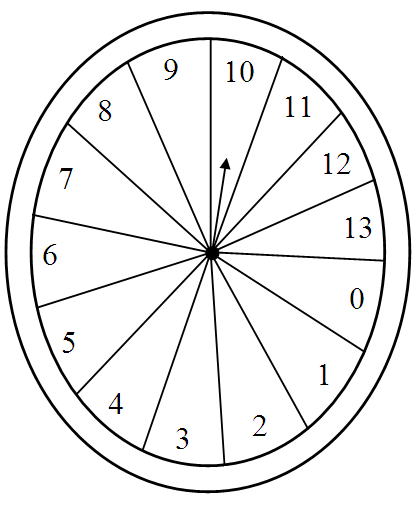
In roulette, Figure, the wheel has 13 numbers 0, 1, 2,...., 12 maked on equally spaced slots. A player sets Rs 10 on a given number. He recieves Rs 100 from the organiser of the game if the ball comes to rest in this slot; otherwise he gets nothing. If X denotes the players net gain/loss, Find E(X).
Answer
$\text{P}(\text{win})=\frac{1}{13}\Rightarrow\text{P}(\text{lose})=\frac{12}{13}$
He gains Rs 90 if he wins and loses Rs 10 if his number does not appear.
Let X denote tptal loss or gain, so,
$\text{X}:$ $90$ $-10$
$\text{P}(\text{X}):$ $\frac{1}{13}$ $\frac{12}{13}$
$\text{XP}:$ $\frac{90}{13}$ $\frac{-120}{13}$
$\text{E}(\text{X})=\sum\text{XP}$
$=\frac{90}{13}-\frac{120}{13}$
$\text{E}(\text{X})=-\frac{30}{13}$
View full question & answer
Question 1003 Marks
If A and B are two independent events such that $\text{P}(\text{A}\cap\text{B})=0.60$ and P(A) = 0.2, find P(B).
Answer
$\text{P}(\text{A}\cup\text{B})=\text{P(A)}+\text{P(B)}-\text{P}(\text{A}\cap\text{B})$
$\text{P}(\text{A}\cup\text{B})=\text{P(A)}+\text{P(B)}-\text{P}(\text{A})\times(\text{B})$
[$\because$ A and B are independent events]
$\Rightarrow\ 0.6=0.2+\text{P(B)}=0.2\times\text{P(B)}$
$\Rightarrow\ 0.6-0.2=\text{P(B)}(1-0.2)$
$\Rightarrow\ \text{P(B)}=\frac{0.6-0.2}{1-0.2}$
$\Rightarrow\ \text{P(B)}=\frac{0.4}{0.8}$
$\Rightarrow\ \text{P(B)}=\frac{1}{2}$
$\Rightarrow\ \text{P(B)}=0.5$
View full question & answer