Question 15 Marks
In a game, a man wins ₹ 5 for getting a number greater than 4 and loses ₹ 1 otherwise, when a fair die is thrown. The man decided to throw a die three but to quit as and when he gets a number greater than 4. Find the expected value of the amount he wins/loses.
Answerlet X = Amount he wins then x = ₹ 5, 4, 3, – 3
P = Probability of getting a no. $>4 = \frac{1}{3}, \text{q} = 1 - \text{p} = \frac{2}{3}$
| X: |
5 |
4 |
3 |
-3 |
| P(x) |
$\frac{1}{3}$ |
$\frac{2}{3}.\frac{1}{3} = \frac{2}{9}$ |
$\bigg(\frac{2}{3}\bigg)^{2}.\frac{1}{3} = \frac{4}{27}$ |
$\bigg(\frac{2}{3}\bigg)^{2}= \frac{8}{27}$ |
Expected amount he wins $=\sum\text{XP(X)} = \frac{5}{3} + \frac{8}{9} + \frac{12}{27} - \frac{24}{27}$
$=₹ \frac{19}{9} \text{or } 2\frac{1}{9}$ View full question & answer→Question 25 Marks
Of the students in a school, it is known that $30 \%$ have $100 \%$ attendanceand $70 \%$ students are irregular. Previous year results report that $70 \%$ of all students who have $100\%$ attendance attain A grade and $10\%$ irregular students attain A grade in their annual examination. At the end of the year, one student is chosen at random from the school and he was found to have an A grade. What is the probability that the student has $100 \%$ attendance? Is regularity required only in school? Justify your answer.
AnswerLet
$E_1$: Selecting a student with $100\%$ attendance.
$E_2$: Selecting a student who is not regular.
$A$: selected student attains A grade.
$\text{P(E}_{1}) = \frac{30}{100} \text{ and } \text{P(E}_{2}) = \frac{70}{100}$
$\text{P(A/E}_{1}) = \frac{70}{100} \text{ and } \text{P(A/E}_{2}) = \frac{10}{100}$
$\text{P(E}_{1}/\text{A}) = \frac{\text{P(E}_{1}). \text{P (A/E}_{1})}{\text{P(E}_{1}). \text{P(A/E}_{1}) + \text{P(E}_{2}) \text{P(A/E}_{2})}$
$= \frac{\frac{30}{100}\times\frac{70}{100}}{\frac{30}{100}\times \frac{70}{100} + \frac{70}{100} \times \frac{10}{100}}$
$= \frac{3}{4}$
View full question & answer→Question 35 Marks
There are 4 cards numbered 1, 3, 5 and 7, one number on one card. Two cards are drawn at random without replacement. Let X denote the sum of the numbers on the two drawn cards. Find the mean and variance of X.
AnswerIt is given that X denote the sum of the numbers on the two drawn cards. Clearly, X can take the values 4, 6, 8, 10 and 12.
P(X = 4) = Probability of getting 4 as sum
= P[(Getting 1 in the first draw and 3 in the second draw) Or (Getting 3 in the first draw and 1 in the second draw)]
$= \frac{1}{4} \times \frac{1}{3} + \frac{1}{4} \times \frac{1}{3} = \frac{2}{12} = \frac{1}{6}$
Similarly,
$\text{P(X} = 6) = \frac{1}{4} \times \frac{1}{3} + \frac{1}{4} \times \frac{1}{3} = \frac{2}{12} = \frac{1}{6}$
$\text{P(X = 8)} = \frac{1}{4} \times \frac{1}{3} + \frac{1}{4} \times \frac{1}{3} + \frac{1}{4} \times \frac{1}{3} + \frac{1}{4} \times\frac{1}{3} = \frac{4}{12} = \frac{2}{6}$
$\text{P(X = 10)} = \frac{1}{4} \times \frac{1}{3} + \frac{1}{4} \times \frac{1}{3} = \frac{2}{12} = \frac{1}{6}$
$\text{P(X = 12)} = \frac{1}{4} \times \frac{1}{3} + \frac{1}{4} \times \frac{1}{3} = \frac{2}{12} = \frac{1}{6}$
Thus, the probability distribution of X is given below:
| $\text{X}$ |
$4$ |
$6$ |
$8$ |
$10$ |
$12$ |
| $\text{P(X)}$ |
$\frac{1}{6}$ |
$\frac{1}{6}$ |
$\frac{2}{6}$ |
$\frac{1}{6}$ |
$\frac{1}{6}$ |
Now,
$\sum p_{i}x_{i} = \frac{1}{6} \times 4 + \frac{1}{6} \times 6 + \frac{2}{6} \times 8 + \frac{1}{6} \times 10 + \frac{1}{6} \times 12$
$= \frac{1}{6} \times (4 + 6 + 16 + 10 + 12)$
$= \frac{1}{6} \times48$
$= 8$
$\sum p_{i}x_{i}^{2} = \frac{1}{6} \times 16 + \frac{1}{6} \times 36 + \frac{2}{6} \times 64 + \frac{1}{6} \times 100 + \frac{1}{6} \times 144$
$ = \frac{1}{6} \times (16 + 36 + 128 + 100 + 144)$
$= \frac{1}{6} \times 424$
$= \frac{212}{3}$
$\therefore \text{Mean[E(X)]} = \sum p_{i} x_{i} = 8$
$\text{Variance} = \sum p_{i}x_{i}^{2} - (\sum p_{i}x_{i})^{2} = \frac{212}{3} - 64 = \frac{212 - 192}{3} = \frac{20}{3}$ View full question & answer→Question 45 Marks
Two numbers are selected at random (without replacement) from the first six positive integers. Let X denote the larger of the two numbers obtained. Find the probability distribution of the random variable X, and hence find the mean of the distribution.
AnswerTotal number of ways of selecting two numbers= $^2C_6 = 15$
Values of x (larger of the two) can be $2, 3, 4, 5, 6$
$\text{ P(x = 2) } = \frac{1}{15},\text{ P(x = 3)} = \frac{2}{15},\text{ P(x = 4)} = \frac{3}{15}$
$\text{P(x = 5)} = \frac{4}{15}\text{ and P(x = 6)} = \frac{5}{15}$
$\therefore$ Distribution can bewritten as
$x: 2 3 4 5 6$
P(x): $\frac{1}{15}\frac{2}{15}\frac{3}{15}\frac{4}{15}\frac{5}{15}$
x P(x): $\frac{2}{15}\frac{6}{15}\frac{12}{15}\frac{20}{15}\frac{30}{15}$
$\text{ Mean } = \sum\text{x}\text{ P(x)} = \frac{70}{15}= \frac{14}{3}.$
View full question & answer→Question 55 Marks
Two schools A and B want to award their selected students on the values of sincerity, truthfulness and helpfulness. The school A wants to award ₹ x each, ₹ y each and ₹ z each for the three respective values to 3, 2 and 1 students respectively with a total award money of ₹ 1,600. School B wants to spend ₹ 2,300 to award its 4, 1 and 3 students on the respective values (by giving the same award money to the three values as before). If the total amount of award for one prize on each value is ₹ 900, using matrices, find the award money for each value. Apart from these three values, suggest one more value which should be considered for award.
AnswerHere $ \begin{matrix} 3\text{x} + 2 \text{y} + \text{z} = 1600 \$0.3em] 4\text{x} + \text{y} + 3\text{y} = 2300 \$0.3em] \text{x} + \text{y} + \text{z} = 900 \end{matrix}$ $\therefore \begin{pmatrix} 3 & 2 & 1 \$0.3em] 4 & 1 & 3 \$0.3em] 1 & 1 & 1 \end{pmatrix}\begin{pmatrix} \text{x} \$0.3em] \text{y} \$0.3em] \text{z} \end{pmatrix}= \begin{pmatrix} 1600 \$0.3em] 2300 \$0.3em] 900 \end{pmatrix}\text{ or }\text{ AX = B |}$ $|\text{A}| = 3(-2)-2(1) + 1(3) = - 5\neq0\therefore\text{X = A}^{-1}\text{B}$ Cofactors are: $\begin{matrix} \text{A}_{11} = -2, & \text{A}_{12} = -1, & \text{A}_{13} = 3 \$0.3em] \text{A}_{21} = -1, & \text{A}_{22} = 2, & \text{A}_{23} = -1 \$0.3em] \text{A}_{31} = 5, & \text{A}_{32} = -5, & \text{A}_{33} = - 5 \end{matrix}$ $\therefore \begin{pmatrix} \text{x} \$0.3em] \text{y} \$0.3em] \text{z} \end{pmatrix} = -\frac{1}{5}\begin{pmatrix} -2 & -1 & 5 \$0.3em] -1 &2 & -5 \$0.3em] 3 & -1 & -5 \end{pmatrix}\begin{pmatrix} 1600 \$0.3em] 2300 \$0.3em] 900 \end{pmatrix}$ $\therefore$ x = 200, y = 300, z = 400i.e. ₹ 200 for sincerity, ₹ 300 for truthfulness and ₹ 400 for helpfulness Onemore value like, honesty, kindness etc.
View full question & answer→Question 65 Marks
A man takes a step forward with probability 0.4 and backward with probability 0.6. Find the probability that at the end of 5 steps, he is one step away from the starting point.
AnswerP (step forward) $= \frac{2}{5},$ P (step backword)$= \frac{3}{5}$
He can remain a step away in either of the ways : 3 steps forward & 2 backwards 1 m or 2 steps forward & 3 backwards
$\therefore \text{required possibility} = ^5{\text{C}_{3}} \bigg(\frac{2}{5}\bigg)^{3}\bigg(\frac{3}{5}\bigg)^{2} + ^5{\text{C}}_{2}\bigg(\frac{2}{5}\bigg)^{2} \bigg(\frac{3}{5}\bigg)^{3}$
$= \frac{72}{125}$
View full question & answer→Question 75 Marks
An urn contains 5 red and 2 black balls. Two balls are randomly drawn, without replacement. Let X represent the number of black balls drawn. What are the possible values of X? Is X a random variable? If yes, find the mean and variance of X.
AnswerPossible values of x are 0, 1, 2 and x is a random variable:
| $\text{x:}$ |
$\text{P(x)}$ |
$\text{x P(x)}$ |
$\text{x}^{2} \text{P(x)}$ |
|
| 0 |
$\frac{^2{\text{C}_{0}}\times^5{\text{C}_{2}}}{^7{\text{C}_{2}}} = \frac{20}{42}$ |
0 |
0 |
$\text{For P (x)}$ |
| 1 |
$\frac{^2{\text{C}_{1}}\times^5{\text{C}_{1}}}{^7{\text{C}_{2}}} = \frac{20}{42}$ |
$\frac{20}{40}$ |
$\frac{20}{42}$ |
$\text{For x P (x)}$ |
| 2 |
$\frac{^2{\text{C}_{2}}\times^5{\text{C}_{0}}}{^7{\text{C}_{2}}} = \frac{2}{42}$ |
$\frac{4}{42}$ |
$\frac{8}{42}$ |
$\text{For x}^{2}\text{ P (x)}$ |
$\sum \text{x P(x)} = \frac{24}{42}; \sum \text{x}^{2} \text{ P(x)} = \frac{28}{42}$ $\text{Mean} = \sum \text{x P(x)} = \frac{4}{7}; \text{variance} = \sum \text{x}^{2} \text{P(x)} - \bigg[\sum \text{x P (x)}\bigg]^{2}$ $\text{Variance} = \frac{50}{147} =\frac{2}{3}- \frac{16}{49} = \frac{50}{147} $ View full question & answer→Question 85 Marks
An experiment succeeds thrice as often as it fails. Find the probability that in the next five trials, there will be at least 3 successes.
AnswerLet probability of success be p and that of failure be q
$\therefore$p = 3 q, and p + q = 1
$\therefore\text{P} = \frac{3}{4}\text{ and }\text{q} = \frac{1}{4}$
$\text{P (atleast 3 successes) = P}\text{(r} \geq 3) = \text{P}(3) + \text{P}(4) + \text{P}(5)$
$ = ^{5}\text{C}_{3}\bigg(\frac{1}{4}\bigg)^{2}.\bigg(\frac{3}{4}\bigg)^{3} + ^{5}\text{C}_{4}\bigg(\frac{1}{4}\bigg)^{1}.\bigg(\frac{3}{4}\bigg)^{4} + ^{5}\text{C}_{5}\bigg(\frac{3}{4}\bigg)^{5}$
$ = \frac{10.27}{1024} + \frac{5.81}{1024} + \frac{243}{1024} = \frac{918}{1024}\text{or }\frac{459}{512}.$
View full question & answer→Question 95 Marks
A bag contains 4 balls. Two balls are random (without replacement) and are found to be white. What is the probability that all balls in the bag are white?
Answer$\text{E}_1 =$ Event that all balls are white,
$\text{E}_2 =$ Event that 3 balls are white and 1 ball is non white
$\text{E}_3 =$ Event that 2 balls are white and 2 balls are non-white
$\text{A} = $ Event that 2 balls drawn without replacement are white
$\text{P(E}_{1}) = \text{P(E}_{2}) = \text{P(E}_{3}) = \frac{1}{3}$
$\text{P(A/E}_{1}) = 1, \text{P(A/E}_{2}) = \frac{3}{4}.\frac{2}{3} = \frac{1}{2}. \text{P(A/E}_{3}) = \frac{2}{3}.\frac{1}{3} = \frac{1}{6}$
$\text{P(E}_{1}{/\text{A}}) = \frac{1.1/3}{1.1/3 + 1/3.1/2 + 1/3.1/6} = \frac{3}{5}$
View full question & answer→Question 105 Marks
Five bad oranges are accidently mixed with 20 good ones. If four oranges are drawn one by one successfully with replacement, then find the probability distribution of number of bad oranges drawn. Hence find the mean and variance of the distribution.
AnswerLet X = Number of bad oranges out of 4 drawn $\text{= 0, 1, 2, 3, 4}$ P = Probability of a bad orange $= \frac{1}{5}, \text{q} = 1 - \text{p} = \frac{4}{5}$ $\therefore$ Probability distribution is:
| $\text{X:}$ |
0 |
1 |
2 |
3 |
4 |
| $\text{P(X):}$ |
$^{4}\text{C}_{0}\bigg(\frac{4}{5}\bigg)^{4} = \frac{256}{625}$ |
$^{4}\text{C}_{1}\frac{1}{5}\bigg(\frac{4}{5}\bigg)^{3}$ |
$^{4}\text{C}_{2}\bigg(\frac{1}{5}\bigg)^{2}\bigg(\frac{4}{5}\bigg)^{2}$ |
$^{4}\text{C}_{3}\bigg(\frac{1}{5}\bigg)^{2}\bigg(\frac{4}{5}\bigg)$ |
$^{4}\text{C}_{4}\bigg(\frac{1}{5}\bigg)^{4}$ |
| |
|
$=\frac{256}{625}$ |
$=\frac{96}{625}$ |
$=\frac{16}{625}$ |
$=\frac{1}{625}$ |
$\text{Mean}(\mu) = \sum\text{X.P(X)} = 0\times\frac{256}{625} + 1 \times \frac{256}{625}+2\times\frac{96}{625} + 3\frac{16}{625} + 4\times\frac{1}{625} = \frac{4}{5}$ $\text{Variance}(\sigma^{2}) = \sum\text{x}^{2}.\text{P(x)} -|\sum\text{x.P(x)|}^{2}$ $= 0\times\frac{256}{625} + \frac{1\times256}{625} + \frac{4\times96}{625} + \frac{9\times16}{625} + \frac{16}{625} - \bigg(\frac{4}{5}\bigg)^{2} = \frac{16}{25}$ View full question & answer→Question 115 Marks
There are three coins. One is a two-headed coin (having head on both faces), another is a biased coin that comes up heads $75\%$ of the times and third is also a biased coin that comes up tails $40\%$ of the times. One of the three coins is chosen at random and tossed, and it shows heads. What is the probability that it was the two-headed coin?
AnswerLet event $E_1$: choosing first (two headed) coin
$E_2$: choosing 2nd (biased) coin
$E_3$: choosing 3rd (biased) coin
$\therefore\text{ P(E}_{1}) = \text{P(E}_{2}) = \text{P(E}_{3}) = \frac{1}{3}$
A: The coin showing heads.
$\therefore\text{ P(A/E}_{1}) = 1, \text{P(A/E}_{2}) = \frac{75}{100} = \frac{3}{4},\text{ P(A/E}_{3}) = \frac{60}{100} =\frac{3}{5}$
$P(E_1/A) = \frac{\frac{1}{3}.1}{\frac{1}{3}.1 + \frac{1}{3}.\frac{3}{4} + \frac{1}{3}.\frac{3}{5}}$
$ =\frac{20}{47}.$
View full question & answer→Question 125 Marks
The probabilities of two students A and B coming to the school in time are $\frac{3}{7}\text{ and }\frac{5}{7}$ respectively. Assuming that the events, ‘A coming in time’ and ‘B coming in time’ are independent, find the probability of only one of them coming to the school in time. Write at least one advantage of coming to school in time.
AnswerLet $E_1$ and $E_2$ be two events such that
$E_1 = A$ coming to the school in time.
$E_2 = B$ coming to the school in time.
Here $\text{P}(\text{E}_{1}) = \frac{3}{7}\text{ and }\text{P}(\text{E}_{2}) = \frac{5}{7}$
$\Rightarrow\text{P}(\overline{\text{E}}_{1}) = \frac{4}{7},\text{P}(\overline{\text{E}}_{2}) = \frac{2}{7}$
P (only one of them coming to the school in time) $ = \text{P}(\text{E}_{1})\times\text{P}(\overline{\text{E}}_{2}) + \text{P}(\overline{\text{E}}_{1})\times\text{P}(\text{E}_{2})$
$ = \frac{3}{7}\times\frac{2}{7} + \frac{5}{7}\times\frac{4}{7}$
$ = \frac{6}{49} +\frac{20}{49} = \frac{26}{49}$
Coming to school in time i.e., punctuality is a part of discipline which is very essential for development of an individual.
View full question & answer→Question 135 Marks
In a hockey match, both teams $A$ and $B$ scored same number of goals up to the end of the game, so to decide the winner, the referee asked both the captains to throw a die alternately and decided that the team, whose captain gets a six first, will be declared the winner. If the captain of team A was asked to start, find their respective probabilities of winning the match and state whether the decision of the referee was fair or not.
AnswerLet $E_1, E_2$ be two events such that
$E_1$ = the captain of team ‘A’ gets a six.
$E_2$ = the captain of team ‘B’ gets a six.
Here $\text{P}(\text{E}_{1}) =\frac{1}{6},\text{P}(\text{E}_{2}) = \frac{1}{6}$
$\text{P}(\text{E}'_{1}) = 1 - \frac{1}{6} = \frac{6}{5},\text{P}(\text{E}'_{1}) = 1 - \frac{1}{6} = \frac{5}{6}$
Now P (winning the match by team A) $ = \frac{1}{6} + \frac{5}{6}\times\frac{5}{6}\times\frac{1}{6} + \frac{5}{6}\times\frac{5}{6}\times\frac{5}{6}\times\frac{5}{6}]\times\frac{1}{6} + ......................$
$ = \frac{1}{6} + \big(\frac{5}{6}\big)^{2}.\frac{1}{6} + \big(\frac{5}{6}\big)^{4}.\frac{1}{6} + ............$
$ = \frac{\frac{1}{6}}{1 - \bigg(\frac{5}{6}\bigg)^{2}} = \frac{1}{6} \times\frac{36}{11}= \frac{6}{11}$
$\therefore\text{ P (winning the match by team B) } = 1 - \frac{6}{11} = \frac{5}{11}$
[Note: If a be the first term and r the common ratio then sum of infinite terms]
$\text{S}_{\infty} = \frac{\text{a}}{1 -\text{r}}$
The decision of refree was not fair because the probability of winning match is more for that team who start to throw dice.
View full question & answer→Question 145 Marks
Two cards are drawn simultaneously (without replacement) from a well-shuffled pack of 52 cards. Find the mean and variance of the number of red cards.
AnswerNumber of red cards = 26Let X be a random variable which can take values
0, 1, 2 where X is the no. of red cards selected
$\therefore$ X = 0 means 0 red card
P(X = 0) = $\frac{26_{\text{c}_{2}}}{\text{52}_{\text{c}_{2}}}=\frac{26\times25}{52\times51}=\frac{25}{102}$
P(X = 1) = $\frac{26_{\text{c}_{1}}\times26_{\text{c}_{1}}}{\text{52}_{\text{c}_{2}}}=\frac{26\times26\times2}{52\times51}=\frac{52}{102}$
P(X = 2) = $\frac{26_{\text{c}_{2}}}{\text{52}_{\text{c}_{2}}}=\frac{26\times25}{52\times51}=\frac{52}{102}$
Probability distribution of random variable X is
| X |
0 |
1 |
2 |
| P(X) |
25/102 |
52/102 |
25/102 |
Mean = $\Sigma$ x P(X) = $\frac{52+50}{102}=1$
variance = $\Sigma\text{x}^{2}\text{P(X)-(}\Sigma\text{xP(X))}^{2}=\frac{152}{102}-1=\frac{50}{102}\text{ OR }\frac{25}{51}$. View full question & answer→Question 155 Marks
Suppose a girl throws a die. If she gets a $5$ or $6$, she tosses a coin $3$ times and notes the number of heads. If she gets $1, 2, 3$ or $4$ she tosses a coin once and notes whether a head or tail is obtained. If she obtained exactly one head, what is the probability that she threw $1, 2, 3$ or $4$ with the die?
AnswerLet the events be
$E_1:$ Getting 5 or 6 in a single throw of a die
$E_2:$ Getting 1, 2, 3 or 4 in a single throw of a die
A: Getting exactly one Head
$P (E_1)$ = $\frac{2}{6}=\frac{1}{3},\text{P(E}_{2})=\frac{4}{6}=\frac{2}{3}$
$P (A/E_1)$ = $3_{\text{c}_{1}}\Bigg(\frac{1}{2}\Bigg)^{1}\Bigg(\frac{1}{2}\Bigg)^{2}=\frac{3}{8}$ (A coin is tossed thrice)
$P (A/E_2)$ = $\frac{1}{2 }$ (A coin is tossed once)
$\therefore\text{P(E}_{2}\text{/A)}=\frac{\text{P(E}_{2})\cdot\text{P(A/E}_{2})}{\Sigma\text{P(E}_{\text{i}})\text{P(A/E}_{\text{i}})}$
$=\frac{\frac{2}{3}\times\frac{1}{2}}{\frac{1}{3}\times\frac{3}{8}+\frac{1}{2}\times\frac{2}{3}}=\frac{\frac{1}{3}}{\frac{1}{8}+\frac{1}{3}}=\frac{8} {11}$.
View full question & answer→Question 165 Marks
Find the probability of throwing at most 2 sixes in 6 throws of a single die.
AnswerHere n = 6, probability of success (p) = $\frac{1}{6}$
probability of failure (q) = $\frac{5}{6}$
P (at most 2 sixes) = P(0) + P(1) + P(2)
= $=6_{\text{c}_0}\Bigg(\frac{1}{6}\Bigg)^{0}\cdot\Bigg(\frac{5}{6}\Bigg)^{6}+6_{\text{c}_1}\Bigg(\frac{1}{6}\Bigg)^{1}\cdot\Bigg(\frac{5}{6}\Bigg)^{5}+6_{\text{c}_2}\Bigg(\frac{1}{6}\Bigg)^{2}\cdot\Bigg(\frac{5}{6}\Bigg)^{4} $
$=\Bigg(\frac{5}{6}\Bigg)^{6}+\Bigg(\frac{5}{6}\Bigg)^{5}+\frac{1}{2}\Bigg(\frac{5}{6}\Bigg)^{5}=\frac{7}{3}\Bigg(\frac{5}{6}\Bigg)^{5}$.
View full question & answer→Question 175 Marks
A random variable $X$ has the following probability distribution:
| $X$ |
$0$ |
$1$ |
$2$ |
$3$ |
$4$ |
$5$ |
$6$ |
$7$ |
| $P(X)$ |
$0$ |
$K$ |
$2K$ |
$2K$ |
$3K$ |
$K^2$ |
$2K^2$ |
$7K^2+ K$ |
Determine:
- $K.$
- $P(X < 3).$
- $P(X > 6).$
- $P(0 < X < 3).$
AnswerHere $k + 2k + 2k + 3k + k^2 + 2k^2 + 7k^2 + k =1$
$\Rightarrow 10k^2 + 9k –1 = 0$
$\Rightarrow (10k – 1) (k + 1) = 0 $
$\Rightarrow k = \frac{1}{10}$
$\therefore \text{ (i) k =}\frac{1}{10}$
$(ii) P(x < 3) = 0 + k + 2k = 3k = \frac{3}{10}$
$(iii) P(x > 6) = 7k^2 + k = \frac{7}{100}+\frac{1}{10}=\frac{17}{100}$
$(iv) P(0 < x < 3) = k + 2k = 3k = \frac{3}{10}$
View full question & answer→Question 185 Marks
Given three identical boxes I, II and III each containing two coins. In box I, both coins are gold coins, in box II, both are silver coins and in box III, there is one gold and one silver coin. A person chooses a box at random and takes out a coin. If the coin is of gold, what is the probability that the other coin in the box is also of gold?
AnswerLet $E_1:$ selecting box $I, E_2: $ selecting box II and $E_3:$ selecting box $III$
$\therefore P (E_1) = P (E_2) = P (E_3) = \frac{1}{3}$
let event A: Getting a gold coin
$\therefore P (A/E_1) = 1 P (A/E_2) = 0 P (A/E_3) = \frac{1}{2} P(E_1/A) = \frac{\text{P(E}_{1})\cdot\text{P(A/E}_{1})}{\text{P(E}_{1})\text{P(A/E}_{1})+\text{P(E}_{2})\text{P(A/E}_{2})+\text{P(E}_{3})\text{P(A/E}_{3})}$ = $ \frac{\frac{1}{3}\cdot1}{\frac{1}{3}\cdot1+0+\frac{1}{3}\cdot\frac{1}{2}}=\frac{2}{3}$.
View full question & answer→Question 195 Marks
A family has 2 children. Find the probability that both are boys, if it is known that.
- at least one of the children is a boy,
- the elder child is a boy.
AnswerLet event A is that the family has two boys
- event B: At least one is a boy
P(both boys, given that at least one is a boy) = P(A/B)
$=\frac{\text{P(A}\cap\text{B}}{\text{P(B)}}=\frac{\text{P}\{\text{(B,B)}\}}{\text{P}\{\text{(B,G),(G,B),(B,B),}\}}\\ =\frac{1/4}{3/4}=\frac{1}{3}$
- event C: the elder child is a boy
P(both boys, given that at elder child is a boy)= P(A/C)
$=\frac{\text{P(A}\cap\text{C})}{\text{P(C)}}=\frac{\text{P}\{\text{(B,B)}\}}{\text{P}\{\text{(B,G),(B,B),}\}}\\ =\frac{1/4}{2/4}=\frac{1}{2}$ View full question & answer→Question 205 Marks
A bag contains $4$ balls. Two balls are drawn at random, and are found to be white. What is the probability that all balls are white?
Answer$E_1$ : Bag contains $2$ white balls and $2$ non whites $E_2$ : Bag contains $3$ white balls and $1$ non whites $1$ m $E_3$: Bag contains $4$ white balls A : Getting two white balls $\text{P}\big(\text{E}_1\big)=\frac{1}{3},\text{P}\big(\text {E}_2\big)=\frac{1}{3}$$\text{P(A/E}_1)=\frac{2\text{c}_2}{4\text{c}_2}=\frac {1}{6},\text{ P(A/E}_2)=\frac{3\text{c}_2}{4\text{c}_2}=\frac{1}{2},\text{ P(A/E}_3)=1$
$\text{P(E}_3/\text{A})=\frac{\text{P(E}_3)\dot{}\text{P(A/E}_3)}{\text{P}\big(\text{E}_1\big)\ \text{P}\big(\text{A}/\text{E}_1)+\text{P(A/E}_2)\ \text{P(A/E}_2)+\text{P(E}_3)\ {\text {P}\big(\text{A/E}_3)}}$
$=\frac{\frac{1}{3}\dot{}1}{\frac{1}{3}\dot{}\frac{1}{6}+\frac{1}{3}\dot{}\frac{1}{2}+\frac{1}{3}\dot{}1}$ $=\frac{6}{10}=\frac{3}{5}$
View full question & answer→Question 215 Marks
On a multiple choice examination with three possible answers (out of which only one is correct) fo each of the five questions, what is the probability that a candidate would get four or more correct answers just by guessing?
AnswerHere $\text{p }=\frac{1}{3},\text{ q}=\frac{2}{3},\text{ n = 5}$
Let x denote the number of successes
$\therefore$ Probability of r successes is given by
$\text{P(x = r) = n}_{c},\text{(p)}^{\text{r}}\text{(q)}^{\text{n - r}},\text{r = 1,2,3.}$
$\therefore\text{P(x = 4, 5) = 5}_{\text{C}_4}\Bigg(\frac{1}{3}\Bigg)^{4}\Bigg(\frac{2}{3}\Bigg)+\text{5}_{\text{c}_{5}}\Bigg(\frac{1}{3}\Bigg)^{5}$
$=\frac{10}{243}+\frac{1}{243}=\frac{11}{243}.$
View full question & answer→Question 225 Marks
Coloured balls are distributed in three bags as shown in the following table:
| Bag |
Colour of the ball |
| Black |
White |
Red |
| I |
1 |
2 |
3 |
| II |
2 |
4 |
1 |
| III |
4 |
5 |
3 |
A bag is selected at random and then two balls are randomly drawn from the selected bag. They happen to be black and red. What is the probability that they came from bag I?
Answer$E_1$: The event that bag I is selected
$E_2$: The event that bag II is selected
$E_3$: The event that bag III is selected
A : The event that a black ball and a red ball have occurred
$\therefore\text{P(E}_{1})=\text{P(E}_{2})=\text{P(E}_{3})=\frac{1}{3}$
$\therefore\text{P}\Big(\text{A/E}_{1}\Big)=\frac{1\times3}{6_{\text{C}_{2}}},\text{ P}\Big(\text{A/E}_{2}\Big)=\frac{2\times1}{7_{\text{C}_{2}}},\text{ P}\Big(\text{A/E}_{3}\Big)=\frac{4\times3}{12_{\text{C}_{2}}}$
| $\text{P}\Big(\text{A/E}_{1}\Big)=\frac{1\times3}{6_{\text{C}_{2}}},$ |
$\text{ P}\Big(\text{A/E}_{2}\Big)=\frac{2\times1}{7_{\text{C}_{2}}},$ |
$\text{ P}\Big(\text{A/E}_{3}\Big)=\frac{4\times3}{12_{\text{C}_{2}}}$ |
| $=\frac{1}{5}$ |
$=\frac{2}{21}$ |
$=\frac{2}{11}$ |
$\therefore\text{P}\Big(\text{E}_{1}/\text{A}\Big)=\frac{\text{P}\Big(\text{A}/\text{E}_{1}\Big)\cdot\text{P(E}_{1})}{\displaystyle\sum_{i=1}^{3}\text{P}\Big(\text{A}/\text{E}_{\text{i}}\Big)\cdot\text{P(E}_{\text{i}}) }$
$=\frac{\frac{1}{3}\times\frac{1}{5}}{\frac{1}{3}\times\frac{1}{5}+\frac{1}{3}\times\frac{2}{21}+\frac{1}{3}\times\frac{2}{11}}=\frac{231}{551}.$ View full question & answer→Question 235 Marks
12 cards, numbered 1 to 12, are placed in a box, mixed up thoroughly and then a card is drawn at random from the box. If it is known that the number on the drawn card is more than 3, find the probability that it is an even number.
AnswerLet A be the event that the card taken out has an even number and B is the event that the card taken out bears a number > 3S = {1, 2, 3,...........,12}
A = {2, 4, 6, 8, 10, 12}
B = {4, 5, 6, 7, 8, 9, 10, 11, 12}
$\text{A}\cap\text{B}$ = {4, 6, 8, 10, 12}
P(A) = $\frac{6}{12}=\frac{1}{2},\text{ P(B)}=\frac{9}{12}=\frac{3}{4},\text{ P(A}\cap\text{B)}=\frac{5}{12}$
P(A/B) = $\frac{\text{P(A}\cap\text{B)}}{\text{P(B)}}=\frac{5/12}{9/12}$
$=\frac{5}{9}$.
View full question & answer→Question 245 Marks
In a bulb factory, machines A, B and C manufacture $60 \%, 30 \%$ and $10 \%$ bulbs respectively. $1 \%, 2 \%$ and $3 \%$ of the bulbs produced respectively by $\mathrm{A}, \mathrm{B}$ and C are found to be defective. A bulb is picked up at random from the total production and found to be defective. Find the probability that this bulb was produced by the machine A.
AnswerLet $E_1, E_2, E_3$ be the events that the bulb has been manufactured on Machines
A, B and C respectively. Let A be the event that bulb is defective.
$\therefore\text{ P(E}_{1})=\frac{6}{10},\text{ P(E}_{2})=\frac{3}{10},\text{ P(E}_{3})=\frac{1}{10},$
$\text{P(A/E}_{1})=\frac{1}{100},\text{ P(A/E}_{2})=\frac{2}{100},\text{ P(A/E}_{3})=\frac{3}{100}$
$\text{P(E}_{1}/\text{A})=\frac{\text{P(E}_{1})\cdot\text{P(A/E}_{1})}{\displaystyle\sum_{\text{i=1}}^{3} \text{P(E}_{1})\cdot\text{P(A/E}_{1})}$
$=\frac{\frac{6}{10}\times\frac{1}{100}}{\frac{6}{10}\times\frac{1}{100}+\frac{3}{10}\times\frac{2}{100}+\frac{1}{10}\times\frac{3}{100}}=\frac{6}{6+6+3}=\frac{2}{5}.$
View full question & answer→Question 255 Marks
The mean and variance of the binomial distribution are 4 and $\frac{4}{3}$ respectively. Find the distribution and P(X>1).
AnswerMean = np = 4, Variance = npq = $\frac{4}{3}\Rightarrow\text{q}=\frac{1}{3},$
$\therefore\text{p}=1-\frac{1}{3}=\frac{2}{3}$
$\text{n}=\frac{4.3}{2}=6$
$\therefore$ Distribution is $\Bigg(\frac{1}{3}+\frac{2}{3}\Bigg)^{6}$
P(X > 1) = 1 - P(X = 0) = 1 -$\Bigg(\frac{1}{3}\Bigg)^{6}\text{ OR }\frac{728}{729}.$
View full question & answer→Question 265 Marks
A box has 20 pens of which 2 are defective. Calculate the probability that out of 5 pens drawn one by one with replacement, at most 2 are defective.
AnswerLet selection of defective pen be considered success
$\text{p} = \frac{2}{20} = \frac{1}{10}, \text{q} = \frac{9}{10}$
Reqd probability = P(x = 0) + P(x = 1) + P(x = 2)
$= \text{ }^5\text{C}_{0}\bigg(\frac{1}{10}\bigg)^{0}\bigg(\frac{9}{10}\bigg)^{5} + \text{ }^5\text{C}_{1} \bigg(\frac{1}{10}\bigg)^{1} \bigg(\frac{9}{10}\bigg)^{4} + \text{ }^5\text{C}_{2} \bigg(\frac{1}{2}\bigg)^{2} \bigg(\frac{9}{10}\bigg)^{3}$
$= \bigg(\frac{9}{10}\bigg)^{5} + \frac{1}{2} \bigg(\frac{9}{10}\bigg)^{4} + \frac{1}{10} \times \bigg(\frac{9}{10}\bigg)^{3}$
$= \bigg(\frac{9}{10}\bigg)^{3} \times\frac{34}{25}$
View full question & answer→Question 275 Marks
In a shop X, 30 tins of pure ghee and 40 tins of adulterated ghee which look alike, are kept for sale while in shop Y, similar 50 tins of pure ghee and 60 tins of adulterated ghee are there. One tin of ghee is purchased from one of the randomly selected shops and is found to be adulterated. Find the probability that it is purchased from shop Y. What measures should be taken to stop adulteration?
AnswerLet A be the event that the ghee is adulterated.
Shop X contains 30 pure ghee container and 40 adultered container.
$\therefore$ Probability of adultered ghee container $= \text{P(A/X)} = \frac{40}{70} = \frac{4}{7}$
Shop Y contains 50 pure ghee container and 60 adultered container.
$\therefore$ Probability of adultered ghee container $= \text{P(A/Y)} = \frac{60}{110} = \frac{6}{11}$
Also, Probability of choosing a shop is $\frac{1}{2},$ as both shop have equal probability of choosing.
$\text{P(X) = P(Y)} = \frac{1}{2}$
SO,
Required Probability, P(Y/A)
$\frac{\text{P(Y)}\times \text{P(A/Y)}}{\text{P(X)} \times \text{P(A/X) + P(Y)} \times \text{P(A/Y)}}$
$= \frac{\frac{1}{2} \times\frac{6}{11}}{\frac{1}{2}\times \frac{4}{7} + \frac{1}{2} \times \frac{6}{11}}$
$= \frac{\frac{6}{11}}{\frac{4}{7} + \frac{6}{11}} = \frac{21}{43}$
As adulteration is rampant everywhere, consumer should be aware of adulterators and one should take steps to safeguard themselves against those food items.
View full question & answer→Question 285 Marks
Let, X denote the number of colleges where you will apply after your results and P (X = x) denotes your probability of getting admission in x number of colleges. It is given that
$ \text{P(x = }x) = \begin{cases} \text{K}x\text{ }\text{ }\text{ }\text{ }\text{ }\text{ }\text{ }\text{ }\text{ }\text{ }\text{ }\text{ }\text{ }, & \text{if } x = 0 \text{ or 1}\\ 2\text{k}x\text{ }\text{ }\text{ }\text{ }\text{ }\text{ }\text{ }\text{ }\text{ }\text{ }\text{ }\text{ }, & \text{if } x = 2\\ \text{k} (5 - x)\text{ }\text{ }\text{ }\text{ }, &\text{if } x = 3 \text{ or 4'}\\ 0\text{ }\text{ }\text{ }\text{ }\text{ }\text{ }\text{ }\text{ }\text{ }\text{ }\text{ }\text{ }\text{ }\text{ }\text{ }\text{ }\text{ }, & \text{if } x > 4 \end{cases}$
where k is a positive constant. Find the value of k. Also find the probability that you will get admission in (i) exactly one college (ii) at most 2 colleges (iii) at least 2 colleges.
Answer$\sum\limits^{4}_{\text{i = 0}} \text{P(x}_{\text{i}}) = 1$
$\Rightarrow \text{8k = 1} \Rightarrow \text{k} = \frac{1}{8}$
- $\text{P(x = 1)} = \frac{1}{8}$
- P(at most 2 colleges) = P(0) + P(1) + P(2)
$= \frac{5}{8}$
- P(atleast 2 colleges) = 1 – [P(x = 0) + P(x = 1)]
$= 1 - \frac{1}{8} = \frac{7}{8}$ View full question & answer→Question 295 Marks
Bag A contains $3$ red and $5$ black balls, while bag B contains $4$ red and $4$ black balls. Two balls are transferred at random from bag A to bag B and then a ball is drawn from bag B at random. If the ball drawn from bag B is found to be red, find the probability that two red balls were transferred from A to B.
AnswerLet $H_1$ be the event 2 red balls are transferred.
$H_2$ be the event 1 red and 1 balck ball, transferred.
$H_3$ be the event 2 black and 1 balck ball transferred.
E be the event that ball drawn from B is red.
| $\text{P(H}_{1}) = \frac{\text{ }^{3}\text{C}_{2}}{\text{ }^{8}\text{C}_{2}} = \frac{3}{8} $ |
$\text{P(E/H}_{1}) = \frac{6}{10}$ |
| $\text{P(H}_{2}) = \frac{\text{ }^{3}\text{C}_{1}\times \text{ }^{5}\text{C}_{1}}{\text{ }^{8}\text{C}_{2}} = \frac{15}{28}$ |
$\text{P(E/H}_{2}) = \frac{5}{10}$ |
| $ \text{P(H}_{3}) = \frac{\text{ }^{5}\text{C}_{2}}{\text{ }^{8}\text{C}_{2}} = \frac{10}{28} $ |
$\text{P(E/H}_{3}) = \frac{4}{10}$ |
$\text{P(H}_{1}/\text{E}) = \frac{\frac{3}{28} \times \frac{6}{10}}{\frac{3}{28} \times\frac{6}{10} + \frac{15}{28} \times\frac{5}{10} + \frac{10}{28} \times \frac{4}{10}}$
$= \frac{18}{133}$ View full question & answer→Question 305 Marks
The random variable X can take only the values 0, 1, 2, 3. Given that P(X = 0) = P(X = 1) = p and P(X = 2) = P(X = 3) such that $\sum{\text{p}}_{\text{i}}x^{2}_{\text{i}} = 2\sum\text{p}_{\text{i}}x_{\text{i}},$find the value of p.
Answer$\begin{array}{c|c} \text{x} & \text{P(x} \\ \hline 0 & \text{p}\\ 1 & \text{p}\\ 2 & \text{k}\\ 3 & \text{k} \end{array}$
$\sum\text{p(x)} = 1 \Rightarrow \text{2p + 2k = 1} \Rightarrow \text{k} = \frac{1}{2} - \text{p}$
| $\text{x}_{\text{i}}$ |
$\text{p}_{\text{i}}$ |
$\text{p}_{\text{i}}\text{x}_{\text{i}}$ |
$\text{p}_{\text{i}}\text{x}^{2}_{\text{i}}$ |
$0$
$1$
$2$
$3$ |
$\text{p}$
$\text{p}$
$\frac{1}{2} - \text{p}$
$\frac{1}{2} - \text{p}$ |
$0$
$\text{p}$
$\text{1 - 2p}$
$\frac{3}{2} - \text{3p}$ |
$0$
$\text{p}$
$\text{2 - 4p}$
$\frac{9}{2} - \text{9p}$ |
| |
|
$\frac{5}{2} - \text{4p}$ |
$\frac{13}{2} - \text{12p}$ |
As per problem, $\sum{\text{p}}_{\text{i}}\text{x}^{2}_{\text{i}} = 2\sum\text{p}_{\text{i}}\text{x}_{\text{i}}$
$\Rightarrow \text{p} = \frac{3}{8}$ View full question & answer→Question 315 Marks
An unbiased coin is tossed 4 times, Find the mean and variance of the number of heads obtained.
Answer
| $\text{X}$ |
: |
0 |
1 |
2 |
3 |
4 |
| $ \text{P (x) }$ |
: |
$^{4}C_{0} \bigg(\frac{1}{2}\bigg)^{4} $ |
$^{4}C_{1} \bigg(\frac{1}{2}\bigg)^{3}\bigg(\frac{1}{2}\bigg)$ |
$^{4}C_{2} \bigg(\frac{1}{2}\bigg)^{2} \bigg(\frac{1}{2}\bigg)^{2}$ |
$^{4}C_{3} \bigg(\frac{1}{2}\bigg)\bigg(\frac{1}{2}\bigg)^{3}$ |
$^{4}C_{4} \bigg(\frac{1}{2}\bigg)^{4} $ |
| |
: |
$= \frac{1}{16}$ |
$= \frac{4}{16}$ |
$= \frac{6}{16}$ |
$= \frac{4}{16}$ |
$= \frac{1}{16}$ |
| $\text{x P (x)}$ |
: |
0 |
$\frac{4}{16}$ |
$\frac{12}{16}$ |
$\frac{12}{16}$ |
$\frac{4}{16}$ |
| $\text{x}^{2}\text{P(x)}$ |
: |
0 |
$\frac{4}{16}$ |
$\frac{24}{16}$ |
$\frac{36}{16}$ |
$\frac{16}{16}$ |
Mean $=\sum \text{x P (x)} \frac{32}{16} = 2$
Variance $= \sum \text{x}^{2} \text{P(x)} - \bigg(\sum \text{x P (x)}\bigg)^{2} = \frac{80}{16} - (2)^{2} = 1$ View full question & answer→Question 325 Marks
If A and B are two independent events such that $\text{P}\overline{\text({A}} \cap \text{B}) = \frac{2}{15} \text{and P} (\text{A}\cap \overline{\text{B)}} = \frac{1}{6},$ then find P(A) and P(B).
Answer$\text{P}\overline{\text({A}} \cap \text{B}) = \frac{2}{15} \Rightarrow \text{P}\overline{\text{(A)}} .\text{P} (\text{B)} = \frac{2}{15}$ $\text{P}(\text{A}\cap \overline{\text{B)}} = \frac{1}{6}, \Rightarrow \text{P(A)}.\text{P}\overline{\text{(B)}} = \frac{1}{6}$ $\therefore \text{( 1 - P(A)) P(B)} = \frac{2}{15} \text{or P (B) - P (A). P (B)} = \frac{2}{15} \dots\dots\dots \text{(i)}$ $\text{P (A) (1 - P (B))} = \frac{1}{6} \text{or P (A) - P (A) . P (B)} = \frac{1}{6}\dots\dots\dots\dots\text{(ii)}$ From (i) and (ii) $\text{P (A) - P (B)} = \frac{1}{6} - \frac{2}{15} = \frac{1}{30}$ $\text{Let P (A)} = \text{x, P(B) = y} \therefore \text{x} = \bigg(\frac{1}{30} + \text{y}\bigg)$ $\text{(i)} \Rightarrow \text{y} - \bigg(\frac{1}{30} + \text{y}\bigg) \text{y} = \frac{2}{15} \therefore 30\text{y}^{2} - 29\text{y} + 4 = 0$ Solving to get $\text{y} = \text{1/6 or y = 4/5} $ $\therefore \text{x = 1/5 or x = 5/6} $ $\text{Hence P (A) = 1/5, P(B) = 1/6 OR P(A) = 5/6, P(B) = 4/5}$
View full question & answer→Question 335 Marks
The random variable $X$ can take only the values $0, 1, 2, 3.$ Given that $P(2) = P(3) = p$ and $P(0) = 2P(1)$. If $\Sigma p_ix_i^2 = 2\Sigma p_ix_i,$ find the value of $p.$
Answer
| $\text{x}_{\text{i}}$ |
$\text{p}_{\text{i}}$ |
$\text{p}_{\text{i}}\text{x}_{\text{i}}$ |
$\text{p}_{\text{i}}\text{x}^{2}_{\text{i}}$ |
$0$
$1$
$2$
$3$ |
$\text{2q}$
$\text{q}$
$\text{p}$
$ \text{p}$ |
$0$
$\text{q}$
$\text{2p}$
$\text{3p}$ |
$0$
$\text{q}$
$\text{4p}$
$\text{9p}$ |
$\Sigma pi = 1 ⇒ 3q + 2p= 1..(1)$
$\Sigma pixi2 = 2 \Sigma pixi ⇒ q = 3p..(2)$
from (1) and (2), p = $\frac{1}{11}$ View full question & answer→Question 345 Marks
Three persons A, B and C apply for a job of Manager in a Private Company. Chances of their selection (A, B and C) are in the ratio $\text{1 : 2 : 4. }$The probabilities that A, B and C can introduce changes to improve profits of the company are 0.8, 0.5 and 0.3 respectively. If the change does not take place, find the probability that it is due to the appointment of C.
AnswerLet event are:
$\text{E}_{1}:$ A is selected
$\text{E}_{2}:$ B is selected
$\text{E}_{3}:$ C is selected
$\text{A}:$ Change is not introducted
$\text{P (E}_{1}) = \frac{1}{7}, \text{P (E}_{2}) = \frac{2}{7}, \text{P (E}_{3}) = \frac{4}{7}$
$\text{P (A/E}_{1}) = 0.2, \text{P (A/E}_{2}) = 0.5,\text{P (A/E}_{3}) = 0.7$
$\therefore\text{P (E}_{3}/\text{A}) =\frac{\frac{4}{7}\times\frac{7}{10}}{\frac{1}{7}\times\frac{2}{10}+\frac{2}{7}\times\frac{5}{10} + \frac{4 }{7}\times\frac{7}{10}}$
$= \frac{28}{40} = \frac{7}{10}$
View full question & answer→Question 355 Marks
An urn contains 3 white and 6 red balls. Four balls are drawn one by one with replacement from the urn. Find the probability distribution of the number of red balls drawn. Also find mean and variance of the distribution.
Answer$\text{X = No. of red}$
| $\text{X}:$ |
0 |
1 |
2 |
3 |
4 |
| $\text{P(X)}:$ |
$^{4}{C}_{0}\bigg(\frac{1}{3}\bigg)^{4}$
$= \frac{1}{81}$ |
$^{4}{C}_{1}\bigg(\frac{1}{3}\bigg)^{3}\frac{2}{3}$
$= \frac{8}{81}$ |
$^{4}{C}_{2}\bigg(\frac{1}{3}\bigg)^{2}\bigg(\frac{2}{3}\bigg)^{2}$
$=\frac{24}{81}$ |
$^{4}{C}_{3}\bigg(\frac{1}{3}\bigg)\bigg(\frac{2}{3}\bigg)^{3}$
$= \frac{32}{81}$ |
$^{4}{C}_{4}\bigg(\frac{2}{3}\bigg)^{4}$
$=\frac{16}{81}$ |
| $\text{XP(X)}:$ |
0 |
$\frac{8}{81}$ |
$\frac{48}{81}$ |
$\frac{96}{81}$ |
$\frac{64}{81}$ |
| $\text{X}^{2}\text{P(X)}:$ |
0 |
$\frac{8}{81}$ |
$\frac{96}{81}$ |
$\frac{288}{81}$ |
$\frac{256}{81}$ |
$\text{Mean } = \sum\text{XP(X)} = \frac{216}{81} = \frac{8}{3}$
$\text{Variance} = \sum\text{X}^{2}\text{P(X)} - [\sum\text{XP(X)}]^2 = \frac{648}{81} - \frac{64}{9} = \frac{8}{9}$ View full question & answer→Question 365 Marks
From a lot of 15 bulbs which include 5 defectives, a sample of 4 bulbs is drawn one by one with replacement. Find the probability distribution of number of defective bulbs. Hence find the mean of the distribution.
AnswerX = No. of defective bulbs out of 4 drawn = 0, 1, 2, 3, 4
Probability of defective bulb = $\frac{5}{15} = \frac{1}{3}$
Probability of a non defective bulb = $1 - \frac{1}{3} = \frac{2}{3}$
Probabilitydistribution is:
x: 0 1 2 3 4
P(x): $\frac{16}{81}\frac{32}{81}\frac{24}{81}\frac{8}{81}\frac{1}{81}$
x P(x): $0 \frac{ 32}{81}\frac{48}{81}\frac{24}{81}\frac{4}{81}$
$\text{Mean} =\sum\text{x}\text{P}(\text{x}) = \frac{108}{81}\text{ or } \frac{4}{3}.$
View full question & answer→Question 375 Marks
Often it is taken that a truthful person commands, more respect in the society. A man is known to speak the truth $4$ out of $5$ times. He throws a die and reports that it is a six. Find the probability that it is actually a six.
Do you also agree that the value of truthfulness leads to more respect in the society?
AnswerLet $H_1$ be the event that 6 appears on throwing a die.
$H_2$ be the event that 6 does not appear on throwing a die.
E be the event that he reports it is six.
$\text{P(H}_{1}) = \frac{1}{6}, \text{P(H}_{2}) = 1 - \frac{1}{6} = \frac{5}{6}$
$\text{P(E/H}_{1}) = \frac{4}{5}, \text{P(E/H}_{2}) = \frac{1}{5}$
$\text{P(H}_{1}/\text{E}) = \frac{\text{P(H}_{1}).\text{P(E/H}_{1})}{\text{P(H}_{1}). \text{P(E/H}_{1}) +{\text{P(H}_{2}). \text{P(E/H}_{2}) }}$
$= \frac{4}{9}$
View full question & answer→Question 385 Marks
A and B throw a pair of dice alternately. A wins the game if he gets a total of 7 and B wins the game if he gets a total of 10. If A starts the game, then find the probability that B wins.
AnswerProb. of success for $\text{A} = \frac{1}{6}$
Prob. of failure for $\text{A} = \frac{5}{6}$
Prob. of success for $\text{B} = \frac{1}{12}$
Prob. of failure for $\text{B} = \frac{11}{12}$
$\text{B can win in 2nd or 4th or 6th or} \dots\dots\text {through}$
$\therefore\text{P(B)} = \bigg(\frac{5}{6}.\frac{1}{12}\bigg)+\bigg(\frac{5}{6}.\frac{11}{12}.\frac{5}{6}.\frac{1}{12}\bigg) + \bigg(\frac{5}{6}.\frac{11}{12}.\frac{5}{6}.\frac{11}{12}.\frac{5}{6}\frac{1}{12}\bigg)+\dots\dots\dots$
$=\frac{5}{72}\Bigg(1 + \frac{55}{72}+\bigg(\frac{55}{72}\bigg)^{2}+\dots\dots\dots\Bigg)$
$= \frac{5}{72}\times\frac{1}{1 - \frac{55}{72}} = \frac{5}{72}\times\frac{72}{17} = \frac{5}{17}$
View full question & answer→Question 395 Marks
A bag A contains 4 black and 6 red balls and bag B contains 7 black and 3 red balls. A die is thrown. If 1 or 2 appears on it, then bag A is chosen, otherwise bag B. If two balls are drawn at random (without replacement) from the selected bag, find the probability of one of them being red and another black.
Answer$\text{Let E}_{1} :$ selecting bag A, and $\text{E}_{2}: $ selecting bag B.
$\therefore \text{P}\text{(E}_{1}) = 1/3, \text{P}\text{(E}_{2}) = 2/3$
$\text{Let A: Getting one Red and one black ball}$
$\therefore \text{P}\text{(A}|\text{E}_{1}) = \frac{^{4}c_{1}.^{6}c_{1}}{^{10}c_{2}} = \frac{8}{15}\text{P}\text{(A}|\text{E}_{2}) \frac{^{7}c_{1}.^{3}c_{1}}{^{10}c_{2}} = \frac{7}{15}$
$\text{P(A) = P (E}_{1}). \text{P(A|E}_{1}) + \text{P (E}_{2}). \text{P(A|E}_{2})$
$= \frac{1}{3}.\frac{8}{15} + \frac{2}{3}.\frac{7}{15} = \frac{22}{45}$
View full question & answer→Question 405 Marks
Assume that each born child is equally likely to be a boy or a girl. If a family has two children, what is the conditional probability that both are girls? Given that
- The youngest is a girl.
- Atleast one is a girl.
Answerlet $b_2, g_2$ be younger boy and girl and $b_1, g_1$ be elder, then, sample space of two children is
$S = \{(b_1, b_2), (g_1, g_2), (b_1, g_2), (g_1, b_2)\}$
$A=$ Event that younger is a girl $= \{(g_1, g_2), (b_1, g_2)\}$
$B =$ Event that at least one is a girl $= \{(g_1, g_2), (b_1, g_2), (g_1, b_2)\}$
$E =$ Event that both are girls $= \{(g_1, g_2)\}$
- $\text{P}(\text{E/A)} = \frac{\text{P}(\text{E}\bigcap\text{A)}}{\text{P}(\text{A})} = \frac{1}{2}$
- $\text{P}(\text{E/B}) = \frac{\text{P}(\text{E}\bigcap\text{B)}}{\text{P}(\text{B})} = \frac{1}{3}.$
View full question & answer→Question 415 Marks
A card from a pack of $52$ playing cards is lost. From the remaining cards of the pack three cards are drawn at random (without replacement) and are found to be all spades. Find the probability of the lost card being a spade.
AnswerLet $E_1$: Event that lost card is a spade
$E_2$: Event that lost card is a non spade
A: Event that three spades are drawn without replacement from51 cards
$\text{P}(\text{E}_{1}) = \frac{13}{52} = \frac{1}{4} ,\text{P}(\text{E}_{2}) = 1 - \frac{1}{4} =\frac{3}{4}$
$\text{P}\text{(A/E}_{1}) = \frac{^{12}\text{C}_{3}}{^{51}\text{C}_{3}},\text{P}(\text{A/E}_{2}) =\frac{^{13}\text{C}_{3}}{^{51}\text{C}_{3}}$
$\text{P}(\text{E}_{1}/\text{A}) = \frac{\frac{1}{4}.\frac{^{12}\text{C}_{3}}{^{51}\text{C}_{3}}}{\frac{1}{4}.\frac{^{12}\text{C}_{3}}{^{51}\text{C}_{3}} + \frac{3}{4}.\frac{^{13}\text{C}_{3}}{^{51}\text{C}_{3}}}$
$ =\frac{10}{49}.$
View full question & answer→Question 425 Marks
A speaks truth in 60% of the cases, while B in 90% of the cases. In what percent of cases are they likely to contradict each other in stating the same fact? In the cases of contradiction do you think, the statement of B will carry more weight as he speaks truth in more number of cases than A?
AnswerLet, the probability that A and B speak truth be P(A) and P(B) respectively.
Therefore,$\text{P}(\text{A}) = \frac{60}{100} = \frac{3}{5}\text{ and }\text{P}(\text{B}) = \frac{90}{100} = \frac{9}{10}.$
They can contradict in stating the fact when one is speaking the truth and other is not speaking the truth.
Case 1: A is speaking the truth and B is not speaking the truth.
Required probability $ = \text{P}(\text{A})\times(1 - \text{P}(\text{B})) = \frac{3}{5}\times\bigg(1 - \frac{9}{10}\bigg) = \frac{3}{50}.$
Case 2: A is not speaking the truth and B is speaking the truth.
Required probability $ = (1 - \text{P}(\text{A}))\times\text{P}(\text{B}) = \bigg(1 - \frac{3}{5}\bigg)\times\frac{9}{10} = \frac{9}{25}.$
Therefore, the percent of cases in which they are likely to contradict in stating the same fact is equal to $\bigg(\frac{3}{50} + \frac{9}{25}\bigg)\times100 = 42 \text{%}$
It is evident from the explanation that it is not necessary that the statement of B will carry more weight as he speaks truth in more number of cases than A, as in case 1.
View full question & answer→Question 435 Marks
Assume that the chances of a patient having a heart attack is $40\%$. Assuming that a meditation and yoga course reduces the risk of heart attack by $30\%$ and prescription of certain drug reduces its chance by $25\%$. At a time a patient can choose any one of the two options with equal probabilities. It is given that after going through one of the two options, the patient selected at random suffers a heart attack. Find the probability that the patient followed a course of meditation and yoga. Interpret the result and state which of the above stated methods is more beneficial for the patient.
AnswerLet $E_1, E_2, A$ be events defined as
$E_1$ = treatment of heart attack with Yoga and meditation
$E_2$ = treatment of heart attack with certain drugs.
$A$ = Person getting heart attack.
$\text{P}(\text{E}_{1}) =\frac{1}{2},\text{P}(\text{E}_{2}) = \frac{1}{2}$
Now $\text{P}\bigg(\frac{\text{A}}{\text{E}_{1}}\bigg) = 40\text{ %} - \bigg(40\times\frac{30}{100}\bigg)\text{ %} = 40\text{ %} - 12\text{ %} = 28 \text{ % } = \frac{28}{100}$
$\text{P}\bigg(\frac{\text{A}}{\text{E}_{2}}\bigg) = 40\text{%} - \bigg(40\times\frac{25}{100}\bigg)\text{ %} = 40\text{ %} -10\text{ %} = 30\text {%} = \frac{30}{100}$
We have to find $\text{P}\bigg(\frac{\text{E}_{1}}{\text{A}}\bigg)$
$\therefore\text{P}\bigg(\frac{\text{E}_{1} }{\text{A}}\bigg) =\frac{\text{P}(\text{E}_{1}).\text{P}\bigg(\frac{\text{A}}{\text{E}_{1}}\bigg)}{\text{P}(\text{E}_{1}).\text{P}\bigg(\frac{\text{A}}{\text{E}_{1}}\bigg) + \text{P}(\text{E}_{2}).\text{P}\bigg(\frac{\text{A}}{\text{E}_{2}}\bigg)}$
$ =\frac{\frac{1}{2}\times\frac{28}{100}}{\frac{1}{2}\times\frac{28}{100} + \frac{1}{2}\times\frac{30}{100}} = \frac{28}{100}\times\frac{100}{58} =\frac{14}{29}$
The problem emphasises the importance of Yoga and meditation. Treatment with Yoga and meditation is more beneficial for the heart patient.
View full question & answer→Question 445 Marks
A cooperative society of farmers has 50 hectares of land to grow two crops A and B. The profits from crops A and B per hectare are estimated as

10,500 and

9,000 respectively. To control weeds, a liquid herbicide has to be used for crops A and B at the rate of 20 litres and 10 litres per hectare, respectively. Further not more than 800 litres of herbicide should be used in order to protect fish and wildlife using a pond which collects drainage from this land. Keeping in mind that the protection of fish and other wildlife is more important than earning profit, how much land should be allocated to each crop so as to maximize the total profit? Form an LPP from the above and solve it graphically. Do you agree with the message that the protection of wildlife is utmost necessary to preserve the balance in environment?
AnswerLet x and y hectare of land be allocated to crop A and B respectively. If Z is the profit then
Z =10500x + 9000 y - - - - (i)
We have to maximize Z subject to the constraints
x + y $\leq$50 - - - - - - (ii)
20x +10y $\leq$800 $\Rightarrow$2x + y $\leq$80 - - - - - -(iii)
x $\geq$0, y $\geq$0
The graph of system of inequalities (ii) to (iv) are drawn, which gives feasible region OABC with corner points O (0, 0), A (40, 0), B (30, 20) and C (0, 50).
Graph for x + y = 50
Graph for 2x + y = 80
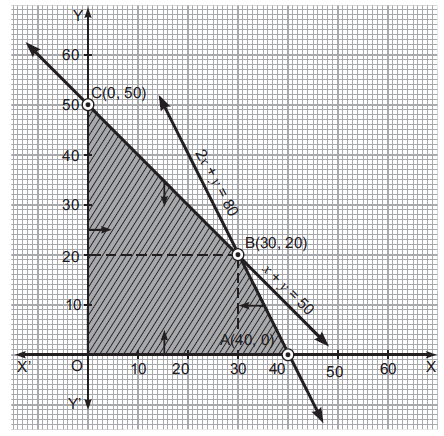
Feasible region is bounded.
Now,
| Corner point |
Z =10500x + 9000y |
| O (0, 0) |
0 |
| A (40, 0) |
420000 |
| B (30, 20) |
495000 |
| C (0, 50) |
450000 |
Maximum
Hence the co-operative society of farmers will get the maximum profit of 4,95,000 by allocating 30 hectares for crop A and 20 hectares for crop B.
Yes, because excess use of herbicide can make drainage water poisonous and thus it harm the life of water living creature and wildlife. View full question & answer→Question 455 Marks
How many times must a man toss a fair coin, so that the probability of having at least one head is more than 80%?
AnswerLet the coin be tossed n times$\therefore$ P(getting at least one head) > $\frac{80}{100}$
$\therefore$ $1-\text{P}(0)>\frac{8}{10}\Rightarrow\text{P}(0)<1-\frac{8}{10}=\frac{2}{10}=\frac{1}{5}$
$\therefore$ $\text{n}_{c_0}\Bigg(\frac{1}{2}\Bigg)^{0}\Bigg(\frac{1}{2}\Bigg)^{n}<\frac{1}{5}\text{ OR }\frac{1}{2^n}<\frac{1}{5}\text{ OR }2^{n}>5 $
$\Rightarrow\text{n = 3}$
View full question & answer→Question 465 Marks
Of the students in a college, it is known that $60\%$ reside in hostel and $40\%$ are day scholars (not residing in hostel). Previous year results report that $30\%$ of all students who reside in hostel attain 'A' grade and $20\%$ of day scholars attain 'A' grade in their annual examination. At the end of the year, one student is chosen at random from the college and he has an 'A' grade, what is the probability that the student is a hostlier?
AnswerLet $E_1$: selected student is a hostlier. $E_2$: selected student is a day scholar. $A$: selected student attain ‘A’grade in exam.$\text{P(E}_{1})=\frac{60}{100},\text{ P(E}_{2})=\frac{40}{60}$
$\text{P(A/E}_{1})=\frac{30}{100},\text{ P(A/E}_{2})=\frac{20}{100}$
$\text{P(E}_{1}/\text{A})=\frac{\text{P(E}_{1})\cdot\text{P}(\text{A/E}_{1})}{\text{P(E}_{1})\cdot\text{P(A/E}_{1})+\text{P(E}_{2})\cdot\text{P(A/E}_{2})}$
$=\frac{\frac{60}{100}\cdot\frac{30}{100}}{\frac{60}{100}\cdot\frac{30}{100}+\frac{40}{100}\cdot\frac{20}{100}}=\frac{9}{13}.$
View full question & answer→Question 475 Marks
Probabilities of solving a specific problem independently by A and B are $\frac{1}{2} \text{and}\frac{1}{3}$ respectively. If both try to solve the problem independently, find the probability that(i) the problem is solved (ii) exactly one of them solves the problem.
AnswerHere P(A) = $\frac{1}{2}$ $\therefore$ P(Not A) = $\frac{1}{2}$
and P(B) = $\frac{1}{3}$ $\therefore$ P(Not A) = $\frac{2}{3}$
- P(problem is solved) = 1 - P (problem is not solved)
= 1 - P(Not A) . P(Not B)
=$1-\frac{1}{2}\cdot\frac{2}{3}=\frac{2}{3}$
- P(exactly one of them solves) =$\text{P(A)}\cdot\text{P}\overline{(B)}+\text{P(B)}\cdot\text{P}\overline{(A)}$
$=\frac{1}{2}\cdot\frac{2}{3}+\frac{1}{3}\cdot\frac{1}{2}$
$=\frac{1}{2}$. View full question & answer→Question 485 Marks
Suppose $5\%$ of men and $0.25\%$ of women have grey hair. Agrey haired person is selected at random.What is the probability of this person being male? Assume that there are equal number of males and females.
AnswerLet event $E_1$: A male is selected
$E_2$: A female is selected
A: Selected person is grey haired
$P(E_1)_= \frac{1}{2},\text{P(E}_{2})=\frac{1}{2}$
$=\text{P(A/E}_{1})-\frac{5}{100}=\frac{1}{20},\text{P(A/E}_{2})=\frac{25}{10000}=\frac{1}{400}$
$=\text{P(A/E}_{1})=\frac{\text{P(E)}_{1}\cdot{\text{P(A/E}_{1})}}{\text{P(E}_{1})\cdot\text{P(A/E}_{1})+\text{P(E}_{2})\cdot\text{P(A/E}_{2})}$
$=\frac{\frac{1}{2}\cdot\frac{1}{20}}{\frac{1}{20}\cdot\frac{1}{20}+\frac{1}{2}\cdot\frac{1}{400}}=\frac{1}{1+\frac{1}{20}}=\frac{20}{21}$.
View full question & answer→Question 495 Marks
On a multiple choice examination with three possible answers (out of which only one is correct) for each of the five questions, what is the probability that a candidate would get four or more correct answers just by guessing?
AnswerProbability of selecting correct choice = $\frac{1}{3}$ Probability of selecting wrong choice =$\frac{2}{3}$ Probability distribution is given by $\Bigg(\frac{2}{3}+\frac{1}{3}\Bigg)^{5}$
we want to compute P (4 correct answers) + P (5 correct answers)= $\Bigg(\frac{1}{3}\Bigg)^{5}+ 5C_4 \Bigg(\frac{1}{3}\Bigg)^{4}$
$\Bigg(\frac{2}{3}\Bigg)$
= $\frac{11}{243}$.
View full question & answer→Question 505 Marks
From a lot of 10 bulbs, which includes 3 defectives, a sample of 2 bulbs is drawn at random. Find the probability distribution of the number of defective bulbs.
AnswerLet X be the random variate giving number of defective bulbs, X can take values 0, 1, 2 $\text{P(X = 0)}=\frac{\text{7c}_{2}}{\text{10c}_{2}}=\frac{7}{15},\text{P(X = 1)}=\frac{\text{7c}_{1}\times\text{3c}_{1}}{\text{10c}_{2}}=\frac{7}{15},\text{P(X = 2)}=\frac{\text{3c}_{2}}{\text{10c}_{2}}=\frac{1}{15}$ $\therefore$ Probability distribution of X is
| X |
0 |
1 |
2 |
| P(X) |
7/15 |
7/15 |
1/15 |
View full question & answer→