Question 512 Marks
Find fog $(2)$ and gof $(1)$ when :$ f : R \rightarrow R; f(x) = x^2 + 8$ and $g : R \rightarrow R; g(x) = 3x^3 + 1.$
Answer$($fog$)(2) = f(g(2)) = f(3 \times 2^3 + 1) = f(25) = 25^2 + 8 = 633$
$($gof$)(1) = g(f(1)) = g(1^2 + 8) = g(9) = 3 \times 9^3 + 1 = 2188$
View full question & answer→Question 522 Marks
Let * be a binary operation on Z defined by a * b = a + b - 4 for all a, b ∈ Z.
Find the invertible elements in Z.
AnswerLet $\text{a}\in\text{Z}$ and $\text{b}\in\text{Z}$ be the inverse of a. Then,
a * b = e = b * a
a * b = e and b * a = e
a + b - 4 = 4 and b + a - 4 = 4
$\text{b}=8-\text{a}\in\text{Z}$
Thus, 8 - a is the inverse of $\text{a}\in\text{Z.}$
View full question & answer→Question 532 Marks
Determine whether or not the definition of $*$ given below gives a binary operation. In the event that $*$ is not a binary operation give justification of this.
On $Z^+,$ defined $*$ by $a * b = a - b$.
Here, $Z^+$ denotes the set of all non-negative integers.
AnswerOn $Z^+, *$ is defined by $a * b = a - b$
It is not a binary operation as the image of $(1, 2)$ under $*$ is $1 * 2 = 1 - 2$
$=-1\notin\text{Z}^{+}$
View full question & answer→Question 542 Marks
Let f: {1, 3, 4} → {1, 2, 5} and g: {1, 2, 5} → {1, 3} be given by f = {(1, 2), (3, 5), (4, 1)} and g = {(1, 3), (2, 3), (5, 1)}. Write down gof.
Answerf = {(1, 2), (3, 5), (4, 1)} and g = {(1, 3), (2, 3), (5, 1)}
Now, f(1) = 2, f(3) = 5, f(4) =1 and g(1) = 3, g(2) = 3, g(5) =1
(gof)(n) = g[f(x)] = g[f(1)] = g(2) = 3
g[f(3)] = g(5) = 1 and g[f(4)] = g(1) = 3
Hence, gof = {(1, 3), (3, 1), (4, 3)}
View full question & answer→Question 552 Marks
Let * be a binary operation on the set Q of rational numbers as follows:
$\text{a} * \text{b} = \frac{\text{ab}}{4}$
Answer$\text{a}*\text{b}=\frac{\text{ab}}{4}=\frac{\text{ba}}{4}=\text{b}*\text{a}$
$\therefore$ operation * is commutative.
$(\text{a}*\text{b})*\text{c}=\frac{\text{ab}}{4}*\text{c}=\frac{\frac{\text{ab}}{4}\text{c}}{4}=\frac{\text{abc}}{16}$
And $\text{a}*(\text{b}*\text{c})=\text{a}*\frac{\text{bc}}{4}=\frac{\text{a}\frac{\text{bc}}{4}}{4}=\frac{\text{abc}}{16}$
Here, $(\text{a}*\text{b})*\text{c}=\text{a}*(\text{b}*\text{c})$
$\therefore$ operation * is associative.
View full question & answer→Question 562 Marks
If the binary operation * on the set Z is defined by a * b = a + b - 5, the find the identity element with respect to *.
AnswerLet e be the identity element in Z with respect to * such that,
a * e = a = e * a, $\forall\ \text{a}\in\text{Z}$
a * e = a and e * a = a, $\forall\ \text{a}\in\text{Z}$
a + e - 5 = a and e + a - 5 = a, $\forall\ \text{a}\in\text{Z}$
e = 5, $\forall\ \text{a}\in\text{Z}$
Thus, 5 is the identity element in Z with respect to *.
View full question & answer→Question 572 Marks
In each of the following cases, state whether the function is one-one, onto or bijective. Justify your answer:
$f: R \rightarrow R$ defined by $f(x) = 3 – 4x$
Answer$f: R \rightarrow R$ is defined as $f(x) = 3 - 4x$.
Let $\text{x}_1,\text{x}_2\in\text{R}$ such that $f(x_1) = f(x_2)$
$\Rightarrow 3 - 4x_1 = 3 - 4x_2$
$\Rightarrow -4x_1 = -4x_2$
$\Rightarrow x_1 = x_2$
$\therefore f$ is one$-$one.
For any real number $(y)$ in $R,$ there exists $\frac{3-\text{y}}{4}$ in $R$ such that $f\Big(\frac{3-\text{y}}{4}\Big)=3-4\Big(\frac{3-\text{y}}{4}\Big)=\text{y}.$
$\therefore f$ is onto.
Hence, $f$ is bijective.
View full question & answer→Question 582 Marks
If A = {3, 5, 7} and B = {2, 4, 9} and R is a relation given by "is less than", write R as a set ordered pairs.
AnswerSince, R = x, y: x, y $\in\text{N}$ and x < y,
Hence, R = {(3, 4), (3, 9), (5, 9), (7, 9)}
View full question & answer→Question 592 Marks
Give an example of a relation which is,Reflexive and transitive but not symmetric.
AnswerLet R be the relation on A such that
R = {(1, 1), (2, 2), (3, 3), (1, 2), (1, 3), (2, 3)}
Clearly, the relation R on A is reflexive and transitive, but not symmetric.
View full question & answer→Question 602 Marks
Let $f : R \rightarrow R$ and $g : R \rightarrow R$ be defined by $f(x) = x^2$ and $g(x) = x + 1$. Show that $\text{fog} \neq \text{gof}.$
AnswerGiven $, f : R \rightarrow R$ and $g : R \rightarrow R$.
So, the domains of $f$ and $g$ are the same.
$\text{(fog)}(x) = f(g(x)) = f(x + 1) = (x + 1)^2 = x^2 + 1 + 2x$
$\text{(gof)}(x) = g(f(x)) = g(x^2) = x^2 + 1$
So $, \text{fog} \neq \text{gof}.$
View full question & answer→Question 612 Marks
Let A = {a, b, c} and the relation R be defined on A as follows: R = {(a, a), (b, c), (a, b)}. Then, write minimum number of ordered pairs to be added in R to make it reflexive and transitive.
AnswerWe have,
A = {a, b, c} and R = {(a, a), (b, c), (a, b)}.
R can be a reflexive relation only when elements (b, b) and (c, c) are added to it.
R can be a transitive relation only when the element (a, c) is added to it.
So, the minimum number of ordered pairs to be added in R is 3.
View full question & answer→Question 622 Marks
Let $R_0$ denote the set of all non-zero real numbers and let $A = R_0 \times R_0.$ If $'*'$ is a binary operation on adefined by,
$(a, b) * (c, d) = (ac, bd)$ for all $(a, b), (c, d) \in A$
Find the invertible element in $A$.
AnswerLet $(m, n)$ be the inverse of $(\text{a, b})\forall(\text{a, b})\in\text{A}$. Then,
$(a, b) * (m, n) = (1, 1)$
Implies that $(am, bn) = (1, 1)$
Implies that $am = 1 bn = 1$
Implies that $\text{m}=\frac{1}{\text{a}} $ and $\text{n}=\frac{1}{\text{b}}$
Thus, $\Big(\frac{1}{\text{a}},\frac{1}{\text{b}}\Big)$ is the inverse of $(\text{a, b})\forall(\text{a, b})\in\text{A}$.
View full question & answer→Question 632 Marks
If $f : C \rightarrow C$ is defined by $f(x) = (x - 2)^3,$ write $f^{-1}(-1).$
AnswerLet $f^{-1}(1) = x ......(1)$
$\Rightarrow f(x) = -1$
$\Rightarrow (x - 2)^3 = -1$
$\Rightarrow\ \text{x}-2=-1\ \text{or }-\omega\text{ or }-\omega^2$
as the roots of $(-1)^\frac{1}{3}$ are $-1,-\omega\text{ and }-\omega^2,$
where $\omega=\frac{1\pm\text{i}\sqrt{3}}{2}$
$\Rightarrow\ \text{x}=-1+2\text{ or }2-\omega\text{ or }2-\omega^2=1,2-\omega,2-\omega$
$\Rightarrow\ \text{f}^{-1}(-1)=1,2-\omega,2-\omega^2 [$from $1]$
View full question & answer→Question 642 Marks
Let * be the binary operation on N defined by a * b = H.C.F. of a and b. Is * commutative? Is * associative? Does there exist identity for this binary operation on N?
Answera * b = H.C.F. of a and b.
- a * b = H.C.F. of a and b = H.C.F. of b and a = b * a
Therefore, operation * is commutative.
- (a * b) * c = (H.C.F. of a and b) * c = H.C.F. of (H.C.F. of a and b) and c
= H.C.F. of a, b and c = a * (b * c)
Therefore, the operation is associative.
$1*\text{a}=\text{a}*1\neq\text{a}.$ View full question & answer→Question 652 Marks
Let $f : X \rightarrow Y$ be an invertible function. Show that f has unique inverse. $($Hint: suppose $g_1$ and $g_2$ are two inverses of $f$. Then for all $y \in Y, \text{fog}_1(y) = 1_Y(y) = \text{fog}_2(y)$. Use one-one ness of $f)$.
AnswerGiven $f: X \rightarrow Y$ be an invertible function.
Thus $f$ is $1 – 1$ and onto and therefore $f^{−1}$ exists.
Let $g_1$ and $g_2$ be two inverses of $f$ . Then for all $\text{y}\in\text{Y},$
$\text{fog}_1(y) = I_y(y) = \text{fog}_2(y)\ \therefore \text{fog}_1(y) = \text{fog}_2(y)$
$\Rightarrow f[g_1(y)] = f[g_{2(y)}]$
$\Rightarrow g_1(y) = g_2(y)$
$\therefore$ The inverse is unique and hence $f$ has a unique inverse.
View full question & answer→Question 662 Marks
If A = {1, 2, 3, 4} define relations on A which have properties of being:
Reflexive, symmetric and transitive.
AnswerThe relation on A having properties of being symmetric, reflexive and transitive is,
R = {(1, 1), (2, 2), (3, 3), (4, 4), (1, 2), (2, 1)}
The relation R is an equivalence relation on A.
View full question & answer→Question 672 Marks
Let $C$ denote the set of all complex numbers. A function $f : C \rightarrow C$ is defined by $f(x) = x^3.$ Write $f^{-1}(1).$
Answer$f : R \rightarrow R$ defined by $f(x) = x^3$
$\therefore f^{-1}(x^3) = x$
$\Rightarrow\ \text{f}^{-1}(1)=\{1,\omega,\omega^2\}$ $[\because\ \sqrt[3]{1}=\{1,\omega,\omega^2\}]$
View full question & answer→Question 682 Marks
Find gof and fog when $f : R \rightarrow R$ and $g : R \rightarrow R$ are defined by$: f(x) = 2x + x^2$ and $g(x) = x^3$
AnswerGiven: $f : R \rightarrow R$ and $g : R \rightarrow R$
Therefore, gof $: R \rightarrow R$ and $fog : R \rightarrow R$
$f(x) = 2x + x^2$ and $g(x) = x^3$
$gof(x) = g(f(x)) = g(2x + x^2)$
$gof(x) = g(2x + x^2)^3$
$fog(x) = f(g(x)) = f(x^3)$
$\therefore fog(x) = 2x^3 + x^6$
View full question & answer→Question 692 Marks
Consider $f : R_+\rightarrow [4, \infty )$ given by $f(x) = x^2 + 4$. Show that f is invertible with the inverse $f^{–1}$ of $f$ given by $f^{-1}(\text{y})=\sqrt{\text{y}-4},$ where $R_+$ is the set of all non$-$negative real numbers.
AnswerConsider $f:\text{R}_{+}\rightarrow[4,\infty]$ and $f(x) = x^2 + 4.$
Let $\text{x}_1,\text{x}_2\in\text{R}\rightarrow[4,\infty],\text{ then }f(\text{x}_1)=\text{x}_{1}^{2}+4$ and $f(\text{x}_2)=\text{x}_{2}^{2}+4$
$\Rightarrow\ \text{x}_{1}^{2}+4=\text{x}_{2}^{2}+4$
$\Rightarrow\text{x}_1=\text{x}_2$
$\therefore f$ is one$-$one.
Now $\text{y}=\text{x}^2+4\Rightarrow\text{x}=\sqrt{\text{y}-4}$ as $x > 0$
$\therefore\ \ f\left(\sqrt{\text{y}-4}\right)=\left(\sqrt{\text{y}-4}\right)^2+4=\text{y}\ \ f(\text{x})=\text{y}$
$\therefore\ f$ is onto.
Therefore$, f(x)$ is invertible and $f^{-1}(\text{y})=\sqrt{\text{y}-4}.$
View full question & answer→Question 702 Marks
If the mappings f and g are given by f = {(1, 2), (3, 5), (4, 1)} and g = {(2, 3), (5, 1), (1, 3)}, write fog.
AnswerWe are given that, f = {(1, 2), (3, 5), (4, 1)} and g = {(2, 3), (5, 1), (1, 3)} Now, the domain of g is {2, 5, 1} We know that, fog(x) = f{g(x)}$\therefore$ fog(2) = f{g(2)} = f(3) = 5
$\therefore$ fog(5) = f{g(5)} = f(1) = 2
$\therefore$ fog(1) = f{g(1)} = f(3) = 5
Therefore, fog = {(2, 5), (5, 2), (1, 5)}
View full question & answer→Question 712 Marks
Write the identity element for the binary operation * defined on the set R of all real numbers by the rule $\text{a}\times\text{b}=\frac{3\text{ab}}{7}\ \forall\text{ a, b}\in\text{R}$.
AnswerWe have,
$\text{a}\times\text{b}=\frac{3\text{ab}}{7}$
Let e be the identity element with respect to *. Then
a * e = a
$\Rightarrow\frac{3\text{ae}}{7}=\text{a}\ \Rightarrow\text{e}=\frac{7}{3}$
View full question & answer→Question 722 Marks
Let * be a binary operation on the set Q of rational numbers as follows:
a * b = a – b
Answera * b = a - b = -(b - a) = -b * a
$\therefore$ operation is not commutative.
(a * b) * c = (a - b) * c = (a - b) - c = a - b - c
And a * b (b * c) = a * (b - c) = a - (b - c) = a - b + c
Here, $(\text{a}*\text{b})*\text{c}\neq\text{a}*(\text{b}*\text{c})$
$\therefore$ operation * is not associative.
View full question & answer→Question 732 Marks
For each binary operation * defined below, determine whether * is commutative or associative.
On Q, define $\text{a} * \text{b} =\frac{\text{ab}}{2}$
AnswerFor commutativity: $\text{a}*\text{b}=\frac{\text{ab}}{2}\ \text{and}\ \text{b}*\text{a}=\frac{\text{ba}}{2}=\frac{\text{ab}}{2}=\text{a}*\text{b}$
For associativity: $\text{a}*(\text{b}*\text{c})=\text{a}*\Big(\frac{\text{bc}}{2}\Big)=\frac{\text{abc/2}}{2}=\frac{\text{abc}}{4}$
Also, $(\text{a}*\text{b})*\text{c}=\Big(\frac{\text{ab}}{2}\Big)*\text{c}=\frac{\text{abc}/2}{2}=\frac{\text{abc}}{4}$
$\therefore$ a * (b * c) = (a * b) * c
Therefore, the operation * is commutative and associative.
View full question & answer→Question 742 Marks
Let $S = \{a, b, c\}.$ Find the total number of binary operations on $S.$
AnswerNumber of binary operations on a set with $n$ elements is $n^2.$
Here, $S = {a, b, c}$
Number of elements in $S = 3$
Number of binary operations on a set with $3$ elements is $3^{3^{2}}=3^9$
View full question & answer→Question 752 Marks
Find which of the binary operations are commutative and which are associative.
Show that none of the operations given above has identity.
AnswerLet the identity be I.
- $\text{a}*\text{I}=\text{a - I}\neq\text{a}$
- $\text{a}*\text{I}=\text{a}^2-\text{I}^2\neq\text{a}$
- $\text{a}*\text{I}=\text{a + aI}\neq\text{a}$
- $\text{a}*\text{I}=(\text{a - I})^2\neq\text{a}$
- $\text{a}*\text{I}=\frac{\text{aI}}{4}\neq\text{a}$
- $\text{a}*\text{I}=\text{aI}^2\neq\text{a}$
Therefore, none of the operations given above has identity. View full question & answer→Question 762 Marks
Let $*$ be a binary operation on the set $Q$ of rational numbers as follows:
$a * b = a^2+ b^2$
Answer$a * b = a^2 + b^2 = b^2 + a^2 = b * a$
$\therefore$ operation is commutative.
$(a * b) * c = (a^2 + b^2) * c = (a^2 + b^2) + c^2 = a^2 + b^2 + c^2$
And $a * b (b * c) = a * (b^2 + c^2) = a^2 + (b^2 + c^2)^2$
Here, $(\text{a}*\text{b})*\text{c}\neq\text{a}*(\text{b}*\text{c})$
$\therefore$ operation $*$ is not associative.
View full question & answer→Question 772 Marks
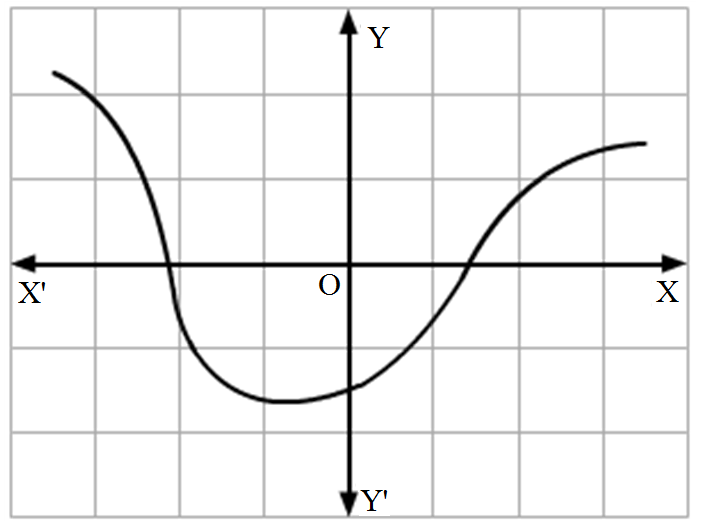
Which one of the following graphs represents a function?
-
-
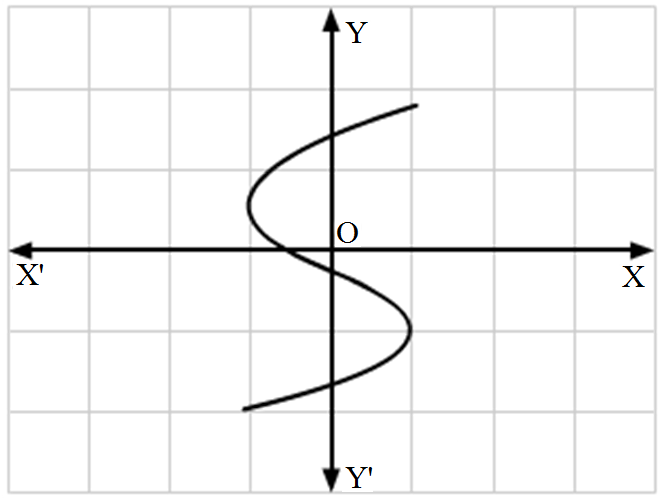
AnswerFigure (a) represents a function f : R → R
Whereas fig (b) does not represent a function.
View full question & answer→Question 782 Marks
Determine whether the following operations define a binary operation on the given set or not:$'\odot'$ on N defined by $\text{a}\odot\text{b}=\text{a}^{\text{b}}+\text{b}^{\text{a}}$ for all $\text{a, b}\in\text{N.}$
AnswerLet $\text{a, b}\in\text{N.}$ Then,
$\text{a}^{\text{b}},\text{b}^{\text{a}}\in\text{N}$
$\Rightarrow\ \text{a}^{\text{b}}+\text{b}^{\text{a}}\in\text{N}$ $\big[\because$ Addition is binary operation on N$\big]$
$\Rightarrow\ \text{a}\odot\text{b}\in\text{N}$
Thus, $\odot$ is a binary operation on N.
View full question & answer→Question 792 Marks
Give an example of a relation which is,
Transitive but neither reflexive nor symmetric.
AnswerLet R be the relation on A such that
R = {(1, 2), (2, 3), (1, 3)}
The relation R on A is transitive, but neither symmetric nor reflexive.
View full question & answer→Question 802 Marks
Let $'o\ '$ be a binary operation on the set $Q_0$ of all non-zero rational numbers defined by $\text{a}\ ^*\ \text{b}=\frac{\text{ab}}{2}$ for all $\text{a},\text{b}\in\text{Q}_0.$
Find the invertible elements of $Q_0$.
AnswerWe have,
$\text{a}^*\text{b}=\frac{\text{ab}}{2}$ for all $\text{a},\text{b}\in\text{Q}_0$
Let $\text{b}\in\text{Q}_0$ be the inverse of $\text{a}\in\text{Q}_0$ with respect to $*,$ then,
$a * b = b * a = e$ for all $\text{a}\in\text{Q}_0$
$\Rightarrow\frac{\text{ab}}{2}=\text{e}\Rightarrow\frac{\text{ab}}{2}=2$
$\Rightarrow\text{b}=\frac{4}{\text{a}}$
Thus, $\text{b}=\frac{4}{\text{a}}$ is the inverse of a with respect to $*$.
View full question & answer→Question 812 Marks
Find the identity element in the set $I^+$ of all positive integers defined by $a * b = a + b$ for all $a, b \in I^+$.
AnswerLet $e$ be the identity element in $I^+$ with respect to $*$ such that
$a * e = a = e * a, \forall\ \text{a}\in\text{I}^{+}$
$a * e = a$ and $e * a = a, \forall\ \text{a}\in\text{I}^{+}$
$a + e = a$ and $e + a = a, \forall\ \text{a}\in\text{I}^{+}$
$e = 0, \forall\ \text{a}\in\text{I}^{+}$
Thus $,0$ is the identity element in $I^+$ with respect to $*$.
View full question & answer→Question 822 Marks
Let C be the set of complex numbers. Prove that the mapping f : C → R given by f(z) = |z|, ∀ z ∈ C, is neither one-one nor onto.
AnswerThe mapping f : C → R Given, f(z) = |z|, ∀ z ∈ C f(1) = |1| = 1 f(-1) = |-1| = 1 f(1) = f(-1)$\text{But}\ 1\neq-1$
So, f(z) is not one-one. Also, f(z) is not onto as there is no pre-image for any negative element of R under the mapping f(z).
View full question & answer→Question 832 Marks
Find the number of all onto functions from the set A = {1, 2, 3, ..., n} to itself.
AnswerWe know that every onto function from A to itself is one-one.
Therefore, the number of one-one functions = number of bijections =n!
View full question & answer→Question 842 Marks
Let '*' be a binary operation on N defined by a * b = 1.c.m. (a, b) for all $\text{a, b}\in\text{N}$
Find 2 * 4, 3 * 5, 1 * 6.
Answera * b = 1.c.m. (a, b)
2 * 4 = 1.c.m. (2, 4)
= 4
3 * 5 = 1.c.m. (3, 5)
= 15
1 * 6 = 1.c.m. (1, 6)
= 6
View full question & answer→Question 852 Marks
Let $'o\ '$ be a binary operation on the set $Q_0$ of all non$-$zero rational numbers defined by $\text{a}\ ^*\ \text{b}=\frac{\text{ab}}{2}$ for all $\text{a},\text{b}\in\text{Q}_0.$ Show that $'o\ '$ is both commutative and associate.
AnswerWe have, $\text{a }^*\text{ b}=\frac{\text{ab}}{2}$ for all $\text{a},\text{b}\in\text{Q}_0$
Commutativity:
Let $\text{a},\text{b}\in\text{Q}_0,$ then
$\Rightarrow\text{a }^*\text{ b}=\frac{\text{ab}}{2}=\frac{\text{ba}}{2}=\text{a }^*\text{ b}$
$\Rightarrow\text{a }^*\text{ b}=\text{b }^*\text{ a}$ Thus, * is commutative on $Q_0.$
Associativity:
Let $\text{a},\text{b},\text{c}\in\text{Q}_0,$ then
$\Rightarrow(\text{a }^*\text{ b})\ ^*\ \text{c}=\frac{\text{ab}}{2}\ ....(1)$ and,
$\text{a }^*\ (\text{b }^*\text{ c})=\text{a }^*\ \frac{\text{bc}}{2}=\frac{\text{abc}}{4}\ ....(2)$
From $(1) (2)$
$(\text{a }^*\text{ b})\ ^*\ \text{c}=\text{a }^*\ (\text{b }^*\text{ c})$
$\Rightarrow$ is accosiative on $Q_0.$
View full question & answer→Question 862 Marks
If f : A → A, g : A → A are two bijections, then prove that:
fog is an injection.
AnswerGiven: A → A, g : A → A are two bijections.
Then, fog : A → A
Injectivity of fog: Let x and y be two elements of the domain (A), such that
(fog)(x) = (fog)(y)
⇒ f(g(x)) = f(g(y))
⇒ g(x) = g(y) (As, f is one-one)
⇒ x = y (As, g is one-one)
So, fog is an injection.
View full question & answer→Question 872 Marks
Let $S = \{a, b, c\}$ and $T = \{1, 2, 3\}.$ Find $F^{–1}$ of the following functions $F$ from $S$ to $T,$ if it exists: $F = \{(a, 3), (b, 2), (c, 1)\}$
Answer$S = \{a, b, c\}, T = \{1, 2, 3\}$
$F: S \rightarrow T$ is defined as:
$F =\{(a, 3), (b, 2), (c, 1)\}$
$\Rightarrow F(a) = 3, F(b) = 2, F(c) = 1$
Therefore, $F^{-1}: T \rightarrow S$ is given by
$F^{-1} = {(3, a), (2, b), (1, c)}.$
View full question & answer→Question 882 Marks
Write the total number of binary operations on a set consisting of two elements.
AnswerNumber of binary operations on a set with $n$ elements $=\text{n}^{\text{n}^2}$
Here, Number of binary operations on a set with $2$ elements $=2^{2^2}$
$= 2^4$
$=16$
View full question & answer→Question 892 Marks
Which of the following functions from $A$ to $B$ are one $-$ one and onto?
$f_1 = {(1, 3), (2, 5), (3, 7)}; A = {1, 2, 3}, B = {3, 5, 7}$
Answer$f_1 = {(1, 3), (2, 5), (3, 7)}$
$A = {1, 2, 3}, B = {3, 5, 7}$
We can earily observe that in $f_1$ every element of $A$ has different image from $B$.
$\therefore f_1$ in not one $-$ one.
Also, each element of $B$ is the image of some element of $A$.
$\therefore f_1$ in not on to.
View full question & answer→Question 902 Marks
If $f : R \rightarrow R$ be defined by $f(x) = x^4,$ write $f^{-1}(1)$.
AnswerLet $f^{-1}(1) = x ......(1)$
$\Rightarrow f(x) = 1$
$\Rightarrow x^4 = 1$
$\Rightarrow x^4 - 1 = 0$
$\Rightarrow (x^2 - 1)(x^2 + 1) = 0 \ [$Using identity: $a^2 - b^2 = (a - b)(a + b)]$
$\Rightarrow (x - 1)(x + 1)(x^2 + 1) = 0 \ [$Using identity:$ a^2 - b^2 = (a - b)(a + b)]$
$\Rightarrow\ \text{x}=\pm1\ [$ as ${x}\in\text{R}]$
$\Rightarrow f^{-1}(1) = {-1, 1} \ [$from $(1)]$
View full question & answer→Question 912 Marks
If $A = \{2, 3, 4\}, B = \{1, 3, 7\}$ and $R = (x, y): x \in A, y \in B$ and $x < y$ is a relation from $A$ to $B,$ then write $R^{-1}.$
AnswerSince $R = (x, y): x \in A, y \in B$ and $x < y$
$R = \{(2, 3), (2, 7), (3, 7), (4, 7)\}$
Hence, $R^{-1} = \{(3, 2), (7, 2), (7, 3), (7, 4)\}$
View full question & answer→Question 922 Marks
If f : A → B is an injection, such that range of f = {a}, determine the number of elements in A.
AnswerRange of f = {a}
Therefore, the number of images of f = 1
Since, is an injection, there will be exactly one image for each element of f.
Therefore, number of element in A = 1.
View full question & answer→Question 932 Marks
If the binary operation $^*$ on the set $Z$ of integers is defined by $a ^* b = a + 3b^2,$ find the value of $2 ^* 4.$
AnswerGiven: $a ^* b = a + 3b^2$
Here,
$2 ^* 4 = 2 + 3(4)^2$
$= 2 + 3(16)$
$= 2 + 48$
$= 50$
View full question & answer→Question 942 Marks
Prove that the operation $^*$ on the set $\text{M}=\Bigg\{\begin{bmatrix}\text{a} & 0 \\0 & \text{b} \end{bmatrix};\text{ a, b}\in\text{R}-\{0\}\Bigg\}$ defined by $A ^* B = AB$ is a binary operation.
AnswerGiven that $*$ is an operation that is valid on the set $\text{M}=\Bigg\{\left(\begin{array}{c}\text{a}&0\\ 0&\text{b}\end{array}\right):\text{b}\in \text{R}-\big\{0\big\}\Bigg\}$ and it is defined as given$: A ^* B = AB.$
According to the problem it is given that on applying the operation $^*$ fore two given numbers in the set $'M\ '$ it gives a number in the set $'M\ '$ as a result of the operation.
$\Rightarrow \text{A}*\text{B}\in \text{M}...(1)$
Let us take $\text{A}=\left(\begin{array}{c}\text{a}&0\\ 0&\text{b}\end{array}\right)\text{ and }\text{B}=\left(\begin{array}{c}\text{c}&0\\ 0&\text{d}\end{array}\right)$
here $\text{a}\in \text{R},\ \text{c}\in \text{R},\ \text{d}\in \text{R}$ then,
$\Rightarrow \text{AB}=\left(\begin{array}{c}\text{a}&0\\ 0&\text{b}\end{array}\right)\times\left(\begin{array}{c}\text{c}&0\\ 0&\text{d}\end{array}\right)$
$\Rightarrow \text{AB}=\begin{pmatrix}((\text{a}\times\text{c})+(0\times 0))&((\text{a}\times0)+(0\times \text{d})) (0\times\text{c})+(\text{b}\times 0))&((0\times0)+(\text{b}\times\text{d})) \end{pmatrix}$
$\Rightarrow \text{Ab}=\begin{pmatrix}(\text{ac}+0)&(0+0)(0+0)&(0+\text{bd}) \end{pmatrix}$
$\Rightarrow \text{AB}=\begin{pmatrix} \text{ac}&0\\0&\text{bd}\end{pmatrix}$
Since $\text{b}\in \text{R}$ and $\text{c}\in \text{R}$ then $\text{ac}\in \text{R}$
And also $\text{b}\in \text{R}$ and $\text{d}\in \text{R}$ then $\text{bd}\in \text{R}$
$\Rightarrow \text{AB}\in \text{R}$
View full question & answer→Question 952 Marks
Let $A = \{3, 5, 7\}, B = \{2, 6, 10\}$ and $R$ be a relation from $A$ to $B$ defined by $R = (x, y): x$ and $y$ are relatively prime. Then, write $R$ and $R^{-1}.$
Answer$R = (x, y): x$ and $y$ are relatively prime
Then,
$R = \{(3, 2), (5, 2), (7, 2), (3, 10), (7, 10), (5, 6), (7, 6)\}$
So, $R^{-1} = \{(2, 3), (2, 5), (2, 7), (10, 3), (10, 7), (6, 5), (6, 7)\}$
View full question & answer→Question 962 Marks
Write the domain of the real function $\text{f(x)}=\frac{1}{\sqrt{|\text{x}|-\text{x}}}.$
AnswerCase-1: When x > 0
|x| = x
$\Rightarrow\ \frac{1}{\sqrt{|\text{x}|-\text{x}}}=\frac{1}{\sqrt{\text{x}-\text{x}}}=\frac{1}{0}=\infty$
Case-2: When x < 0
|x| = -x
$\Rightarrow\ \frac{1}{\sqrt{|\text{x}|-\text{x}}}=\frac{1}{\sqrt{-\text{x}-\text{x}}}=\frac{1}{\sqrt{-2\text{x}}}$ (exists because when x < 0, -2x > 0)
⇒ f(x) is defined when x < 0
So, domain $=(-\infty,0)$
View full question & answer→Question 972 Marks
Define an equivalence relation.
AnswerA relation R on a set A is said to be equivalence relation on a if R is:
Reflexive, Symmetric and Transitive.
R = {(x, y): x = y} on the set of real numbers is an equivalence relation.
View full question & answer→Question 982 Marks
$f : Z \rightarrow Z$ given by $f(x) = x^2$
Answer$f : Z \rightarrow Z$ is given by,
$f(x) = x^2$
It is seen that for $f(= 1) = f(1) = 1,$ but $-1\neq1.$
$\therefore f$ is not injective.
Now$, -2\in\text{Z}.$
But, there does not exist any element $\text{x}\in\text{Z}$ such that $f(x) = x^2 = -2$.
$\therefore f$ is not surjective.
Hence, function $f$ is neither injective but not surjective.
View full question & answer→Question 992 Marks
If $A = \{a, b, c, d\}$ and the function $f = \{(a, b), (b, d), (c, a), (d, c)\},$ write $f^{-1}.$
AnswerWe are given that, $f = \{(a, b), (b, d), (c, a), (d, c)\}$
An inverse relation is the set of ordered pairs obtained by interchanging the first and second elements of each pair in the original relation.
$\therefore f^{-1} = \{(b, a), (d, b), (a, c), (c, d)\}$
View full question & answer→Question 1002 Marks
Let A = {0, 1, 2, 3} and R be a relation on A defined as R = {(0, 0), (0, 1), (0, 3), (1, 0), (1, 1), (2, 2), (3, 0), (3, 3)}. Is R reflexive? symmetric? transitive?
AnswerWe have, R = {(0, 0), (0, 1), (0, 3), (1, 0), (1, 1), (2, 2), (3, 0), (3, 3)}As, $(\text{a, a})\in\text{R}\ \forall\ \text{a}\in\text{A}$
So, R is a reflexive relation. Also, $(\text{a, b})\in\text{R}$ and $(\text{b, a})\in\text{R}$ So, R is a symmetric as well And, $(0,1)\in\text{R}$ but $(1,2)\notin\text{R}$ and $(2,3)\notin\text{R}$ So, R is not a transitive relation.
View full question & answer→