Sample QuestionsThree Dimensional Geometry questions
One sample from each question group in this chapter. Select any group above to see the full set with answer keys.
The direction cosines of the normal to the plane 2x - 3y - 6z - 3 = 0 are:
- $\frac{2}{7},\frac{-3}{7},\frac{-6}{7}$
- $\frac{2}{7},\frac{3}{7},\frac{6}{7}$
- $\frac{-2}{7},\frac{-3}{7},\frac{-6}{7}$
- None of these
View full solution →The points A(1, 1, 0), B(0, 1, 1), C(1, 0, 1) and $\text{D}\big(\frac{2}{3},\frac{2}{3},\frac{2}{3}\big)$
- Coplanar
- Non-coplanar
- Vertices of a parallelogram
- None of these
View full solution →The sum of the squares of sine of the angles made by the line AB with OX, OY, OZ where O is the origin is:
- 1
- 2
- -1
- 3
A point P lies on the line segment joining the points (-1, 3, 2) and (5, 0, 6). If x-coordinate of P is 2, then its z-coordinate is:
- $-1$
- $4$
- $\frac{3}{2}$
- $8$
View full solution →The vector equation of the plane containing the line $\vec{\text{r}}=(-2\hat{\text{i}}-3\hat{\text{j}}+\hat{\text{k}})+\lambda(3\hat{\text{i}}-2\hat{\text{j}}-\hat{\text{k}})$ and the point $\hat{\text{i}}+2\hat{\text{j}}+3\hat{\text{k}}$ is:
- $\vec{\text{r}}.(\hat{\text{i}}+3\hat{\text{k}})=10$
- $\vec{\text{r}}.(\hat{\text{i}}-3\hat{\text{k}})=10$
- $\vec{\text{r}}.(3\hat{\text{i}}+\hat{\text{k}})=10$
- $\text{None of these}$
View full solution →Directions: In these questions, a statement of Assertion is followed by a statement of Reason is given.Choose the correct answer out of the following choices:
Assertion: If the cartesian equation of a line is $\frac{\text{x}-5}{3}=\frac{\text{y}+4}{7}=\frac{\text{z}-6}{2},$ then its vector form is $\vec{\text{r}}=5\hat{\text{i}}-4\hat{\text{j}}+6\hat{\text{k}}+\lambda(3\hat{\text{i}}+7\hat{\text{j}}+2\hat{\text{k}}).$
Reason: The cartesian equation of the line which passes through the point (-2, 4, -5) and parallel to the line given by $\frac{\text{x}+3}{3}=\frac{\text{y}-4}{5}=\frac{\text{z}+8}{6}$ is $\frac{\text{x}+3}{-2}=\frac{\text{y}-4}{4}=\frac{\text{z}+8}{-5}.$
- Assertion and Reason both are correct statements and Reason is the correct explanation of Assertion.
- Assertion and Reason both are correct statements but Reason is not the correct explanation of Assertion.
- Assertion is correct statement but Reason is wrong statement.
- Assertion is wrong statement but Reason is correct statement.
View full solution →Directions: In the following questions, the Assertions $(A)$ and Reason$(s)\ (R)$ have been put forward. Read both the statements carefully and choose the correct alternative from the following:
Assertion: Points $A(4, 0, 4), B(1, 2, 3), C(-2, 4, 2)$ are collinear.
Reason: Three points $A, B, C$ are collinear if $AB + BC = AC$ and $AB, BC < AC.$
- ✓
Both Assertion $\&$ Reason are individually true $\&$ Reason is correct explanation of Assertion.
- B
Both Assertion $\&$ Reason are individually true but Reason is not the, correct $($proper$)$ explanation of Assertion.
- C
Assertion is true but Reason is false.
- D
Assertion is false but Reason is true.
Answer: A.
View full solution →Directions: In the following questions, the Assertions (A) and Reason(s) (R) have been put forward. Read both the statements carefully and choose the correct alternative from the following:
Assertion: The points (1, 2, 3), (-2, 3, 4) and (7, 0, 1) are collinear
Reason: If a line makes angles $\frac{\pi}{2}, \frac{3\pi}{4}$ and $\frac{\pi}{4}$ with X, Y, and Z - axes respectively, then its direction cosines are $0,\frac{-1}{\sqrt{2}}$ and $\frac{1}{\sqrt{2}}$
- Assertion and Reason both are correct statements and Reason is the correct explanation of Assertion.
- Assertion and Reason both are correct statements but Reason is not the correct explanation of Assertion.
- Assertion is correct statement but Reason is wrong statement.
- Assertion is wrong statement but Reason is correct statement.
View full solution →Write the direction cosines of a line equally inclined to the three coordinate axes.
$\text{Find}\ \lambda\ \text{if}\ (2\hat{\text{i}}+6\hat{\text{j}}+14\hat{\text{k}})\times(\hat{\text{i}}-\lambda\hat{\text{i}}+7\hat{\text{k}})=\overrightarrow{0}\dot{}$
View full solution →If a line makes angles 90° and 60° respectively with the positive directions of x and y axes, find the angle which it makes with the positive direction of z-axis.
Write the distance of the point (3, – 5, 12) from x-axis.
Find the angle between the lines $\text{2x = 3y = – z and 6x = – y = – 4z.}$
View full solution →Write the direction consines of the line whose cartesian equations are 2x = 3y = -z.
Write the distance of the point P(x, y, z) from XOY plane.
Find the vector equation of the plane which is at a distance of 5 units from the orgin and its normal vector is $2\hat{\text{i}}+3\hat{\text{j}}+6\hat{\text{k}}.$
View full solution →Show that the line joining the origin to the point $(2, 1, 1)$ is perpendicular to the line determined by the points $(3, 5, -1), (4, 3, -1).$
View full solution →If the equations of a line AB are $\frac{3-\text{x}}{1}=\frac{\text{y}+2}{-2}=\frac{\text{z}-5}{4},$ write the direction ratios of a line parallel to AB.
View full solution →Find the length of the perpendicular drow from the point (5, 4, -1) to the line $\vec{\text{r}}=\hat{\text{i}}+\lambda\big(2\hat{\text{i}}+9\hat{\text{j}}+5\hat{\text{k}}\big).$
View full solution →Find the equation of the line in vector and in cartesian form that passes through the point with position vector $2\hat{\text{i}}-\hat{\text{j}}+4\hat{\text{k}}$ and is in the direction $\hat{\text{i}}+2\hat{\text{j}}-\hat{\text{k}}.$
View full solution →Show that the line through points $(1, -1, 2)$ and $(3, 4, -2)$ is perpendicular to the line throught the points $(0, 3, 2)$ and $(3, 5, 6).$
View full solution →Find the angle between the following pairs of lines:
-
$\vec{\text{r}}=2\hat{\text{i}}-5\hat{\text{j}}+\hat{\text{k}}+\lambda\Big(3\hat{\text{i}}+2\hat{\text{j}}+6\hat{\text{k}}\Big)\ \text{and}$
$\vec{\text{r}}=7\hat{\text{i}}-6\hat{\text{k}}+\mu\Big(\hat{\text{i}}+2\hat{\text{j}}+2\hat{\text{k}}\Big)$
View full solution →Find the angle between the following pair of lines:
- $\frac{\text{x}}{2}=\frac{\text{y}}{2}=\frac{\text{z}}{1}\ \text{and}\ \frac{\text{x}-5}{4}=\frac{\text{y}-2}{1}=\frac{\text{z}-3}{8}$
View full solution →If O be the origin and the coordinates of P be (1, 2, -3), then find the equation of the plane passing through P and perpendicular to OP.
Find the equation of the plane through the points $(2, 2, -1)$ and $(3, 4, 2)$ and parallel to the line whose direction ratios are $7, 0, 6.$
View full solution →Find the angle between the lines whose direction ratios are proportional to a, b, c and b - c, c - a, a - b.
Find the equation of the plane passing through the point (-1, 3, 2) and perpendicular to each of the planes $\text{x + 2y +3z = 5 and 3x + 3y + z} = 0$
View full solution →Find the coordinates of the foot of the perpendicular and the perpendicular distance of the point P(3, 2, 1) from the plane 2x - y + z + 1 = 0. Also, find the image of the point in the plane.
A football match is organised between students of class XII of two schools, say school A and school B. For which a team from each school is chosen. Remaining students of class XII of school A and Bare respectively sitting
on the plane represented by the equation$ \vec{\text{r}}.(\hat{\text{i}}+\hat{\text{j}}+\hat{2\text{k}})=5$ and $ \vec{\text{r}}.(\hat{2\text{i}}-\hat{\text{j}}+\hat{\text{k}})=6$ to cheer up the team of their respective schools. 
Based on the above information, answer the following questions.
- The cartesian equation of the plane on which students of school A are seated is:
- 2x - y + z = 8
- 2x + y + z = 8
- x + y + 2z = 5
- x + y + z = 5
- The magnitude of the normal to the plane on which students of school Bare seated, is:
- $\sqrt{5}$
- $\sqrt{6}$
- $\sqrt{3}$
- $\sqrt{2}$
- The intercept form of the equation of the plane on which students of school Bare seated is:
- $\frac{\text{x}}{6}+\frac{\text{y}}{6}+\frac{\text{z}}{6}=1$
- $\frac{\text{x}}{3}+\frac{\text{y}}{(-6)}+\frac{\text{z}}{6}=1$
- $\frac{\text{x}}{3}+\frac{\text{y}}{6}+\frac{\text{z}}{6}=1$
- $\frac{\text{x}}{3}+\frac{\text{y}}{6}+\frac{\text{z}}{3}=1$
- Which of the following is a student of school B?
- Mohit sitting at (1, 2, 1)
- Ravi sitting at (0, 1, 2)
- Khushi sitting at (3, 1, 1)
- Shewta sitting at (2, -1, 2)
- The distance of the plane, on which students of school Bare seated, from the origin is:
- 6 units
- $\frac{1}{\sqrt{6}}\text{ units}$
- $\frac{5}{\sqrt{6}}\text{ units}$
- $\sqrt{6}\text{ units}$
View full solution →Consider the following diagram, where the forces in the cable are given. 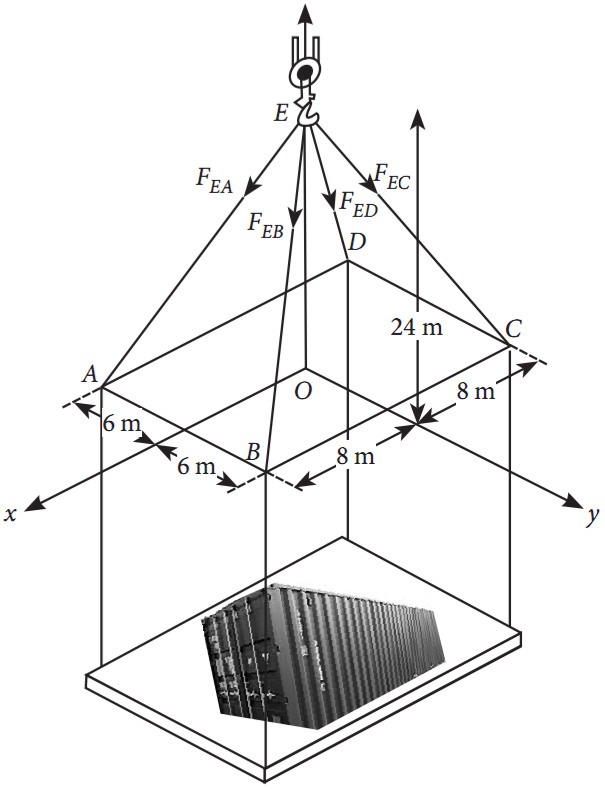 Based on the above information, answer the following questions.
- The cartesian equation of line along EA is:
- $\frac{\text{x}}{-4}=\frac{\text{y}}{3}=\frac{\text{z}}{12}$
- $\frac{\text{x}}{-4}=\frac{\text{y}}{3}=\frac{\text{z}-24}{12}$
- $\frac{\text{x}}{-3}=\frac{\text{y}}{3}=\frac{\text{z}-12}{12}$
- $\frac{\text{x}}{3}=\frac{\text{y}}{4}=\frac{\text{z}-24}{12}$
- The vector $\overline{\text{ED}}$ is:
- $8\hat{\text{i}}-6\hat{\text{j}}+24\hat{\text{k}}$
- $-8\hat{\text{i}}-6\hat{\text{j}}+24\hat{\text{k}}$
- $-8\hat{\text{i}}-6\hat{\text{j}}-24\hat{\text{k}}$
- $8\hat{\text{i}}+6\hat{\text{j}}+24\hat{\text{k}}$
- The length of the cable EB is:
- 24 units
- 26 units
- 27 units
- 25 units
- The length of cable EC is equal to the length of:
- EA
- EB
- ED
- All of these
- The sum of all vectors along the cables is:
- $96\hat{\text{i}}$
- $96\hat{\text{j}}$
- $-96\hat{\text{k}}$
- $96\hat{\text{k}}$
View full solution →A mobile tower stands at the top of a hill. Consider the surface on which tower stand as a plane having points A(0, 1, 2), B(3, 4, -1), and C(2, 4, 2) on it. The mobile tower is tied with 3 cables from the point A, Band C such that it stand vertically on the ground. The peak of the tower is at the point ( 6, 5, 9), as shown in the figure. 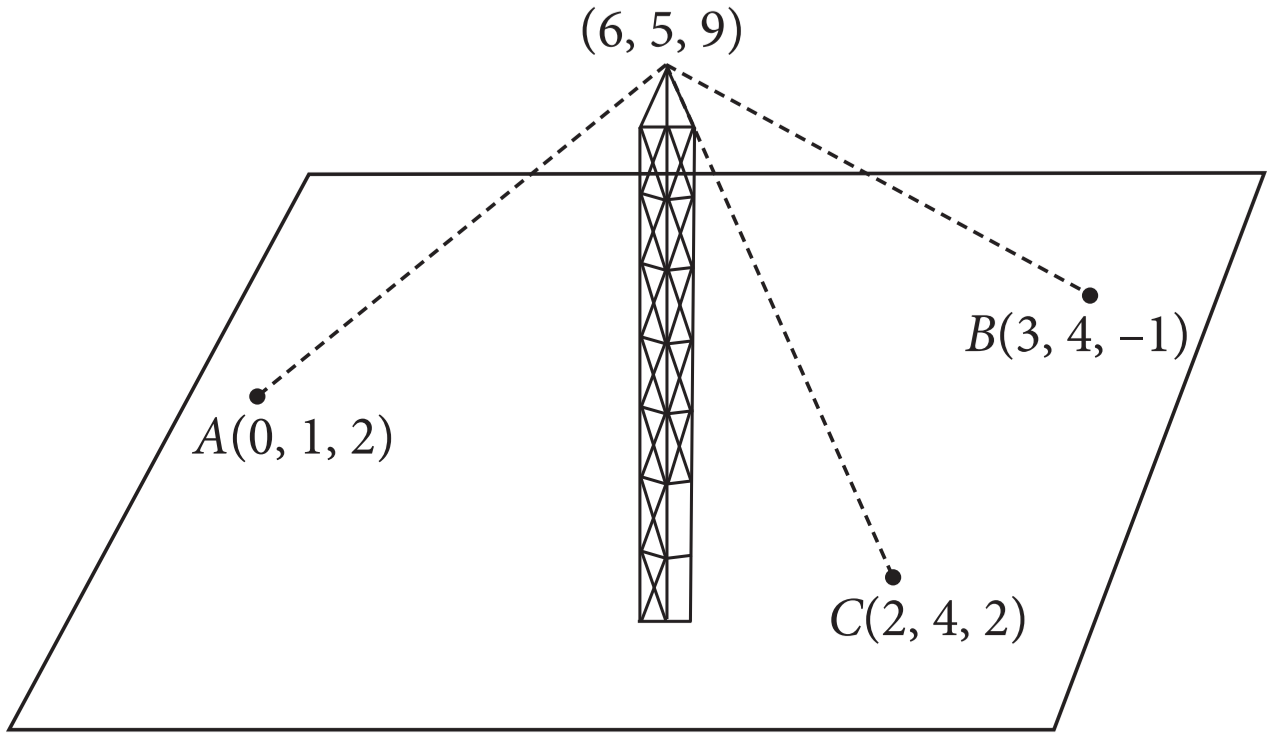 Based on the above information, answer the following questions.
- The equation of plane passing through the points A, Band C is:
- 3x - 4y + z = 0
- 3x - 2y + z = 0
- 3x - 2y + z = 0
- 4x - 3y + 3z = 0
- The height of the tower from the ground is:
- 6 units
- 5 units
- $\frac{17}{\sqrt{14}}\text{units}$
- $\frac{5}{\sqrt{14}}\text{units}$
- The equation of line of perpendicular drawn from the peak of tower to the ground is:
- $\frac{\text{x}-6}{3}=\frac{\text{y}-4}{-2}=\frac{\text{z}-9}{1}$
- $\frac{\text{x}-6}{3}=\frac{\text{y}-5}{-2}=\frac{\text{z}-9}{1}$
- $\frac{\text{x}-6}{3}=\frac{\text{y}-4}{2}=\frac{\text{z}-9}{1}$
- $\frac{\text{x}-6}{3}=\frac{\text{y}-5}{2}=\frac{\text{z}-9}{1}$
- The coordinates of foot of perpendicular drawn from the peak of tower to the ground are:
- $\Big(\frac{33}{14},\frac{104}{14},\frac{109}{14}\Big)$
- $\Big(\frac{33}{14},\frac{109}{14},\frac{104}{14}\Big)$
- $\Big(\frac{33}{14},\frac{105}{14},\frac{109}{14}\Big)$
- None of these
- The area of $\triangle\text{ABC}$ is:
- $\frac{1}{2}\sqrt{14}\text{sq}.\text{units}$
- $\frac{3}{2}\sqrt{14}\text{sq}.\text{units}$
- $\sqrt{14}\text{sq}.\text{units}$
- $2\sqrt{14}\text{sq}.\text{units}$
View full solution →Suppose the floor of a hotel is made up of mirror polished Kota stone. Also, there is a large crystal chandelier attached at the ceiling of the hotel. Consider the floor of the hotel as a plane having equation $x - 2y + 2z = 3$ and crystal chandelier at the point $(3, -2, 1)$. 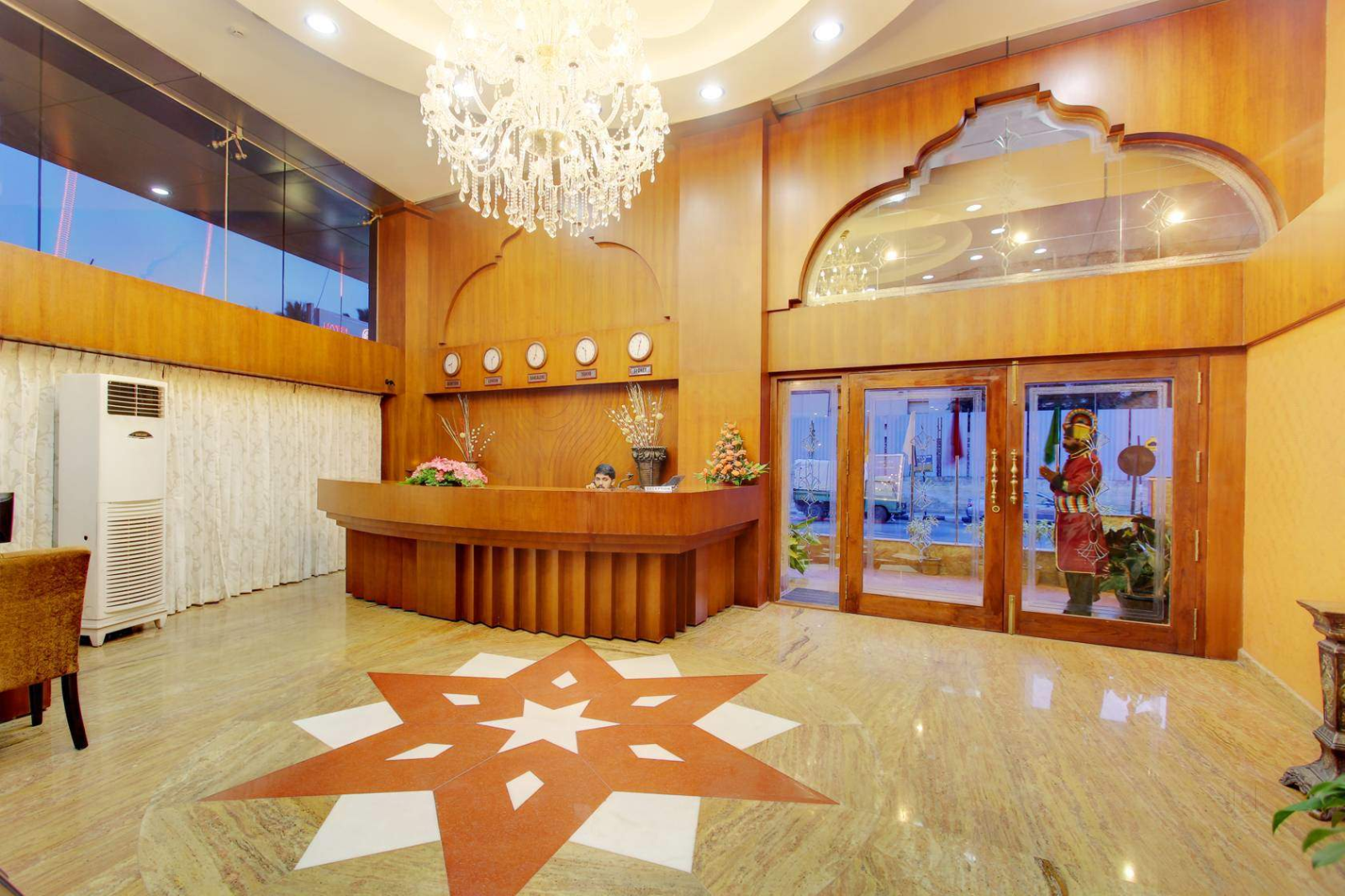 Based on the above information, answer the following questions.
- The $d.r\ '$. of the perpendicular from the point $(3, -2, 1)$ to the plane $x - 2y + 2z = 3,$ is:
- $ < 1, 2, 2 > $
- $ < 1, -2, 2 > $
- $ < 2, 1, 2 > $
- $ < 2, -1, 2 > $
- The length of the perpendicular from the point $(3, -2, 1)$ to the plane $x - 2y + 2z = 3,$ is:
- $\frac{2}{3}$ units
- $3$ units
- $2$ units
- None of these
- The equation of the perpendicular from the point $(3, -2, 1)$ to the plane $x - 2y + 2z = 3,$ is:
- $\frac{\text{x}-3}{1}=\frac{\text{y}-2}{-2}=\frac{\text{z}-1}{2}$
- $\frac{\text{x}-3}{1}=\frac{\text{y}+2}{-2}=\frac{\text{z}-1}{2}$
- $\frac{\text{x}+3}{1}=\frac{\text{y}+2}{-2}=\frac{\text{z}-1}{2}$
- None of these
- The equation of plane parallel to the plane $x - 2y + 2z = 3,$ which is at a unit distance from the point $(3, -2, 1)$ is:
- $x - 2y + 2z = 0$
- $x - 2y + 2z = 6$
- $x - 2y + 2z = 12$
- Both $(b)$ and $(c)$
- The image of the point $(3, -2, 1)$ in the given plane is:
- $\Big(\frac{5}{3},\frac{2}{3},\frac{-5}{3}\Big)$
- $\Big(\frac{-5}{3},\frac{-2}{3},\frac{5}{3}\Big)$
- $\Big(\frac{-5}{3},\frac{2}{3},\frac{5}{3}\Big)$
- None of these
View full solution →If $a_{1,} b_{1,} c_{1,}$ and $a_{2, }b_{2,} c_2$ are direction ratios of two lines say $L_1$ and $L_2$ respectively. Then $L_1 \| L_2$ iff $\frac{\text{a}_1}{\text{a}_2}=\frac{\text{b}_1}{\text{b}_2}=\frac{\text{c}_1}{\text{c}_2}$ and $\text{L}_1\perp\text{L}_2$ iff $a_1a_2 + b_1b_2 + c_1c_2 = 0.$ 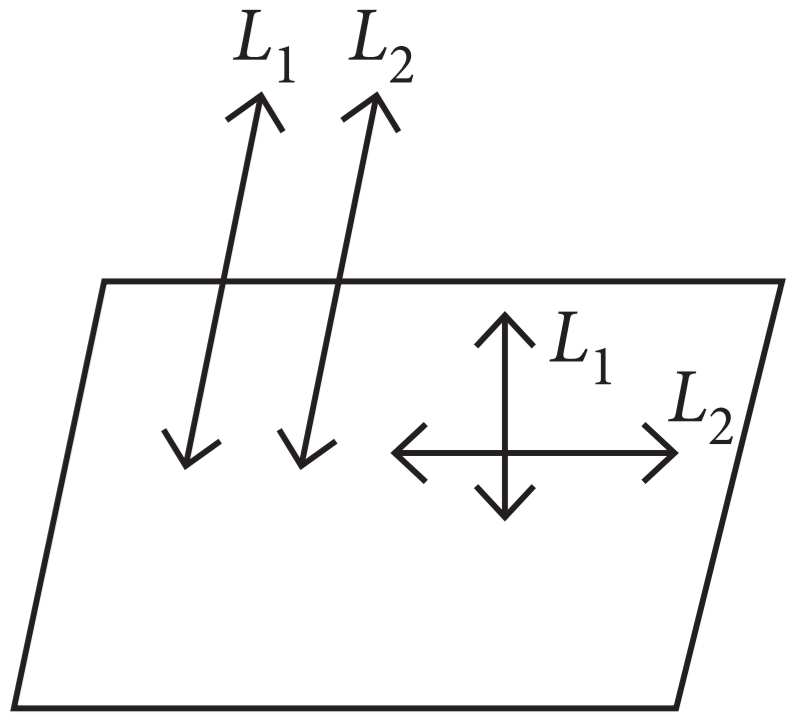
Based on the above information, answer the following questions.
- If $l_{1,} m_1, n_{1,}$ and $l_2, m_2, n_2$ are the direction cosines of $L_1$ and $L_2$ respectively, then $L_1$ will be perpendicular to $L_2,$ iff:
- $l_1l_2 + m_1m_2 + n_1n_2 = 0$
- $l_1m_2 + m_1l_2 + n_1n_2 = 0$
- $\frac{\text{l}_1}{\text{l}_2}=\frac{\text{m}_1}{\text{m}_2}=\frac{\text{n}_1}{\text{n}_2}$
- None of these
- If $l_1, m_1, n_1$ and $l_2, m_2, n_2$ are direction cosines of $L_1$ and $L_2$ respectively, then $L_1$ will be parallel to $L_2,$ iff:
- $l_1l_2 + m_1m_2 + n_1n_2 = 0$
- $l_1m_2 + m_1l_2 + n_1n_2 = 0$
- $\frac{\text{l}_1}{\text{l}_2}=\frac{\text{m}_1}{\text{m}_2}=\frac{\text{n}_1}{\text{n}_2}$
- $m_1n_2 + m_2n_2 + l_1l_2 = 0$
- The coordinates of the foot of the perpendicular drawn from the point $A(1, 2, 1)$ to the line joining $B(1, 4, 6)$ and $C(5, 4, 4),$ are:
- $(1, 2, 1)$
- $(2, 4, 5)$
- $(3, 4, 5)$
- $(3, 4, 5)$
- The direction ratios of the line which is perpendicular to the lines with direction ratios proportional to $(1, -2, -2)$ and $(0, 2, 1)$ are:
- $< 1, 2, 1 >$
- $< 2,-1, 2 >$
- $< -1,2, 2 >$
- None of these
- The lines $\frac{\text{x}-2}{3}=\frac{\text{y}+1}{-2}=\frac{\text{z}-2}{0}$ and $\frac{\text{x}-1}{1}=\frac{\frac{\text{y}+3}{2}}{\frac{3}{2}}=\frac{\text{z}+5}{2}$ are:
- Parallel.
- Perpendicular.
- Skew lines.
- Non-intersecting.
View full solution →Fill in the blanks.
A plane passes through the points (2, 0, 0) (0, 3, 0) and (0, 0, 4). The equation of plane is __________.
The position vectors of two points A and B are $\overrightarrow{\text{OA}}=2\hat{\text{i}}-\hat{\text{j}}-\hat{\text{k}}$ and $\overrightarrow{\text{OB}}=2\hat{\text{i}}-\hat{\text{j}}-2\hat{\text{k}},$ respectively. The position vector of a point P which divides the line segment joining A and B in the ratio 2 : 1 is ___________.
View full solution →The position vectors of two points A and B are $\overrightarrow{\text{OA}}=2\hat{\text{i}}-\hat{\text{j}}-\hat{\text{k}}$ and $\overrightarrow{\text{OB}}=2\hat{\text{i}}-\hat{\text{j}}-2\hat{\text{k}},$ respectively. The position vector of a point P which divides the line segment joining A and B in the ratio 2 : 1 is ___________.
View full solution →Fill in the blanks.
The vector equation of the line $\frac{\text{x}-5}{3}=\frac{\text{y}+4}{7}=\frac{\text{z}-6}{2}$ is _________.
View full solution →The position vectors of two points A and B are $\overrightarrow{\text{OA}}=2\hat{\text{i}}-\hat{\text{j}}-\hat{\text{k}}$ and $\overrightarrow{\text{OB}}=2\hat{\text{i}}-\hat{\text{j}}-2\hat{\text{k}},$ respectively. The position vector of a point P which divides the line segment joining A and B in the ratio 2 : 1 is ___________.
View full solution →State True or False for the following:
The line $\vec{\text{r}}=2\hat{\text{i}}-3\hat{\text{j}}-\hat{\text{k}}+\lambda({\text{i}}-{\text{j}}+2{\text{k}})$ lies in the plane $\vec{\text{r}}\cdot(3\hat{\text{i}}+{\text{j}}-{\text{k}})+2=0$
View full solution →State True or False for the following:
The equation of a line, which is parallel to $2\hat{\text{i}}+\hat{\text{j}}+3\hat{\text{k}}$ and which passes through the point (5, -2, 4) is $\frac{\text{x}-5}{2}=\frac{\text{y}-5}{-1}=\frac{\text{z}-4}{3}.$
View full solution →State True or False for the following:
The intercepts made by the plane 2x - 3y + 5z + 4 = 0 on the co-ordinate axis are $-2, \frac{4}{3},-\frac{4}{5}.$
View full solution →State True or False for the following:
The unit vector normal to the plane x + 2y +3z – 6 = 0 is $\frac{1}{\sqrt{14}}\hat{\text{i}}+\frac{2}{\sqrt{14}}\hat{\text{j}}+\frac{3}{\sqrt{14}}\hat{\text{k}}.$
View full solution →State True or False for the following:
The angle between the line $\vec{\text{r}}=(5\hat{\text{i}}-\hat{\text{j}}-4\hat{\text{k}})+\lambda(2\hat{\text{i}}-\hat{\text{j}}-\hat{\text{k}})$ and the plane $\vec{\text{r}}(3\hat{\text{i}}-4\hat{\text{j}}-\hat{\text{k}})+5=0$ is $\sin^{-1}\Big(\frac{5}{2\sqrt{91}}\Big).$
View full solution →