Questions

3 Marks Question

🎯

Test yourself on this topic

9 questions · timed · auto-graded

Question 13 Marks
Find the equation of the line in vector and in Cartesian form that passes through the point with position vector $2 \hat{i}-\hat{j}+4 \hat{k}$ and is in the direction $\hat{i}+2 \hat{j}-\hat{k}$
View full question & answer
Question 23 Marks
Find the shortest distance between the lines $l_1$ and $l_2$ whose vector equations are
$\vec{r} =\hat{i}+\hat{j}+\lambda(2 \hat{i}-\hat{j}+\hat{k})$
$\vec{r} =2 \hat{i}+\hat{j}-\hat{k}+\mu(3 \hat{i}-5 \hat{j}+2 \hat{k})$
Answer
Given lines
$\vec{r} =\hat{i}+\hat{j}+\lambda(2 \hat{i}-\hat{j}+\hat{k})$
$\vec{r} =2 \hat{i}+\hat{j}-\hat{k}+\mu(3 \hat{i}-5 \hat{j}+2 \hat{k})$
Comparing equations $(1)$ and $(2)$ with $\vec{r}=\overrightarrow{a_1}+\lambda \overrightarrow{b_1}$ and
$\vec{r}=\overrightarrow{a_2}+\mu \overrightarrow{b_2} $
$ \overrightarrow{a_1}=\hat{i}+\hat{j}, \overrightarrow{b_1}=2 \hat{i}-\hat{j}+\hat{k}$
$ \overrightarrow{a_2}=2 \hat{i}+\hat{j}-\hat{k} \text { and } \overrightarrow{b_2}=3 \hat{i}-5 \hat{j}+2 \hat{k}$
So, $\quad \overrightarrow{a_2}-\overrightarrow{a_1}=\hat{i}-\hat{k}$
and
$\begin{aligned}\overrightarrow{b_1} \times \overrightarrow{b_2} & =(2 \hat{i}-\hat{j}+\hat{k}) \times(3 \hat{i}-5 \hat{j}+2 \hat{k}) \\& =\left|\begin{array}{rrr}\hat{i} & \hat{j} & \hat{k} \\2 & -1 & 1 \\3 & -5 & 2\end{array}\right|\end{aligned}$
$\begin{array}{l}=(-2+5) \hat{i}-(4-3) \hat{j}+(-10+3) \hat{k} \\=3 \hat{i}-\hat{j}-\hat{k}\end{array}$
Thus $\quad\left|\overrightarrow{b_1} \times \overrightarrow{b_2}\right|=\sqrt{9+1+49}=\sqrt{59}$
Therefore the shortest distance $d=\left|\frac{\left(\overrightarrow{b_1} \times \overrightarrow{b_2}\right) \cdot\left(\overrightarrow{a_2} \times\overrightarrow{a_1}\right)}{\left|\overrightarrow{b_1} \times \overrightarrow{b_2}\right|}\right|$
Putting the values
$\begin{aligned}d & =\left|\frac{(3 \hat{i}-\hat{j}-7 \hat{k}) \cdot(\hat{i}-\hat{k})}{\sqrt{59}}\right| \\& =\left|\frac{3-0+7}{\sqrt{59}}\right|=\frac{10}{\sqrt{59}}\end{aligned}$
 
View full question & answer
Question 33 Marks
Find the shortest distance between the following given lines $l_1$ and $l_2$
$\vec{r}=\hat{i}+2 \hat{j}-4 \hat{k}+\lambda(2 \hat{i}+3 \hat{j}+6 \hat{k})$
$\text { and } \vec{r}=3 \hat{i}+3 \hat{j}-5 \hat{k}+\lambda(2 \hat{i}+3 \hat{j}+6 \hat{k})$
Answer
Both the lines are parallel, because
$\overrightarrow{a_1}=\hat{i}+2 \hat{j}-4 \hat{k}, \quad \overrightarrow{a_2}=3 \hat{i}+3 \hat{j}-5 \hat{k}$ and
$\overrightarrow{b_1}=2 \hat{i}+3 \hat{j}+6 \hat{k}=\vec{b}_2$
Hence the distance between the parallel lines
$d=\left|\frac{\vec{b} \times\left(\vec{a}_2-\vec{a}_1\right)}{|\vec{b}|}\right| \\\vec{a}_2-\vec{a}_1=(3 \hat{i}+3 \hat{j}-5 \hat{k})-(\hat{i}+2 \hat{j}-4 \hat{k})=2 \hat{i}+\hat{j}-\hat{k} \\\therefore \vec{b} \times\left(\vec{a}_2-\vec{a}_1\right)=\left|\begin{array}{ccc}\hat{i} & \hat{j} & \hat{k} \\2 & 3 & 6 \\2 & 1 & -1\end{array}\right|=(-3-6) \hat{i} $

$-(-2-12) \hat{j}+(2-6) \hat{k}$
$=-9 \hat{i}+14 \hat{j}-4 \hat{k}$
$|\vec{b}|=\sqrt{(2)^2+(3)^2+(6)^2}$
$=\sqrt{4+9+36}=\sqrt{49}=7$
$\text { Hence }\left|\frac{\vec{b} \times\left(\vec{a}_2-\vec{a}_1\right)}{|\vec{b}|}\right|=\frac{\sqrt{(-9)^2+(14)^2+(-4)^2}}{7}$
$=\frac{\sqrt{81+196+16}}{7}=\frac{\sqrt{293}}{7} \text { }$
View full question & answer
Question 43 Marks
If the direction cosines of any variable line in its two adjacent position are $l , m , n$ and $l +\delta, m +\delta m$, $n +\delta n$ the angle between those position be $\delta \theta$, then prove that
$
(\delta \theta)^2=(\delta l)^2+(\delta m)^2+(\delta n)^2
$
View full question & answer
Question 53 Marks
Find the shortest distance between the following lines: $\vec{r}=(\hat{i}+2 \hat{j}+3 \hat{k})+\lambda(2 \hat{i}+3 \hat{j}+4 \hat{k}) \ \vec{r}=(2 \hat{i}+4 \hat{j}+5 \hat{k})+\mu(4 \hat{i}+6 \hat{j}+8 \hat{k})$
Answer
Comparing the equations of the given line with $\vec{r}=\overrightarrow{a_1}+\lambda \overrightarrow{b_1}$ and $\vec{r}=\overrightarrow{a_2}+\lambda \overrightarrow{b_2}$, we get
$\overrightarrow{a_1}=\hat{i}+2 \hat{j}+3 \hat{k}, \overrightarrow{b_1}=2 \hat{i}+3 \hat{j}+4 \hat{k}$
$\overrightarrow{a_2}=2 \hat{i}+4 \hat{j}+5 \hat{k}$ and $ \overrightarrow{b_2}=4 \hat{i}+6 \hat{j}+8 \hat{k}$
$ \therefore \overrightarrow{b_2}=\vec{b}$
So $\overrightarrow{a_2}-\vec{a}_1=2 \hat{i}+4 \hat{j}+5 \hat{k}-\hat{i}-2 \hat{j}-3 \hat{k}=\hat{i}+2 \hat{j}+2 \hat{k}$
Here both the lines are parallel to each other.
Hence the distance between the parallel lines $
d=\left|\frac{\vec{b} \times\left(\vec{a}_2-\vec{a}_1\right)}{|\vec{b}|}\right|$
Now finding the value of $\vec{b} \times\left(a_2-a_1\right)$,
$\left|\begin{array}{ccc}\hat{i} & \hat{j} & \hat{k} \\2 & 3 & 4 \\1 & 2 & 2\end{array}\right|$
$=(6-8) \hat{i}-(4-4) \hat{j}+(4-3) \hat{k}$
$ =-2 \hat{i}+\hat{k}$
$\therefore\left|\vec{b} \times\left(\vec{a}_2-\overrightarrow{a_1}\right)\right| $
$=\sqrt{(-2)^2+(1)^2}=\sqrt{5}$
$|\vec{b}| =\sqrt{(2)^3+(3)^2+(4)^2}$
$=\sqrt{4+9+16}$
$ =\sqrt{29}$
Hence the distance between the parallel lines.
$d=\left|\frac{\vec{b} \times\left(\vec{a}_2-\vec{a}_1\right)}{|\vec{b}|}\right|$
$d=\frac{\sqrt{5}}{\sqrt{29}}$
$d=\frac{\sqrt{5}}{\sqrt{29}} \times \frac{\sqrt{29}}{\sqrt{29}}=\frac{\sqrt{145}}{29}$
View full question & answer
Question 63 Marks
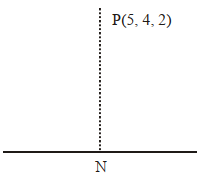
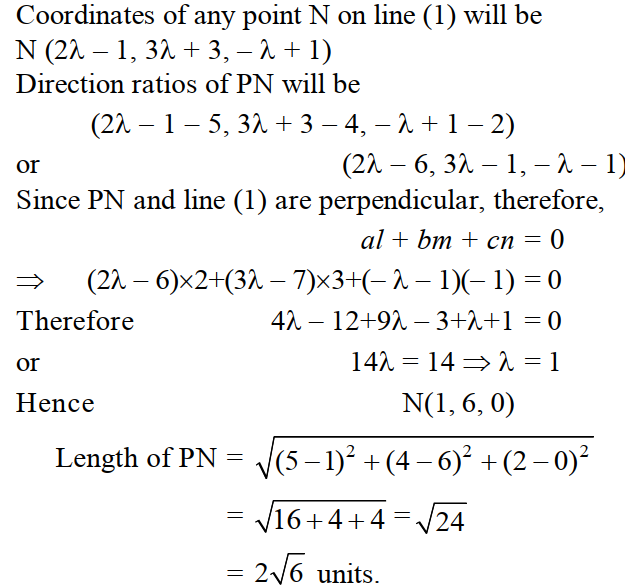
Find the coordinates of the foot of the perpendicular and its length drawn from the point $P(5,4,2)$ to the line
$
\vec{r}=-\hat{i}+3 \hat{j}+\hat{k}+\lambda \quad(2 \hat{i}+3 \hat{j}-\hat{k})
$
Answer
$
\vec{r}=-\hat{i}+3 \hat{j}+\hat{k}+\lambda(2 \hat{i}+3 \hat{j}-\hat{k})
$
Equation of the line in Cartesian form are
$
\frac{x+1}{2}=\frac{y-3}{3}=\frac{z-1}{-1}=\lambda
$

Image
Image
View full question & answer
Question 73 Marks
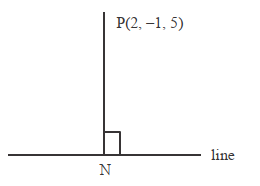
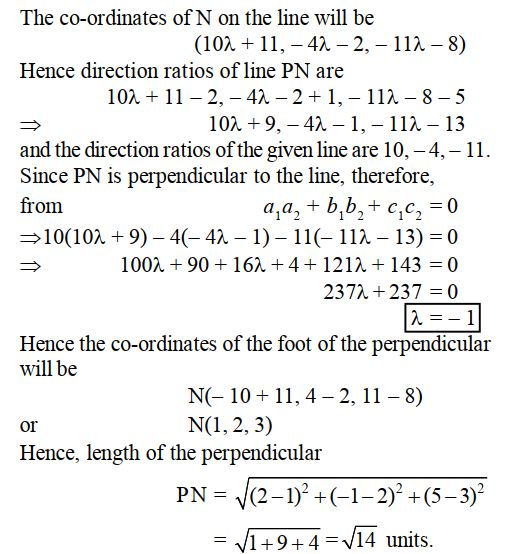
Find the length of the perpendicular and coordinates of the foot of the perpendicular drawn from point $P(2,-1,5)$ on the given line $\frac{x-11}{10}=\frac{y+2}{-4}=\frac{z+8}{-11}$.
Answer
The equations of the given line are
$
\frac{x-11}{10}=\frac{y+2}{-4}=\frac{z+8}{-11}=\lambda \text { (say) }
$
Image
Image
View full question & answer
Question 83 Marks
Find the angle between the lines
$
\begin{array}{ll}
& 2 x=3 y=-z \\
\text { and } & 6 x=-y=-4 z .
\end{array}
$
View full question & answer
Question 93 Marks
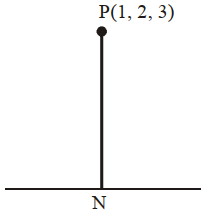
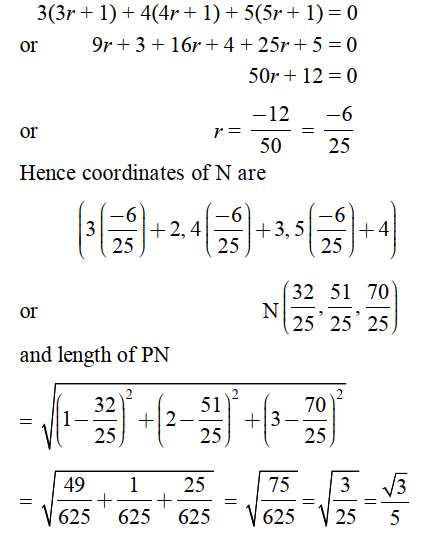
From point $P(1,2,3)$ perpendicular $P N$ is drawn to the line $\frac{x-2}{3}=\frac{y-3}{4}=\frac{z-4}{5}$. Then find the following :
(i) Coordinates of point N
(ii) Length of PN
Answer
From point $P (1,2,3)$ perpendicular PN is drawn to the line
$
\frac{x-2}{3}=\frac{y-2}{4}=\frac{z-4}{5}=r \text { (say) }
$
Then the coordinates of N can be taken as $(3 r+2,4 r$ $+3,5 r+4$ ).
Direction ratios of PN are
$
\begin{array}{r}
3 r+2-1,4 r+3-2,5 r+4-3 \\
3 r+1,4 r+1,5 r+1
\end{array}
$
i.e., Since PN is perpendicular to the line, therefore,
Image
Image
View full question & answer
3 Marks Question - MATHS STD 12 Science Questions - Vidyadip