MCQ 511 Mark
The image of the point $(1, 3, 4)$ in the plane $2x - y + z + 3 = 0$ is :
- A
$(3, 5, 2)$
- B
$(-3, 5, 2)$
- ✓
$(3, 5, -2)$
- D
$(3, -5, 2)$
AnswerCorrect option: C. $(3, 5, -2)$
Let $Q$ be the image of the point $P(1, 3, 4)$ in the plane $2x - y +z + 3 = 0$
Then $PQ$ is normal to the plane.
So, the direction ratios of $PQ$ are proportional to $2, -1, 1$ equation of $PQ$ is
Let the coordinates of $Q$ be $(2r + 1, -r + 3, r + 4)$
Let $R$ be the mid point of $PQ.$
Then,
$\text{R}=\Big(\frac{2\text{r}+1+1}{2},\frac{-\text{r}+3+3}{2},\frac{\text{r}+4+4}{2}\Big)$
$=\Big(\text{r}+1,\frac{-\text{r}+6}{2},\frac{\text{r}+8}{2}\Big)$
Since $R$ lies in the plane $2x - y + z + 3 = 0,$
$2(\text{r}+1)-\Big(\frac{-\text{r}+6}{2}\Big)+\frac{\text{r}+8}{2}+3=0$
$\Rightarrow 4r + 4 + r - 6 + r + 8 + 6 = 0$
$\Rightarrow 6r + 12 = 0$
$\Rightarrow r = -2$
Substituting this in the coordinates of $Q, $ we get
$Q = (2r + 1, -r + 3, r + 4)$
$=(2 (-2) + 1, 2 + 3, -2 + 4)$
$=(-3, 5, 2).$
View full question & answer→MCQ 521 Mark
The angle between the straight lines $\frac{\text{x}+1}{2}=\frac{\text{y}-2}{5}=\frac{\text{z}+3}{4}$ and $\frac{\text{x}-1}{1}=\frac{\text{y}+2}{2}=\frac{\text{z}-3}{-3}$ is:
- A
$45^\circ$
- B
$30^\circ$
- C
$60^\circ$
- ✓
$90^\circ$
AnswerCorrect option: D. $90^\circ$
We have
$\frac{\text{x}+1}{2}=\frac{\text{y}-2}{5}=\frac{\text{z}+3}{4}$
$\frac{\text{x}-1}{1}=\frac{\text{y}+2}{2}=\frac{\text{z}-3}{-3}$
The direction of the given lines are propotional to $2, 5, 4$ are $1, 2, -3.$
The given lines are parallel to the vectors $\vec{\text{b}}_1=2\hat{\text{i}}+5\hat{\text{j}}+4\hat{\text{k}}$ and $\vec{\text{b}}_2=\hat{\text{i}}+2\hat{\text{j}}-3\hat{\text{k}}.$
Let $\theta$ be the angle between the given lines.
Now,
$\cos\theta=\frac{\vec{\text{b}}_1.\vec{\text{b}}_2}{\big|\vec{\text{b}}_1\big|\big|\vec{\text{b}}_2\big|}$
$=\frac{\big(2\hat{\text{i}}+5\hat{\text{j}}+4\hat{\text{k}}\big).\big(\hat{\text{i}}+2\hat{\text{j}}-3\hat{\text{k}}\big)}{\sqrt{2^2+5^2+4^2}\sqrt{1^2+2^2+(-3)^2}}$
$=\frac{2+10-12}{\sqrt{45}\sqrt{14}}$
$\Rightarrow\theta=90^\circ$
View full question & answer→MCQ 531 Mark
If $P(x, y, z)$ moves such that $x = 0, z = 0$ then the locus of $P$ is the line whose $d.cs$ are:
- A
$y-$axis
- B
$1, 0, 0$
- ✓
$0, 1, 0$
- D
AnswerCorrect option: C. $0, 1, 0$
When $P$ moves then $x = 0, z = 0$ but $y$ is not given.
Let $y = y$
Then the coordinates of the point will be $(0, y, 0)$
Now, direction cosines with respect to $(0, y, 0)$ is given by.
$\cos\alpha=\frac{0}{0^2+\text{y}^2+0^2}=\frac{0}{\text{y}}=0$
$\cos\beta=\frac{\text{y}}{0^2+\text{y}^2+0^2}=\frac{\text{y}}{\text{y}}=1$
$\cos\gamma=\frac{{0}}{0^2+\text{y}^2+0^2}=\frac{{0}}{\text{y}}=0$
The direction cosines are $0, 1, 0$
View full question & answer→MCQ 541 Mark
A rectangular parallelopiped is formed by planes drawn through the point $(5, 7, 9)$ and $(2, 3, 7)$ parallel to the coordinate planes. The length of an edge of this rectangular parallelopiped is:
AnswerThe give point $(5, 7, 9)$ and $(2, 3, 7)$ are two diagonally opposite vertices of the parallelopiped as all of theire coordinates.
Edges of the paralleloppiped $= |5 - 2|, |7 - 3|, |9 - 7|$
$=3, 4, 2.$
View full question & answer→MCQ 551 Mark
If $\alpha,\beta$ and $\gamma$ are the angles which a half ray makes with the positive direction of the axes, then $\sin^2\alpha+\sin^2\beta+\sin^2\gamma$ is equal to:
AnswerGiven expression, $\sin^2\alpha+\sin^2\beta+\sin^2\gamma$
$=(1-\cos^2\alpha)+(1-\cos^2\beta)+(1-\cos^2\gamma)$
$=3-\cos^2\alpha+\cos^2\beta+\cos^2\gamma=3-1=2$
$(\because\cos^2\alpha+\cos^2\beta+\cos^2\gamma=1)$
View full question & answer→MCQ 561 Mark
The direction ratios of the line joining the points $A(4, −3, 7)$ and $B(1, 3, 5)$ are:
AnswerCorrect option: B. $(3, −6, 2)$
View full question & answer→MCQ 571 Mark
The eqution of the plane $\vec{\text{r}}=\hat{\text{i}}-\hat{\text{j}}+\lambda(\hat{\text{i}}+\hat{\text{j}}+\hat{\text{k}})+\mu(\hat{\text{i}}-2\hat{\text{j}}+3\hat{\text{k}})$ in scalar product from is:
- ✓
$\vec{\text{r}}.(5\hat{\text{i}}-2\hat{\text{j}}-3\hat{\text{k}})=7$
- B
$\vec{\text{r}}.(5\hat{\text{i}}+2\hat{\text{j}}-3\hat{\text{k}})=7$
- C
$\vec{\text{r}}.(5\hat{\text{i}}-2\hat{\text{j}}+3\hat{\text{k}})=7$
- D
AnswerCorrect option: A. $\vec{\text{r}}.(5\hat{\text{i}}-2\hat{\text{j}}-3\hat{\text{k}})=7$
We know that the equation $\vec{\text{r}}=\vec{\text{a}}+\lambda\vec{\text{b}}+\mu\vec{\text{c}}$ represents a plane passing through a point whose position vectors is $\vec{\text{a}}$ and parrallel to the vectors $\vec{\text{b}}$ and $\vec{\text{c}}$.
Here, $\vec{\text{a}}=\hat{\text{i}}-\hat{\text{j}}+0\hat{\text{k}};\ \vec{\text{b}}=\hat{\text{i}}+\hat{\text{j}}+\hat{\text{k}};\ \vec{\text{c}}=\hat{\text{i}}-2\hat{\text{j}}+3\hat{\text{k}}$
Normal vector, $\vec{\text{n}}=\vec{\text{b}}\times\vec{\text{c}}$
$=\begin{vmatrix}\hat{\text{i}} \hat{\text{j}} \hat{\text{k}}1 1 11 -2 3\end{vmatrix}$
$=5\hat{\text{i}}-2\hat{\text{j}}-3\hat{\text{k}}$
The vector equation of the plane in scalar product from is
$\vec{\text{r}}.\vec{\text{n}}=\vec{\text{a}}.\vec{\text{n}}$
$\Rightarrow\vec{\text{r}}.\big(5\hat{\text{i}}-2\hat{\text{j}}-3\hat{\text{k}}\big)=\big(\hat{\text{i}}-\hat{\text{j}}-0\hat{\text{k}}\big).\big(5\hat{\text{i}}-2\hat{\text{j}}-3\hat{\text{k}}\big)$
$\Rightarrow\vec{\text{r}}.\big(5\hat{\text{i}}-2\hat{\text{j}}-3\hat{\text{k}}\big)=5+2+0$
$\Rightarrow\vec{\text{r}}.\big(5\hat{\text{i}}-2\hat{\text{j}}-3\hat{\text{k}}\big)=7$
$\Rightarrow\vec{\text{r}}.\big(5\hat{\text{i}}-2\hat{\text{j}}-3\hat{\text{k}}\big)=7$
View full question & answer→MCQ 581 Mark
Direction cosines of ray from $P(1, -2, 4)$ to $Q(-1, 1, -2)$ are:
- A
$-2, 3, -6$
- B
$2, -3, 6$
- C
$2, 3, 6$
- ✓
$\frac{-2}{7},\frac{3}{7},\frac{-6}{7}$
AnswerCorrect option: D. $\frac{-2}{7},\frac{3}{7},\frac{-6}{7}$
Given the points are $P(1, -2, 4)$ and $Q(-1, 1, -2)$ Now the direction
ratios of the ray $PQ$ are $(-1 - 1, 1 + 2, -2 - 4) = (-2, 3, -6)$
The direction cosines of the line $PQ$ will be
$\Big(\frac{2}{\sqrt{2^2+3^2+6^2}},\frac{3}{\sqrt{2^2+3^2+6^2}},\frac{-6}{\sqrt{2^2+3^2+6^2}}\Big)=\Big(\frac{-2}{7},\frac{3}{7},\frac{-6}{7}\Big)$
View full question & answer→MCQ 591 Mark
The angle between the two diagonals of a cube is:
AnswerCorrect option: A. $30^\circ$
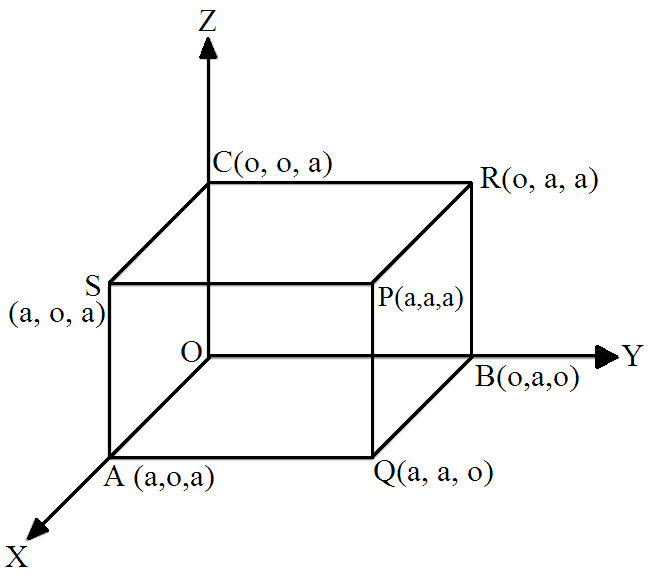
Let a be the length of an edge of the cube and let one corner be at the origin as shown in the figure. Clearly, $OP, AR,$ Consider the diagonals $OP$ and $AR.$
Direction ratios of $OP$ and $AR$ are proportional to $a - 0, a - 0, a - 0$ and $0 - a, a - 0, a - 0, e.i. a, a, a$ and $-a, a, a,$ respectivelly.
Let $\theta$ be the angle between $OP$ and $AR.$ Then,
$\cos\theta=\frac{\text{a}\times-\text{a}+\text{a}\times\text{a}+\text{a}\times\text{a}}{\sqrt{\text{a}^2+\text{a}^2+\text{a}^2}\sqrt{(-\text{a})^2+\text{a}^2+\text{a}^2}}$
$\Rightarrow\cos\theta=\frac{-\text{a}+\text{a}^2+\text{a}^2}{\sqrt{3\text{a}^2}\sqrt{3\text{a}^2}}$
$\Rightarrow\cos\theta=\frac{1}{3}$
$\Rightarrow\theta=\cos^{-1}\Big(\frac{1}{3}\Big)$
Similarly, the angles between other pairs of the diagonals are equal to $\cos^{-1}\Big(\frac{1}{3}\Big)$ as the angle between any two diagonals. View full question & answer→MCQ 601 Mark
The direction ratios of the line $x - y + z - 5 = 0 = x - 3y - 6$ are proportional to:
- ✓
$3,1,-2$
- B
$2,-4,1$
- C
$\frac{3}{\sqrt{14}},\frac{1}{\sqrt{14}},\frac{-2}{\sqrt{14}}$
- D
$\frac{2}{\sqrt{41}},\frac{-4}{\sqrt{41}},\frac{1}{\sqrt{41}}$
AnswerCorrect option: A. $3,1,-2$
We have
$x - y + z - 5 = 0 = x - 3y - 6$
$\Rightarrow x - 3y - 6=0$
$x - y + z - 5 = 0$
$\Rightarrow x = 3y + 6 .....(1)$
$x - y + z - 5 = 0.....(2)$
From $(1)$ and $(2),$ we get
$3y + 6 - y + z - 5 = 0$
$\Rightarrow 2y + z + 1 = 0$
$\Rightarrow\text{y}=\frac{-\text{z}-1}{2}$
$\text{y}=\frac{\text{x}-6}{3} [$From $(1)]$
$\therefore\frac{\text{x}-6}{3}=\text{y}=\frac{-\text{z}-1}{2}$
So, the given equation can be re$-$witten as
$\frac{\text{x}-6}{3}=\frac{\text{y}}{1}=\frac{\text{z}+1}{-2}$
Hence, the direction ratios the given line are proportional to $3, 1, -2.$
View full question & answer→MCQ 611 Mark
The plane $2\text{x}-(1-\lambda)\text{y}+3\lambda\text{z}=0$ passes through the intersection of the planes:
- ✓
$2x - y = 0$ and $y- 3z = 0$
- B
$2x + 3z = 0$ and $y = 0$
- C
$2x - y + 3z = 0$ and $y - 3z = 0$
- D
AnswerCorrect option: A. $2x - y = 0$ and $y- 3z = 0$
The given plane is
$2\text{x}-(1-\lambda)\text{y}+3\lambda\text{z}=0$
$\Rightarrow(2\text{x}-\text{y})+\lambda(-\text{y}+3\text{z})=0$
So, this plane passes through the intersection of the planes
$2x - y = 0$ and $-y + 3z = 0$
$\Rightarrow 2x - y = 0$ and $y - 3z = 0.$
View full question & answer→MCQ 621 Mark
Which of the following represents direction cosines of the line:
- A
$0,\frac{1}{\sqrt{2}},\frac{1}{2}$
- B
$0,\frac{-\sqrt{3}}{2},\frac{1}{\sqrt{2}}$
- ✓
$0,\frac{\sqrt{3}}{2},\frac{1}{2}$
- D
$\frac{1}{2},\frac{1}{2},\frac{1}{2}$
AnswerCorrect option: C. $0,\frac{\sqrt{3}}{2},\frac{1}{2}$
If direction cosine of a line is $l, m, n$ then
$l^2 + m^2 + n^2 = 1$
$=0^2+\Big(\frac{\sqrt{3}}{2}\Big)^2+\Big(\frac{1}{2}\Big)^2=1$
The correct answer from the given alternative is $(c) \ 0,\frac{\sqrt{3}}{2},\frac{1}{2}$
View full question & answer→MCQ 631 Mark
If $\alpha,\beta,\gamma$ are the angles which a directed line makes with the positive directions of the coordinate axes, then $\sin^2\alpha+\sin^2\beta+\sin^2\gamma$ is equal to:
AnswerThe direction cosines of the line are
$\text{l}^2+\text{m}^2+\text{n}^2=1$
Now, $\Rightarrow\cos^2\alpha+\cos^2\beta+\cos^2\gamma=1$
$\Rightarrow1-\sin^2\alpha+1-\sin^2\beta+1-\sin^2\gamma=1$
$\Rightarrow\sin^2\alpha+\sin^2\beta+\sin^2\gamma=2$
View full question & answer→MCQ 641 Mark
The reflection of the point $(\text{a}, \beta, \gamma) $ in the $xy-$plane is:
AnswerCorrect option: D. $(\alpha,\beta,\gamma)$
View full question & answer→MCQ 651 Mark
What are the direction ratios of the line if it passes through the intersection of the planes $x = 3z + 4$ and $y = 2z - 3:$
- A
$(1, 2, 3)$
- B
$(2, 1, 3)$
- ✓
$(3, 2, 1)$
- D
AnswerCorrect option: C. $(3, 2, 1)$
Equations of the planes are $x = 3z + 4$ and $y = 2z - 3$
$\therefore$ The equation of the plane passing through the line of intersection of these planes is $x = 3z + 4$ and $y = 2z - 3$
Thus The direction Ratios of the equation passes through intersection of the planes is $(3, 2, 1).$
View full question & answer→MCQ 661 Mark
The product of the of the line which makesequal angles with $ox, oy, oz$ is:
- A
$1$
- B
$\sqrt{3}$
- ✓
$\frac{1}{3\sqrt{3}}$
- D
$\frac{1}{\sqrt{3}}$
AnswerCorrect option: C. $\frac{1}{3\sqrt{3}}$
$\cos^2(\alpha)+\cos^2(\beta)+\cos^2(\gamma)=1$
$\Rightarrow3\cos^2(\alpha)=1$
$\Rightarrow\cos\alpha=\underline{+}\frac{1}{\sqrt{3}}$
View full question & answer→MCQ 671 Mark
A line passes through the points $(6, -7, -1)$ and $(2, -3, 1)$. What are the direction ratios of the line?
- A
$(4, −4, 2)$
- B
$(4, 4, 2)$
- ✓
$(−4, 4, 2)$
- D
$(2, 1, 1)$
AnswerCorrect option: C. $(−4, 4, 2)$
Direction ratios of a line passing through points $\left(x_1, y_1, z_1\right)$ and $\left(x_2, y_2, z_2\right)$ are represented by $\pm\left(x_1-x_2, y_1-y_2, z_1-z_2\right)$ Hence for the given line, direction ratios are $(6-2,-7-(-3),-1-1)$
$\Rightarrow \pm(4,-4,-2)$
$\Rightarrow(-4,4,2)$ or $(4,-4,-2)$
View full question & answer→MCQ 681 Mark
If a line makes angle $\frac{\pi}{3}$ and $\frac{\pi}{4}$ with $x-$axis and $y-$axis respectively, then the angle made by the line with $z-$axis is:
- A
$\frac{\pi}{2}$
- ✓
$\frac{\pi}{3}$
- C
$\frac{\pi}{4}$
- D
$\frac{5\pi}{12}$
AnswerCorrect option: B. $\frac{\pi}{3}$
If a line makes angles $\alpha,\beta$ and $\gamma$ with the axis, then $\cos2\alpha+\cos2\beta+\cos2\gamma=1.$
Here,
$\alpha=\frac{\pi}{3}$
$\beta=\frac{\pi}{4}$
Now,
$\cos^2\alpha+\cos^2\beta+\cos^2\gamma=1$
$\Rightarrow\cos^2\frac{\pi}{3}+\cos^2\frac{\pi}{4}+\cos^2\gamma=1$
$\Rightarrow\frac{1}{4}+\frac{1}{2}+\cos^2\gamma=1 $
$\Rightarrow\cos^2\gamma=1-\frac{3}{4}$
$\Rightarrow\cos^2\gamma=\frac{1}{4}$
$\Rightarrow\cos\gamma=\frac{1}{2}$
$\Rightarrow\gamma=\frac{\pi}{3}$
View full question & answer→MCQ 691 Mark
The direction cosines of the straight linegiven by the planes $x = 0$ and $z = 0$ are:
- A
$1, 0, 0$
- B
$0, 0, 1$
- C
$1, 1, 0$
- ✓
AnswerGiven$, x = z = 0$
It represents $Z-$axis
$\therefore$ Direction cosines $= (0, 1, 0)$
View full question & answer→MCQ 701 Mark
Choose the correct answer from the given four options.The sine of the angle between the straight line $\frac{\text{x}-2}{3}=\frac{\text{y}-2}{3}=\frac{\text{z}-2}{3}$ and the plane $2\text{x}-2\text{y}+\text{z}=5$ is:
- A
$\frac{10}{6\sqrt{5}}$
- B
$\frac{4}{5\sqrt{2}}$
- C
$\frac{2\sqrt{3}}{5}$
- ✓
$\frac{\sqrt{2}}{10}$
AnswerCorrect option: D. $\frac{\sqrt{2}}{10}$
We have, the equation of line as
$\frac{\text{x}-2}{3}=\frac{\text{y}-2}{3}=\frac{\text{z}-2}{3}$
This line is parallel to the vector $\vec{\text{b}}=3\hat{\text{i}}+4\hat{\text{j}}+5\hat{\text{k}}$
Equation of plane is $2\text{x}-2\text{y}+\text{z}=5$
Normal to the plane $\vec{\text{n}}=2\hat{\text{i}}-2\hat{\text{j}}+\hat{\text{k}}$
Its angle between line and plane is $'\theta\ '.$
Then $\sin\theta=\frac{|\vec{\text{b}}\cdot{\vec{\text{b}}}|}{|{\vec{\text{b}}}||{\vec{\text{b}}}|}$
$=\frac{\big|(3\hat{\text{i}}+4\hat{\text{j}}+5\hat{\text{k}})\cdot(2\hat{\text{i}}-2\hat{\text{j}}+\hat{\text{k}})\big|}{\sqrt{3^2+4^2+5^2}\sqrt{4+4+1}}$
$=\frac{|6-8+5|}{\sqrt{50}\sqrt{9}}$
$=\frac{3}{15\sqrt{2}}=\frac{1}{5\sqrt{2}}$
$\sin\theta=\frac{\sqrt{2}}{10}$
View full question & answer→MCQ 711 Mark
The three points $\text{ABC}$ have position vectors $(1, x, 3), (3, 4, 7)$ and $(y, -2, -5)$ are collinear then $(x, y):$
- ✓
$(2, -3)$
- B
$(-2, 3)$
- C
$(-2, -3)$
- D
AnswerCorrect option: A. $(2, -3)$
View full question & answer→MCQ 721 Mark
The shortest distance between the lines $\frac{\text{x}-3}{3}=\frac{\text{y}-8}{-1}=\frac{\text{z}-3}{1}$ and, $\frac{\text{x}+3}{-3}=\frac{\text{y}+7}{2}=\frac{\text{z}-6}{4}$ is:
- A
$\sqrt{30}$
- B
$2\sqrt{30}$
- C
$5\sqrt{30}$
- ✓
$3\sqrt{30}$
AnswerCorrect option: D. $3\sqrt{30}$
We have
$\frac{\text{x}-3}{3}=\frac{\text{y}-8}{-1}=\frac{\text{z}-3}{1}\dots(1)$
$\frac{\text{x}+3}{-3}=\frac{\text{y}+7}{2}=\frac{\text{z}-6}{4}\dots(2)$
We know that line $(1)$ passes through the point $(3, 8, 3)$ and has direction ratios proportional to $3, -1, 1.$
Its vector equation is $\vec{\text{r}}=\vec{\text{a}}_1+\lambda\vec{\text{b}}_1,$
where $\vec{\text{a}}_1=3\hat{\text{i}}+8\hat{\text{j}}+3\hat{\text{k}}$ and $\vec{\text{b}}_1=3\hat{\text{i}}-\hat{\text{j}}+\hat{\text{k}}.$
Also, line $(2)$ passes through the point $(3, -7, 6)$ and has direction ratios proprtional to $-3, 2, 4.$
Its vector equation is $\vec{\text{r}}=\vec{\text{a}}_2+\mu\vec{\text{b}}_2,$
where $\vec{\text{a}}_2=-3\hat{\text{i}}-7\hat{\text{j}}+6\hat{\text{k}}$ and $\vec{\text{b}}_2=-3\hat{\text{i}}+2\hat{\text{j}}+4\hat{\text{k}}.$
Now,
$\vec{\text{a}}_2-\vec{\text{a}}_1=-6\hat{\text{i}}-15\hat{\text{j}}+3\hat{\text{k}}$
$\vec{\text{b}}_1\times\vec{\text{b}}_2=\begin{vmatrix}\hat{\text{i}} \hat{\text{j}} \hat{\text{k}}3 -1 1-3 2 4\end{vmatrix}$
$=-6\hat{\text{i}}-15\hat{\text{j}}+3\hat{\text{k}}$
$\Rightarrow\big|\vec{\text{b}}_1\times\vec{\text{b}}_2\big|=\sqrt{(-6)^2+(-15)^2+3^2}$
$=\sqrt{36+225+9}$
$=\sqrt{270}$
$\big(\vec{\text{a}}_2-\vec{\text{a}}_1\big).\big(\vec{\text{b}}_1\times\vec{\text{b}}_2\big)=\big(-6\hat{\text{i}}-15\hat{\text{j}}+3\hat{\text{k}}\big).\big(-6\hat{\text{i}}-15\hat{\text{j}}+3\hat{\text{k}}\big)$
$=36+225+9$
$=270$
The shortest distance between the lines $\vec{\text{r}}=\vec{\text{a}}_1+\lambda_1$ and $\vec{\text{r}}=\vec{\text{a}}_2+\mu\vec{\text{b}}_2$ is given by
$\text{d}=\Bigg|\frac{\big(\vec{\text{a}}_2-\vec{\text{a}}_1\big).\big(\vec{\text{b}}_1\times\vec{\text{b}}_2\big)}{\big|\vec{\text{b}}_1\times\vec{\text{b}}_2\big|}\Bigg|$
$=\Big|\frac{270}{\sqrt{270}}\Big|$
$=\sqrt{270}$
$=3\sqrt{30}$
View full question & answer→MCQ 731 Mark
The projection of a directed line segment on the $co-$ordinate axes are $12, 4, 3,$ then the direction cosines of the line are:
- A
$\frac{-12}{13},\frac{-4}{13},\frac{-3}{13}$
- ✓
$\frac{12}{13},\frac{4}{13},\frac{3}{13}$
- C
$\frac{12}{13},\frac{-4}{13},\frac{3}{13}$
- D
$\frac{12}{13},\frac{4}{13},\frac{-3}{13}$
AnswerCorrect option: B. $\frac{12}{13},\frac{4}{13},\frac{3}{13}$
$x = 12, y = 4, z = 3$
Direction cosines $=$
$\frac{\text{x}}{\text{x}^2 + \text{y}^2+\text{z}^2},\frac{\text{y}}{\text{x}^2 + \text{y}^2+\text{z}^2},\frac{\text{x}}{\text{x}^2 + \text{y}^2+\text{z}^2}$
$=\frac{12}{13},\frac{4}{13},\frac{3}{13}$
View full question & answer→MCQ 741 Mark
The length of perpendicular from the origin to the plane which makes intercepts $\frac{1}{3},\frac{1}{4},\frac{1}{5}$ respectively on the coordinate axes is:
- ✓
$\frac{1}{\sqrt[5]{2}}$
- B
$\frac{1}{10}$
- C
$\sqrt[5]{2}$
- D
$5$
AnswerCorrect option: A. $\frac{1}{\sqrt[5]{2}}$
Equation of plane $\frac{\text{x}}{\text{a}}+\frac{\text{y}}{\text{b}}+\frac{\text{z}}{\text{c}}=1$
$3x + 4y + 5z − 1 = 0$
diatance from origin $\frac{1}{\sqrt{150}}=\frac{1}{\sqrt[5]{2}}$
View full question & answer→MCQ 751 Mark
For every point $P(x, y, z)$ on the $xy-$plane,
- A
$x = 0$
- B
$y = 0$
- ✓
$z = 0$
- D
$x = y = z = 0$
AnswerCorrect option: C. $z = 0$
The $Z-$coordinate of every point on the $XY-$plane is zero.
View full question & answer→MCQ 761 Mark
The straigth line $\frac{\text{x}-3}{3}=\frac{\text{y}-2}{1}=\frac{\text{z}-1}{0}$ is:
AnswerCorrect option: D. perpendicular to $z-$axis
We have
$\frac{\text{x}-3}{3}=\frac{\text{y}-2}{1}=\frac{\text{z}-1}{0}$
Also, the given line is parallel to the vector $\vec{\text{b}}=3\hat{\text{i}}+\hat{\text{j}}+0\hat{\text{k}}$
Let $\text{x}\hat{\text{i}}+\text{y}\hat{\text{j}}+\text{z}\hat{\text{k}}$ be parpendicular to the given line.
Now,
$3\text{x}+4\text{y}+0\text{z}=0$
It is satisfied by the coordinates of $z-$axis, i.e. $(0, 0, 1).$
Hence, the given line is perpendicular to $z-$axis.
View full question & answer→MCQ 771 Mark
The $d.rs$ of the lines $x = ay + b, z = cy + d$ are:
- A
$1, a, c$
- ✓
$a, 1, c$
- C
$b, 1, c$
- D
$c, a, 1$
AnswerCorrect option: B. $a, 1, c$
Given $x = ay + b$ and $z = cy + d$
$\Rightarrow\frac{\text{x}-\text{b}}{\text{a}}=\text{y}$ and $\frac{\text{z}-\text{d}}{\text{c}}=\text{y}$
$\Rightarrow\frac{\text{x}-\text{b}}{\text{a}}=\frac{\text{y}}{1}=\frac{\text{z}-\text{d}}{c}$
Therefore $Drs$ of given line is $a, 1, c$
View full question & answer→MCQ 781 Mark
Choose the correct answer.Distance between the two planes$:\ 2x + 3y + 4z = 4$ and $4x + 6y + 8z = 12$ is:
AnswerCorrect option: D. $\frac{2}{\sqrt{29}}\ \text{units}.$
Equation of one plane is $2x + 3y + 4z = 4$
$\Rightarrow 2x + 3y + 4z - 4 = 0$
Equation of second plane is $4x + 6y + 8z = 12$
$\Rightarrow 4x + 6y + 8z - 12 = 0$
$\Rightarrow 2x + 3y + 4z - 6 = 0$
Here $\frac{\text{a}_1}{\text{a}_2}=\frac{2}{4}=\frac{1}{2},\ \frac{\text{b}_1}{\text{b}_2}=\frac{3}{6}=\frac{1}{2},\ \frac{\text{c}_1}{\text{c}_2}=\frac{4}{8}=\frac{1}{2}$
Since, $\frac{\text{a}_1}{\text{a}_2}=\frac{\text{b}_1}{\text{b}_2}=\frac{\text{c}_1}{\text{c}_2}$
therefore, the given two lines are parallel.
We know that the distance of parallel lines $=\frac{|\text{d}_1-\text{d}_2|}{\sqrt{\text{a}^2+\text{b}^2+\text{c}^2}}$
$\Rightarrow\ \frac{|-4-(-6)|}{\sqrt{(2)^2+(3)^2+(4)^2}}$
$=\frac{|-4+6|}{\sqrt{4+9+16}}$
$=\frac{2}{\sqrt{29}}$
Therefore, option $(D)$ is correct.
View full question & answer→MCQ 791 Mark
The following lines are $\hat{\text{r}}=\Big(\hat{\text{i}}+\hat{\text{j}}\Big)+\lambda\Big(\hat{\text{i}}+2\hat{\text{j}}-\hat{\text{k}}\Big)+\mu\Big(-\hat{\text{i}}+\hat{\text{j}}-2\hat{\text{k}}\Big)$
- ✓
- B
Skew$-$lines
- C
$Co-$planar lines
- D
View full question & answer→MCQ 801 Mark
Are the points $(1, 1), (2, 3)$ and $(8, 11)$ collinear?
AnswerArea of triangle formed by these vertices is,
$\triangle=\frac{1}{2}\begin{vmatrix}1&1&1\\2&3&1\\8&11&1\end{vmatrix}$
Applying $R_2 \rightarrow R_2-R_1, R_3 \rightarrow R_3-R 1$
$\triangle=\frac{1}{2}\begin{vmatrix}1&1&1\\1&2&0\\7&10&0\end{vmatrix}=\frac{1}{2}(10-14)=2$
Hence points are non collinear
View full question & answer→MCQ 811 Mark
The direction cosines of a line which is equally inclined to axes, is given by:
AnswerCorrect option: B. $\underline{+}\frac{1}{\sqrt{3}}$
View full question & answer→MCQ 821 Mark
Let a vector $\vec{\text{r}}$ make angles $60^\circ , 30^\circ$ with it and $y-$axes respectively. Find the angle $\vec{\text{r}}$ make with $z-$axis:
- A
$30^\circ$
- B
$60^\circ$
- ✓
$90^\circ$
- D
$ 120^\circ$
AnswerCorrect option: C. $90^\circ$
View full question & answer→MCQ 831 Mark
If the $x-$coordinate of a point $P$ on the join of $Q(2, 2, 1)$ and $R(5, 1, -2)$ is $4,$ then its $z-$coordinate is:
AnswerSuppose the point $P$ divided the line segment joining the point $Q(2, 2, 1)$ and $R(5, 1, -2)$ in the ratio $k : 1.$
Using the section formula, the coordinates of the point of intersection are given by
$\Big(\frac{\text{k}(5)+2}{\text{k}+2},\frac{\text{k}(1)+2}{\text{k}+1},\frac{\text{k}(-2)+1}{\text{k}+1}\Big) $
On the $XY-$plane, the $Z-$coordinate of any point is zero.
$\Rightarrow\frac{\text{k}(5)+2}{\text{k}+2}=4$
$\Rightarrow5\text{k}+2=4(\text{k}+1)$
$\Rightarrow\text{k}=2$
Now,
$Z-$coordinate of $P =\frac{\text{k}(-2)+1}{\text{k}+1}$
$\frac{2(-2)+1}{2+1}\ [$Substituting $\text{ k}=2]$
$=-1$
View full question & answer→MCQ 841 Mark
If $P(3, 2, -4), Q(5, 4, -6)$ and $R(9, 8, -10)$ are collinear, then $R$ divided $PQ$ in the ratio:
- A
$3 : 2$ internally
- ✓
$3 : 2$ externally
- C
$2 : 1$ internally
- D
$2 : 1$ externally
AnswerCorrect option: B. $3 : 2$ externally
Suppose the point $R$ divides $PQ$ in the ratio $\lambda:1$.
Coordinates of $R$ are $\Big(\frac{5\lambda+3}{\lambda+1},\frac{4\lambda+2}{\lambda+1},\frac{-6\lambda-4}{\lambda+1}\Big)$.
But the coordinates of $R$ are $(9, 8, -10).$
$\therefore\frac{5\lambda+3}{\lambda+1}=9,\frac{4\lambda+2}{\lambda+1}=8$ and $\frac{-6\lambda-4}{\lambda+1}=-10$
From each of these equations, we get
$\lambda=-\frac{3}{2}$
$\therefore R$ divided $PQ$ in the ratio $3 : 2$ externally.
View full question & answer→MCQ 851 Mark
How many lines through the origin in make equal angles with the coordinate axis:
MCQ 861 Mark
The locus of $xy + yz = 0$ is:
- A
- B
- C
A pair of parallel planes
- ✓
A pair of perpendicular planes
AnswerCorrect option: D. A pair of perpendicular planes
View full question & answer→MCQ 871 Mark
What are the direction ratios of normal to the plane $2x - y + 2z + 1 = 0:$
AnswerCorrect option: A. $(2, -1, 2)$
Direction ratios of normal to the plane $ax + by + cz + d = 0,$ are
$a, b, c.$
So, here in the question the given plane is $2x - y + 2z + 1=0$
Thus, the direction ratios are $2, -1, 2$
View full question & answer→MCQ 881 Mark
Choose the correct answer from the given four options.The reflection of the point $(\alpha,\beta,\gamma)$ in the $xy–$plane is:
AnswerCorrect option: D. $(\alpha,\beta,-\gamma)$
In $XY-$plane, only the sign of z coordinate of the point got changed after the reflection. Therefore, the reflection of the point $(\alpha,\beta,\gamma)$ is $(\alpha,\beta,-\gamma).$
View full question & answer→MCQ 891 Mark
The points $(k − 1, k + 2), (k, k + 1), (k + 1, k)$ are collinear for:
AnswerCorrect option: A. any value of $k$
View full question & answer→MCQ 901 Mark
If the points $(p, 0), (0, q)$ and $(1, 1)$ are collinear, then $\frac{1}{\text{p}}+\frac{1}{\text{q}}$ is equal to:
AnswerAs the points are collinear, the slope of the line joining
any two points, should be same as the slope of the line joining two other points.
Slope of the line passing through points $\left(x_1, y_1\right)$ and $\text{x}_2,\text{y}_2=\frac{\text{y}_2-\text{y}_1}{\text{x}_2-\text{x}_1}$
So, slope of the line joining $(p, 0), (0, q) =$ Slope of the line joining
$(0, q)$ and $(1, 1)$
$\frac{\text{q}-0}{0-\text{p}}=\frac{1-\text{q}}{1-\text{p}}$
$-\frac{\text{q}}{\text{p}}=1-\text{q}$
Dividing both sides by $q,$
$-\frac{1}{\text{p}}=\frac{1}{\text{q}}-1$
$\Rightarrow\frac{1}{\text{p}}+\frac{1}{\text{q}}=1$
View full question & answer→MCQ 911 Mark
$(2, -3, -1) 2x - 3y + 6z + 7 = 0:$
- A
$4$
- B
$3$
- ✓
$2$
- D
$\frac{1}{5}$
View full question & answer→MCQ 921 Mark
The plane $x + y = 0:$
AnswerCorrect option: C. Passes through $z-$axis
View full question & answer→MCQ 931 Mark
The lines $\frac{\text{x}}{1}=\frac{\text{y}}{2}=\frac{\text{z}}{3}$ and $\frac{\text{x}-1}{-2}=\frac{\text{y}-2}{-4}=\frac{\text{z}-3}{-6}$ are:
AnswerThe equation of the given lines are
$\frac{\text{x}}{1}=\frac{\text{y}}{2}=\frac{\text{z}}{3}\dots(1)$
$\frac{\text{x}-1}{-2}=\frac{\text{y}-2}{-4}=\frac{\text{z}-3}{-6}$
$=\frac{\text{x}-1}{1}=\frac{\text{y}-2}{2}=\frac{\text{z}-3}{3}\dots(2)$
Thus, the two lines are parallel to the vector $\vec{\text{b}}=\hat{\text{i}}+2\hat{\text{j}}+3\hat{\text{k}}$ and pass through the points $(0, 0, 0)$ and $(1, 2, 3).$
Now,
$\big(\vec{\text{a}}_2-\vec{\text{a}}_1\big)\times\vec{\text{b}}=\big(\hat{\text{i}}+2\hat{\text{j}}+3\hat{\text{k}}\big)\times\big(\hat{\text{i}}+2\hat{\text{j}}+3\hat{\text{k}}\big)$
$=\vec{0}$
$\big[\because\vec{\text{a}}\times\vec{\text{a}}=\vec{0}\big]$
View full question & answer→MCQ 941 Mark
Choose the correct answer The planes: 2x – y + 4z = 5 and 5x – 2.5y + 10z = 6 are:
AnswerEquation of the given planes are $2 x-y+4 z=5\left(a_1 x+b_1 y+c_1 z+d=0\right)$
and $5 x-2.5 y+10 z=6\left(a_2 x+b_2 y+c_2 z+d=0\right)$
For perpendicular $a_1 a_2+b_1 b_2+c_1 c_2=2(5)+(-1)(-2.5)+4(10)=10+2.5+40=52.5$
$\because \mathrm{a}_1 \mathrm{a}_2+\mathrm{b}_1 \mathrm{~b}_2+\mathrm{c}_1 \mathrm{c}_2 \neq 0$
$\therefore$ Planes are not perpendicular.
For parallel $\frac{a_1}{a_2}=\frac{2}{5}, \frac{b_1}{b_2}=\frac{-1}{-2.5}=\frac{10}{25}=\frac{2}{5}, \frac{c_1}{c_2}=\frac{4}{10}=\frac{2}{5}$
$\because \frac{\mathrm{a}_1}{\mathrm{a}_2}=\frac{\mathrm{b}_1}{\mathrm{~b}_2}=\frac{\mathrm{c}_1}{\mathrm{c}_2}$
$\therefore$ given planes are parallel.
Therefore, option (B) is correct.
b. Parallel.
View full question & answer→MCQ 951 Mark
If a line makes angles $\alpha,\beta,\gamma$ with the axis then $\cos 2\alpha+ \cos 2\beta +\cos 2\gamma=$
View full question & answer→MCQ 961 Mark
If the lines $\text{x}- \frac{2}{1} =\text{y}-\frac{2}{1} =\text{z}-\frac{4}{\text{k}} $ and $\text{x}-\frac{1}{\text{k}} = \text{y}-\frac{4}{2} = \text{z}-\frac{5}{1} $ are coplanar, then $k$ can have:
View full question & answer→MCQ 971 Mark
Choose the correct answer from the given four options.The distance of the plane $\vec{\text{r}}\Big(\frac{2}{7}\hat{\text{i}}+\frac{3}{7}\hat{\text{j}}-\frac{6}{7}\hat{\text{k}}\Big)=1$ from the origin is:
- ✓
$1.$
- B
$7.$
- C
$\frac{1}{7}.$
- D
AnswerThe general equation of a plane in vector form is given by $\vec{\text{r}}\cdot\hat{\text{n}}=\text{d}$
Where $d$ is the distance of the plane from the origin.
Comparing $\vec{\text{r}}\cdot\hat{\text{n}}=\text{d}$ and $\vec{\text{r}}\Big(\frac{2}{7}\hat{\text{i}}+\frac{3}{7}\hat{\text{j}}-\frac{6}{7}\hat{\text{k}}\Big)=1,$ we get
Therefore, the distance of the plane $\vec{\text{r}}\Big(\frac{2}{7}\hat{\text{i}}+\frac{3}{7}\hat{\text{j}}-\frac{6}{7}\hat{\text{k}}\Big)=1$ from the origin is $1.$
View full question & answer→MCQ 981 Mark
The direction cosines $l, m, n$ of two lines are connected by the relations $l + m + n = 0, lm = 0,$ then the angle between them is:
- ✓
$\frac{\pi}{3}$
- B
$\frac{\pi}{4}$
- C
$\frac{\pi}{2}$
- D
$0$
AnswerCorrect option: A. $\frac{\pi}{3}$
View full question & answer→MCQ 991 Mark
Find the value of $p$ for which the points $(−5, 1), (1, p)$ and $(4, −2)$ are collinear.
AnswerThe given points are $A(-5,1), B(1, p)$ and $C(4,-2)$
We have $\left( x _1=-5, y _1=1\right),\left( x _2=1, y _2= p \right)$ and $\left( x _3=4, y _3=-2\right)$
The given points $A, B$ and $C$ are collinear
Therefore, $x_1\left(y_2-y_3\right)+x_2\left(y_3-y_1\right)+x_3\left(y_1-y_2\right)=0$
$\Rightarrow(-5) \cdot(p+2)+1 \cdot(-2-1)+4 \cdot(1-p)=0$
$\Rightarrow(-5 p-10-3+4-4 p)=0$
$\Rightarrow-9 p=-9$
$\Rightarrow p=-1$
Hence, $p=-1$
View full question & answer→MCQ 1001 Mark
If a line has the direction ratio $18, 12, 4,$ then its direction cosines are:
- ✓
$\frac{9}{11},\frac{6}{11},\frac{2}{11}$
- B
$\frac{9}{13},\frac{6}{13},\frac{2}{13}$
- C
$\frac{9}{7},\frac{6}{7},\frac{2}{7}$
- D
AnswerCorrect option: A. $\frac{9}{11},\frac{6}{11},\frac{2}{11}$
Dr's of the line are $: 18, 12, 4$
$\text{Dc's}=\frac{18}{\sqrt{18^2+12^2+4^2}},\frac{12}{\sqrt{18^2+12^2+4^2}},\frac{4}{\sqrt{18^2+12^2+4^2}}$
$=\frac{18}{22},\frac{12}{22},\frac{4}{22}$
$=\frac{9}{11},\frac{6}{11},\frac{2}{11}$
View full question & answer→