MCQ 1511 Mark
What are the $\text{DRs}$ of vector parallel to $(2, -1, 1)$ and $(3, 4, -1):$
- ✓
$(1, 5, -2)$
- B
$(-2, -5, 2)$
- C
$(-1, 5, 2)$
- D
$(-1, -5, -2)$
AnswerCorrect option: A. $(1, 5, -2)$
View full question & answer→MCQ 1521 Mark
If a plane passes through the point $(1, 1, 1)$ and is perpendicular to the line $\frac{\text{x}-1}{3}=\frac{\text{y}-1}{0}=\frac{\text{z}-1}{4}$ then its perpendicular distance from the origin is:
- A
$\frac{3}{4}$
- B
$\frac{4}{3}$
- ✓
$\frac{7}{5}$
- D
$1$
AnswerCorrect option: C. $\frac{7}{5}$
Since the plane is perpendicular to the given line, its direction ratios are proportinal to $3, 0, 4.$
So the required equation of the plane is of the form
$3x + 0y + 4z + d = 0 .....(1),$
where $d$ is a constant.
Since this plane passes through $(1, 1, 1),$
$3 + 0 + 4 + d = 0$
$d = -7$
Substituting this in $(1),$ we get
$3x + 0y + 4z -7 = 0 ......(2)$
perpendicular distance of $(2)$ from the origin
$=\frac{|3(0)+0+4(0)-7|}{\sqrt{3^2+0^2+4^2}}$
$=\frac{|0+0-7|}{\sqrt{25}}$
$=\frac{7}{5}\text{ units}$
View full question & answer→MCQ 1531 Mark
If $l, m, n$ are the $d.cs$ of the line joining $(5, -3, 8)$ and $(6, -1, 6)$ then $l + m + n =$
- A
$1$
- ✓
$\frac{1}{3}$
- C
$-1$
- D
$\frac{5}{3}$
AnswerCorrect option: B. $\frac{1}{3}$
The line joining $(5, -3, 8)$ and $(6, -1, 6)$ is given by the vector $-i + 2j - 2k.$
the direction cosines are given by. $l =$
$\frac{1}{\sqrt{1^2+2^2+(-2)^2}}=\frac{1}{3}, \text{m}=\frac{2}{\sqrt{1^2+2^2+(-2)^2}}=\frac{2}{3}$
$\text{n}=\frac{-2}{1^2+2^2+(-2)^2}=\frac{-2}{3}$
$\Rightarrow\text{l + m + n}=\frac{1}{3}$
View full question & answer→MCQ 1541 Mark
$l = m = n = 1$ represents the direction cosines of:
- A
$x-$axis
- B
$y-$axis
- C
$z-$axis
- ✓
View full question & answer→MCQ 1551 Mark
If a line makes angles $\alpha,\beta,\gamma,\delta$ with four diagonals of a cube, then $\cos^2\alpha+\cos^2\beta+\cos^2\gamma+\cos^2\delta$ is equal to :
- A
$\frac{1}{3}$
- B
$\frac{2}{3}$
- ✓
$\frac{4}{3}$
- D
$\frac{8}{3}$
AnswerCorrect option: C. $\frac{4}{3}$
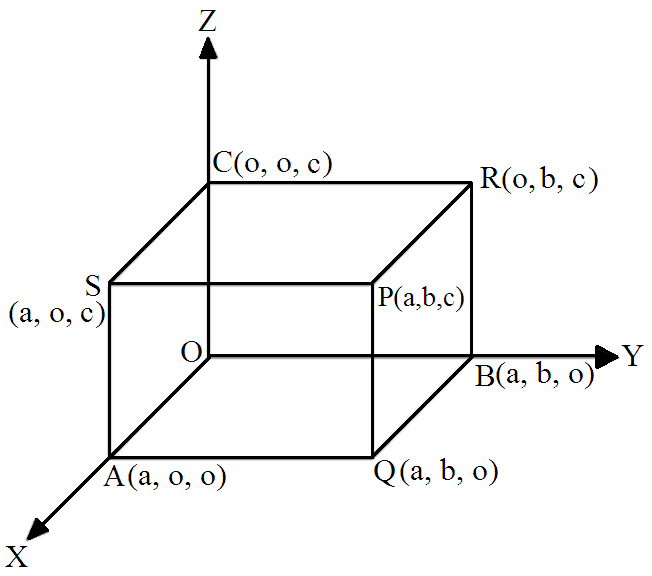
Let a be the length of an edge of the cube and let one corner be at the origin as shown in the figure.
Clearly, $\text{OP, AR}$
The direction ratiosm of $\text{OP, AR, BS}$ and $CQ$ are
$a - 0, a - 0, a - 0,$ i.e. $ a, a, a$
$0 - a, a - 0, a - 0,$ i.e. $-a, a, a$
$a - 0, 0 - a, a - 0,$ i.e. $a, -a, a$
$a - 0, a - 0, 0 - a,$ i.e. $a, a, -a$
Let the direction ratios of a line be proportional to $l, m$ and $n$.
Suppose this line makes angles $\alpha,\beta,\gamma$ and $\delta$ with $OP, AR.$
Now, $\alpha$ is the angle between $OP$ and the line whose direction ratios are proportional to $l, m$ and $n.$
$\cos\alpha=\frac{\text{a}.\text{l}+\text{a}.\text{m}+\text{a}.\text{n}}{\sqrt{\text{a}^2+\text{a}^2+\text{a}^2}\sqrt{\text{l}^2+\text{m}^2+\text{n}^2}}$
$\Rightarrow\cos\alpha=\frac{\text{l}+\text{m}+\text{n}}{\sqrt{3}\sqrt{\text{l}^2+\text{m}^2+\text{n}^2}}$
Since $\beta$ is the angle between $AR$ and the line with direction ratios proportional to $l, m$ and $n,$ we get
$\cos\beta=\frac{-\text{a}.\text{l}+\text{a}.\text{m}+\text{a}.\text{n}}{\sqrt{\text{a}^2+\text{a}^2+\text{a}^2}\sqrt{\text{l}^2+\text{m}^2+\text{n}^2}}$
$\Rightarrow\cos\beta=\frac{-\text{l}+\text{m}+\text{n}}{\sqrt{3}\sqrt{\text{l}^2+\text{m}^2+\text{n}^2}}$
Similarly,
$\cos\gamma=\frac{\text{a}.\text{l}-\text{a}.\text{m}+\text{a}.\text{n}}{\sqrt{\text{a}^2+\text{a}^2+\text{a}^2}\sqrt{\text{l}^2+\text{m}^2+\text{n}^2}}$
$\Rightarrow\cos\gamma=\frac{\text{l}-\text{m}+\text{n}}{\sqrt{3}\sqrt{\text{l}^2+\text{m}^2+\text{n}^2}}$
$\cos\delta=\frac{\text{a}.\text{l}+\text{a}.\text{m}-\text{a}.\text{n}}{\sqrt{\text{a}^2+\text{a}^2+\text{a}^2}\sqrt{\text{l}^2+\text{m}^2+\text{n}^2}}$
$\Rightarrow\cos\delta=\frac{\text{l}+\text{m}-\text{n}}{\sqrt{3}\sqrt{\text{l}^2+\text{m}^2+\text{n}^2}}$
$\cos^2\alpha+\cos^2\beta+\cos^2\gamma+\cos^2\delta$
$=\frac{(\text{l}+\text{m}+\text{n})^2}{3(\text{l}^2+\text{m}^2+\text{n}^2)}+\frac{(-\text{l}+\text{m}+\text{n})^2}{3(\text{l}^2+\text{m}^2+\text{n}^2)}+\frac{(\text{l}-\text{m}+\text{n})^2}{3(\text{l}^2+\text{m}^2+\text{n}^2)}+\frac{(\text{l}+\text{m}-\text{n})^2}{\sqrt{3}\sqrt{\text{l}^2+\text{m}^2+\text{n}^2}}$
$=\frac{1}{3(\text{l}^2+\text{m}^2+\text{n}^2)}\Big\{(\text{l}+\text{m}+\text{n})^2+(-\text{l}+\text{m}+\text{n})^2+(\text{l}-\text{m}+\text{n})^2+(\text{l}+\text{m}-\text{n})^2\Big\}$
$=\frac{1}{3(\text{l}^2+\text{m}^2+\text{n}^2)}4\big(\text{l}^2+\text{m}^2+\text{n}^2\big)=\frac{4}{3}$. View full question & answer→MCQ 1561 Mark
The distance of the plane through the intersection of the planes $ax + by + cz +d = 0$ and $lx + my + nz + P = 0$ and parallel to the line $y = 0, z = 0$
- ✓
$\text{(bl $-$ am)y + (cl $-$ an)z + dl $-$ ap = 0}$
- B
$\text{(am $-$ bl)x + (mc $-$ bn)z + md $-$ bp = 0}$
- C
$\text{(na $-$ cl)x + (bn $-$ cm)y + nd $-$ cp = 0}$
- D
AnswerCorrect option: A. $\text{(bl $-$ am)y + (cl $-$ an)z + dl $-$ ap = 0}$
The equation of the plane passing through the intersection of the planes
$\text{ax + by + cz + d = 0}$
and $\text{lx + my + nz + p =0}$
Will be $(\text{ax} + \text{by} +\text{cz} +\text{d})+\lambda(\text{lm}+\text{my}+\text{nz}+\text{p})=0$
$\text{x}(\text{a}+\lambda1)+\text{y}(\text{b}+\lambda\text{m})+\text{z}(\text{c}+\lambda\text{n})+(\text{d}+\lambda\text{p})=0\ (1)$
Since the plane is parallel to the line $y = 0$ and $z = 0$
$\text{a}+\lambda1=0$
$\lambda=\frac{-\text{a}}{\text{l}}$
Putting the value of $A$ in eqution $(1),$ we get
$\text{x}\Big(\text{a}+\Big(\frac{\text{-a}}{\text{l}}\Big)\text{l}\Big)+\text{y}\Big(\text{b}+\Big(\frac{-\text{a}}{\text{l}}\Big)\text{m}+\text{y}\Big(\text{c}+\Big(\frac{-\text{a}}{\text{l}}\Big)\text{n}+\text{d}+\Big(\frac{-\text{a}}{\text{l}}\Big)\text{p}=0$
$\text{y}(\text{bl}-\text{am})+\text{z}(\text{cl}-\text{an})+\text{dl}-\text{ap}=0$
Heance, option $(a)$
View full question & answer→MCQ 1571 Mark
The eqution of the plane contaning the two lines $\frac{\text{x}-1}{2}=\frac{\text{y}+1}{-1}=\frac{\text{z}-0}{3}$ and $\frac{\text{x}}{-2}=\frac{\text{y}-2}{-3}=\frac{\text{z}+1}{-1}$ is:
- A
$8x + y - 5z - 7 = 0$
- B
$8x + y + 5z - 7 = 0$
- C
$8x - y - 5z - 7 = 0$
- ✓
Answer$\frac{\text{x}-1}{2}=\frac{\text{y}+1}{-1}=\frac{\text{z}-0}{3}$ and $\frac{\text{x}}{-2}=\frac{\text{y}-2}{-3}=\frac{\text{z}+1}{-1}$
Now, if these two lines lie on a plane, so the direction ratio of lines will be perpendicular to the plane's normal vector.
View full question & answer→MCQ 1581 Mark
If a line makes the angle $\alpha,\beta,\gamma$ with three dimensional coordinate axes respectively, then $\cos2\alpha+\cos2\beta+\cos2\gamma$ is equal to:
AnswerWe need to find value of $\cos2\alpha+\cos2\beta+\cos2\gamma$
It is further equal to $\cos^2\alpha-1+\cos^2\beta-1+\cos^2\gamma-1$
$=2\big(\cos^2\alpha+\cos^2\beta+\cos^2\gamma\big)-3$
$= 2(1) - 3 = 2 = -1$
$\therefore(\text{l}^2 + \text{m}^2 + \text{n}^2 = 1)$
View full question & answer→MCQ 1591 Mark
The perpendicular distance of the point $P(1, 2, 3)$ from the line $\frac{\text{x}-6}{3}=\frac{\text{y}-7}{2}=\frac{\text{z}-7}{-2}$ is:
Answer$\frac{\text{x}-6}{3}=\frac{\text{y}-7}{2}=\frac{\text{z}-7}{-2}$
Let point $(1, 2, 3)$ be $P$ and the point through which the line passes be $Q(6, 7, 7)$. Also, the line is parallel to the vector $\vec{\text{b}}=3\hat{\text{i}}+2\hat{\text{j}}-2\hat{\text{k}}.$
Now,
$\overrightarrow{\text{PQ}}=5\hat{\text{i}}+5\hat{\text{j}}+4\hat{\text{k}}$
$\therefore\vec{\text{b}}\times\overrightarrow{\text{PQ}} =\begin{vmatrix}\hat{\text{i}}&\hat{\text{j}}&\hat{\text{k}}\\3&2&-2\\5&5&4\end{vmatrix}$
$=18\hat{\text{i}}-22\hat{\text{j}}+5\hat{\text{k}}$
$\Rightarrow\big|\vec{\text{b}}\times\overrightarrow{\text{PQ}}\big|=\sqrt{18^2+(-22)^2+5^2}$
$=\sqrt{324+484+25}$
$=\sqrt{833}$
$\because\text{d}=\frac{\big|\vec{\text{b}}\times\overrightarrow{\text{PQ}}\big|}{\big|\vec{\text{b}}\big|}$
$=\frac{\sqrt{833}}{\sqrt{17}}$
$=\sqrt{49}$
$=7$
View full question & answer→MCQ 1601 Mark
Can $\frac{1}{\sqrt{3}},\frac{2}{\sqrt{3}},\frac{-2}{\sqrt{3}}$ be the direction cosines of any directed line?
AnswerNo, they can not be the direction cosines of any directed line.
As the sum of square of them is not $1.$
As $\Big(\frac{1}{\sqrt{3}}\Big)^2+\Big(\frac{2}{\sqrt{3}}\Big)^2+\Big(\frac{-2}{\sqrt{3}}\Big)^2$
$=\frac{1+4+4}{3}$
$=3$
View full question & answer→MCQ 1611 Mark
The angle between the lines $\frac{\text{x}-1}{1}=\frac{\text{y}-1}{1}=\frac{\text{z}-1}{2}$ and $\frac{\text{x}-1}{-\sqrt{3}-1}=\frac{\text{y}-1}{\sqrt{3}-1}=\frac{\text{z}-1}{4}$ is:
AnswerCorrect option: C. $\frac{\pi}{3}$
We have
$\frac{\text{x}-1}{1}=\frac{\text{y}-1}{1}=\frac{\text{z}-1}{2}$
$\frac{\text{x}-1}{-\sqrt{3}-1}=\frac{\text{y}-1}{\sqrt{3}-1}=\frac{\text{z}-1}{4}$
The direction ratios of the given lines are proportional to $1, 1, 2$ and $-\sqrt{3}-1,\sqrt{3}-1, 4$
The given lines are parallel to vectors $\vec{\text{b}}_1=\hat{\text{i}}+\hat{\text{j}}+2\hat{\text{k}}$ and $\vec{\text{b}}_2=\big(-\sqrt{3}-1\big)\hat{\text{i}}+\big(\sqrt{3}-1\big)\hat{\text{j}}+4\hat{\text{k}}$
Let $\theta$ be the angle between the given lines.
Now,
$\cos\theta=\frac{\vec{\text{b}}_1.\vec{\text{b}}_2}{\big|\vec{\text{b}}_1\big|\big|\vec{\text{b}}_2\big|}$
$=\frac{\big(\hat{\text{i}}+\hat{\text{j}}+2\hat{\text{k}}\big).\big\{\big(-\sqrt{3}-1\big)\hat{\text{i}}+\big(\sqrt{3}-1\big)\hat{\text{j}}+4\hat{\text{k}}\big\}}{\sqrt{1^2+1^2+1^2}\sqrt{\big(-\sqrt{3}-1\big)^2+\big(\sqrt{3}-1\big)^2+4^2}}$
$=\frac{-\sqrt{3}-1+\sqrt{3}-1+8}{\sqrt{3}\sqrt{24}}$
$=\frac{6}{6\sqrt{2}}$
$\frac{1}{\sqrt{2}}$
$\Rightarrow\theta=\frac{\pi}{3}$
View full question & answer→MCQ 1621 Mark
$(2, -3, -1) 2x - 3y + 6z + 7 = 0:$
- A
$4$
- B
$3$
- ✓
$2$
- D
$\frac{1}{5}$
View full question & answer→MCQ 1631 Mark
length of the $1^{\mathrm{er}}$ from the point $(0, -1, 3)$ to the plane $2x + y - 2z + 1 = 0$ is:
- A
$0$
- B
$2\sqrt{3}$
- C
$\frac{2}{3}$
- ✓
$2$
View full question & answer→MCQ 1641 Mark
The projection of the join of the two points $(1, 4, 5), (6, 7, 2)$ on the line whose are $(4, 5, 6)$ is:
- ✓
$\frac{17}{\sqrt{77}}$
- B
$\frac{7}{6}$
- C
$21$
- D
$\frac{7}{9}$
AnswerCorrect option: A. $\frac{17}{\sqrt{77}}$
View full question & answer→MCQ 1651 Mark
If the diraction ratios of a line are proportional to $1, -3, 2,$ then its diraction cosines are:
- ✓
$\frac{1}{\sqrt{14}},-\frac{3}{\sqrt{14}},\frac{2}{\sqrt{14}}$
- B
$\frac{1}{\sqrt{14}},\frac{2}{\sqrt{14}},\frac{3}{\sqrt{14}}$
- C
$-\frac{1}{\sqrt{14}},\frac{3}{\sqrt{14}},\frac{2}{\sqrt{14}}$
- D
$-\frac{1}{\sqrt{14}},-\frac{2}{\sqrt{14}},-\frac{3}{\sqrt{14}}$
AnswerCorrect option: A. $\frac{1}{\sqrt{14}},-\frac{3}{\sqrt{14}},\frac{2}{\sqrt{14}}$
The diraction ratios of the line are proportional to $1, -3, 2.$
$\therefore$ The direction cosines of the line are
$\frac{1}{\sqrt{1^2+(-3)^2+2^2}},\frac{-3}{\sqrt{1^2+(-3)^2+2^2}},\frac{2}{\sqrt{1^2+(-3)^2+2^2}}$
$=\frac{1}{\sqrt{14}},-\frac{3}{\sqrt{14}},\frac{2}{\sqrt{14}}$
View full question & answer→MCQ 1661 Mark
If a line makes angles $Q_1, Q_{21}$ and $Q_3$ respectively with the coordinate axis then the value of $\cos^2 \text{Q}_{1} + \cos^2 \text{Q}_{2} + \cos^2 \text{Q}_{3}$:
- A
$2$
- ✓
$1$
- C
$4$
- D
$\frac{3}{2}$
View full question & answer→MCQ 1671 Mark
The equation $x^2 - x - 2 = 0$ in three$-$dimensional space is represented by:
- ✓
A pair of parallel planes
- B
- C
A pair of the perpendicular plane
- D
AnswerCorrect option: A. A pair of parallel planes
View full question & answer→MCQ 1681 Mark
lf $\text{AB}\perp\text{BC}$ then the value of $\lambda$ equal, where $A(2k, 2, 3), B(k, 1, 5), C(3 + k, 2, 1):$
- A
$3$
- B
$\frac{1}{3}$
- ✓
$-3$
- D
$-\frac{1}{3}$
AnswerThe drs of $AB$ are $(k, 1, -2)$
The drs of $BC$ are $(3, 1, -4)$
Since, they are perpendicular, $\text{AB.BC} = 0$
$3k + 1 + 8 = 0$
$k = -3$
View full question & answer→MCQ 1691 Mark
If $2x + 5y - 6z + 3 = 0$ be the equation of the plane, then the equation of any plane parallel to the given plane is:
- A
$3x + 5y – 6z + 3 = 0$
- B
$2x - 5y - 6z + 3 = 0$
- ✓
$2x + 5y - 6z + k = 0$
- D
AnswerCorrect option: C. $2x + 5y - 6z + k = 0$
View full question & answer→MCQ 1701 Mark
The direction ratios of the line perprndicular to the lines $\frac{\text{x}-7}{2}=\frac{\text{y}+17}{-3}=\frac{\text{z}-6}{1}$ and, $\frac{\text{x}+5}{1}=\frac{\text{y}+3}{2}=\frac{\text{z}-4}{-2}$ are proportional to:
- ✓
$4, 5, 7$
- B
$4, -5, 7$
- C
$4, -5, -7$
- D
$-4, 5, 7$
AnswerCorrect option: A. $4, 5, 7$
We have
$\frac{\text{x}-7}{2}=\frac{\text{y}+17}{-3}=\frac{\text{z}-6}{1}$
$\frac{\text{x}+5}{1}=\frac{\text{y}+3}{2}=\frac{\text{z}-4}{-2}$
The direction ratios of the given lines are proportional to $2, -3, 1$ and $1, 2, -2.$
The vectors parallel to the given vectors are $\vec{\text{b}}_1=2\hat{\text{i}}-3\hat{\text{j}}+\hat{\text{k}}$ and $\vec{\text{b}}_2=\hat{\text{i}}+2\hat{\text{j}}-2\hat{\text{k}}.$
Vector perpendicular to the given two lines is
$\vec{\text{b}}=\vec{\text{b}}_1\times\vec{\text{b}}_2$
$=\begin{vmatrix}\hat{\text{i}} \hat{\text{j}} \hat{\text{k}}2 -3 11 2 -2\end{vmatrix}$
$=4\hat{\text{i}}+5\hat{\text{j}}+7\hat{\text{k}}$
Hence, the direction ration of the line perpendicular to the given two lines are proportional to $4, 5, 7.$
View full question & answer→MCQ 1711 Mark
The area of the quadrilateral $\text{ABCD},$ where $A(0, 4, 1), B(2, 3, -1), C(4, 5, 0)$ and $D(2, 6, 2)$ is equal to:
- ✓
$9\ sq.$ units
- B
$1\ sq.$ units
- C
$27\ sq.$ units
- D
$81\ sq.$ units
AnswerCorrect option: A. $9\ sq.$ units
View full question & answer→MCQ 1721 Mark
The equation of the plane passing through the points $(3, 2, −1), (3, 4, 2)$ and $(7, 0, 6)$ is $5x + 3y −2z = \lambda$ where $\lambda$ is:
View full question & answer→MCQ 1731 Mark
If the $d.rs$ of two lines are $1, -2, 3$ and $2, 0, 1,$ then the $d.rs$ of the line perpendicular to both the given lines is:
- ✓
$-2, 5, 4$
- B
$2, -5$
- C
$2, 5, -4$
- D
AnswerCorrect option: A. $-2, 5, 4$
$OA$ and $OB$ are given by $(1, -2, 3), (2, 0, 1)$
A line that will be perpendicular to both $OA$ and $OB$ can be obtained by doing the cross product of $OA$ with $OB.$
Then$, n = OA \times OB$
$n = -2i + 5j + 4k$
$(-2, 5, 4).$
View full question & answer→MCQ 1741 Mark
Can $\frac{1}{\sqrt{3}},\frac{2}{\sqrt{3}},\frac{-2}{\sqrt{3}}$ be the direction cosines of any directed line:
AnswerNo, they can not be the direction cosines of any directed line.
As the sum of square of them is not $1.$
As $=\Big(\frac{1}{\sqrt{3}}\Big)^2+\Big(\frac{2}{\sqrt{3}}\Big)^2+\Big(\frac{-2}{\sqrt{3}}\Big)^2$
$=\frac{1+4+4}{3}$
$=3$
View full question & answer→MCQ 1751 Mark
The angle between the planes $2x - y + z = 6$ and $x + y + 2z = 7$ is:
- A
$\frac{\pi}{4}$
- B
$\frac{\pi}{6}$
- ✓
$\frac{\pi}{3}$
- D
$\frac{\pi}{2}$
AnswerCorrect option: C. $\frac{\pi}{3}$
View full question & answer→MCQ 1761 Mark
The Cartesian equation of the line passing through the point $(1,-3,2)$ and parallel to the line $\vec{r}=(2+\lambda) \hat{i}+\lambda \hat{j}+(2 \lambda-1) \hat{k}$ is
- A
$\frac{x-1}{2}=\frac{y+3}{0}=\frac{z-2}{-1}$
- B
$\frac{x+1}{1}=\frac{y-3}{0}=\frac{z+2}{2}$
- C
$\frac{x+1}{2}=\frac{y-3}{0}=\frac{z+2}{-1}$
- D
$\frac{x-1}{1}=\frac{y+3}{1}=\frac{z-2}{2}$
AnswerGiven line is
$\begin{aligned}
\vec{r} & =(2+\lambda) \hat{i}+\lambda \hat{j}+(2 \lambda-1) \hat{k} \\
& =2 \hat{i}-\hat{k}+\lambda(\hat{i}+\hat{j}+2 \hat{k})
\end{aligned}$
And, position vector of a point on the required line is
$\hat{i}-3 \hat{j}+2 \hat{k} \text {. }
$Thus, vector equation of the line is
$\vec{r}=(\hat{i}-3 \hat{j}+2 \hat{k})+\lambda(\hat{i}+\hat{j}+2 \hat{k}), \lambda \in R
$The line passes through $(1,-3,2)$ and has direction ratios $1,1,2$
$\therefore \quad$ The cartesian equation of the line is
$\frac{x-1}{1}=\frac{y+3}{1}=\frac{z-2}{2}$
View full question & answer→MCQ 1771 Mark
The angle which the line $\frac{x}{1}=\frac{y}{-1}=\frac{z}{0}$ makes with the positive direction of $Y$-axis is :
- A
$\frac{5 \pi}{6}$
- B
$\frac{3 \pi}{4}$
- C
$\frac{5 \pi}{4}$
- D
$\frac{7 \pi}{4}$
AnswerGiven, $\frac{x}{1}=\frac{y}{-1}=\frac{z}{0}$.........(i)
Dr's of (i) is $1,-1,0$.
Dr's of $y$-axis is $0,1,0$.
Now, $\cos \theta=\left|\frac{1 \times 0+1(-1)+0 \times 0}{\sqrt{1^2+(-1)^2} \sqrt{1^2}}\right|=\frac{1}{\sqrt{2}} \quad \therefore \quad \theta=\frac{7 \pi}{4}$
View full question & answer→MCQ 1781 Mark
The coordinates of the foot of the perpendicular drawn from the point $(0,1,2)$ on the $x$-axis are given by:
- A
$(1,0,0)$
- B
$(2,0,0)$
- C
$(\sqrt{5}, 0,0)$
- ✓
$(0,0,0)$
AnswerCorrect option: D. $(0,0,0)$
$(0,0,0)$
View full question & answer→MCQ 1791 Mark
The lines $\frac{1-x}{2}=\frac{y-1}{3}=\frac{z}{1}$ and $\frac{2 x-3}{2 p}=\frac{y}{-1}=\frac{z-4}{7}$ are perpendicular to each other for $p$ equal to :
- A
$-\frac{1}{2}$
- B
$\frac{1}{2}$
- C
- D
AnswerAs the given lines can be written as
$\frac{x-1}{-2}=\frac{y-1}{3}=\frac{z-0}{1} \text { and } \frac{x-3 / 2}{p}=\frac{y}{-1}=\frac{z-4}{7}$
These lines are perpendicular, then
$
\begin{aligned}
& -2 \times p+3(-1)+1 \times 7=0 \Rightarrow-2 p-3+7=0 \\
\Rightarrow \quad & -2 p+4=0 \Rightarrow-2 p=-4 \therefore p=2
\end{aligned}$
View full question & answer→MCQ 1801 Mark
The vector equation of a line passing through the point $(1,-1,0)$ and parallel to $Y$-axis is :
- A
$\vec{r}=\hat{i}-\hat{j}+\lambda(\hat{i}-\hat{j})$
- B
$\vec{r}=\hat{i}-\hat{j}+\lambda \hat{j}$
- C
$\vec{r}=\hat{i}-\hat{j}+\lambda \hat{k}$
- D
$\vec{r}=\lambda \hat{j}$
AnswerEquation of line passing through the point $(1,-1,0)$ and parallel to $y$ - axis is given by
$\vec{r}=(\hat{i}-\hat{j}+0 \hat{k})+\lambda(0 \hat{i}+\hat{j}+0 \hat{k}) \quad \therefore \quad \vec{r}=(\hat{i}-\hat{j})+\lambda \hat{j}$
View full question & answer→MCQ 1811 Mark
Direction ratios of a vector parallel to line $\frac{x-1}{2}=-y=\frac{2 z+1}{6}$ are :
- A
$2,-1,6$
- B
$2,1,6$
- C
$2,1,3$
- D
$2,-1,3$
AnswerThe given line can be written as
$
\frac{x-1}{2}=\frac{y}{-1}=\frac{z+1 / 2}{3}
$
So, direction ratios of line parallel to given line is <2,-1,3>
View full question & answer→MCQ 1821 Mark
If a line makes an angle of $30^{\circ}$ with the positive direction of $x-$axis, $120^{\circ}$ with the positive direction of $y-$axis, then the angle which it makes with the positive direction of $z-$axis is :
- ✓
$90^{\circ}$
- B
$120^{\circ}$
- C
$60^{\circ}$
- D
$0^{\circ}$
AnswerCorrect option: A. $90^{\circ}$
Let the angle made with positive direction of $z-$axis be $\gamma$.
Then, $\cos ^2 30^{\circ}+\cos ^2 120^{\circ}+\cos ^2 \gamma=1$
$\Rightarrow\left(\frac{\sqrt{3}}{2}\right)^2+\left(\frac{-1}{2}\right)^2+\cos ^2 \gamma=1$
$\Rightarrow \cos ^2 \gamma=1-\frac{3}{4}-\frac{1}{4}=0$
$\Rightarrow \gamma=90^{\circ}$
View full question & answer→MCQ 1831 Mark
A line $\overrightarrow{O P}$ in space, represented by the figure below; has a magnitude of $2 \sqrt{2}$ units.
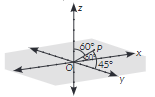
Which of these are the direction ratios of $\overrightarrow{O P}$ ? - A
$(2, \sqrt{2}, 2)$
- ✓
$(\sqrt{2}, 2, \sqrt{2})$
- C
$\left(\frac{1}{2}, \frac{1}{\sqrt{n}}, \frac{1}{2}\right)$
- D
$(2 \sqrt{2}, 2 \sqrt{2}, 2 \sqrt{2})$
AnswerCorrect option: B. $(\sqrt{2}, 2, \sqrt{2})$
$(\sqrt{2}, 2, \sqrt{2})$
View full question & answer→MCQ 1841 Mark
The angle between the lines $2 x=3 y=-z$ and $6 x=-y=-4 z$ is
- A
$0^{\circ}$
- B
$30^{\circ}$
- C
$45^{\circ}$
- ✓
$90^{\circ}$
AnswerCorrect option: D. $90^{\circ}$
The given equation of lines can be rewritten as
$\frac{x-0}{1 / 2}=\frac{y-0}{1 / 3}=\frac{z-0}{-1}$ and $\frac{x-0}{1 / 6}=\frac{y-0}{-1}=\frac{z-0}{-1 / 4}$
$\therefore a_1=\frac{1}{2}, b_1=\frac{1}{3}, c_1=-1$ and $a_2=\frac{1}{6}, b_2=-1, c_2=\frac{-1}{4}$
Now, $\cos \theta=\frac{a_1 a_2+b_1 b_2+c_1 c_2}{\sqrt{a_1^2+b_1^2+c_1^2} \sqrt{a_2^2+b_2^2+c_2^2}}$
$=\frac{\frac{1}{2} \cdot \frac{1}{6}+\frac{1}{3} \cdot(-1)+(-1) \cdot\left(\frac{-1}{4}\right)}{\sqrt{\left(\frac{1}{2}\right)^2+\left(\frac{1}{3}\right)^2+(-1)^2} \sqrt{\left(\frac{1}{6}\right)^2+(-1)^2+\left(\frac{-1}{4}\right)^2}}=0$
$\Rightarrow \cos \theta=0 $
$\Rightarrow \theta=90^{\circ}$
View full question & answer→MCQ 1851 Mark
The vector equation of a line which passes through the point $(2,-4,5)$ and is parallel to the line $\frac{x+3}{3}=\frac{4-y}{2}=\frac{z+8}{6}$ is :
- A
$\vec{r}=(-2 \hat{i}+4 \hat{j}-5 \hat{k})+\lambda(3 \hat{i}+2 \hat{j}+6 \hat{k})$
- B
$\vec{r}=(2 \hat{i}-4 \hat{j}+5 \hat{k})+\lambda(3 \hat{i}-2 \hat{j}+6 \hat{k})$
- C
$\vec{r}=(2 \hat{i}-4 \hat{j}+5 \hat{k})+\lambda(3 \hat{i}+2 \hat{j}+6 \hat{k})$
- D
$\vec{r}=(-2 \hat{i}+4 \hat{j}-5 \hat{k})+\lambda(3 \hat{i}-2 \hat{j}-6 \hat{k})$
AnswerLet $\vec{a}$ be the position vector of the point $(2,-4,5)$, then $\vec{a}=2 \hat{i}-4 \hat{j}+5 \hat{k}$.
The given equation of line is $\frac{x+3}{3}=\frac{4-y}{2}=\frac{z+8}{6}$ $\Rightarrow \frac{x+3}{3}=\frac{y-4}{-2}=\frac{z+8}{6}$
$\therefore \quad$ Direction ratios of (i) are $3,-2,6$.
Let $\vec{b}$ be the vector parallel to line (i).
Then, $\vec{b}=3 \hat{i}-2 \hat{j}+6 \hat{k}$
$\therefore$ The vector equation of required line is $\vec{r}=\vec{a}+\lambda \vec{b}$ $\Rightarrow \vec{r}=(2 \hat{i}-4 \hat{j}+5 \hat{k})+\lambda(3 \hat{i}-2 \hat{j}+6 \hat{k})$
View full question & answer→MCQ 1861 Mark
If a line makes angles of $90^{\circ}, 135^{\circ}$ and $45^{\circ}$ with the $x, y$ and $z$ axes respectively, then its direction cosines are
- A
$0,-\frac{1}{\sqrt{2}}, \frac{1}{\sqrt{2}}$
- B
$\frac{1}{\sqrt{2}}, 0, \frac{1}{\sqrt{2}}$
- C
$\frac{1}{\sqrt{2}}, 0,-\frac{1}{\sqrt{2}}$
- D
$0, \frac{1}{\sqrt{2}}, \frac{1}{\sqrt{2}}$
AnswerDirection cosines are $\left\langle\cos 90^{\circ}, \cos 135^{\circ}, \cos 45^{\circ}\right\rangle$
$
=\left\langle 0, \cos \left(90^{\circ}+45^{\circ}\right), \frac{1}{\sqrt{2}}\right\rangle=\left\langle 0,-\sin 45^{\circ}, \frac{1}{\sqrt{2}}\right\rangle=\left\langle 0,-\frac{1}{\sqrt{2}}, \frac{1}{\sqrt{2}}\right\rangle$
View full question & answer→MCQ 1871 Mark
If the direction cosines of a line are $\left(\frac{1}{a}, \frac{1}{a}, \frac{1}{a}\right)$, then
- A
$0 < a <1$
- B
$a>2$
- C
$a>0$
- ✓
$a= \pm \sqrt{3}$
AnswerCorrect option: D. $a= \pm \sqrt{3}$
Given that the direction cosines of a line are
$\left(\frac{1}{a}, \frac{1}{a}, \frac{1}{a}\right)$
We know that the sum of squares of the direction cosines is $1 .$
$\Rightarrow \frac{1}{a^2}+\frac{1}{a^2}+\frac{1}{a^2}=1$
$\Rightarrow \frac{3}{a^2}=1$
$\Rightarrow a^2=3$
$\Rightarrow a= \pm \sqrt{3}$
View full question & answer→MCQ 1881 Mark
Direction cosines of the line $\frac{x-1}{2}=\frac{1-y}{3}=\frac{2 z-1}{12}$ are:
- A
$\frac{2}{7}, \frac{3}{7}, \frac{6}{7}$
- B
$\frac{2}{\sqrt{157}},-\frac{3}{\sqrt{157}}, \frac{12}{\sqrt{157}}$
- C
$\frac{2}{7},-\frac{3}{7},-\frac{6}{7}$
- ✓
$\frac{2}{7},-\frac{3}{7}, \frac{6}{7}$
AnswerCorrect option: D. $\frac{2}{7},-\frac{3}{7}, \frac{6}{7}$
Given equation of the line is $\frac{x-1}{2}=\frac{1-y}{3}=\frac{2 z-1}{12}$
Which can be written as
$\frac{x-1}{2}=\frac{(y-1)}{-3}=\frac{z-\frac{1}{2}}{6}$
$\therefore$ The direction cosines are
$\frac{2}{\sqrt{(2)^2+(-3)^2+(6)^2}}, \frac{-3}{\sqrt{(2)^2+(-3)^2+(6)^2}}, \frac{6}{\sqrt{(2)^2+(-3)^2+(6)^2}}$
$=\frac{2}{\sqrt{49}}, \frac{-3}{\sqrt{49}}, \frac{6}{\sqrt{49}}=\frac{2}{7}, \frac{-3}{7}, \frac{6}{7}$
View full question & answer→MCQ 1891 Mark
Distance of the point $(p, q, r)$ from $y$-axis is
- A
$q$
- B
$|q|$
- C
$|q|+|r|$
- D
$\sqrt{p^2+r^2}$
AnswerGiven point is $(p, q, r)$
The foot of perpendicular drawn from point $(p, q, r)$ on the $y$-axis is $(0, q, 0)$.
Now, distance between these two points is
$\sqrt{(p-0)^2+(q-q)^2+(r-0)^2}=\sqrt{p^2+r^2}$
View full question & answer→MCQ 1901 Mark
$P$ is a point on the line joining the points $A(0,5,-2)$ and $B(3,-1,2)$. If the $x$-coordinate of $P$ is 6 , then its $z$-coordinate is
AnswerThe line through the points $(0,5,-2)$ and $(3,-1,2)$ is
$\frac{x}{3-0}=\frac{y-5}{-1-5}=\frac{z+2}{2+2} \text { or } \frac{x}{3}=\frac{y-5}{-6}=\frac{z+2}{4}$
Any point on the line is $P(3 k,-6 k+5,4 k-2)$, where $k$ is an arbitrary scalar.
$\because \quad 3 k=6 \Rightarrow k=2$
The $z$-coordinate of the point $P$ will be $4 \times 2-2=6$.
View full question & answer→MCQ 1911 Mark
A line $m$ passes through the point $(-4,2,-3)$ and is parallel to line $n$, given by:
$\frac{-x-2}{4}=\frac{y+3}{-2}=\frac{2 z-6}{3}$
The vector equation of line $m$ is given by: $\vec{r}=(-4 \hat{i}+2 \hat{j}-3 \hat{k})+\lambda(p \hat{i}+q \hat{j}+r \hat{k})$, where $\lambda \in R$
Which of the following could be the possible values for $p, g$ and $r$ ?
- A
$p=4, q=(-2), r=3$
- B
$p=(-4), q=(-2), r=3$
- C
$p=(-2), q=3, r=(-6)$
- ✓
$p=8, q=4, r=(-3)$
AnswerCorrect option: D. $p=8, q=4, r=(-3)$
$p=8, q=4, r=(-3)$
View full question & answer→MCQ 1921 Mark
If the two lines $L_1: x=5, \frac{y}{3-\alpha}=\frac{z}{-2} \quad L_2: x=2, \frac{y}{-1}=\frac{z}{2-\alpha}$ are perpendicular, then the value of $\alpha$ is
- A
$\frac{2}{3}$
- B
- C
- D
$\frac{7}{3}$
AnswerThe given lines are perpendicular, if
$a_1 a_2+b_1 b_2+c_1 c_2=0$
Here, $L_1: \frac{x-5}{0}=\frac{y-0}{3-\alpha}=\frac{z-0}{-2}$
$L _2: \frac{x-2}{0}=\frac{y-0}{-1}=\frac{z-0}{2-\alpha}$
Here, $a_1, b_1, c_1$ are $0,3-\alpha,-2$, and $a_2, b_2, c_2$ are $0,-1,2-\alpha$ respectively.
$\begin{array}{ll}
\therefore & 0 \times 0-(3-\alpha)-2(2-\alpha)=0 \\
\Rightarrow & \alpha=\frac{7}{3}
\end{array}$
View full question & answer→MCQ 1931 Mark
The vector equation of $X Y$-plane is
- A
$\overrightarrow{ r } \cdot \hat{ k }=0$
- B
$\vec{r} \cdot \hat{j}=0$
- C
$\overrightarrow{ r } \cdot \hat{ i }=0$
- D
$\overrightarrow{ r } \cdot \vec{n}=1$
AnswerVector equation of $X Y$-plane is $\vec{r} \cdot \hat{k}=0$.
View full question & answer→MCQ 1941 Mark
The length of the perpendicular drawn from the point $(4,-7,3)$ on the $y-$axis is
- A
$3$ units
- B
$4$ units
- ✓
$5$ units
- D
$7$ units
AnswerCorrect option: C. $5$ units
Let $P(4,-7,3)$ be the given point and $A$ be a point on $y-$axis s.t. $P A \perp$ to $y-$axis.
$\therefore A \equiv(0,-7,0)$
Now,
$P A =\sqrt{(4-0)^2+(-7-(-7))^2+(3-0)^2}$
$ =\sqrt{4^2+3^2}$
$=\sqrt{16+9}=\sqrt{25}$
$=5$ units
View full question & answer→MCQ 1951 Mark
If the two lines $L_1: x=5, \frac{y}{3-\alpha}=\frac{z}{-2}$
$L_2: x=2, \frac{y}{-1}=\frac{z}{2-\alpha}$ are perpendicular, then the value of $\alpha$ is
- A
$\frac{2}{3}$
- B
- C
- ✓
$\frac{7}{3}$
AnswerCorrect option: D. $\frac{7}{3}$
(d) : The given lines are perpendicular, if
$
a_1 a_2+b_1 b_2+c_1 c_2=0 ...(i)
$
Here, $L_1: \frac{x-5}{0}=\frac{y-0}{3-\alpha}=\frac{z-0}{-2}$
$
L_2: \frac{x-2}{0}=\frac{y-0}{-1}=\frac{z-0}{2-\alpha}
$
Here, $a_1, b_1, c_1$ are $0,3-\alpha,-2$, and $a_2, b_2, c_2$ are $0,-1$, $2-\alpha$ respectively.
$
\begin{array}{ll}
\therefore & 0 \times 0-(3-\alpha)-2(2-\alpha)=0 \\
\Rightarrow & \alpha=\frac{7}{3} & [From (i)]
\end{array}
$
View full question & answer→MCQ 1961 Mark
The angle between the lines $2 x=3 y=-z$ and $6 x=-y=-4 z$ is
- A
$0^{\circ}$
- B
$30^{\circ}$
- C
$45^{\circ}$
- ✓
$90^{\circ}$
AnswerCorrect option: D. $90^{\circ}$
The given equation of lines can be rewritten as $\frac{x-0}{1 / 2}=\frac{y-0}{1 / 3}=\frac{z-0}{-1}$ and $\frac{x-0}{1 / 6}=\frac{y-0}{-1}=\frac{z-0}{-1 / 4}$
$\therefore \quad a_1=\frac{1}{2}, b_1=\frac{1}{3}, c_1=-1$
and $a_2=\frac{1}{6}, b_2=-1, c_2=\frac{-1}{4}$
Now, $\cos \theta=\frac{a_1 a_2+b_1 b_2+c_1 c_2}{\sqrt{a_1^2+b_1^2+c_1^2} \sqrt{a_2^2+b_2^2+c_2^2}}$
$=\frac{\frac{1}{2} \cdot \frac{1}{6}+\frac{1}{3} \cdot(-1)+(-1) \cdot\left(\frac{-1}{4}\right)}{\sqrt{\left(\frac{1}{2}\right)^2+\left(\frac{1}{3}\right)^2+(-1)^2} \sqrt{\left(\frac{1}{6}\right)^2+(-1)^2+\left(\frac{-1}{4}\right)^2}}=0$
$\Rightarrow \cos \theta=0$
$\Rightarrow \theta=90^{\circ}$
View full question & answer→MCQ 1971 Mark
The cartesian equation of the line which passes through the point $(-2,4,-5)$ and parallel to the line given by $\frac{x+3}{3}=\frac{y-4}{5}=\frac{z+8}{6}$ is
- ✓
$\frac{x+2}{3}=\frac{y-4}{5}=\frac{z+5}{6}$
- B
$\frac{x+2}{2}=\frac{y-4}{5}=\frac{z+5}{-6}$
- C
$\frac{x-2}{-3}=\frac{y-4}{5}=\frac{z-5}{-6}$
- D
$\frac{x-2}{3}=\frac{y-4}{5}=\frac{z-5}{5}$
AnswerCorrect option: A. $\frac{x+2}{3}=\frac{y-4}{5}=\frac{z+5}{6}$
(a) : It is given that the line passes through the point $(-2,4,-5)$ and is parallel to
$
\frac{x+3}{3}=\frac{y-4}{5}=\frac{z+8}{6} \text {. }
$
Clearly, the direction ratios of line are $(3,5,6)$.
Now the equation of the line (in cartesian form) is
$
\frac{x-(-2)}{3}=\frac{y-4}{5}=\frac{z-(-5)}{6} \Rightarrow \frac{x+2}{3}=\frac{y-4}{5}=\frac{z+5}{6}
$
View full question & answer→MCQ 1981 Mark
The length of the perpendicular drawn from the point $(4,-7,3)$ on the $y$-axis is
Answer(c) : Let $P(4,-7,3)$ be the given point and $A$ be a point on $y$-axis s.t. $P A \perp$ to $y$-axis.
$
\therefore A \equiv(0,-7,0)
$
Now, $P A=\sqrt{(4-0)^2+(-7-(-7))^2+(3-0)^2}$
$
=\sqrt{4^2+3^2}=\sqrt{16+9}=\sqrt{25}=5 \text { units }
$
View full question & answer→MCQ 1991 Mark
$P$ is a point on the line joining the points $A(0$, $5,-2)$ and $B(3,-1,2)$. If the $x$-coordinate of $P$ is 6 , then its $z$-coordinate is
Answer(b) : The line through the points $(0,5,-2)$ and $(3,-1,2)$ is
$
\frac{x}{3-0}=\frac{y-5}{-1-5}=\frac{z+2}{2+2} \text { or } \frac{x}{3}=\frac{y-5}{-6}=\frac{z+2}{4}
$
Any point on the line is $P(3 k,-6 k+5,4 k-2)$, where $k$ is an arbitrary scalar.
$
\because 3 k=6 \Rightarrow k=2
$
The $z$-coordinate of the point $P$ will be $4 \times 2-2=6$.
View full question & answer→MCQ 2001 Mark
Direction cosines of the line that makes equal angles with the three axes in space are
- A
$\pm \frac{1}{\sqrt{3}}, \pm \frac{1}{3}, \pm \frac{1}{3}$
- B
$\pm \frac{6}{7}, \pm \frac{2}{7}, \pm \frac{3}{7}$
- ✓
$\pm \frac{1}{\sqrt{3}}, \pm \frac{1}{\sqrt{3}}, \pm \frac{1}{\sqrt{3}}$
- D
$\sqrt{\frac{1}{7}}, \pm \sqrt{\frac{3}{14}}, \frac{1}{\sqrt{14}}$
AnswerCorrect option: C. $\pm \frac{1}{\sqrt{3}}, \pm \frac{1}{\sqrt{3}}, \pm \frac{1}{\sqrt{3}}$
(c) : Since $l=m=n$ and $l^2+m^2+n^2=1$
$\therefore \quad l=m=n= \pm \frac{1}{\sqrt{3}}$.
View full question & answer→