Questions

3 Marks Question

Take a timed test

9 questions · self-marked practice — reveal the answer and mark yourself.

Question 13 Marks
If two sides of a triangle be represented by the vectors $\hat{i}+2 \hat{j}+2 \hat{k}$ and $3 \hat{i}-2 \hat{j}+\hat{k},$ then prove that the area of the triangle is $\frac{5}{2} \sqrt{5}$ square units.
Answer
According to question, the adjacent sides of parallelogram,
and
$\vec{a}=\hat{i}-\hat{j}+3 \hat{k}$
$\therefore \vec{a} \times \vec{b}=\left|\begin{array}{rrr}\hat{i} & \hat{j} & \hat{k} \\ 1 & -1 & 3 \\ 2 & -7 & 1\end{array}\right|$
$ =(-1+21) \hat{i}-(1-6) \hat{j}+(-7+2) \hat{k}$
$ =20 \hat{i}+5 \hat{j}-5 \hat{k}$
$ =(-1+21) \hat{i}-(1-6) \hat{j}+(-7+2) \hat{k}$
$ =20 \hat{i}+5 \hat{j}-5 \hat{k}$
$\therefore$ Area of parallelogram $=|\vec{a} \times \vec{b}|$
$=|20 \hat{i}+5 \hat{j}-5 \hat{k}|$
$=\sqrt{20^2+5^2+(-5)^2}$
$=\sqrt{400+25+25}$
$=\sqrt{400}$
$=15 \sqrt{2} \text { sq. unit. }$
 
View full question & answer
Question 23 Marks
Vectors $\vec{a}, \vec{b}$ and $\vec{c}$ are such that $\vec{a}+\vec{b}+\vec{c}=0$ and $|\vec{a}|=3,|\vec{b}|=5$ and $|\vec{c}|=7$. Then find the angle between $\vec{a}$ and $\vec{b}$.
View full question & answer
Question 33 Marks
For vectors $\vec{a}$ and $\vec{b}$ prove that : $|\vec{a} \times \vec{b}|^2=|\vec{a}|^2|\vec{b}|^2-|\vec{a} \cdot \vec{b}|^2 .$
Answer
$|\vec{a} \times \vec{b}|^2=|\vec{a}|^2|\vec{b}|^2-|\vec{a} \cdot \vec{b}|^2$
We know that $\vec{a} \times \vec{b}=|\vec{a}||\vec{b}| \sin \theta \cdot \hat{n}$
$\vec{a} \times \vec{b}$
$= a b \sin \theta\ \hat{n}$
$\therefore |\vec{a} \times \vec{b}|
=|a b \sin \theta\  \hat{n}|=a b \sin \theta  \quad[\because| \ \hat{ n}|=1]$
So $\quad|\vec{a} \times \vec{b}|^2=a^2 b^2 \sin ^2 \theta \ldots \ldots(1)$
$\text{R.H.S}. \quad=|\vec{a}|^2|\vec{b}|^2-|\vec{a} \cdot \vec{b}|^2$
$=\vec{a} \cdot \vec{a} \vec{b} \cdot \vec{b}-|a b \cos \theta|^2$
$=a^2 b^2-a^2 b^2 \cos ^2 \theta=a^2 b^2\left(1-\cos ^2 \theta\right)$
$=a^2 b^2 \sin ^2 \theta \ldots \ldots(2)$
Hence from equations $(1)$ and $(2), $ it is clear that
$|\vec{a} \times \vec{b}|^2=|\vec{a}|^2|\vec{b}|^2-|\vec{a} \cdot \vec{b}|^2 \quad$
View full question & answer
Question 43 Marks
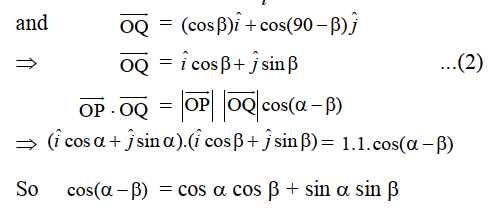
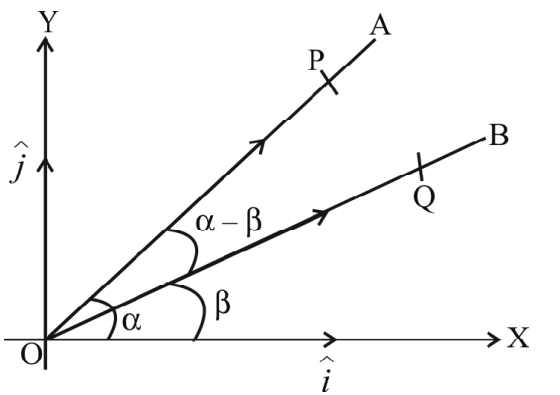
Using vector method prove that in $\triangle ABC$, $\cos (\alpha-\beta)=\cos \alpha \cos \beta+\sin \alpha \sin \beta$
Answer
Let $\hat{i}$ and $\hat{j}$ be the unit vectors along X -axis and Y -axis respectively.
$
\begin{array}{ll}
\text { Let } & OP=OQ=1 \text { unit } \\
\therefore & \overrightarrow{OP}=(\cos \alpha) \hat{i}+\cos (90-\alpha) \hat{j} \\
\Rightarrow & \overrightarrow{OP}=\hat{i} \cos \alpha+\hat{j} \sin \alpha
\end{array}
$
Image
Image
View full question & answer
Question 53 Marks
Let $\overrightarrow{ a }=\hat{ i }+4 \hat{ j }+2 \hat{ k }, \overrightarrow{ b }=3 \hat{ i }-2 \hat{ j }+7 \hat{ k }$ and $\overrightarrow{ c }= 2 \hat{ i }-\hat{ j }+4 \hat{ k }$.Find a vector $\vec{d}$ such that $i t$ is perpendicular to both $\vec{a}$ and $\vec{b}$ and $\vec{c} \cdot \vec{d}=27$.
Answer
According to the question any vector perpendicular to $\overrightarrow{ a }=\hat{ i }+4 \hat{ j }+2 \hat{ k }$ and $\overrightarrow{ b }=3 \hat{ i }-2 \hat{ j }+7 \hat{ k }=\overrightarrow{ a } \times \overrightarrow{ b }$.
$
\begin{aligned}
\therefore \quad \vec{a} \times \vec{b} & =\left|\begin{array}{ccc}
\hat{i} & \hat{j} & \hat{k} \\
1 & 4 & 2 \\
3 & -2 & 7
\end{array}\right| \\
& =(28+4) \hat{i}-(7-6) \hat{j}+(-2-12) \hat{k} \\
& =32 \hat{i}-\hat{j}-14 \hat{k}
\end{aligned}
$
Let $\quad \vec{d}=\lambda(32 \hat{ i }-\hat{ j }-14 \hat{ k })$
Then vector $\vec{d}$ is perpendicular to vector $\vec{a}$ and $\vec{b}$.
Also,
$
\vec{c} \cdot \vec{d}=27
$
$
\begin{array}{ll}
\therefore & (2 \hat{i}-\hat{j}+4 \hat{k}) \cdot \lambda(32 \hat{i}-\hat{j}-14 \hat{k})=27 \\
\text { or } & \lambda(64+1-56)=27 \\
\text { or } & \\
\begin{aligned}9 \lambda & 27\end{aligned} & \therefore \lambda=3 \\
& \vec{d}=3(32 \hat{i}-\hat{j}-14 \hat{k}) \\
& =96 \hat{i}-3 \hat{j}-42 \hat{k}
\end{array}
$
View full question & answer
Question 63 Marks
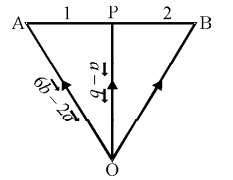
$A$ and $B$ are two points. The position vector of point $A$ is $6 \vec{b}-2 \vec{a}$. A point $P$ divides line $A B$ in the ratio of $1: 2$. If the position vector of $P$ is $\vec{a}-\vec{b},$ then find the position vector of $B$.
Answer
Let $O$ be the origin, Then,
Image
$\overrightarrow{OA}=6 \vec{b}-2 \vec{a}$ and 
$\overrightarrow{OP}=\vec{a}-\vec{b}$
$\overrightarrow{OB}=?$
According to the question, point $P$ divides the line $AB$ in the ratio of $1: 2$.
$\therefore \overrightarrow{ OP }=\frac{1 \cdot \overrightarrow{ OB }+2 \cdot \overrightarrow{ OA }}{1+2}$
or $ \vec{a}-\vec{b}=\frac{1 \cdot \overrightarrow{ OB }+2(6 \vec{b}-2 \vec{a})}{1+2}$
or $ 3(\vec{a}-\vec{b})=\overrightarrow{ OB }+2(6 \vec{b}-2 \vec{a})$
or $ \overrightarrow{ OB }=3(\vec{a}-\vec{b})-2(6 \vec{b}-2 \vec{a})$
or $ \overrightarrow{ OB }=3 \vec{a}-3 \vec{b}-12 \vec{b}+4 \vec{a}$
or $ \overrightarrow{ OB }=7 \vec{a}-15 \vec{b}$
$\therefore$ The position vector of the point $B$ will be $7 \vec{a}-15 \vec{b}$.
View full question & answer
Question 73 Marks
Using vector method prove that in any triangle ABC,
$
\frac{\sin A}{a}=\frac{\sin B}{b}=\frac{\sin C}{c} .
$
Answer
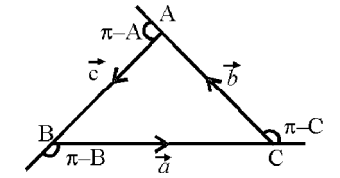
Let in $\triangle ABC$
$\overrightarrow{ BC }=\vec{a}, \overrightarrow{ CA }=\vec{b}$ and $\overrightarrow{ AB }=\vec{c}$
$\therefore \quad|\overrightarrow{ BC }|=a,|\overrightarrow{ CA }|=b$ and $|\overrightarrow{ AB }|=c$
Now in $\triangle ABC$ by triangle law of vector addition,
Image
$\overrightarrow{BC}+\overrightarrow{CA}=\overrightarrow{BA}
$
or $
\overrightarrow{BC}+\overrightarrow{CA}=-\overrightarrow{AB}
$
or $
\overrightarrow{BC}+\overrightarrow{CA}+\overrightarrow{AB}=0
$
or $
\vec{a}+\vec{b}+\vec{c}=0
$
Now
$
\vec{a} \times(\vec{a}+\vec{b}+\vec{c})=\vec{a} \times 0
$
or $\quad(\vec{a} \times \vec{a})+(\vec{a} \times \vec{b})+(\vec{a} \times \vec{c})=0 \quad$ [by distribution law]
$
\begin{aligned}
or \quad \vec{a} \times \vec{b}+\vec{a} \times \vec{c} & =0 \\
\end{aligned}
$
$
\begin{array}{ll}
\text { or } & \vec{a} \times \vec{b}=-\vec{a} \times \vec{c} \\
\text { or } & \vec{a} \times \vec{b}=\vec{c} \times \vec{a}
\end{array}
$
$
|\vec{a} \times \vec{b}|=|\vec{c} \times \vec{a}|
$
Similarly from $\vec{b} \times(\vec{a}+\vec{b}+\vec{c})=\overrightarrow{0}$ we can find that
$
|\vec{b} \times \vec{c}|=|\vec{a} \times \vec{b}|
$
Hence from equations (2) and (3),
$
|\vec{b} \times \vec{c}|=|\vec{c} \times \vec{a}|=|\vec{a} \times \vec{b}|
$
or $b c \sin (\pi- A )=c a \sin (\pi- B )=a b \sin (\pi- C )$
or $\quad b c \sin A=c a \sin B=a b \sin C$
Dividing $a b c$ in equation ....... (4),
$
\frac{b c \sin A}{a b c}=\frac{c a \sin B}{a b c}=\frac{a b \sin C}{a b c}
$
or $
\frac{\sin A}{a}=\frac{\sin B}{b}=\frac{\sin C}{c}
$
Hence proved.
View full question & answer
Question 83 Marks
Find a vector perpendicular to vectors $\overrightarrow{ a }=\hat{ i }+2 \hat{ j }-3 \hat{ k }$ and $\overrightarrow{ b }=3 \hat{ i }-\hat{ j }+2 \hat{ k }, $ whose magnitude is $\sqrt{171}$.
Answer
Given that $\vec{a}=\hat{i}+2 \hat{j}-3 \hat{k}$ and $\vec{b}=3 \hat{i}-\hat{j}+2 \hat{k}$
${l} \overrightarrow{a} \times \overrightarrow{b}=\left|\begin{array}{ccc}\hat{i} & \hat{j} & \hat{k} \\1 & 2 & -3 \\3 & -1 & 2 \end{array}\right|$
$=\hat{i}(4-3)-\hat{j}(2+9)+\hat{k}(-1-6) \\
\therefore \overrightarrow{a} \times \overrightarrow{b}=\hat{i}-11 \hat{j}-7 \hat{k}$
Unit vector perpendicular to $\vec{a} \times \vec{b}$
$\hat{n}=\frac{\overrightarrow{a} \times \overrightarrow{b}}{|\overrightarrow{a} \times \overrightarrow{b}|}=\frac{\hat{i}-11 \hat{j}-7 \hat{k}}{\sqrt{1^2+(-11)^2+(-7)^2}}$
$\hat{n}=\frac{\hat{i}-11 \hat{j}-7 \hat{k}}{\sqrt{1+121+49}}=\frac{\hat{i}-11 \hat{j}-7 \hat{k}}{\sqrt{171}}$
Hence a vector of magnitude $\sqrt{171}$ units perpendicular $\vec{a}$ and $\vec{b}$.
$=\sqrt{171} \hat{n}$
$=\sqrt{171} \frac{\hat{i}-11 \hat{j}-7 \hat{k}}{\sqrt{171}}$
$=\hat{i}-11 \hat{j}-7 \hat{k}$
View full question & answer
Question 93 Marks
Find the area of a triangle whose vertices are $A(1,1,1), B(1,2,3)$ and $C(2,3,3)$.
Answer
According to the question, the position vectors of the vertices of triangle $\text{ABC}$ are $A (1,1,1), B (1,2,3), C (2,3,3)$ and let $O$ be the origin.
Then,
$\overrightarrow{OA}=\hat{i}+\hat{j}+\hat{k}$
$\overrightarrow{OB}=\hat{i}+2 \hat{j}+3 \hat{k}$
$\overrightarrow{OC}=2 \hat{i}+3 \hat{j}+3 \hat{k}$
$

\therefore \overrightarrow{AB} =\overrightarrow{OB}-\overrightarrow{OA}$
$ =\hat{i}+2 \hat{j}+3 \hat{k}-\hat{i}-\hat{j}-\hat{k}$
$ =\hat{j}+2 \hat{k}$
$\overrightarrow{AC} =\overrightarrow{OC}-\overrightarrow{OA}$
$ =2 \hat{i}+3 \hat{j}+3 \hat{k}-\hat{i}-\hat{j}-\hat{k}$
$ =\hat{i}+2 \hat{j}+2 \hat{k}$
Area of triangle $\text{ABC} =\left|\frac{1}{2}(\overrightarrow{ AB } \times \overrightarrow{ AC })\right|$
then $\overrightarrow{ AB } \times \overrightarrow{ AC }=(\hat{j}+2 \hat{k}) \times(\hat{i}+2 \hat{j}+2 \hat{k})$
${l} =\left|\begin{array}{ccc} \hat{i} & \hat{j} & \hat{k} \\ 0 & 1 & 2 \\ 1 & 2 & 2 \end{array}\right| $
$=\hat{i}(2-4)-\hat{j}(0-2)+\hat{k}(0-1)$
$=-2 \hat{i}+2 \hat{j}-\hat{k}$
$\therefore$ Area of triangle $\text{ABC} =\frac{1}{2}|\overrightarrow{ AB } \times \overrightarrow{ AC }|$
$=\frac{1}{2}|-2 \hat{i}+2 \hat{j}-\hat{k}|$
$=\frac{1}{2} \sqrt{(-2)^2+(2)^2+(-1)^2}$
$=\frac{1}{2} \sqrt{4+4+1}=\frac{1}{2} \sqrt{9}$
$=\frac{3}{2} \text { square unit }$
View full question & answer
3 Marks Question - MATHS STD 12 Science Questions - Vidyadip