Question 12 Marks
If $\theta$ is the angle between two vectors $\hat{\text{i}}-2\hat{\text{j}}+3\hat{\text{k}}\ \text{and}\ 3\hat{\text{i}}-2\hat{\text{j}}+\hat{\text{k}},$ find $\sin\theta.$
Answer$\vec{\text{a}}\cdot\vec{\text{b}}=|\vec{\text{a}}||\vec{\text{b}}|\cos\theta$
$\vec{\text{a}}\cdot\vec{\text{b}}=(\hat{\text{i}}-2\hat{\text{j}}+3\vec{\text{k}})\cdot(3\hat{\text{i}}-2\hat{\text{i}}+\hat{\text{k}})$
$=3+4+3$
$=10$
$10=\big(\sqrt{1+4+9}\big)\big(\sqrt{9+4+1}\big)\cos\theta$
$\cos\theta=\frac{10}{\sqrt{14}\sqrt{14}}$
$\cos\theta=\frac{10}{14}$
$\sin\theta=\sqrt{1-\cos^2\theta}$
$=\sqrt{{1-\frac{25}{49}}}=\sqrt{\frac{49-25}{49}}$
$=\frac{\sqrt{24}}{7}=\frac{2\sqrt{6}}{7}$
View full question & answer→Question 22 Marks
If $\theta$ is the angle between two vectors $\hat{\text{i}}-2\hat{\text{j}}+3\hat{\text{k}}\ \text{and}\ 3\hat{\text{i}}-2\hat{\text{j}}+\hat{\text{k}},$ find $\sin\theta.$
Answer$\vec{\text{a}}\cdot\vec{\text{b}}=|\vec{\text{a}}||\vec{\text{b}}|\cos\theta$
$\vec{\text{a}}\cdot\vec{\text{b}}=(\hat{\text{i}}-2\hat{\text{j}}+3\vec{\text{k}})\cdot(3\hat{\text{i}}-2\hat{\text{i}}+\hat{\text{k}})$
$=3+4+3$
$=10$
$10=\big(\sqrt{1+4+9}\big)\big(\sqrt{9+4+1}\big)\cos\theta$
$\cos\theta=\frac{10}{\sqrt{14}\sqrt{14}}$
$\cos\theta=\frac{10}{14}$
$\sin\theta=\sqrt{1-\cos^2\theta}$
$=\sqrt{{1-\frac{25}{49}}}=\sqrt{\frac{49-25}{49}}$
$=\frac{\sqrt{24}}{7}=\frac{2\sqrt{6}}{7}$
View full question & answer→Question 32 Marks
If $\theta$ is the angle between two vectors $\hat{\text{i}}-2\hat{\text{j}}+3\hat{\text{k}}\ \text{and}\ 3\hat{\text{i}}-2\hat{\text{j}}+\hat{\text{k}},$ find $\sin\theta.$
Answer$\vec{\text{a}}\cdot\vec{\text{b}}=|\vec{\text{a}}||\vec{\text{b}}|\cos\theta$
$\vec{\text{a}}\cdot\vec{\text{b}}=(\hat{\text{i}}-2\hat{\text{j}}+3\vec{\text{k}})\cdot(3\hat{\text{i}}-2\hat{\text{i}}+\hat{\text{k}})$
$=3+4+3$
$=10$
$10=\big(\sqrt{1+4+9}\big)\big(\sqrt{9+4+1}\big)\cos\theta$
$\cos\theta=\frac{10}{\sqrt{14}\sqrt{14}}$
$\cos\theta=\frac{10}{14}$
$\sin\theta=\sqrt{1-\cos^2\theta}$
$=\sqrt{{1-\frac{25}{49}}}=\sqrt{\frac{49-25}{49}}$
$=\frac{\sqrt{24}}{7}=\frac{2\sqrt{6}}{7}$
View full question & answer→Question 42 Marks
If $|\vec{\text{a}}|=2,\big|\vec{\text{b}}\big|=3$ and $\vec{\text{a}}.\vec{\text{b}}=3,$ find the projection of $\vec{\text{b}}$ on $\vec{\text{a}}.$
AnswerWe have
$|\vec{\text{a}}|=2$ and $\vec{\text{a}}.\vec{\text{b}}=3$
So, the projection of $\vec{\text{b}}$ on $\vec{\text{a}}$ is
$\Big(\frac{\vec{\text{a}}.\vec{\text{b}}}{|\vec{\text{a}}|}\Big)$
$=\frac{3}{2}$
View full question & answer→Question 52 Marks
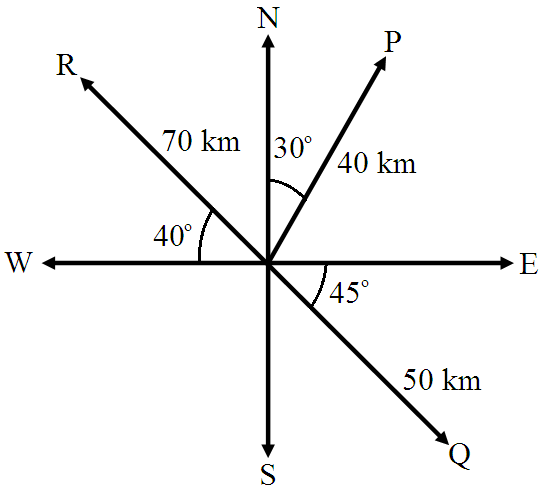
Represent the following graphically:
- A displacement of 40km, 30º east of north.
- A displacement of 50km south-east.
- A displacement of 70km, 40º north of west.
Answer
- The vector $\overrightarrow{\text{OP}}$ represents the required displacement vector.
- The vector $\overrightarrow{\text{OQ}}$ represents the required vector.
- The vector $\overrightarrow{\text{OR}}$ represents the required vector.
View full question & answer→Question 62 Marks
Find the angle at which the following vectors are inclined to each of the coordinate axes:
$4\hat{\text{i}}+8\hat{\text{j}}+\hat{\text{k}}$
AnswerLet $\vec{\text{r}}$ be the given vector, and let it make an angle $\alpha,\beta,\gamma$ with OX, OY, OZ respectively. Then, its direction cosines are $\cos\alpha,\cos\beta,\cos\gamma$.So direction ratios of $\vec{\text{r}}=4\hat{\text{i}}+8\hat{\text{j}}+\hat{\text{k}}$ are proportional to 4, 8, 1. Therefore,
Direction cosine of $\vec{\text{r}}$ are $\frac{4}{\sqrt{4^2+8^2+1^2}},\frac{8}{\sqrt{4^2+8^2+1^2}},\frac{1}{\sqrt{4^2+8^2+1^2}}$ or $\frac{4}{9},\frac{8}{9},\frac{1}{9}.$
$\therefore\alpha=\cos^{-1}=\Big(\frac{4}{9}\Big),\beta=\cos^{-1}=\Big(\frac{8}{9}\Big),\gamma=\cos^{-1}=\Big(\frac{1}{9}\Big)$.
View full question & answer→Question 72 Marks
Find $\vec{\text{a}}.\vec{\text{b}}$ when
$\vec{\text{a}}=\hat{\text{i}}-2\hat{\text{j}}+\hat{\text{k}}$ and $\vec{\text{b}}=4\hat{\text{i}}-4\hat{\text{j}}+7\hat{\text{k}}$
Answer$\vec{\text{a}}.\vec{\text{b}}$
$=(\hat{\text{i}}-2\hat{\text{j}}+\hat{\text{k}}).(4\hat{\text{i}}-4\hat{\text{j}}+7\hat{\text{k}})$
$=(1)(4)+(-2).(-4)+(1)(7)$
$=4+8+7$
$=19$
$\vec{\text{a}}.\vec{\text{b}}=19$
View full question & answer→Question 82 Marks
For any two vectors $\vec{\text{a}}$ and $\vec{\text{b}}$ write the value of $\big(\vec{\text{a}}.\vec{\text{b}}\big)^2+\big|\vec{\text{a}}\times\vec{\text{b}}\big|^2$ in terms of their magnitudes.
Answer$\big(\vec{\text{a}}.\vec{\text{b}}\big)^2+\big|\vec{\text{a}}\times\vec{\text{b}}\big|^2$
$=\big(|\vec{\text{a}}|\big|\vec{\text{b}}\big|\cos\theta\big)^2+\big(|\vec{\text{a}}|\big|\vec{\text{b}}\big|\sin\theta\big)^2$
$=|\vec{\text{a}}|^2\big|\vec{\text{b}}\big|^2$ $\big(\cos^2\theta+\sin^2\theta\big)$
$=|\vec{\text{a}}|^2\big|\vec{\text{b}}\big|^2$ (1)
$=|\vec{\text{a}}|^2\big|\vec{\text{b}}\big|^2$
View full question & answer→Question 92 Marks
Write the projection of the vector $7\hat{\text{i}}+\hat{\text{j}}-4\hat{\text{k}}$ on the vector $2\hat{\text{i}}+6\hat{\text{j}}+3\hat{\text{k}}.$
AnswerLet $\vec{\text{a}}=7\hat{\text{i}}+\hat{\text{j}}-4\hat{\text{k}};\vec{\text{b}}=2\hat{\text{i}}+6\hat{\text{j}}+3\hat{\text{k}}$
The projection of $\vec{\text{a}}$ on $\vec{\text{b}}$ is
$\Bigg(\frac{\vec{\text{a}}\vec{\text{b}}}{\big|\vec{\text{b}}\big|}\Bigg)$
$=\frac{\big(7\hat{\text{i}}+\hat{\text{j}}-4\hat{\text{k}}\big).\big(2\hat{\text{i}}+6\hat{\text{j}}+3\hat{\text{k}}\big)}{\big|2\hat{\text{i}}+6\hat{\text{j}}+3\hat{\text{k}}\big|}$
$=\frac{14+6-12}{\sqrt{4+36+9}}$
$=\frac{8}{7}$
View full question & answer→Question 102 Marks
Find $\big|\vec{\text{a}}-\vec{\text{b}}\big|$ if
$|\vec{\text{a}}|=3,\big|\vec{\text{b}}\big|=4$ and $\vec{\text{a}}.\vec{\text{b}}=1$
AnswerGiven that$|\vec{\text{a}}|=3,\big|\vec{\text{b}}\big|=4$ and $\vec{\text{a}}.\vec{\text{b}}=1\dots(1)$
We know that
$\big|\vec{\text{a}}-\vec{\text{b}}\big|^2=|\vec{\text{a}}|^2+\big|\vec{\text{b}}\big|^2-2\vec{\text{a}}.\vec{\text{b}}$
$=3^2+4^2-2(1)$ [using (1)]
$=9+16-2$
$=23$
$\therefore \big|\vec{\text{a}}-\vec{\text{b}}\big|=\sqrt{23}$
View full question & answer→Question 112 Marks
If $\vec{\text{a}}$ and $\vec{\text{b}}$ are two vectors of the same magnitude inclined at an angle of 60° such that $\vec{\text{a}}.\vec{\text{b}}=8,$
write the value of their magnitude.
AnswerGiven that
$|\vec{\text{a}}|=\big|\vec{\text{b}}\big|$
and $\vec{\text{a}}$ and $\vec{\text{b}}$ are inclined at an angle of 60°
Also, given that
$\vec{\text{a}}.\vec{\text{b}}=8$
$\Rightarrow|\vec{\text{a}}|\big|\vec{\text{b}}\big|\cos60^\circ=8$
$\Rightarrow|\vec{\text{a}}||\vec{\text{a}}|\big(\frac{1}{2}\big)=8$
$\Rightarrow|\vec{\text{a}}|^2=16$
$\Rightarrow|\vec{\text{a}}|=4$
View full question & answer→Question 122 Marks
Find the sum of the vectors $\vec{a}=\hat{i}-2\hat{j}+\hat{k,}\ \ \vec{b}=-2\hat{i}+4\hat{j}+5\hat{k}\ \text{and}\ \vec{c}= \hat{i}-6\hat{j}-7\hat{k}.$
AnswerThe given vectors are $\vec{a}=\hat{i}-2\hat{j}+\hat{k,}\ \ \vec{b}=-2\hat{i}+4\hat{j}+5\hat{k}\ \text{and}\ \vec{c}= \hat{i}-6\hat{j}-7\hat{k}$
$\therefore\vec{a}+\vec{b}+\vec{c}=(1-2+1)\hat{i}+(-2+4-6)\hat{j}+(1+5-7)\hat{k}$
$=0\cdot\hat{i}-4\hat{j}-1\cdot\hat{k}$
$=-4\hat{j}-\hat{k}$
View full question & answer→Question 132 Marks
Find the sum of the following vectors: $\vec{\text{a}}=\hat{\text{i}}-2\hat{\text{j}},\vec{\text{b}}=2\hat{\text{i}}-3\hat{\text{j}},\vec{\text{c}}=2\hat{\text{i}}-3\hat{\text{k}}$.
AnswerGiven: $\vec{\text{a}}=\hat{\text{i}}-2\hat{\text{j}},\vec{\text{b}}=2\hat{\text{i}}-3\hat{\text{j}},\vec{\text{c}}=2\hat{\text{i}}-3\hat{\text{k}}$So, Sum of the three vectors$=\vec{\text{a}}+\vec{\text{b}}+\vec{\text{c}}=\hat{\text{i}}-2\hat{\text{j}}+2\hat{\text{i}}-3\hat{\text{j}}+2\hat{\text{i}}+3\hat{\text{k}}$
$=5\hat{\text{i}}-5\hat{\text{j}}+3\hat{\text{k}}$
View full question & answer→Question 142 Marks
$\text{If}\ \vec{a}\cdot\vec{a}=0\ \text{and}\ \vec{a}\cdot\vec{b}=0,$ then what can be concluded about the vector $\vec{b}?$
Answer$\text{Given:}\ \ \vec{a}.\vec{a}=0\Rightarrow\ \ \big|\vec{a}\big|^2=0$ $ \ \Rightarrow\ \ \ \ \big|\vec{a}\big|=0$ $\text{Again}\ \ \vec{a}.\vec{b}=0\ \Rightarrow\ \ \big|\vec{a}\big|.\Big|\vec{b}\Big|\text{cos}\ \theta=0$ $\ \Rightarrow\ \ 0.\Big|\vec{b}\Big|\text{cos}\theta=0\ \Big[\because\big|\vec{a}\big|=0\Big]$ $\Rightarrow\ $ 0 = 0 for all (any vector $\vec{b}.$)Therefore, $\vec{b}$ can be any vector.
View full question & answer→Question 152 Marks
Find the position vector of the mid-point of the vector joining the points P(2, 3, 4) and Q(4, 1, -2).
AnswerThe position vector of mid-point R of the vector joining points P(2, 3, 4) and Q(4, 1, -2) is given by,
$\overrightarrow{\text{OR}}=\frac{\big(2\hat{\text{i}}+3\hat{\text{j}}+4\hat{\text{k}}\big)+\big(4\hat{\text{i}}+\hat{\text{j}}-2\hat{\text{k}}\big)}{2}$
$=\frac{(2+4)\hat{\text{i}}+(3+1)\hat{\text{j}}+(4-2)\hat{\text{k}}}{2}$
$=\frac{6\hat{\text{i}}+4\hat{\text{j}}+2\hat{\text{k}}}{2}$
$=3\hat{\text{i}}+2\hat{\text{j}}+\hat{\text{k}}$
View full question & answer→Question 162 Marks
Find the value of $\theta\in(0,\frac{\pi}{2})$ for which vectors $\vec{\text{a}}=(\sin\theta)\hat{\text{i}}+(\cos\theta)\hat{\text{j}}$ and $\vec{\text{b}}=\hat{\text{i}}-\sqrt{3}\hat{\text{j}}+2\hat{\text{k}}$ are perpendicular.
AnswerWe have
$\vec{\text{a}}=(\sin\theta)\hat{\text{i}}+(\cos\theta)\hat{\text{j}}$
and
$\vec{\text{b}}=\hat{\text{i}}-\sqrt{3}\hat{\text{j}}+2\hat{\text{k}}$
It is given that the vectors are perpendicular.
$\Rightarrow\vec{\text{a}}.\vec{\text{b}}=0$
$\Rightarrow\sin\theta-\sqrt{3}\cos\theta=0$
$\Rightarrow\sin\theta=\sqrt{3}\cos\theta$
$\Rightarrow\tan\theta=\sqrt{3}$
$\Rightarrow\theta=\frac{\pi}{3}$
View full question & answer→Question 172 Marks
For what value of 'a' the vectors $2\hat{\text{i}}-3\hat{\text{j}}+4\hat{\text{k}}$ and $\text{a}\hat{\text{i}}+6\hat{\text{j}}-8\hat{\text{k}}$ are collinear?
AnswerGiven: Two vectors, let $\vec{\text{p}}=2\hat{\text{i}}-3\hat{\text{j}}+4\hat{\text{k}}$ and $\vec{\text{q}}=\text{a}\hat{\text{i}}+6\hat{\text{j}}-8\hat{\text{k}}$
Since the given vectors are collinear, we have,
$\vec{\text{p}}=\lambda\vec{\text{q}}$
$\Rightarrow\ 2\hat{\text{i}}-3\hat{\text{j}}+4\hat{\text{k}}=\lambda\big(\text{a}\hat{\text{i}}+6\hat{\text{j}}-8\hat{\text{k}}\big)$
$\Rightarrow\ 2\hat{\text{i}}-3\hat{\text{j}}+4\hat{\text{k}}=\text{a}\lambda\hat{\text{i}}+6\lambda\hat{\text{j}}-8\lambda\hat{\text{k}}$
$\Rightarrow\ \lambda\text{a}=2,6\lambda=-3$ and $-8\lambda=4$
$\Rightarrow\ \lambda=-\frac{1}2$ and $\text{a}= -4$
View full question & answer→Question 182 Marks
If $\vec{\text{a}},\vec{\text{b}},\vec{\text{c}}$ are the position vectors of the vertices of an equilateral triangle whose orthocentre is at the origin, then write the values of $\vec{\text{a}}+\vec{\text{b}}+\vec{\text{c}}$.
AnswerLet, ABC be a given equilateral ttriangle and its vertices are $\text{A}(\vec{\text{a}}),\text{B}(\vec{\text{b}})$ and $\text{C}(\vec{\text{c}})$.
Also, $\text{O}(\vec{0})$ be the orthocentre of trianglre ABC.
We know that centroid and orthocentre of equilateral triangle coincide at one point.
Orthocentre of $\triangle\text{ABC}=\vec0$
$\Rightarrow$ Centroid $\triangle\text{ABC}=\vec0$
$\Rightarrow\ \frac{\vec{\text{a}}+\vec{\text{b}}+\vec{\text{c}}}3=\vec0$
$\therefore\ \vec{\text{a}}+\vec{\text{b}}+\vec{\text{c}}=\vec0$
View full question & answer→Question 192 Marks
If $\vec{\text{a}}$ and $\vec{\text{b}}$ are vectors of equal magnitude, write the value of $\big(\vec{\text{a}}+\vec{\text{b}}\big).\big(\vec{\text{a}}-\vec{\text{b}}\big).$
AnswerWE have
$|\vec{\text{a}}|=\big|\vec{\text{b}}\big|\dots(1)$
Now,
$\big(\vec{\text{a}}+\vec{\text{b}}\big).\big(\vec{\text{a}}-\vec{\text{b}}\big)$
$=|\vec{\text{a}}|^2-\big|\vec{\text{b}}\big|^2$
$=|\vec{\text{a}}|^2-|\vec{\text{a}}|^2$ [using (1)]
$=0$
View full question & answer→Question 202 Marks
Find the value of $\lambda$ is the vectors $2\hat{\text{i}}+\lambda\hat{\text{j}}+3\hat{\text{k}}$ and $3\hat{\text{i}}+2\hat{\text{j}}-4\hat{\text{k}}$ are perpendicular to each other.
AnswerGiven: $2\hat{\text{i}}+\lambda\hat{\text{j}}+3\hat{\text{k}}$ and $3\hat{\text{i}}+2\hat{\text{j}}-4\hat{\text{k}}$ are perpendicular to each other.
So, their dot product is zero.
$\big(2\hat{\text{i}}+\lambda\hat{\text{j}}+3\hat{\text{k}}\big).(3\text{i}+2\text{j}-4\text{k})$
$\Rightarrow6+2\lambda-12=0$
$\Rightarrow2\lambda-6=0$
$\Rightarrow\lambda=3$
View full question & answer→Question 212 Marks
Write the direction cosines of the vector $\vec{\text{r}}=6\hat{\text{i}}-2\hat{\text{j}}+3\hat{\text{k}}$.
AnswerGiven: $\vec{\text{r}}=6\hat{\text{i}}-2\hat{\text{j}}+3\hat{\text{k}}$
Then, direction cosines of $\hat{\text{r}}$ are $\frac{6}{\sqrt{6^2+(-2)^2+3^2}},\frac{-2}{\sqrt{6^2+(-2)^2+3^2}},\frac{3}{\sqrt{6^2+(-2)^2+3^2}}$ or, $\frac{6}7,\frac{-2}7,\frac{3}7$
View full question & answer→Question 222 Marks
If $\vec{\text{a}}=\hat{\text{i}}+2\hat{\text{j}}-3\hat{\text{k}}$ and $\vec{\text{b}}=2\hat{\text{i}}+4\hat{\text{j}}+9\hat{\text{k}}$, find a unit vector parallel to $\vec{\text{a}}+\vec{\text{b}}$.
AnswerGiven:$\vec{\text{a}}=\hat{\text{i}}+2\hat{\text{j}}-3\hat{\text{k}},\ \vec{\text{b}}=2\hat{\text{i}}+4\hat{\text{j}}+9\hat{\text{k}}$
Now, $\vec{\text{a}}+\vec{\text{b}}=3\hat{\text{i}}+6\hat{\text{j}}+6\hat{\text{k}}$
$\big|\vec{\text{a}}+\vec{\text{b}}\big|=\sqrt{3^2+6^2+6^2}$
$=\sqrt{9+36+36}$ $=\sqrt{81}$ $=9$Unit vector parallel to $\vec{\text{a}}+\vec{\text{b}}=\frac{\vec{\text{a}}+\vec{\text{b}}}{\big|\vec{\text{a}}+\vec{\text{b}}\big|}=\frac{3\hat{\text{i}}+6\hat{\text{j}}+6\hat{\text{k}}}{9}$
$=\frac{1}9\times3\big(\hat{\text{i}}+2\hat{\text{j}}+2\hat{\text{k}}\big)=\frac{1}3\big(\hat{\text{i}}+2\hat{\text{j}}+2\hat{\text{k}}\big)$
View full question & answer→Question 232 Marks
If $\vec{\text{a}},\vec{\text{b}},\vec{\text{c}}$ are non-coplanar vectors, then find the value of $\frac{\vec{\text{a}}.\big(\vec{\text{b}}\times\vec{\text{c}}\big)}{\big(\vec{\text{c}}\times\vec{\text{a}}\big).\vec{\text{b}}}+\frac{\vec{\text{b}}.\big(\vec{\text{a}}\times\vec{\text{c}}\big)}{\vec{\text{c}}.\big(\vec{\text{a}}\times\vec{\text{b}}\big)}$
View full question & answer→Question 242 Marks
If $\hat{\text{a}},\hat{\text{b}}$ are unit vectors such that $\hat{\text{a}}+\hat{\text{b}}$ is a unit vector, write the value of $\big|\hat{\text{a}}-\hat{\text{b}}\big|.$
AnswerGiven that $\hat{\text{a}}$ and $\hat{\text{b}}$ are unit vectors such that $\hat{\text{a}}+\hat{\text{b}}$ is a unit vector.
$\Rightarrow|\hat{\text{a}}|=\big|\hat{\text{b}}\big|=\big|\hat{\text{a}}+\hat{\text{b}}\big|=1\dots(1)$
Now,
$\big|\hat{\text{a}}+\vec{\text{b}}\big|=1$
Squaring both sides, we get
$|\vec{\text{a}}|^2+\big|\hat{\text{b}}\big|^2+2\hat{\text{a}}.\hat{\text{b}}=1$
$\Rightarrow1+1+2\hat{\text{a}}.\hat{\text{b}}=1$ [Form (1)]
$\Rightarrow\hat{\text{a}}.\hat{\text{b}}=\frac{-1}{2}\dots(2)$
Now,
$\big|\hat{\text{a}}-\hat{\text{b}}\big|^2=|\text{a}|^2+\big|\hat{\text{b}}\big|^2-2\hat{\text{a}}.\hat{\text{b}}$
$=1+1-2\big(\frac{-1}{2}\big)=3$ [From (1) and (2)]
$\therefore\big|\hat{\text{a}}-\hat{\text{b}}\big|=\sqrt{3}$
View full question & answer→Question 252 Marks
Find the angle between the vectors $\vec{\text{a}} $ and $\vec{\text{b}},$ where$\vec{\text{a}}=2\hat {\text{i}}-\hat{\text{j}}+2\hat{\text{k}}$ and $\vec{\text{b}} =4\hat{\text{i}}+4\hat{\text{j}}-2\hat{\text{k}}$
AnswerLet $\theta$ be the angle between $\vec{\text{a}}$ and $\vec{\text{b}}$.
$\big|\vec{\text{a}}\big|=\sqrt{(2)^2+(-1)^2+(2)^{2}}=\sqrt{9}=3$
$\big|\vec{\text{b}}\big|=\sqrt{(4)^2+(4)^2+(-2)^{2}}=\sqrt{36}=6$
$\vec{\text{a}}.\vec{\text{b}}=8-4-4=0$
$\cos\theta=\frac{\vec{\text{a }}.\vec{\text{ b}}}{\big|\vec{a}\big|\big|\vec{b}\big|}=\frac{0}{(3)(6)}=0$
$\Rightarrow\theta=\cos^{-1}(0)=\frac{\pi}{2}$
View full question & answer→Question 262 Marks
If $\vec{\text{a}}=\hat{\text{i}}-\hat{\text{j}}$ and $\vec{\text{b}}=-\hat{\text{j}}+\hat{\text{k}},$ find the projection of $\vec{\text{a}}$ on $\vec{\text{b}}.$
AnswerWe have
$\vec{\text{a}}=\hat{\text{i}}-\hat{\text{j}}$ and $\vec{\text{b}}=-\hat{\text{j}}+\hat{\text{k}}$
The projection of $\vec{\text{a}}$ on $\vec{\text{b}}$ is
$\frac{\vec{\text{a}}.\vec{\text{b}}}{\big|\vec{\text{b}}\big|}$
$=\frac{(\hat{\text{i}}-\hat{\text{j}}).(-\hat{\text{j}}+\hat{\text{k}})}{\big|-\hat{\text{j}}+\hat{\text{k}}\big|}$
$=\frac{0+1+0}{\sqrt{1+1}}$
$=\frac{1}{\sqrt{2}}$
View full question & answer→Question 272 Marks
For any two vectors $\vec{\text{a}}$ and $\vec{\text{b}},$ find $\big(\vec{\text{a}}\times\vec{\text{b}}\big).\vec{\text{b}}.$
AnswerLet:$\vec{\text{a}}=\text{a}_1\hat{\text{i}}+\text{a}_2\hat{\text{j}}+\text{a}_3\hat{\text{k}}$
$\vec{\text{b}}=\text{b}_1\hat{\text{i}}+\text{b}_2\hat{\text{j}}+\text{b}_3\hat{\text{k}}$
$\vec{\text{a}}\times\vec{\text{b}}=\begin{vmatrix}\hat{\text{i}}&\hat{\text{j}}&\hat{\text{k}}\\\text{a}_1&\text{a}_2&\text{a}_3\\\text{b}_1&\text{b}_2&\text{b}_3\end{vmatrix}$
$=\hat{\text{i}}(\text{a}_2\text{b}_3-\text{a}_3\text{b}_2)-\hat{\text{j}}(\text{a}_1\text{b}_3-\text{a}_3\text{b}_1)+\hat{\text{k}}(\text{a}_1\text{b}_2-\text{a}_2\text{b}_1)$
$\big(\vec{\text{a}}\times\vec{\text{b}}\big).\vec{\text{b}}$
$=\big[\hat{\text{i}}(\text{a}_2\text{b}_3-\text{a}_3\text{b}_2)-\hat{\text{j}}(\text{a}_1\text{b}_3-\text{a}_3\text{b}_1)+\hat{\text{k}}(\text{a}_1\text{b}_2-\text{a}_2\text{b}_1)\big]\\.\big(\text{b}_1\hat{\text{i}}+\text{b}_2\hat{\text{j}}+\text{b}_3\hat{\text{k}}\big)$
$=\text{a}_2\text{b}_1\text{b}_3-\text{a}_3\text{b}_1\text{b}_2-\text{a}_1\text{b}_2\text{b}_3+\text{a}_3\text{b}_1\text{b}_2+\text{a}_1\text{b}_2\text{b}_3-\text{a}_2\text{b}_1\text{b}_3$
$=\text{b}_1(\text{a}_2\text{b}_3-\text{a}_3\text{b}_2)-\text{b}_2(\text{a}_1\text{b}_3-\text{a}_3\text{b}_1)+\text{b}_3(\text{a}_1\text{b}_2-\text{a}_2\text{b}_1)$
$=\text{a}_2\text{b}_1\text{b}_3-\text{a}_3\text{b}_1\text{b}_2-\text{a}_1\text{b}_2\text{b}_3+\text{a}_3\text{b}_1\text{b}_2+\text{a}_1\text{b}_2\text{b}_3-\text{a}_2\text{b}_1\text{b}_3$
$=0$
View full question & answer→Question 282 Marks
If $\vec{\text{a}},\vec{\text{b}},\vec{\text{c}}$ represent the sides of a triangle taken in order, then write the value of $\vec{\text{a}}+\vec{\text{b}}+\vec{\text{c}}$.
AnswerLet ABC be a triangle such that $\overrightarrow{\text{BC}}=\vec{\text{a}},\ \overrightarrow{\text{CA}}=\vec{\text{b}},\ \overrightarrow{\text{AB}}=\vec{\text{c}}$. Then,$\vec{\text{a}}+\vec{\text{b}}+\vec{\text{c}}=\overrightarrow{\text{BC}}+\overrightarrow{\text{CA}}+\overrightarrow{\text{AB}}$
$=\overrightarrow{\text{BA}}+\overrightarrow{\text{AB}}$ $\Big[\because \overrightarrow{\text{BC}}+\overrightarrow{\text{CA}}=\overrightarrow{\text{BA}}\Big]$
$=\vec0$
View full question & answer→Question 292 Marks
Find a vector of magnitude 4 units which is parallel to the vector $\sqrt3\hat{\text{i}}+\hat{\text{j}}$.
AnswerLet $\vec{\text{a}}=\sqrt3\hat{\text{i}}+\hat{\text{j}}$
Then, $\big|\vec{\text{a}}\big|=\sqrt{\big(\sqrt3\big)^2+1}=\sqrt{3+1}=\sqrt4=2$
A unit vector parallel to $\vec{\text{a}}=\hat{\text{a}}=\frac{\vec{\text{a}}}{|\vec{\text{a}}|}=\frac{1}2\big(\sqrt3\hat{\text{i}}+\hat{\text{j}}\big)$
Hence, Required vector $=4\hat{\text{a}}=4\times\frac{1}2\big(\sqrt3\hat{\text{i}}+\hat{\text{j}}\big)=2\sqrt3\hat{\text{i}}+2\hat{\text{j}}$
View full question & answer→Question 302 Marks
Find the components along the coordinate axis of the position vector of the following point:
P(3, 2)
AnswerHere, P = (3, 2)
Position vector of $\text{P}=3\hat{\text{i}}+2\hat{\text{j}}$
Component of P along x-axis $=3\hat{\text{i}}$
Component of P along x-axis $=2\hat{\text{j}}$
View full question & answer→Question 312 Marks
If $\vec{\text{a}},\vec{\text{b}},\vec{\text{c}}$ are the position vectors of the vertices of a triangle, then write the position vector of its centroid.
AnswerLet ABC be a triangle and D, E and F are the midpoints of the sides BC, CA and AB respectively.
Also, Let $\vec{\text{a}},\vec{\text{b}},\vec{\text{c}}$ are the position vectors of A, B, C respectively. Then the position vectors of D, E, F are $\Big(\frac{\vec{\text{b}}+\vec{\text{c}}}2\Big),\Big(\frac{\vec{\text{c}}+\vec{\text{a}}}2\Big),\Big(\frac{\vec{\text{a}}+\vec{\text{b}}}2\Big)$ respectively.
The position vector of a point divides AD in the ratio of 2; is $\frac{1.\vec{\text{a}}+2\frac{\vec{\text{b}}+\vec{\text{c}}}{2}}{2}=\frac{\vec{\text{a}}+\vec{\text{b}}+\vec{\text{c}}}3$
Similarly, Position vectors of the points divides BE, CF in the ratio of 2 : 1 are equal to $\frac{\vec{\text{a}}+\vec{\text{b}}+\vec{\text{c}}}3$.
Thus, the point dividing AD in the ratio 2 : 1 also divides BE, CF in the same ratio.
Hence, the medians of a triangle are concurrent and the position vector of the centroid is $\frac{\vec{\text{a}}+\vec{\text{b}}+\vec{\text{c}}}3$.
View full question & answer→Question 322 Marks
Write the projection of $\vec{\text{r}}=3\hat{\text{i}}-4\hat{\text{j}}+12\hat{\text{k}}$ on the coordinate axes.
AnswerWe have
$\vec{\text{r}}=3\hat{\text{i}}-4\hat{\text{j}}+12\hat{\text{k}}$
Projection of $\vec{\text{r}}$ on x-axis $=\frac{\vec{\text{r}}.\hat{\text{i}}}{|\hat{\text{i}}|}=\frac{3}{1}=3$
Projection of $\vec{\text{r}}$ on y-axis $=\frac{\vec{\text{r}}.\hat{\text{j}}}{|\hat{\text{j}}|}=\frac{-4}{1}=-4$
Projection of $\vec{\text{r}}$ on z-axis $=\frac{\vec{\text{r}}.\hat{\text{k}}}{|\hat{\text{k}}|}=\frac{12}{1}=12$
View full question & answer→Question 332 Marks
For what value of $\lambda$ are the vectors $\vec{\text{a}}$ and $\vec{\text{b}}$ perpendicular to each other if
$\vec{\text{a}}=\lambda\hat{\text{i}}+2\hat{\text{j}}+\hat{\text{k}}$ and $\vec{\text{b}}=4\hat{\text{i}}-9\hat{\text{j}}+2\hat{\text{k}}$
AnswerIf the vectors $\vec{\text{a}}$ and $\vec{\text{b}}$ are perpendicular to each other, then
$\vec{\text{a}}.\vec{\text{b}}=0$
$\Rightarrow\Big(\lambda\hat{\text{i}}+2\hat{\text{j}}+\hat{\text{k}}\Big).\Big(4\hat{\text{i}}-9\hat{\text{j}}+2\hat{\text{k}}\Big)=0$
$\Rightarrow4\lambda-18+2=0$
$\Rightarrow4\lambda-16=0$
$\Rightarrow4\lambda=16$
$\Rightarrow\lambda=4$
View full question & answer→Question 342 Marks
If $\vec{\text{a}},\ \vec{\text{b}},\ \vec{\text{c}}$ are non-coplanar vectors, prove that the given vectors are non-coplanar:
$\vec{\text{a}}+2\vec{\text{b}}+3\vec{\text{c}},\ 2\vec{\text{a}}+\vec{\text{b}}+3\vec{\text{c}}$ and $\vec{\text{a}}+\vec{\text{b}}+\vec{\text{c}}$
AnswerLet if possible the given vectors are coplanar. Then one of the vector is expressible in the terms of the other two.
We have,
$\vec{\text{a}}+2\vec{\text{b}}+3\vec{\text{c}}=\text{x}\big(2\vec{\text{a}}+\vec{\text{b}}+3\vec{\text{c}}\big)+\text{y}\big(\vec{\text{a}}+\vec{\text{b}}+\vec{\text{c}}\big)$
$=\vec{\text{a}}(\text{2x + y})+\vec{\text{b}}(\text{x + y})+\vec{\text{c}}(3\text{x}+\text{y})$
$\Rightarrow\text{2x + y}=1,\ \text{x + y}=2,\ 3\text{x}+\text{y}=3$
On solving the first two equations we get x = -1, y = 3. Clearly the values of x, y does not satisfy the third equation.
Hence, the given vectors are non-coplanar.
View full question & answer→Question 352 Marks
If $\vec{\text{a}}=3\hat{\text{i}}-\hat{\text{j}}+2\hat{\text{k}}$ and $\vec{\text{b}}=2\hat{\text{i}}+\hat{\text{j}}-\hat{\text{k}},$ then find $\big(\vec{\text{a}}\times\vec{\text{b}}\big)\vec{\text{a}}.$
AnswerSince $\vec{\text{a}}\times\vec{\text{b}}$ is a vector, $\big(\vec{\text{a}}\times\vec{\text{b}}\big)\vec{\text{a}}$ without any dot or cross product in between is meaningless.
View full question & answer→Question 362 Marks
Write the projection of $\hat{\text{i}}+\hat{\text{j}}+\hat{\text{k}}$ along the vector $\hat{\text{j}}.$
AnswerProjection of $\vec{\text{a}}$ on $\vec{\text{b}}=\frac{\vec{\text{a}}.\vec{\text{b}}}{\big|\vec{\text{b}}\big|}$
Projection of $\hat{\text{i}}+\hat{\text{j}}+\hat{\text{k}}$ along $\hat{\text{j}}$
$=\frac{\big(\hat{\text{i}}+\hat{\text{j}}+\hat{\text{k}}\big).\vec{\text{j}}}{|\vec{\text{j}}|}$
$=\frac{1}{1}$
$=1$
View full question & answer→Question 372 Marks
Write a unit vector in the direction of the sum of the vectors $\vec{\text{a}}=2\hat{\text{i}}+2\hat{\text{j}}-5\hat{\text{k}}$ and $\vec{\text{b}}=2\hat{\text{i}}+\text{y}\hat{\text{j}}-7\hat{\text{k}}$.
AnswerWe have, $\vec{\text{a}}=2\hat{\text{i}}+2\hat{\text{j}}-5\hat{\text{k}}$ and $\vec{\text{b}}=2\hat{\text{i}}+\text{y}\hat{\text{j}}-7\hat{\text{k}}$
$\therefore\ \vec{\text{a}}+\vec{\text{b}}=\big(2\hat{\text{i}}+2\hat{\text{j}}-5\hat{\text{k}}\big)+\big(2\hat{\text{i}}+\hat{\text{j}}-7\hat{\text{k}}\big)$
$=4\hat{\text{i}}+3\hat{\text{j}}-12\hat{\text{k}}$
$\Rightarrow\ \big|\vec{\text{a}}+\vec{\text{b}}\big|=\sqrt{4^2+3^2+(-12)^2}$
$=\sqrt{16+9+144}$
$=\sqrt{169}$
$=13$
$\therefore$ Required unit vector $=\frac{\vec{\text{a}}+\vec{\text{b}}}{\big|\vec{\text{a}}+\vec{\text{b}}\big|}=\frac{4\hat{\text{i}}+3\hat{\text{j}}-12\hat{\text{k}}}{13}$
$=\frac{4}{13}\hat{\text{i}}+\frac{3}{13}\hat{\text{j}}-\frac{12}{13}\hat{\text{k}}$
View full question & answer→Question 382 Marks
Show that the vector $\hat{i}+\hat{j}+\hat{k}$ is equally inclined to the axes OX, OY and OZ.
Answer$\text{Let}\ \vec{a}=\hat{i}+\hat{j}+\hat{k}.$ Then,$|\vec{a}|=\sqrt{1^2+1^2+1^2}=\sqrt{3}$
Therefore, the direction cosines of $\vec{a}=\text{are}\ \bigg(\frac{1}{\sqrt{3}},\frac{1}{\sqrt{3}},\frac{1}{\sqrt{3}}\bigg).$
Now, let $\alpha,\ \beta,$ and $\gamma$ be the angles formed by $\vec{a}$ with the positive directions of x, y, and z axes.
Then, we have $\text{cos}\ \alpha=\frac{1}{\sqrt{3}},\text{cos}\beta=\frac{1}{\sqrt{3}},\text{cos}\ \gamma=\frac{1}{\sqrt{3}}.$ Hence, the given vector is equally is equally inclined to axes OX, OY, and OZ.
View full question & answer→Question 392 Marks
Find the components along the coordinate axis of the position vector of the following point:S(4,-3)
AnswerHere, S = (4, -3)
Position vector of $\text{S}=4\hat{\text{i}}-3\hat{\text{j}}$
Component of S along x-axis $=4\hat{\text{i}}$
Component of S along x-axis $=-3\hat{\text{j}}$
View full question & answer→Question 402 Marks
If $\big|\vec{\text{a}}\times\vec{\text{b}}\big|^2+\big(\vec{\text{a}}.\vec{\text{b}}\big)^2=144$ and $|\vec{\text{a}}|=4,$ find $\big|\vec{\text{b}}\big|.$
AnswerWe know
$\big|\vec{\text{a}}\times\vec{\text{b}}\big|^2+\big(\vec{\text{a}}.\vec{\text{b}}\big)^2=|\vec{\text{a}}|^2\big|\vec{\text{b}}\big|^2$
$\Rightarrow144=4^2\big|\vec{\text{b}}\big|^2$
$\Rightarrow144=16\big|\vec{\text{b}}\big|^2$
$\Rightarrow\big|\vec{\text{b}}\big|^2=9$
$\Rightarrow\big|\vec{\text{b}}\big|=3$
View full question & answer→Question 412 Marks
If the position vector of a point (-4, -3) be $\vec{\text{a}}$, find $\big|\vec{\text{a}}\big|$.
AnswerGiven a point (-4, -3) such that its position vector $\vec{\text{a}}$ is given by
$\vec{\text{a}}=-4\hat{\text{i}}-3\hat{\text{j}}$
Then,
$\big|\vec{\text{a}}\big|=\sqrt{(-4)^2+(-3)^2}$
$=\sqrt{16+9}$
$=\sqrt{25}$
$=5$
View full question & answer→Question 422 Marks
If $\vec{\text{a}}$ and $\vec{\text{b}}$ are two vectors such that $\big|\vec{\text{a}}\big|=4,\big|\vec{\text{b}}\big|=3$ and $\vec{\text{a}}.\vec{\text{b}}=6,$ find the angle between $\vec{\text{a}}$ and $\vec{\text{b}}$.
AnswerLet $\theta$ be the angle between $\vec{\text{a}}$ and $\vec{\text{b}}$.Given that
$\vec{\text{a}}.\vec{\text{b}}=6$
$\Rightarrow\big|\vec{\text{a}}\big|\big|\vec{\text{b}}\big|\cos\theta=6$
$\Rightarrow(4)(3)\cos\theta=6$
$\Rightarrow12\cos\theta=6$
$\Rightarrow\cos\theta=\frac{6}{12}=\frac{1}{2}$
$\Rightarrow\theta=\cos^{-1}\big(\frac{1}{2}\big)=\frac{\pi}{3}$
View full question & answer→Question 432 Marks
If $\vec{\text{a}},\vec{\text{b}},\vec{\text{c}}$ are three mutually perpendicular unit vectors, then prove that $\big|\vec{\text{a}}+\vec{\text{b}}+\vec{\text{c}}\big|=\sqrt{3}$
AnswerGiven that $\vec{\text{a}},\vec{\text{b}}$ and $\vec{\text{c}}$ are unit vectors.
So, $\big|\vec{\text{a}}\big|=1,\Big|\vec{\text{b}}\big|=1$ and $\big|\vec{\text{c}}\big|=1$
Since they are mutually perpendicular,
$\vec{\text{a}}.\vec{\text{b}}=\vec{\text{b}}.\vec{\text{c}}=\vec{\text{c}}.\vec{\text{a}}=0$
Now,
$\big|\vec{\text{a}}+\vec{\text{b}}+\vec{\text{c}}\big|^2=|\vec{\text{a}}|^2+\big|\vec{\text{b}}\big|^2+|\vec{\text{c}}|+2\vec{\text{a}}.\vec{\text{b}}+2\vec{{\text{b}}}.\vec{\text{c}}+2\vec{\text{c}}.\vec{\text{a}}$
$=1+1+1+0+0+0$
$=3$
$\therefore\big|\vec{\text{a}}+\vec{\text{b}}+\vec{\text{c}}\big|=\sqrt{3}$
View full question & answer→Question 442 Marks
If $\vec{\text{a}}=3\hat{\text{i}}-\hat{\text{j}}-4\hat{\text{k}},\ \vec{\text{b}}=-2\hat{\text{i}}+4\hat{\text{j}}-3\hat{\text{k}}$ and $\vec{\text{c}}=\hat{\text{i}}+2\hat{\text{j}}-\hat{\text{k}}$, find $\big|3\vec{\text{a}}-2\vec{\text{b}}+4\vec{\text{c}}\big|$.
AnswerGiven: $\vec{\text{a}}=3\hat{\text{i}}-\hat{\text{j}}-4\hat{\text{k}},\ \vec{\text{b}}=-2\hat{\text{i}}+4\hat{\text{j}}-3\hat{\text{k}} $ and $\vec{\text{c}}=\hat{\text{i}}+2\hat{\text{j}}-\hat{\text{k}}$
Now, $3\vec{\text{a}}-2\vec{\text{b}}+4\vec{\text{c}}=3\big(\vec{\text{a}}=3\hat{\text{i}}-\hat{\text{j}}-4\hat{\text{k}}\big)\\-2\big(\vec{\text{b}}=-2\hat{\text{i}}+4\hat{\text{j}}-3\hat{\text{k}}\big)+4\big(\vec{\text{c}}=\hat{\text{i}}+2\hat{\text{j}}-\hat{\text{k}}\big)$
$=9\hat{\text{i}}-3\hat{\text{j}}-12\hat{\text{k}}+4\hat{\text{i}}-8\hat{\text{j}}+6\hat{\text{k}}+4\hat{\text{i}}+8\hat{\text{j}}-4\hat{\text{k}}$
$=17\hat{\text{i}}-3\hat{\text{j}}-10\hat{\text{k}}$
Hence, $\big|3\vec{\text{a}}-2\vec{\text{b}}+4\vec{\text{c}}\big|$
$=\sqrt{17^2+(-3)^2+(-10)^2}$
$=\sqrt{289+9+100}$
$=\sqrt{398}$
View full question & answer→Question 452 Marks
Find the area of the triangle with vertices A(1, 1, 2), B(2, 3, 5) and C(1, 5, 5).
AnswerVertices of $\triangle\text{ABC}$ are A(1, 1, 2), B(2, 3, 5) and C(1, 5, 5).
$\therefore\ \ \ \ \ \ \text{Position vector of point A}={(1, 1, 2) }=\hat{i}+\hat{j}+2\hat{k}$
$\text{Position vector of point B}={(2, 3, 5) }=2\hat{i}+3\hat{j}+5\hat{k}$
$\text{Position vector of point C}={(1, 5, 5) }=\hat{i}+5\hat{j}+5\hat{k}$
$\text{Now}\ \ \overrightarrow{\text{AB}}\ \ $ = Position vector of point B - Position vector of point A
$= 2\hat{i}+3\hat{j}+5\hat{k}-\big(\hat{i}+\hat{j}+2\hat{k}\big)$ $=2\hat{i}+3\hat{j}+5\hat{k}-\hat{i}-\hat{j}-2\hat{k}$
$=\hat{i}+2\hat{j}+3\hat{k}$
$\text{And}\ \ \overrightarrow{\text{AC}}\ \ $ = Position vector of point C - Position vector of point A
$=\hat{i}+5\hat{j}+5\hat{k}\ -(\hat{i}+\hat{j}+2\hat{k})$ $=\hat{i}+5\hat{j}+5\hat{k}\ -\hat{i}-\hat{j}-2\hat{k}$
$=0\hat{i}+4\hat{j}+3\hat{k}$
$\therefore\ \ \ \ \ \ \overrightarrow{\text{AB}}\ \text{x}\ \overrightarrow{\text{AC}}=\begin{vmatrix}\hat{i}&\hat{j}&\hat{k}\\1&2&3\\0&4&3\end{vmatrix}=\hat{i}(6-12)-\hat{j}(3-0)+\hat{k}(4-0)=-6\hat{i}-3\hat{j}+4\hat{k}$
$\text{Now}\ \ \ \ \text{Area of triangle ABC}=\frac{1}{2}\bigg|\overrightarrow{\text{AB}}\times\overrightarrow{\text{AC}}\bigg|$ $=\frac{1}{2}\sqrt{36+9+16}$
$=\frac{1}{2}\sqrt{61}\ \text{sq.units}$
View full question & answer→Question 462 Marks
If $\vec{\text{a}}$ is a unit vector, then find $|\vec{\text{x}}|$ in each of the following.$\big(\vec{\text{x}}-\vec{\text{a}}\big).\big(\vec{\text{x}}+\vec{\text{a}}\big)=12$
AnswerGiven that $\vec{\text{a}}$ is a unit vector.$\big(\vec{\text{x}}-\vec{\text{a}}\big).\big(\vec{\text{x}}+\vec{\text{a}}\big)=12$
$\Rightarrow|\vec{\text{x}}|^2-|\vec{\text{a}}|^2=12$
$\Rightarrow|\vec{\text{x}}|^2-1^2=12$ [From (1)]
$\Rightarrow|\vec{\text{x}}|^2=13$
$\Rightarrow|\vec{\text{x}}|=\sqrt{13}$
View full question & answer→Question 472 Marks
For what value of $\lambda$ are the vectors $\vec{\text{a}}$ and $\vec{\text{b}}$ perpendicular to each other if
$\vec{\text{a}}=2\hat{\text{i}}+3\hat{\text{j}}+4\hat{\text{k}}$ and $\vec{\text{b}}=3\hat{\text{i}}+2\hat{\text{j}}+\lambda\hat{\text{k}}$
AnswerIf the vectors $\vec{\text{a}}$ and $\vec{\text{b}}$ are perpendicular to each other, then$\vec{\text{a}}.\vec{\text{b}}=0$
$\Rightarrow\Big(2\hat{\text{i}}+3 \hat{\text{j}}+4\hat{\text{k}}\Big).\Big(3\hat{\text{i}}+2\hat{\text{j}}-\lambda\hat{\text{k}}\Big)=0$
$\Rightarrow6+6-4\lambda=0$
$\Rightarrow12-4\lambda=0$
$\Rightarrow4\lambda=12$
$\Rightarrow\lambda=3$
View full question & answer→Question 482 Marks
Find the angle between the vectors $\vec{\text{a}} $ and $\vec{\text{b}},$ where$\vec{\text{a}}=\hat {\text{i}}+2\hat{\text{j}}-\hat{\text{k}},$ and $\vec{\text{b}} =\hat{\text{i}}-\hat{\text{j}}+\hat{\text{k}}$
AnswerLet $\theta$ be the angle between $\vec{\text{a}}$ and $\vec{\text{b}}$.$\big|\vec{\text{a}}\big|=\sqrt{(1)^2+(2)^2+(-1)^{2}}=\sqrt{6}$
$\big|\vec{\text{b}}\big|=\sqrt{(1)^2+(-1)^2+(1)^{2}}=\sqrt{3}$
$\vec{\text{a}}.\vec{\text{b}}=1-2-1=-2$
$\cos\theta=\frac{\vec{\text{a }}.\vec{\text{ b}}}{\big|\vec{a}\big|\big|\vec{b}\big|}=\frac{-2}{\sqrt{6}\sqrt{3}}=\frac{-2}{\sqrt{18}}=\frac{-\sqrt{2}\times\sqrt{2}}{\sqrt{2}\times\sqrt{9}}=\frac{-\sqrt{2}}{3}$
$\Rightarrow\theta=\cos^{-1}\Big(\frac{-\sqrt{2}}{{3}}\Big)$
View full question & answer→Question 492 Marks
If $\vec{\text{a}}$ is a unit vector, then find $|\vec{\text{x}}|$ in each of the following.$\big(\vec{\text{x}}-\vec{\text{a}}\big).\big(\vec{\text{x}}+\vec{\text{a}}\big)=8$
AnswerGiven that $\vec{\text{a}}$ is a unit vector.
$\Rightarrow|\vec{\text{a}}|=1\dots(1)$
$\big(\vec{\text{x}}-\vec{\text{a}}\big).\big(\vec{\text{x}}+\vec{\text{a}}\big)=8$
$\Rightarrow|\vec{\text{x}}|^2-|\vec{\text{a}}|^2=8$
$\Rightarrow|\vec{\text{x}}|^2-1^2=8$ [From (1)]
$\Rightarrow|\vec{\text{x}}|^2=9$
$\Rightarrow|\vec{\text{x}}|=3$
View full question & answer→Question 502 Marks
Write two different vectors having same magnitude.
AnswerLet $\vec{\text{a}}=2\hat{\text{i}}-\hat{\text{j}}+3\hat{\text{k}}$ and $\vec{\text{b}}=-2\hat{\text{i}}+\hat{\text{j}}-3\hat{\text{k}}$
It can be observed that
$|\vec{\text{a}}|=\sqrt{2^2+(-1)^2+3^2}=\sqrt{14}$
$\big|\vec{\text{b}}\big|=\sqrt{(-2)^2+1^2+(-3)^2}=\sqrt{14}$
Hence, $\vec{\text{a}}\text{ and }\vec{\text{b}}$ are two vectors having same direction.
View full question & answer→