Questions

M.C.Q (1 Marks)

Take a timed test

16 questions · 2 auto-graded MCQ + 14 self-marked written.

Question 11 Mark
An AC source rated 100V (rms) supplies a current of 10A (rms) to a circuit. The average power delivered by the source:
  1. Must be 1000W.
  2. May be 1000W.
  3. May be greater than 1000W.
  4. May be less than 1000W.
Answer
  1. May be 1000W.
  1. May be less than 1000W.
Explanation:
Average power $\text{P}_\text{av}=\text{V}_\text{rms}\text{I}_\text{rms}\cos\phi$
$=100\times10\cos\phi$
$\text{P}_\text{av}=1000\cos\phi$
$\therefore\ \cos\phi$ lies "0 to 1".
$\Rightarrow\ 0\leq\text{P}_\text{av}\leq1000.$
View full question & answer
Question 21 Mark
An AC source is rated 220V, 50Hz. The average voltage is calculated in a time interval of 0.01s, It:
  1. Must be zero.
  2. May be zero.
  3. Is never zero.
  4. Is $\Big(\frac{200}{\sqrt{2}}\Big)\text{V}.$
Answer
  1. May be zero.
Explanation:
  1. $\text{V}=\text{V}_0\sin\omega\text{t}$
$\omega=2\pi\text{f}=2\times3.14\times50$
$\omega=314$
$\text{V}_\text{avg}=\frac{\int\limits_0^{0.01}\text{V}\text{dt}}{\int\limits_0^{0.01}\text{dt}}$
$=\text{V}_0\Big(\frac{1\cos\omega\text{t}}{\omega}\Big)_0^{0.01}$
$=\frac{\text{V}_0}{\omega\times0.01}\big(1-\cos\omega(0.1)\big)$
$=\frac{\text{V}_0}{314\times0.01}\big(1-\cos(314\times0.01)\big)$
$=\frac{\text{V}_0}{3.14}\big(1-\cos(314)\big)$
$=\frac{\text{V}_0}{3.14}\big(1-\cos\pi\big)$
$=\frac{2\text{V}_0}{\pi}=140.127\text{volt}$
  1.  

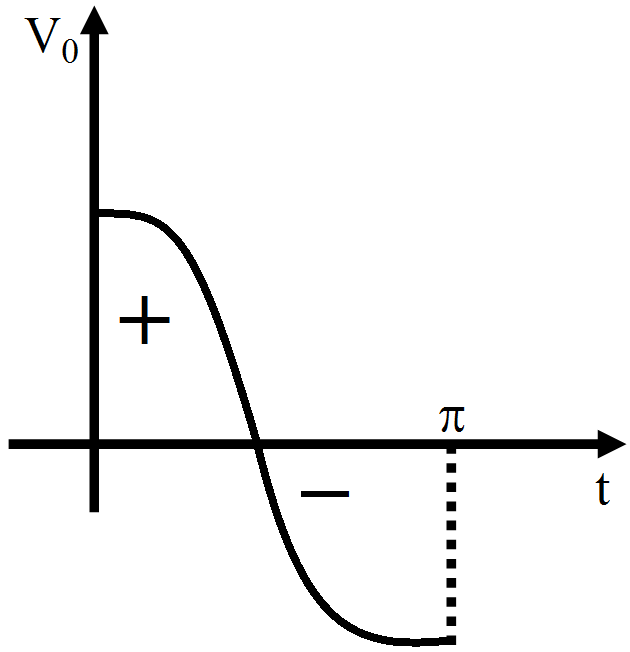
if $\text{V}=\text{V}_0\cos\omega\text{t}$
$\text{V}_\text{avg}=\frac{\int\text{V d}\rho}{\int\text{dt}}=0$
View full question & answer
Question 31 Mark
In an AC series circuit, the instantaneous current is zero when the instantaneous voltage is maximum. Connected to the source may be a:
  1. Pure inductor.
  2. Pure capacitor.
  3. Pure resistor.
  4. Combination of an inductor and a capacitor.
Answer
  1. Pure inductor.
  2. Pure capacitor.
  1. Combination of an inductor and a capacitor.
Explanation:
Instantaneous current is zero when the intantaneous voltage is maximum.
Mean resistance = 0.
View full question & answer
Question 41 Mark
The magnetic field energy in an inductor changes from maximum value to minimum value in 5.0ms when connected to an AC source. The frequency of the source:
  1. 20Hz.
  2. 50Hz.
  3. 200Hz.
  4. 500Hz.
Answer
  1. 50Hz.
Explanation:
Frequency of the source is remain constant = 50Hz.
View full question & answer
MCQ 51 Mark
An $AC$ source producing emf $\epsilon=\epsilon_{0}\Big[\cos\big(100\pi\text{s}^{-1}\big)\text{t}+\cos\big(500\pi\text{s}^{-1}\big)\text{t}\Big]$ is connected in series with a capacitor and a resistor. The steady$-$state current in the circuit is found to be $\text{i}=\text{i}_1\cos\Big[\big(100\pi\text{s}^{-1}\big)\text{t}+\phi_1\Big]+\text{i}_2\cos\Big[\big(500\pi\text{s}^{-1}\big)\text{t}+\phi_2\Big].$
  • A
    $i_1 > i_2$
  • B
    $i_1 = i_2$
  • $i_1 < i_2$
  • D
    The information is insufficient to find the relation between $i_1$ and $i_2$
Answer
Correct option: C.
$i_1 < i_2$
$\text{Q}=\text{C}\epsilon=\epsilon_{0}\text{C}\Big[\cos\big(100\pi\text{s}^{-1}\big)\text{t}+\cos\big(500\pi\text{s}^{-1}\big)\text{t}\Big]$
$\text{i}=\frac{\text{dQ}}{\text{dt}}$
$\text{Q}=\text{C}\epsilon=\epsilon_{0}\text{C}\Big[\cos\big(100\pi\text{s}^{-1}\big)\text{t}+\cos\big(500\pi\text{s}^{-1}\big)\text{t}\Big]$
$\epsilon_0\text{C}\times100\pi\Big[\sin\big(100\pi\text{s}^{-1}\big)\text{t}\Big]\\+\epsilon_0\text{C}\times500\pi\Big[\sin\big(500\pi\text{s}^{-1}\big)\text{t}\Big]$
$=100\text{C}\pi\epsilon_0\cos\Big[\big(100\pi\text{s}^{-1}\big)\text{t}+\phi_1\Big]\\+500\text{C}\pi\epsilon_0\cos\Big[\big(500\pi\text{s}^{-1}\big)\text{t}+\phi_2\Big]$
$\text{i}_1=100\pi\epsilon_0\text{C}$ and $\text{i}_2=500\pi\epsilon_0\text{C}$
$\text{i}_2>\text{i}_1$
View full question & answer
Question 61 Mark
A series AC circuit has a resistance of $4\Omega$ and a reactance of $3\Omega.$ The impedance of the circuit is:
  1. $5\Omega$
  2. $7\Omega$
  3. $\frac{12}{7}\Omega$
  4. $\frac{7}{12}\Omega$
Answer
  1. $5\Omega$
Explanation:
$\text{Z}=\sqrt{\text{R}^2+\text{X}^2}$
$\text{R}=4\Omega,\text{X}=3\Omega$
$=\text{Z}=\sqrt{4^2+3^2}=5\Omega$
View full question & answer
Question 71 Mark
The peak voltage in a 220V AC source is:
  1. 220V.
  2. About 160V.
  3. About 310V.
  4. 440V.
Answer
  1. About 310V.
Explanation:
$\text{V}_\text{rms}=220\text{V}$
$\text{V}_\text{p}=\sqrt{2}\times\text{V}_\text{rms}$
$=220\times1.414=311\text{volt}$
View full question & answer
Question 81 Mark
Transformers are used:
  1. In DC circuits only.
  2. In AC circuits only.
  3. In both DC and AC circuits.
  4. Neither in DC nor in AC circuits.
Answer
  1. In AC circuits only.
Explanation:
Transformers are used in AC circuits only.
View full question & answer
Question 91 Mark
The reactance of a circuit is zero. It is possible that the circuit contains:
  1. An inductor and a capacitor.
  2. An inductor but no capacitor.
  3. A capacitor but no inductor.
  4. Neither an inductor nor a capacitor.
Answer
  1. An inductor and a capacitor.
Explanation:
$\text{X}=0$ (Given)
$\text{X}=\text{X}_\text{L}+\text{X}_\text{C}$
$=\omega\text{L}-\frac{1}{\omega\text{C}}=0$
It is possible that the circuit contains an inductor and a capacitor.
View full question & answer
Question 101 Mark
An inductor coil of some resistance is connected to an AC source. Which of the following quantities have zero average value over a cycle?
  1. Current.
  2. Induced emf in the inductor.
  3. Joule heat.
  4. Magnetic energy stored in the inductor.
Answer
  1. Current.
  2. Induced emf in the inductor.
Explanation:
$\text{I}=\text{I}_0\sin\omega\text{t}$


Average value of current over a cycle = 0
$\text{V}=\text{V}_0\cos\omega\text{t}$
$=\text{V}_0\sin\bigg(\omega\text{t}+{\frac{\pi}{2}}\bigg)$

Average value of induced emf in inductor over a cycle = 0.
View full question & answer
MCQ 111 Mark
An inductor, a resistance and a capacitor are joined in series with an $AC$ source. As the frequency of the source is slightly increased from a very low value, the reactance$:$
  • Of the inductor increases.
  • B
    Of the resistor increases.
  • C
    Of the capacitor increases.
  • D
    Of the circuit increases.
Answer
Correct option: A.
Of the inductor increases.
$\text{X}_\text{L}=\omega\text{L}$
$\text{X}_\text{C}=\frac{1}{\omega\text{C}}$
If frequency increases that causes $'X_L\ '$ raction of inductor increases and $'X_C\ '$ reactance of capacitor decreses.
View full question & answer
Question 121 Mark
A capacitor acts as an infinite resistance for:
  1. DC.
  2. AC.
  3. DC as well as AC.
  4. Neither AC nor DC.
Answer
  1. DC.
Explanation:
$\text{X}_\text{C}\frac{1}{\omega\text{C}}=\frac{1}{0\times\text{C}}$ $\bigg\{\text{in}\stackrel{{\text{DC}}}{{\omega = 0 }}\bigg\}$
$=\infty$
View full question & answer
Question 131 Mark
An alternating current is given by $\text{i}=\text{i}_1\cos\omega\text{t}+\text{i}_2\sin\omega\text{t}.$ The rms current is given by:
  1. $\frac{\text{i}_1+\text{i}_2}{\sqrt{2}}$
  2. $\frac{|\text{i}_1+\text{i}_2|}{\sqrt{2}}$
  3. $\sqrt{\frac{\text{i}_1^2+\text{i}_2^2}{2}}$
  4. $\sqrt{\frac{\text{i}_1^2+\text{i}_2^2}{\sqrt{2}}}$
Answer
  1. $\sqrt{\frac{\text{i}_1^2+\text{i}_2^2}{2}}$
Explanation:
$\text{i}=\text{i}_1\cos\omega\text{t}+\text{i}_2\sin\omega\text{t}$
$\text{I}_\text{rms}=\frac{\int\limits_0^\text{T}\text{I}^2\text{dt}}{\int\limits_0^\text{T}\text{dt}}$
if $\text{I}=\cos\omega\text{t}$
$\text{I}_\text{rms}^2=\frac{\text{I}_0^2}{2}$
$\text{i}=\text{i}_1\cos\omega\text{t}+\text{i}_2\sin\omega\text{t}$
Than $\text{i}_\text{rms}^2=\frac{\text{i}_1^2}{2}+\frac{\text{i}_2^2}{2}$
$\text{i}_\text{rms}=\sqrt{\frac{\text{i}_1^2+\text{i}_2^2}{2}}$
View full question & answer
Question 141 Mark
To convert mechanical energy into electrical energy, one can use:
  1. DC dynamo.
  2. AC dynamo.
  3. Motor.
  4. Transformer.
Answer
  1. DC dynamo.
  2. AC dynamo.
Explanation:
DC dynamo or AC dynamo use to convert mechnical energy into electrial energy.
View full question & answer
Question 151 Mark
A constant current of 2.8A exists in a resistor. The rms current is:
  1. 2.8A.
  2. About 2A.
  3. 1.4A.
  4. Undefined for a direct current.
Answer
  1. 2.8A.
Explanation:
A constant current exists in a resistor is rms current it is equal to 2.8Amp.
View full question & answer
Question 161 Mark
The AC voltage across a resistance can be measured using:
  1. A potentiometer.
  2. A hot-wire voltmeter.
  3. A moving-coil galvanometer.
  4. A moving-magnet galvanometer.
Answer
  1. A hot-wire voltmeter.
Explanation:
The AC voltae across a resustance can be measured using a hot-wore volmeter.
View full question & answer