Questions

3 Marks Question

Take a timed test

9 questions · self-marked practice — reveal the answer and mark yourself.

Question 13 Marks
An inductor-coil, a capacitor and an AC source of rms voltage 24V are connected in series. When the frequency of the source is varied, a maximum rms current of 6.0A is observed. If this inductor coil is connected to a battery of emf 12V and internal resistance $4.0\Omega,$ what will be the current?
Answer
$\text{E}_\text{rms}=24\text{V}$
$\text{r}=4\Omega,\text{I}_\text{rms}=6\text{A}$
$\text{R}=\frac{\text{E}}{\text{I}}=\frac{24}{6}=4\Omega$
Internal Resistance $=4\Omega$
Hence net resistance $=4+4=8\Omega$
$\therefore$ Current $=\frac{12}{8}=1.5\text{A}$
View full question & answer
Question 23 Marks
Find the time required for a 50Hz alternating current to change its value from zero to the rms value.
Answer
$\text{f}=50\text{Hz}$
$=\text{I}=\text{I}_0\sin\omega\text{t}$
Peak value $\text{I}=\frac{\text{I}_0}{\sqrt{2}}$
$\frac{\text{I}_0}{\sqrt{2}}=\text{I}_0\sin\omega\text{t}$
$\Rightarrow\ \frac{1}{\sqrt{2}}=\sin\omega\text{t}=\sin\frac{\pi}{4}$
$\Rightarrow\ \frac{\pi}{4}=\omega\text{t}$
Or $\text{t}=\frac{\pi}{400}$
$=\frac{\pi}{4\times2\pi\text{f}}=\frac{1}{8\text{f}}$
$=\frac{1}{8\times50}=0.0025\text{s}=2.5\text{ms}$
View full question & answer
Question 33 Marks
A bulb rated 60W at 220V is connected across a household supply of alternating voltage of 220V. Calculate the maximum instantaneous current through the filament.
Answer
$\text{P}=60\text{W},\text{V}=220\text{V}=\text{E}$
$\text{R}=\frac{\text{V}^2}{\text{P}}=\frac{220\times220}{60}$
$=806.67$
$\in_0=\sqrt{2}\text{E}=1.414\times220$
$=311.08$
$\text{I}_0=\frac{\in_0}{\text{R}}=\frac{806.67}{311.08}$
$=0.385\approx0.39\text{A}$
View full question & answer
Question 43 Marks
Consider the situation of the previous problem. Find the average electric field energy stored in the capacitor and the average magnetic field energy stored in the coil.
Answer
$\text{R}=300\Omega$
$\text{C}=20\mu\text{F}=20\times10^{-6}\text{F}$
$\text{L}=1\text{H},\text{Z}=500$ $(\text{from}\ 14)$
$\in_0=50\text{V},\text{I}_0=\frac{\text{E}_0}{\text{Z}}=\frac{50}{500}=0.1\text{A}$
Electric Energy stored in Capacitor $=\Big(\frac{1}{2}\Big)\text{CV}^2$
$=\Big(\frac{1}{2}\Big)\times20\times10^{-6}\times50\times50$
$=25\times10^{-3}\text{J}=25\text{mJ}$
Magnetic field energy stored in the coil $=\Big(\frac{1}{2}\Big)\text{LI}_0{^2}$
$=\Big(\frac{1}{2}\Big)\times1\times(0.1)^{2}$
$=5\times10^{-3}\text{J}=5\text{mJ}$
View full question & answer
Question 53 Marks
A coil of inductance 5.0mH and negligible resistance is connected to the oscillator of the previous problem. Find the peak currents in the circuit for $\omega=100\text{s}^{-1},500\text{s}^{-1},1000\text{s}^{-1}.$
Answer
Inductance $=5.0\text{mH}=0.005\text{H}$
  1. $\omega=100\text{s}^{-1}$
$\text{X}_\text{L}=\omega\text{L}$

$=100\times\frac{5}{1000}=0.5\Omega$

$=\text{i}=\frac{\in_0}{\text{X}_\text{L}}=\frac{10}{0.5}=20\text{A}$
  1. $\omega=500\text{s}^{-1}$
$\text{X}_\text{L}=\omega\text{L}$

$=500\times\frac{5}{1000}=2.5\Omega$

$=\text{i}=\frac{\in_0}{\text{X}_\text{L}}=\frac{10}{2.5}=4\text{A}$
  1. $\omega=1000\text{s}^{-1}$
$\text{X}_\text{L}=\omega\text{L}$

$=1000\times\frac{5}{1000}=5\Omega$

$=\text{i}=\frac{\in_0}{\text{X}_\text{L}}=\frac{10}{5}=2\text{A}$
View full question & answer
Question 63 Marks
The voltage and current in a series AC circuit are given by, $\text{V}=\text{V}_0\cos\omega\text{t}$ and $\text{i}=\text{i}_0\sin\omega\text{t}.$ What is the power dissipated in the circuit?
Answer
Power $=\text{I}_\text{rms}\text{E}_\text{rms}\cos\phi$
$\phi=\frac{\pi}{2}$ so $\text{P}=0.$
View full question & answer
Question 73 Marks
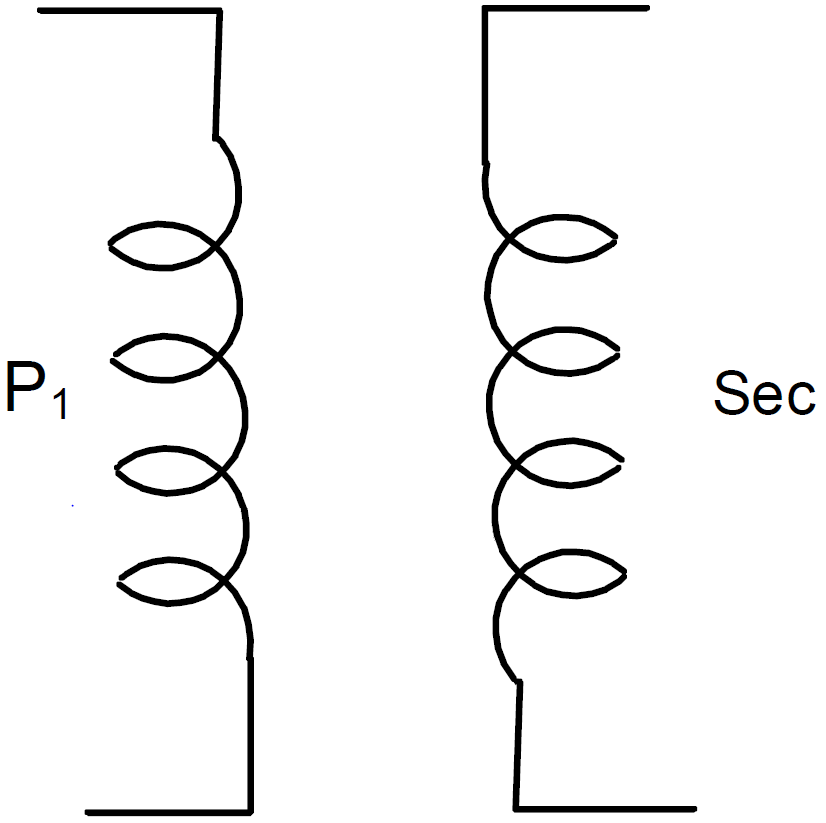
A transformer has 50 turns in the primary and 100 in the secondary. If the primary is connected to a 220V DC supply, what will be the voltage across the secondary?
Answer

Transformer works upon the principle of induction which is only possible in case of AC.
Hence when DC is supplied to it, the primary coil blocks the Current supplied to it and hence induced current supplied to it and hence induced Current in the secondary coil is zero.
View full question & answer
Question 83 Marks
An electric bulb is designed to operate at 12 volts DC. If this bulb is connected to an AC source and gives normal brightness, what would be the peak voltage of the source?
Answer
$\text{E}=12\text{volt}$
$\text{i}^2\text{Rt}=\text{i}^2_\text{rms}\text{RT}$
$\Rightarrow\ \frac{\text{E}^2}{\text{R}^2}=\frac{\text{E}^2_\text{rms}}{\text{R}^2}$
$\Rightarrow\ \text{E}^2=\frac{\text{E}_0^2}{2}$
$\Rightarrow\ \text{E}_0{^2}=2\text{E}^2$
$\Rightarrow\ \text{E}_0{^2}=2\times12^2=2\times144$
$\Rightarrow \text{E}_0=\sqrt{2\times144}=16.97\approx17\text{V}$
View full question & answer
Question 93 Marks
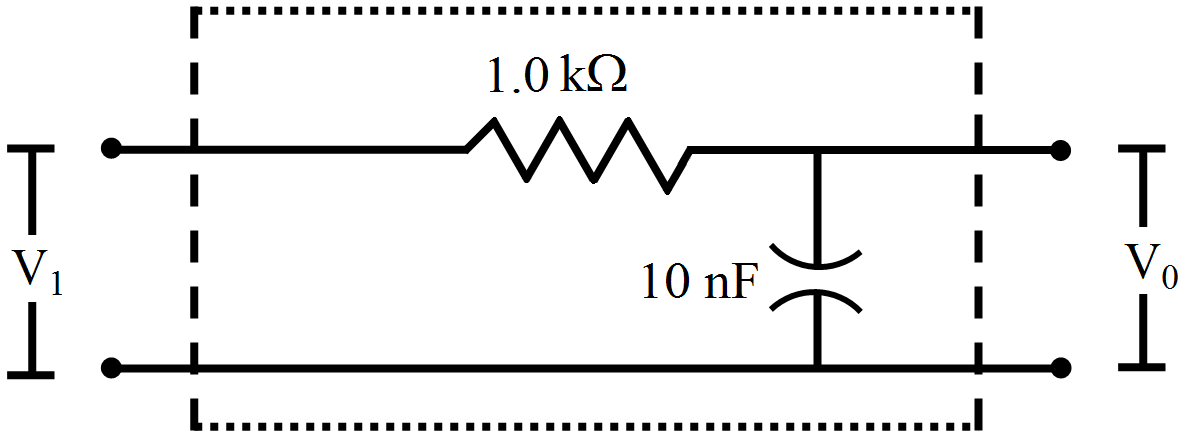
Figure shows a typical circuit for a low-pass filter. An AC input $V_{i }= 10mV$ is applied at the left end and the output $V_0$ is received at the right end. Find the output voltage for ν = 10kHz, 1.0MHz and 10.0MHz. Note that as the frequency is increased the output decreases and, hence, the name low-pass filter.
Answer

$\text{V}_1=10\times10^{-3}\text{V}$
$\text{R}=1\times10^3\Omega$
$\text{C}=10\times10^{-9}\text{F}$
  1. $\text{X}_\text{C}=\frac{1}{\omega\text{C}}=\frac{1}{2\pi\text{fC}}$
$=\frac{1}{2\pi\times10\times10^3\times10\times10^{-9}}$
$=\frac{1}{2\pi\times10^{-4}}$
$=\frac{10^4}{2\pi}=\frac{5000}{\pi}$
$\text{Z}=\sqrt{\text{R}^2+\text{X}_\text{C}{^2}}$
$=\sqrt{\big(1\times10^3\big)^2+\Big(\frac{5000}{\pi}\Big)^2}$

$=\sqrt{10^6+\Big(\frac{5000}{\pi}\Big)^2}$
$\text{I}_0=\frac{\text{E}_0}{\text{Z}}=\frac{\text{V}_1}{\text{Z}}$
$=\frac{10\times10^{-3}}{\sqrt{10^6+\Big(\frac{5000}{\pi}\Big)^2}}$
  1. $\text{X}_\text{C}=\frac{1}{\omega\text{C}}=\frac{1}{2\pi\text{fC}}$
$=\frac{1}{2\pi\times10^5\times10\times10^{-9}}$
$=\frac{1}{2\pi\times10^{-3}}=\frac{10^3}{2\pi}=\frac{500}{\pi}$
$\text{Z}=\sqrt{\text{R}^2+\text{X}_\text{C}{^2}}$
$=\sqrt{\big(10^3\big)^{2}+\Big(\frac{500}{\pi}\Big)^2}$
$=\sqrt{10^6+\Big(\frac{500}{\pi}\Big)^2}$
$\text{I}_0=\frac{\text{E}_0}{\text{Z}}=\frac{\text{V}_1}{\text{Z}}$
$=\frac{10\times10^{-3}}{\sqrt{10^6+\Big(\frac{500}{\pi}\Big)^2}}$
$\text{V}_0=\text{I}_0\text{X}_\text{C}=\frac{10\times10^{-3}}{\sqrt{10^6+\Big(\frac{500}{\pi}\Big)^2}}\times\frac{500}{\pi}$
$=1.6124\text{V}\approx1.6\text{mV}$
  1. $\text{f}=1\text{MHz}=10^6\text{Hz}$
$\text{X}_\text{C}=\frac{1}{\omega\text{C}}=\frac{1}{2\pi\text{fC}}$
$=\frac{1}{2\pi\times10^6\times10\times10^{-9}}$
$=\frac{1}{2\pi\times10^{-2}}=\frac{10^2}{2\pi}=\frac{50}{\pi}$
$\text{Z}=\sqrt{\text{R}^2+\text{X}_\text{C}{^2}}$
$=\sqrt{\big(10^3\big)^{2}+\Big(\frac{50}{\pi}\Big)^2}$
$=\sqrt{10^6+\Big(\frac{50}{\pi}\Big)^2}$
$\text{I}_0=\frac{\text{E}_0}{\text{Z}}=\frac{\text{V}_1}{\text{Z}}$
$=\frac{10\times10^{-3}}{\sqrt{10^6+\Big(\frac{50}{\pi}\Big)^2}}$
$\text{V}_0=\text{I}_0\text{X}_\text{C}=\frac{10\times10^{-3}}{\sqrt{10^6+\Big(\frac{50}{\pi}\Big)^2}}\times\frac{50}{\pi}$
$\approx1.16\mu\text{V}$
  1. $\text{f}=10\text{MHz}=10^7\text{Hz}$
$\text{X}_\text{C}=\frac{1}{\omega\text{C}}=\frac{1}{2\pi\text{fC}}$
$=\frac{1}{2\pi\times10^7\times10\times10^{-9}}$
$=\frac{1}{2\pi\times10^{-1}}=\frac{10}{2\pi}=\frac{5}{\pi}$
$\text{Z}=\sqrt{\text{R}^2+\text{X}_\text{C}{^2}}$
$=\sqrt{\big(10^3\big)^{2}+\Big(\frac{5}{\pi}\Big)^2}$
$=\sqrt{10^6+\Big(\frac{5}{\pi}\Big)^2}$
$\text{I}_0=\frac{\text{E}_0}{\text{Z}}=\frac{\text{V}_1}{\text{Z}}$
$=\frac{10\times10^{-3}}{\sqrt{10^6+\Big(\frac{5}{\pi}\Big)^2}}$
$\text{V}_0=\text{I}_0\text{X}_\text{C}=\frac{10\times10^{-3}}{\sqrt{10^6+\Big(\frac{5}{\pi}\Big)^2}}\times\frac{5}{\pi}$
$\approx16\mu\text{V}$
View full question & answer