Questions

4 Marks Questions

Take a timed test

4 questions · self-marked practice — reveal the answer and mark yourself.

Question 14 Marks
In the given figure, a part ABC of electric circuit is shown. The magnitudes of potentials at points $A, B$ and $C$ are and respectively, then find the value of potential at point $O$.
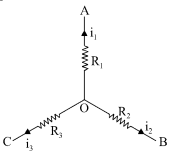
Image
Answer
Sol. By junction rule, at point O
$-i_1-i_2-i_3=0$ or $i_1+i_2+i_3=0$
If magnitude of potential at point O is, then by Ohm 's law, magnitudes of current in different branches will be
$i_1=\frac{V_0-V_{ A }}{ R _1}, i_2=\frac{V_0-V_{ B }}{ R _2}$ and $i_3=\frac{V_0-V_{ C }}{ R _3}$
Putting the value of $i_1, i_2$ and $i_3$
$\frac{V_0-V_A}{R_1}+\frac{V_0-V_B}{R_2}+\frac{V_0-V_C}{R_3}=0$
or $V _0\left(\frac{1}{ R _1}+\frac{ l }{ R _2}+\frac{1}{ R _3}\right)=\frac{ V _{ A }}{ R _1}+\frac{ V _{ B }}{ R _2}+\frac{ V _{ C }}{ R _3}$
$V _0=\left(\frac{ V _{ A }}{ R _1}+\frac{ V _{ B }}{ R _2}+\frac{ V _{ C }}{ R _3}\right)\left(\frac{1}{ R _1}+\frac{1}{ R _2}+\frac{1}{ R _3}\right)^{-1}$

View full question & answer
Question 24 Marks
A thick wire of $15 \Omega$ is stretched to three times its original length. Assuming that the density of the wire remains unchanged, calculate the resistance of the new wire.
Answer
Let original length of the wire be $l_1$ and original area of cross-section be $A _1$. Let the new area of cross-section be $A_2$ and new length be $l_2$.
Since density of the wire remains unchanged, so the volume of wire before stretching is equal to the volume of the wire after stretching. $ \begin{aligned} A_1 l_1 & =A_2 l_2 \\ A_2 & =\frac{A_1 l_1}{l_2} \\ l_2 & =3 l_1 \end{aligned} $ or Since $\therefore$ Area of wire after stretching.
$A _1 l_1= A _2 l_2$
or $A _2=\frac{ A _1 l_1}{l_2}$
Since $l_2=3 l_1$
$\therefore$ Area of wire after stretching
$A _2=\frac{ A _1 l_1}{3 l_1}=\frac{1}{3} A_1$
Given that, $R =\frac{\rho l}{A}$
$R _1=\rho\left(\frac{l_1}{A_1}\right)$ and $R _2=\rho\left(\frac{l_2}{A_2}\right)=\frac{\rho \times 3 l_1}{A_2}$
$\therefore \quad \frac{ R _2}{ R _1}=\frac{3 \rho l_1}{A_2} \times \frac{ A _1}{\rho l_1}=3\left(\frac{A_1}{A_2}\right)$
$\Rightarrow \quad \frac{ R _2}{ R _1}=\frac{3 A_{\perp}}{\frac{1}{3} A_1}=9$
$\Rightarrow \quad \frac{ R _2}{ R _1}=9$
$R_2=9 R_1$
But given that, $R _1=15 \Omega$
$\therefore \quad R _2=9 \times 15=135 \Omega$ Ans.
View full question & answer
Question 34 Marks
A wire is stretched to reduce its diameter to half. What will be the magnitude of its new resistance?
Answer
Let original length be $l_1$ and original diameter be $d_1$, new length be $l_2$ and new diameter be $d_2$.
$A _1 l_1= A _2 l_2$
$\frac{\pi d_1^2}{4} l_1=\frac{\pi d_2^2}{4} l_2$
$l_2=\left(\frac{d_1}{d_2}\right)^2 l_1$
$\because \quad d_2=\frac{1}{2} d_1$
$\therefore \quad \frac{d_1}{d_2}=\frac{2}{1}=2$
$l_2=(2)^2 l_1=4 l_1$
New length $l_2=4 l_1 $
$\therefore \quad R _1=\frac{\rho \times 4 l_1}{\pi d_1^2}$
and $R _2=\frac{4 l_2 \rho}{\pi d_2^2}$
$\therefore \quad \frac{ R _2}{ R _1}=\frac{l_2 d_1^2}{l_1 d_1^2}$
$=\frac{4 l_1 d_1^2 \times 4}{l_1 \times d_1^2}=16$
New resistance $R _2=16 R _1$
Resistance will become 16 times of its original value.

View full question & answer
Question 44 Marks
The number of free electrons in a unit volume copper conductor estimated in Example 8.1 is 8.5 x 1028 per m3.How long does an electron take to drift from one end of a wire 3.0 m long to its other end? The area of cross-section of the wire is 2.0 x 10⁻⁶ m2and it is carrying a current of 3.0 A.
View full question & answer
4 Marks Questions - Physics STD 12 Science Questions - Vidyadip