Questions

3 Marks Question

Take a timed test

7 questions · self-marked practice — reveal the answer and mark yourself.

Question 13 Marks
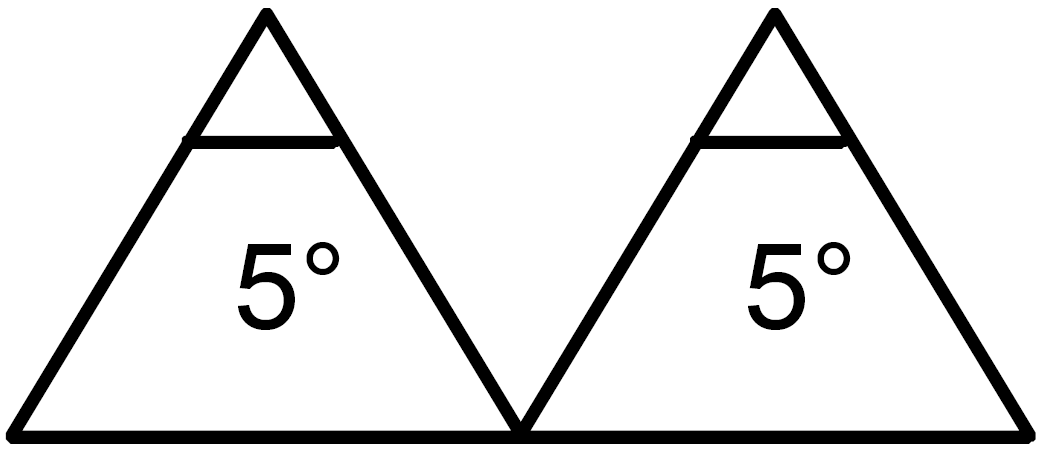
A thin prism of crown glass $(\mu_\text{r}=1.515,\mu_\text{v}=1.525)$ and a thin prism of flint glass $(\mu_\text{r}=1.612,\mu_\text{v}=1.632)$ are placed in contact with each other. Their refracting angles are 5.0° each and are similarly directed. Calculate the angular dispersion produced by the combination.
Answer
Given that,
$\mu_\text{cr}=1.515,\mu_\text{cv}=1.525$ and $\mu_\text{fr}=1.612,\mu_\text{fv}=1.632$ and A = 5°
Since, they are similarly directed, the total deviation produced is given by,$\delta=\delta_\text{c}+\delta_\text{r}=(\mu_\text{c}-1)\text{A}+(\mu_\text{r}-1)\text{A}$ $=(\mu_\text{c}+\mu_\text{r}-2)\text{A}$
So, angular dispersion of the combination is given by,$\delta_\text{v}-\delta_\text{y}=(\mu_\text{cv}+\mu_\text{fv}-2)\text{A}-(\mu_\text{cr}+\mu_\text{fr}-2)\text{A}$
$=(\mu_\text{cv}+\mu_\text{fv}-\mu_\text{cr}-\mu_\text{fr})\text{A}$ $=(1.525+1.632-1.515-1.612)5=0.15^\circ$
View full question & answer
Question 23 Marks
The focal lengths of a convex lens for red, yellow and violet rays are 100cm, 98cm and 96cm respectively. Find the dispersive power of the material of the lens.
Answer
The focal length of a lens is given by$\frac{1}{\text{f}}=(\mu-1)\Big(\frac{1}{\text{R}_1}-\frac{1}{\text{R}_2}\Big)$
$\Rightarrow(\mu-1)=\frac{1}{\text{f}}\times\frac{1}{\Big(\frac{1}{\text{R}_1}-\frac{1}{\text{R}_2}\Big)}=\frac{\text{k}}{\text{f}}\ ...(1)$
So, $\mu_\text{r}-1=\frac{\text{K}}{100}\ ...(2)$$\mu_\text{y}-1=\frac{\text{K}}{98}\ ...(3)$
And $\mu_\text{v}-1=\frac{\text{K}}{96}\ ...(4)$ So, Dispersive power $=\omega=\frac{\mu_\text{v}-\mu_\text{r}}{\mu_\text{y}-1}=\frac{(\mu_\text{v}-1)-(\mu_\text{r}-1)}{(\mu_\text{y}-1)}=\frac{\frac{\text{K}}{96}-\frac{\text{K}}{100}}{\frac{\text{K}}{98}}$ $=\frac{98\times4}{9600}=0.0408$
View full question & answer
Question 33 Marks
Two prisms of identical geometrical shape are combined with their refracting angles oppositely directed. The materials of the prisms have refractive indices 1.52 and 1.62 for violet light. A violet ray is deviated by 1.0° when passes symmetrically through this combination. What is the angle of the prisms?
Answer
Two prisms of identical geometrical shape are combined. Let A = Angle of the prisms $\mu'_\text{v}=1.52$ and $\mu_\text{v}=1.62,\delta_\text{v}=1^\circ$
$\delta_\text{v}=(\mu_\text{v}-1)\text{A}-(\mu'_\text{v}-1)\text{A}$ [Since A = A']
$\Rightarrow\delta_\text{v}=(\mu_\text{v}-\mu'_\text{v})\text{A}$
$\Rightarrow\text{A}=\frac{\delta_\text{v}}{\mu_\text{v}-\mu'_\text{v}}=\frac{1}{1.62-1.52}=10^\circ$
View full question & answer
Question 43 Marks
A certain material has refractive indices 1.56, 1.60 and 1.68 for red, yellow and violet light respectively.
  1. Calculate the dispersive power.
  2. Find the angular dispersion produced by a thin prism of angle 6° made of this material.
Answer
Given that,$\mu_\text{r}=1.56,\mu_\text{y}=1.60,\ \text{and}\ \mu_\text{v}=1.68$
  1. Dispersive power $=\omega=\frac{\mu_\text{v}-\mu_\text{r}}{\mu_\text{y}-1}=\frac{1.68-1.56}{1.60-1}$
$=\frac{0.12}{0.60}=0.2$​​​​​​​
  1. Angular dispersion $=(\mu_\text{v}-\mu_\text{r})\text{A}=0.12\times6^\circ=7.2^\circ$
View full question & answer
Question 53 Marks
A flint glass prism and a crown glass prism are to be combined in such a way that the deviation of the mean ray is zero. The refractive index of flint and crown glasses for the mean ray are 1.620 and 1.518 respectively. If the refracting angle of the flint prism is 6.0°, what would be the refracting angle of the crown prism?
Answer
Given that, Refractive index of flint glass $=\mu_\text{f}=1.620$ Refractive index of crown glass $=\mu_\text{c}=1.518$ Refracting angle of flint prism $=\text{A}_\text{f}=6.0^\circ$ For zero net deviation of mean ray$(\mu_\text{f}-1)\text{A}_\text{f}=(\mu_\text{c}-1)\text{A}_\text{c}$
$\Rightarrow\text{A}_\text{c}=\frac{\mu_\text{f}-1}{\mu_\text{c}-1}\text{A}_\text{f}=\frac{1.620-1}{1.518-1}(6.0)^\circ=7.2^\circ$
View full question & answer
Question 63 Marks
Does focal length of a lens depend on the colour of the light used? Does focal length of a mirror depend on the colour?
Answer
Yes, the focal length of a lens depends on the colour of light. According to lens-maker's formula,$\frac{1}{\text{f}}=(\mu-1)\Big(\frac{1}{\text{R}_1}-\frac{1}{\text{R}_2}\Big)$
Here, f is the focal length, $\mu$ is the refractive index, R is the radius of curvature of lens. The refractive index $(\mu)$ depends on the inverse of square of wavelength. The focal length of a mirror is independent of the colour of light.
View full question & answer
Question 73 Marks
A thin prism is made of a material having refractive indices 1.61 and 1.65 for red and violet light. The dispersive power of the material is 0.07. It is found that a beam of yellow light passing through the prism suffers a minimum deviation of 4.0° in favourable conditions. Calculate the angle of the prism.
Answer
Given that, $\mu_\text{r}=1.61,\mu_\text{v}=1.65,\omega=0.07\ \text{and}\ \delta_\text{y}=4^\circ$ Now, $\omega=\frac{\mu_\text{v}-\mu_\text{r}}{\mu_\text{y}-1}$$\Rightarrow0.07=\frac{1.65-1.61}{\mu_\text{y}-1}$
$\Rightarrow\mu_\text{y}-1=\frac{0.04}{0.07}=\frac{4}{7}$
Again,$\delta=(\mu-1)\text{A}$$\Rightarrow\text{A}=\frac{\delta_\text{y}}{\mu_\text{y}-1}=\frac{4}{\Big(\frac{4}{7}\Big)}=7^\circ$
View full question & answer