Questions

2 Marks Questions

Take a timed test

7 questions · self-marked practice — reveal the answer and mark yourself.

Question 12 Marks
The equation $\omega=\frac{\mu_\text{v}-\mu_\text{r}}{\mu-1}$ asderived for a prism having small refracting angle. Is it also valid for a prism of large refracting angle? Is it also valid for a glass slab or a glass sphere?
Answer
Dispersive power depends on angular deviation, and angular deviation is valid only for a small refracting angle and a small angle of incidence. Therefore, dispersive power is not valid for a prism of large refracting angle. It is also not valid for a glass slab or a glass sphere, as it has a large refracting angle.
View full question & answer
Question 22 Marks
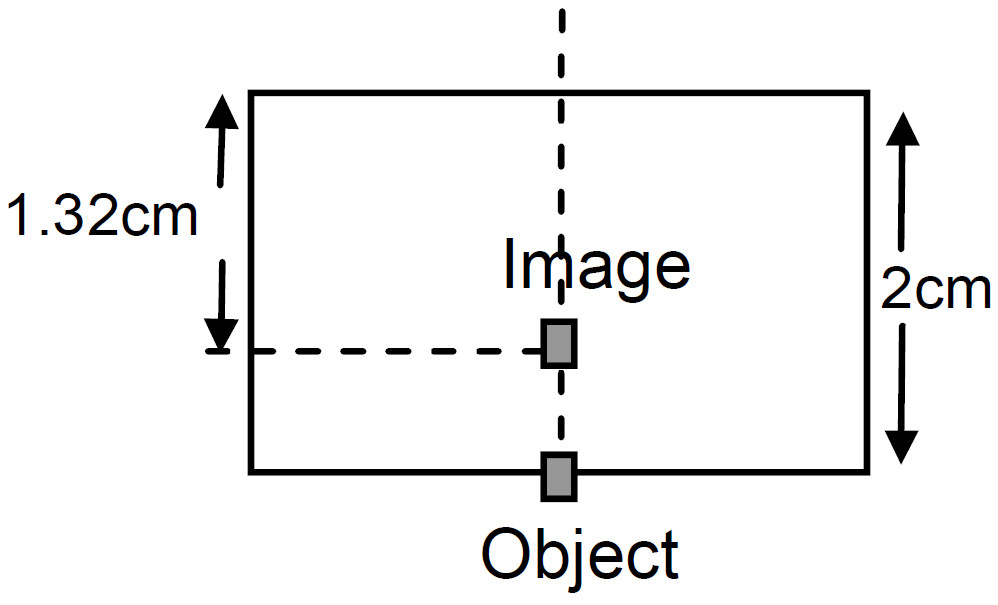
The refractive index of a material changes by 0.014 as the colour of the light changes from red to violet. A rectangular slab of height 2.00cm made of this material is placed on a newspaper. When viewed normally in yellow light, the letters appear 1.32cm below the top surface of the slab. Calculate the dispersive power of the material.
Answer
Given that, $\mu_\text{v}-\mu_\text{r}=0.014$
$\text{Again,}\ \mu_\text{y}=\frac{\text{Real depth}}{\text{Apparent depth}}=\frac{2.00}{1.30}=1.515$
So, dispersive power $=\frac{\mu_\text{v}-\mu_\text{r}}{\mu_\text{y}-1}=\frac{0.014}{1.515-1}=0.027$
View full question & answer
Question 32 Marks
Can the dispersive power $\omega=\frac{\mu_\text{v}-\mu\text{r}}{\mu-1}$ be negative? What is the sign of co if a hollow prism is immersed into water?
Answer
No, it cannot be negative, as the refractive index for violet light is always greater than that for red light. Also, refractive index is inversely proportional to $\lambda^2$. The sign of wwill be positive, as $\mu$ is still greater than 1 and es $\mu_\text{v}>\mu_\text{r}.$
View full question & answer
Question 42 Marks
The minimum deviations suffered by red, yellow and violet beams passing through an equilateral transparent prism are 38.4°, 38.7° and 39.2° respectively. Calculate the dispersive power of the medium.
Answer
Given that, $\delta_\text{r}=38.4^\circ,\delta_\text{y}=38.7^\circ\ \text{and}\ \delta_\text{v}=39.2^\circ$ Dispersive power $=\frac{\mu_\text{v}-\mu_\text{r}}{\mu_\text{y}-1}=\frac{(\mu_\text{v}-1)-(\mu_\text{r}-1)}{(\mu_\text{y}-1)}$ $=\frac{\Big(\frac{\delta_\text{v}}{\text{A}}\Big)-\Big(\frac{\delta_\text{r}}{\text{A}}\Big)}{\Big(\frac{\delta_\text{v}}{\text{A}}\Big)}\ [\because\delta=(\mu-1)\text{A}]$$=\frac{\delta_\text{v}-\delta_\text{r}}{\delta_\text{y}}=\frac{39.2-3.84^\circ}{38.7}=0.0204$
View full question & answer
Question 52 Marks
Suggest a method to produce a rainbow in your house.
Answer
A rainbow can be produced using a prism. Another way of producing a rainbow is to dip a mirror inside water, keeping it inclined along the wall of a tumbler. The light coming from water after reflecting from the mirror will give a rainbow.
View full question & answer
Question 62 Marks
If three identical prisms are combined, is it possible to pass a beam that emerges undeviated? Undispersed?
Answer
No, it is not possible even when prisms are be combined with their refractive angle reversed with respect to each other. There will be at least a net deviation and dispersion equal to the dispersion and deviation produced by a single prism.
View full question & answer
Question 72 Marks
"Monochromatic light should be used to produce pure spectrum". Comment on this statement.
Answer
No, monochromatic light cannot be used to produce a pure spectrum. A spectrum is produced when a light of different wavelengths is deviated through different angles and gets separated. Monochromatic light, on the other hand, has a single wavelength.
View full question & answer