Questions

3 Marks Question

Take a timed test

11 questions · self-marked practice — reveal the answer and mark yourself.

Question 13 Marks
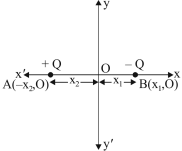
Two electric charges $+Q$ and $-Q(x-y)$ are placed at the points $\left(-x_2, 0\right)$ and $\left(x_1, 0\right)$ respectively in the plane. Find the magnitude and direction of the resultant electric field at the origin $(0,0)$.
Answer
The positions of the given charges are shown in the figure. The magnitude of the original point intensity $\overrightarrow{ E _1}$ due to $+Q$ charge at point $O$.
$ E_1=\frac{1}{4 \pi \epsilon_0}\left(\frac{Q}{x_2^2}\right) $
Similarly, due to the charge ( $-Q$ ) located at point B , the origin is at O . The magnitude of the electric field intensity $\overrightarrow{ E _2}$.
$ E_2=\frac{1}{4 \pi \epsilon_0}\left(\frac{Q_1}{x_1^2}\right) $
Since $\vec{E}_1$ and $\vec{E}_2$ both have the same direction, hence the magnitude of the resultant electric field $\overrightarrow{ E }$ at O is
$E=E_1+E_2$
$=\frac{ l }{4 \pi \epsilon_0}\left(\frac{ Q }{x_2^2}\right)+\frac{1}{4 \pi \epsilon_0}\left(\frac{ Q }{x_1^2}\right)$
$=\frac{ Q }{4 \pi \epsilon_0}\left[\frac{1}{x_2^2}+\frac{1}{x_1^2}\right]$
or $E =\frac{ Q }{4 \pi \epsilon_0}\left[\frac{1}{x_1^2}+\frac{1}{x_2^2}\right]$ (Direction from O to B )
Image
View full question & answer
Question 23 Marks
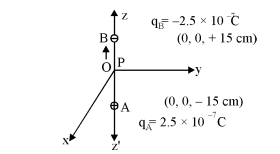
A system has two charges $q_A=2.5$$\times 10^{-7} C$ and $q_B=-2.5 \times 10^{-7} C$ located at points A: $(0$,$0,-15 cm)$and $B :( 0 , 0 ,+15 cm)$, respectively. What are the total charge and electric dipole moment of the system?
Answer
An electric dipole has two equal and opposite charges, hence total charge = zero
Dipole moment $\overrightarrow{ P }=q(\overrightarrow{2 a})$ along Z-axis
Given :
$q=q_{ A }=q_{ B }=2.5 \times 10^{-7} C$
$2 a =30 cm=30 \times 10^{-2} m$
Image
Electric dipole moment of the system
$p=q \times 2 a$
$=2.5 \times 10^{-7} \times 30 \times 10^{-2}$
$=75 \times 10^{-9}=7.5 \times 10^{-8}$
$p=7.5 \times 10^{-8} C \times m$
Its direction will be along the negative z-axis.
View full question & answer
Question 33 Marks
When a glass rod is rubbed with a silk cloth, charges appear on both. A similar phenomenon is observed with many other pairs of bodies. Explain how this observation is consistent with the law of conservation of charge.
Answer
The following things are seen in the friction process:
(i) The amount of positive charge transferred to the glass when the glass rod is rubbed with silk. The same amount of negative charge is transferred to the silk.
(ii) When an ebonite rod is rubbed with fur, the same number of negative charges are transferred to the ebonite rod as are the same number of positive charges transferred to the fur.
It is clear from the above that charges can neither be created nor destroyed but they can be transferred from one object to another. Here the value of total net charge becomes zero. All these things are according to the law of conservation of charge because the total charge of the isolated system is conserved.
View full question & answer
Question 43 Marks
(a) Explain the meaning of the statement "electric charge of a body is quantised". (b) Why can one ignore quantisation of electric charge when dealing with macroscopic i.e., large scale charges?
Answer
(a) (i) Being quantized of charge means that, no matter what is the reason for the origin of charge on a charged object, the charge is always an integer multple of the charge of the electron and not a fraction multiple. Math-ematicallys $q= \pm n e, w$ where n = perfect multiple number i.e. n = 0 ,1,2,3...
(ii) A charge less than the electron charge (minimum charge) is impossible. Mathematically $q= \pm e, \pm 2 e, \pm 3 e$,$\pm 4 e, \pm \ldots$
(iii) The magnitude of the quantum of charge is equal to the charge of the electron or proton i. e. $1.6 \times 10^{-19}$ coulomb.
21
(b) When we deal with electrical charges on a macro or large scale, then this charge is much larger than the electronic charge. For example, a charge of $1 \mu C$ has approximately $10^{13}$ electronic charges. On this large scale, if we say that the charge increases or decreases in units of e, then it means that the large has a constant value and its quantization is unimportant and can be neglected.
View full question & answer
Question 53 Marks
An infinite line charge produces a field of 9 x10⁴ N C-1at a distance of 2 cm. Calculate the linear charge density.
Answer
E = Electric field produced by an infinite linear charge
$=9 \times 10^4 NC ^{-1}$
r Distance of the point where E electric field is produced
$r=2 cm=2 \times 10^{-2} m$
linear charge density λ = ?
Since we know
$E =\frac{1}{4 \pi \in_0} \frac{2 \lambda}{r}=\frac{\lambda}{2 \pi \in_0 r}$
$\therefore \quad \lambda= E \times 2 \pi \in_0 r$
On putting values $\lambda=9 \times 10^4 \times 2 \times 3.14 \times 8.85 \times$
$10^{-12} \times 2 \times 10^{-2}$
$\begin{array}{l}=9 \times 2 \times 3.14 \times 8.85 \times 2 \times 10^{-10} \\
=36 \times 3.14 \times 8.85 \times 10^{-10} \\
=1000.404 \times 10^{-10} \\
=0.10 \times 10^{-6} Cm ^{-1} \\
=1.0 \times 10^{-7} Cm ^{-1}\end{array}$
View full question & answer
Question 63 Marks
A conducting sphere of radius 10 cm has an unknown charge. If the electric field 20 cm from the centre of the sphere is $1.5 \times 10^3 N / C$ and directed radially inward, what is the net charge on the sphere?
Answer
Here, R = radius of the conducting sphere
$=10 cm=10 \times 10^{-2} m$
r = distance of point from the centre of sphere
$=20 cm$
$=20 \times 10^{-2} m$
Here, it clear r > R
E = electric field at a point 20 cm away from the sphere $1.5 \times 10^3 NC ^{-1}$ inwards
q =net charge on the sphere
Using radius of electric field
$E =\frac{1}{4 \pi \in_0} \frac{q}{r^2}$
$1.5 \times 10^3=\frac{9 \times 10^9 \times q}{\left(20 \times 10^{-2}\right)^2}$
$\Rightarrow \frac{1.5 \times 10^3 \times 400 \times 10^{-4}}{9 \times 10^9}=q$
$\frac{60}{9 \times 10^9}=q$
$q=6.67 \times 10^{-9} C$
$=-6.67 nC$
View full question & answer
Question 73 Marks
A point charge causes an electric flux of$-1.0 \times 10^3 Nm ^2 / C$ to pass through a spherical Gaussian surface of 10.0 cm radius centred on the charge.
(a) If the radius of the Gaussian surface were doubled, how much flux would pass through the sur-face?
(b) What is the value of the point charge?
Answer
(a) Electric flux depends only on the charge present on the Gaussian surface. Therefore, flux will still pass even if the radius of the Gaussian surface is doubled.
$\phi=-1.0 \times 10^3 Nm ^2 C ^{-1}$
because the bound charges of both the cases are same
(b) $q=$ point charge $=?$
$\in_0=8.854 \times 10^{-12} N^{-1} m^{-2} C ^2$
$r=$ radius of spherical Gaussian surface
Using formula $\phi=\frac{q}{\in_0}$
$q=\phi \in_0$
On putting values $=\left(-1,0 \times 10^3\right) \times\left(8.854 \times 10^{-12}\right)$
$=-8.854 \times 10^{-9} C =-8.9 \times 10^{-9} C$
$=-8.9 nC$
View full question & answer
Question 83 Marks
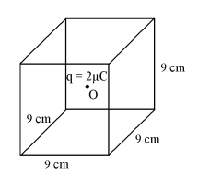
A point charge of $2.0 \mu C$ is at centre of a cubic Gaussian surface 9.0 cm on edge. What is the net electric flux through the surface?
Answer
$q=2 \mu C =2 \times 10^{-6} C$
$\in_0=8.854 \times 10^{-12} N^{-1} m^{-2} C ^2$
Image
$\phi$ = Net flux accor-ding to Gauss theory, net flux from six faces of the cube i.e. Gaussian planes
$\phi=\frac{q}{\in_0}$
$\phi=\frac{2 \times 10^{-6}}{8.854 \times 10^{-12}}$
$=2.26 \times 10^5 Nm ^2 C ^{-1}$


View full question & answer
Question 93 Marks
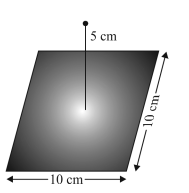
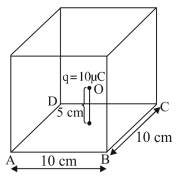
A point charge +10 µC is at a of distance 5 cm directly above the centre of a square of side 10 cm, as shown in Fig. What is the magnitude of the electric flux through the square? (Hint: Think of the square as one face of a cube with edge 10 cm.)
Image
Answer

Image
Consider the square as one face of a cube of side 10 cm. Charge +q is placed at the centre of the cube. A given charge can be imagined at the centre of this cube at a distance of 5 cm.
Here:
$q=10 \mu C$
$=10 \times 10^{-6} C$
$=10^{-5} C$
Then according to Gauss's law the total electric flux through the six faces of the cube is
$\phi=\frac{q}{\in_0}$
Hence, the value of flux from each face is
$\phi_{ s }=\frac{1}{6} \times \frac{q}{\in_0}=\frac{1}{6} \times \frac{10}{8.85 \times 10^{-12}}$
$=\frac{100}{53.1} \times 10^5=1.88 \times 10^5 Nm ^2 C ^{-1}$
View full question & answer
Question 103 Marks
Careful measurement of the electric field at the surface of a black box indicates that the net outward flux passing through the surface of the box is $8.0 \times 10^3 Nm ^2 / C$.
(a) What is the net charge inside the box?
(b) If the net outward flux through the surface of the box were zero, could you conclude that there were no charges inside the box? Why or why not?
Answer
(a) Given:
Net flux passing through the surface
$\phi=8 \times 10^3 Nm ^2 / C$
$\in_0=8.854 \times 10^{-12} C ^2 N^{-1} m^{-2}$
If the net charge on black box is q then
From formula $\quad \begin{aligned} \phi & =\frac{q}{\in_0} \\
q & =\phi \in_0\end{aligned}$
$\begin{aligned} \text { On putting values } & =8 \times 10^0 \times 8.854 \times 10^{-12} \\ &
=70.832 \times 10^{-9} C \end{aligned}$
$=\frac{70.832 \times 10^{-9} \mu C }{10^{-6}}$
$=70.832 \times 10^{-3} \mu C$
$=0.071 \mu C$ (Approx).
(b) We cannot conclude that the net charge inside the box is zero. If the net flow from the surface outside the box is zero because the negative and positive charge can be equal, which cancel each other's effect due to which the net charge inside becomes zero and we conclude that the net charge inside the box is zero.
View full question & answer
Question 113 Marks
Consider a uniform electric field E =
3 × 10³ $\hat{ i }$ N/C.
(a) What is the flux of this field through a square of 10 cm on a side whose plane is parallel to the yz plane?
(b) What is the flux through the same square if the normal to its plane makes of 60° angle with the x-axis?
Answer
Electric field $\vec{E}=3 \times 10^3 \hat{ i } N / C$ i.e. electric field works along the positive x -axis.
Side of square $=10 cm=10 \times 10^{-2} m$
$\therefore \quad$ Surface area $\Delta S =\left(10 \times 10^{-2}\right)^2$
$=1000 \times 10^{-4}=1 \times 10^{-2} m^2$
or $\quad \overrightarrow{\Delta S }=10^{-2} \hat{ i } m ^2$
Since the normal to the square is along the x-axis
(a) $\therefore \quad$ Flux $\phi=\overrightarrow{ E } \cdot \overrightarrow{\Delta S }$
$=\left[3 \times 10^3 \hat{ i N } / C \right] \cdot\left[10^{-2} \hat{ i } m ^2\right]

=30 NC { }^1 m^2 \quad \because i \cdot i=1$.
(b)Here the square ie. the normal to the vector area and the electric field have an angle of 60°.
$\phi=\overrightarrow{ E } \cdot \overrightarrow{\Delta S }= E \Delta S \cos 60^{\circ} \quad \because \theta=60^{\circ}$
On putting values $=3 \times 10^3 \times 10^{-2} \times 1 / 2 NC ^{-1} m^2$
$=15 Nm ^2 C ^{-1}$.
View full question & answer
3 Marks Question - Physics STD 12 Science Questions - Vidyadip