Question 12 Marks
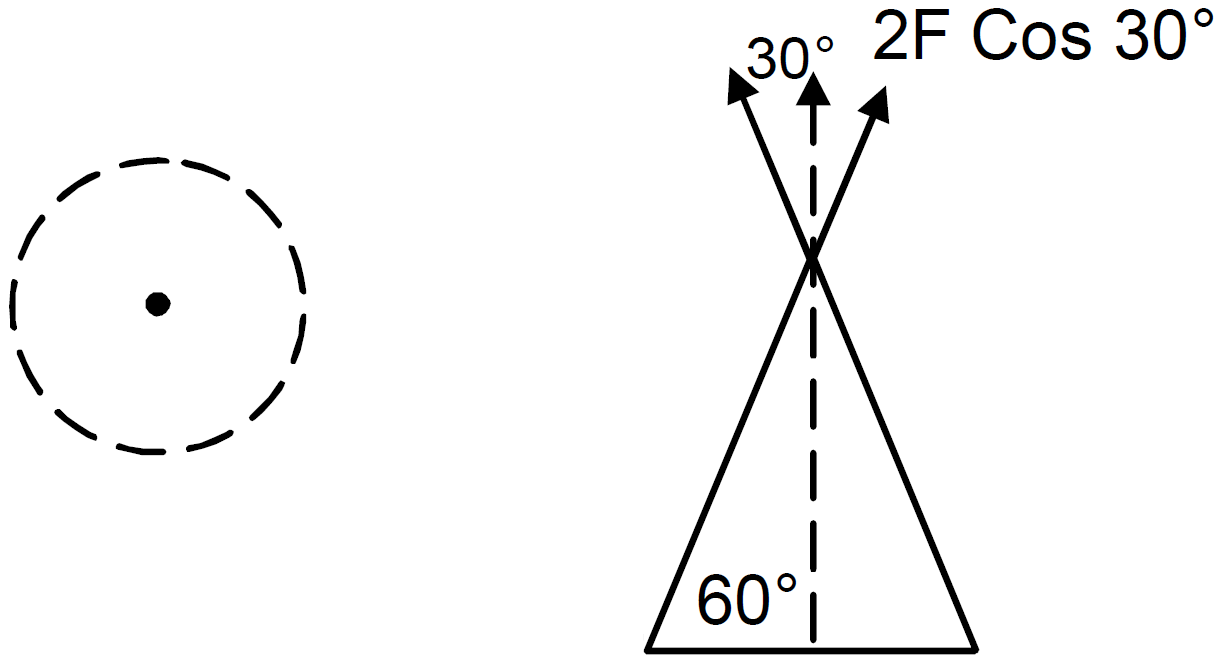
A hydrogen atom contains one proton and one electron. It may be assumed that the electron revolves in a circle of radius $0.53$ angstrom $(1$ angstrom $= 10^{-10}m$ and is abbreviated as $A)$ with the proton at the centre. The hydrogen atom is said to be in the ground state in this case. Find the magnitude of the electric force between the proton and the electron of a hydrogen atom in its ground state.
Answer
View full question & answer→$\text{R}=0.53\text{A}^\circ=0.53\times10^{-10}\text{m}$
$\text{F}=\frac{\text{Kq}_1\text{q}_2}{\text{r}^2}$
$=\frac{9\times10^9\times1.6\times1.6\times10^{-38}}{0.53\times0.53\times10^{-10}\times10^{-10}}$
$=82.02\times10^{-9}\text{N}$
$\text{F}=\frac{\text{Kq}_1\text{q}_2}{\text{r}^2}$
$=\frac{9\times10^9\times1.6\times1.6\times10^{-38}}{0.53\times0.53\times10^{-10}\times10^{-10}}$
$=82.02\times10^{-9}\text{N}$
 $\text{E}=\vec{\text{i}}\times\text{Ax}=100\vec{\text{i}}$
 Let two protons be at a distance be 13.8 femi,
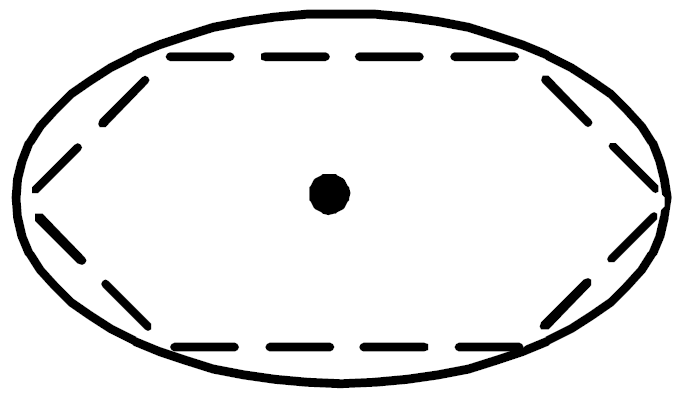 Since it is a regular hexagon. So, it forms an equipotential surface. Hence the charge at each point is equal. Hence the net entire field at the centre is Zero.
 We know,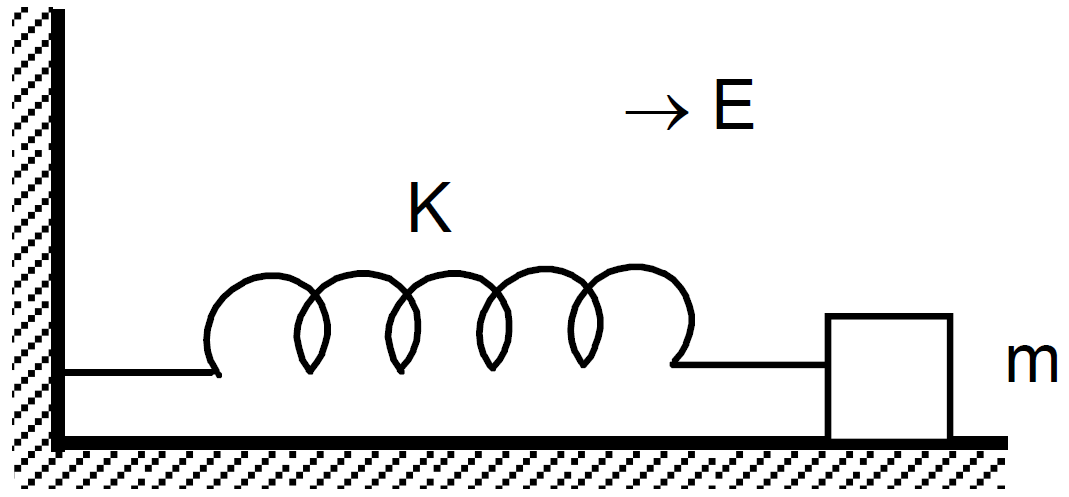
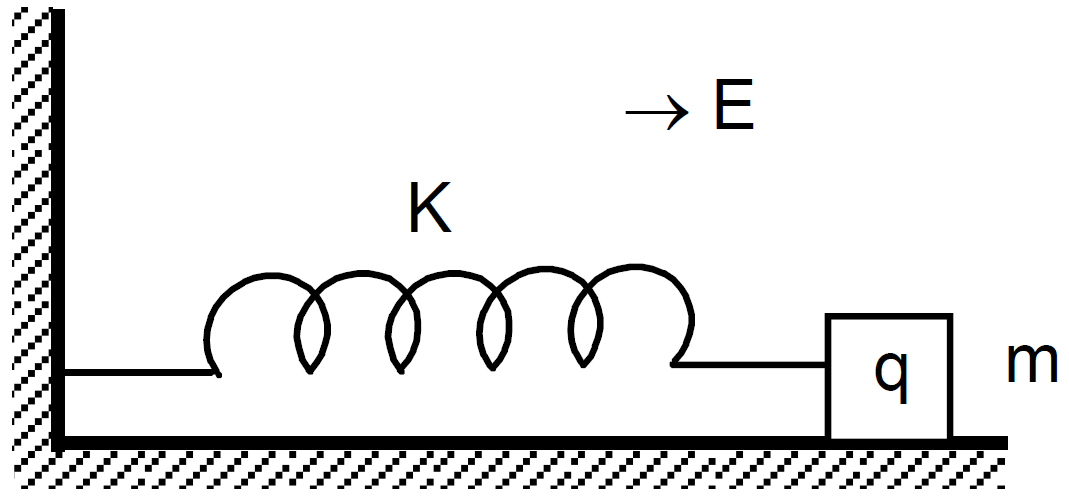 $\text{F}=\text{qE},\ \text{F}=-\text{Kx}$