Questions · Page 3 of 8

M.C.Q (1 Marks)

Question 1011 Mark
Assertion  :   Faraday’s laws are consequences of conservation of energy.
Reason      : In a purely resistive ac circuit, the current lags behind the e.m.f. in phase. (a) If both assertion and reason are true and the reason is the correct explanation of the assertion.(b) If both assertion and reason are true but reason is not the correct explanation of the assertion.(c) If assertion is true but reason is false.(d) If the assertion and reason both are false.


Answer
(c) If assertion is true but reason is false.
View full question & answer
MCQ 1021 Mark
The current in a $LR$ circuit builds up to $\frac{3}{4}^{th}$ in of its steady state value in $4s.$ The time constant of this circuit is
  • A
    $\frac{1}{\ln 2} s$
  • $\frac{2}{\ln 2} s$
  • C
    $\frac{3}{\ln 2} s$
  • D
    $\frac{4}{\ln 2} s$
Answer
Correct option: B.
$\frac{2}{\ln 2} s$
$\frac{2}{\ln 2} s$
View full question & answer
MCQ 1031 Mark
A $50$ volt potential difference is suddenly applied to a coil with $L= 5 \times 10^{-3}$ henry and $R = 180$ ohm. The rate of increase of current after $0.001$ second is
  • A
    $27.3\ \ce{amp/sec}$
  • B
    $27.8\ \ce{amp/sec}$
  • C
    $2.73\ \ce{amp/sec}$
  • None of the above
Answer
Correct option: D.
None of the above
None of the above
View full question & answer
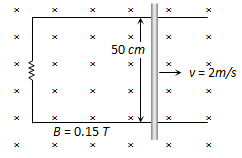
MCQ 1041 Mark
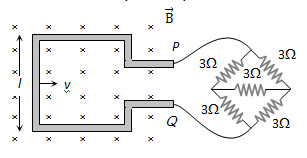
As shown in the figure a metal rod makes contact and complete the circuit. The circuit is perpendicular to the magnetic field with $B = 0.15$ tesla. If the resistance is $3Ω,$ force needed to move the rod as indicated with a constant speed of $2m/\sec$  is
  • $3.75 \times 10^{-3} N$
  • B
    $3.75 \times 10^{-2} N$
  • C
    $3.75 \times 10^2$
  • D
    $3.75 \times 10^{-4} N$
Answer
Correct option: A.
$3.75 \times 10^{-3} N$
View full question & answer
MCQ 1051 Mark
A coil of inductance $8.4\ mH$ and resistance $6\Omega$ is connected to a $12\ V$ battery. The current in the coil is $1.0\ A$ at approximately the time
  • A
    $500$ sec
  • B
    $20$ sec
  • C
    $35$ milli sec
  • $1$ milli sec
Answer
Correct option: D.
$1$ milli sec
$1$ milli sec
View full question & answer
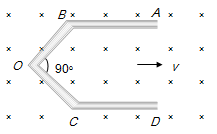
MCQ 1061 Mark
A conductor $\ce{ABOCD}$ moves along its bisector with a velocity of $1 \mathrm{~m} / \mathrm{s}$ through a perpendicular magnetic field of $1 \ \mathrm{wb} / \mathrm{m}^2$, as shown in fig. If all the four sides are of $1 m$ length each, then the induced emf between points $A$ and $D$ is 
  • A
    $0$
  • $1.41$ volt
  • C
    $0.71$ volt
  • D
    None of the above
Answer
Correct option: B.
$1.41$ volt
$1.41$ volt
View full question & answer
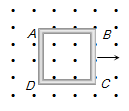
MCQ 1071 Mark
A square metallic wire loop of side $0.1 m$ and resistance of $1 \Omega$ is moved with a constant velocity in a magnetic field of $2 \ \mathrm{wb} / \mathrm{m}^2$ as shown in figure. The magnetic field is perpendicular to the plane of the loop, loop is connected to a network of resistances. What should be the velocity of loop so as to have a steady current of $1 \ mA$ in loop
  • A
    $1 \mathrm{~cm} / \mathrm{sec}$
  • $2 \mathrm{~cm} / \mathrm{sec}$
  • C
    $3 \mathrm{~cm} / \mathrm{sec}$
  • D
    $4 \mathrm{~cm} / \mathrm{sec}$
Answer
Correct option: B.
$2 \mathrm{~cm} / \mathrm{sec}$
View full question & answer
MCQ 1081 Mark
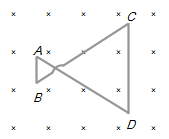
A conducting wire frame is placed in a magnetic field which is directed into the paper. The magnetic field is increasing at a constant rate. The directions of induced current in wires $AB$ and $CD$ are
  • $B$ to $A$ and $D$ to $C$
  • B
    $A$ to $B$ and $C$ to $D$
  • C
    $A$ to $B$ and $D$ to $C$
  • D
    $B$ to $A$ and $C$ to $D$
Answer
Correct option: A.
$B$ to $A$ and $D$ to $C$
View full question & answer
MCQ 1091 Mark
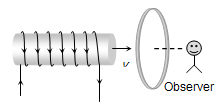
A current carrying solenoid is approaching a conducting loop as shown in the figure. The direction of induced current as observed by an observer on the other side of the loop will be
  • A
    Anticlockwise
  • Clockwise
  • C
    East    
  • D
    West
Answer
Correct option: B.
Clockwise
Clockwise
View full question & answer
MCQ 1101 Mark
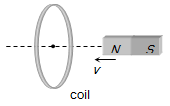
In the following figure, the magnet is moved towards the coil with a speed $v$ and induced $emf$ is $e.$ If magnet and coil recede away from one another each moving with speed $v,$ the induced $emf$ in the coil will be
  • A
    $e$
  • $2 e$
  • C
    $e / 2$
  • D
    $4 e$
Answer
Correct option: B.
$2 e$
$2 e$
View full question & answer
Question 1111 Mark
Two identical coaxial circular loops carry current i each circulating in the clockwise direction. If the loops are approaching each other, then              (a) Current in each loop increases(b) Current in each loop remains the same(c) Current in each loop decreases(d) Current in one-loop increases and in the other it decreases


Answer
(c) Current in each loop decreases
View full question & answer
Question 1121 Mark
An inductor of 2 henry and a resistance of 10 ohms are connected in series with a battery of 5 volts. The initial rate of change of current is (a) 0.5 amp/sec(b) 2.0 amp/sec(c) 2.5 amp/sec(d) 0.25 amp/sec
       
Answer
(c) 2.5 amp/sec
View full question & answer
Question 1131 Mark
Two identical circular loops of metal wire are lying on a table without touching each other. Loop-A carries a current which increases with time. In response, the loop-B(a) Remains stationary(b) Is attracted by the loop-A(c) Is repelled by the loop-A(d) Rotates about its CM, with CM fixed


Answer
(c) Is repelled by the loop-A
View full question & answer
MCQ 1141 Mark
A wire of length $1 m$ is moving at a speed of $2 \mathrm{~ms}^{-1}$ perpendicular to its length and a homogeneous magnetic field of $0.5 T .$ The ends of the wire are joined to a circuit of resistance $6 \Omega$. The rate at which work is being done to keep the wire moving at constant speed is
  • A
    $\frac{1}{12} \mathrm{W}$
  • $\frac{1}{6} \mathrm{W}$
  • C
    $\frac{1}{3} \mathrm{W}$
  • D
    $1 \mathrm{W}$
Answer
Correct option: B.
$\frac{1}{6} \mathrm{W}$
View full question & answer
Question 1151 Mark
If a coil made of conducting wires is rotated between poles pieces of the permanent magnet. The motion will generate a current and this device is called(a) An electric motor(b) An electric generator(c) An electromagnet (d) All of above
   
   
Answer
(b) An electric generator
View full question & answer
Question 1161 Mark
In a step up transformer, if ratio of turns of primary to secondary is 1 : 10 and primary voltage is 230 V. If the load current is 2A, then the current in primary is(a) 20 A   (b) 10 A(c) 2 A     (d) 1 A
       
Answer
(a) 20 A   
View full question & answer
MCQ 1171 Mark
A transformer with efficiency 80% works at 4 kW and 100 V. If the secondary voltage is 200 V, then the primary and secondary currents are respectively
  • 40 A, 16 A
  • B
    16 A, 40 A
  • C
    20 A, 40 A
  • D
    40 A, 20 A
Answer
Correct option: A.
40 A, 16 A
40 A, 16 A
View full question & answer
MCQ 1181 Mark
A physicist works in a laboratory where the magnetic field is $2 T .$ She wears a necklace enclosing area $0.01 \mathrm{~m}^2$ in such a way that the plane of the necklace is normal to the field and is having a resistance $R=0.01 \Omega$. Because of power failure, the field decays to $1 T$ in time $10^{-3}$ seconds. Then what is the total heat produced in her necklace ? $(T=$Tesla$)$
  • $10 J$
  • B
    $ 20 J$
  • C
    $ 30 J$
  • D
    $ 40 J$
Answer
Correct option: A.
$10 J$
$10 J$
View full question & answer
MCQ 1191 Mark
A copper rod of length $l$ is rotated about one end perpendicular to the magnetic field $B$ with constant angular velocity $ω.$ The induced $\text{e.m.f.}$ between the two ends is
  • $\frac{1}{2} B \omega l^2$
  • B
    $\frac{3}{4} B wl ^2$
  • C
    $B \omega l^2$
  • D
    $2 B \omega l^2$
Answer
Correct option: A.
$\frac{1}{2} B \omega l^2$
View full question & answer
Question 1201 Mark
A short-circuited coil is placed in a time-varying magnetic field. Electrical power is dissipated due to the current induced in the coil. If the number of turns were to be quadrupled and the wire radius halved, the electrical power dissipated would be(a) Halved(b) The same(c) Doubled(d) Quadrupled
       
Answer
(b) The same
View full question & answer
MCQ 1211 Mark
In a transformer, the number of turns in primary and secondary are 500 and 2000 respectively. If current in primary is 48 A, the current in the secondary is
  • 12 A
  • B
    24 A
  • C
    48 A
  • D
    144 A
Answer
Correct option: A.
12 A
12 A
View full question & answer
MCQ 1221 Mark
The induction coil works on the principle of
  • A
    Self-induction
  • Mutual induction
  • C
    Ampere's rule
  • D
    Fleming's right hand rule
Answer
Correct option: B.
Mutual induction
Mutual induction
View full question & answer
Question 1231 Mark
The turn ratio of a transformers is given as 2 : 3. If the current through the primary coil is 3 A, thus calculate the current through load resistance(a) 1 A(b) 4.5 A(c) 2 A(d) 1. 5 A
       
Answer
(c) 2 A
View full question & answer
Question 1241 Mark
A step up transformer has transformation ration 5 : 3. What is voltage in secondary if voltage in primary is 60 V(a) 20 V(b) 60 V(c) 100 V(d) 180 V
       
Answer
(c) 100 V
View full question & answer
Question 1251 Mark
In a primary coil 5A current is flowing on 220 volts. In the secondary coil 2200V voltage produces. Then ratio of number of turns in secondary coil and primary coil will be(a) 1 : 10 (b) 10 : 1(c) 1 : 1    (d) 11 : 1
       
Answer
(b) 10 : 1
View full question & answer
Question 1261 Mark
An ideal transformer has 500 and 5000 turn in primary and secondary windings respectively. If the primary voltage is connected to a 6V battery then the secondary voltage is(a) 0(b) 60 V(c) 0.6 V(d) 6.0 V
       
Answer
(a) 0
View full question & answer
MCQ 1271 Mark
In a transformer, the number of turns in primary coil and secondary coil are 5 and 4 respectively. If 240 V is applied on the primary coil, then the ratio of current in primary and secondary coil is
  • 4 : 5
  • B
    5 : 4
  • C
    5 : 9
  • D
    9 : 5
Answer
Correct option: A.
4 : 5
4 : 5
View full question & answer
Question 1281 Mark
In an inductor of inductance L = 100 mH, a current of I = 10A is flowing. The energy stored in the inductor is (a) 5 J(b) 10 J(c) 100 J  (d) 1000 J
       
Answer
(a) 5 J
View full question & answer
Question 1291 Mark
The primary winding of transformer has 500 turns whereas its secondary has 5000 turns. The primary is connected to an ac supply of 20 V, 50 Hz. The secondary will have an output of(a) 200 V, 50 Hz(b) 2 V, 50 Hz(c) 200 V, 500 Hz(d) 2 V, 5 Hz
       
Answer
(a) 200 V, 50 Hz
View full question & answer
Question 1301 Mark
The number of turns in the primary coil of a transformer is 200 and the number of turns in the secondary coil is 10. If 240 volt AC is applied to the primary, the output from the secondary will be(a) 48 V(b) 24 V(c) 12 V(d) 6 V
       
Answer
(c) 12 V
View full question & answer
Question 1311 Mark
Assertion :   Only a change in magnetic flux will maintain an induced current the coil.
Reason     : The presence of large magnetic flux through a coil maintains a current in the coil if the circuit is continuous.(a) If both assertion and reason are true and the reason is the correct explanation of the assertion.(b) If both assertion and reason are true but reason is not the correct explanation of the assertion.(c) If assertion is true but reason is false.(d) If the assertion and reason both are false.


Answer
(c) If assertion is true but reason is false.
View full question & answer
Question 1321 Mark
A transformer is used to(a) Change the alternating potential (b) Change the alternating current(c) To prevent the power loss in alternating current flow (d) To increase the power of current source


Answer
(a) Change the alternating potential
View full question & answer
Question 1331 Mark
In a transformer the primary has 500 turns and secondary has 50 turns. 100 volts are applied to the primary coil, the voltage developed in the secondary will be(a) 1 V(b) 10 V(c) 1000 V(d) 10000 V
       
Answer
(b) 10 V
View full question & answer
Question 1341 Mark
A step up transformer connected to a 220 V AC line is to supply 22 kV for a neon sign in secondary circuit. In primary circuit a fuse wire is connected which is to blow when the current in the secondary circuit exceeds 10 mA. The turn ratio of the transformer is(a) 50(b) 100(c) 150(d)  200
       
Answer
(b) 100
View full question & answer
Question 1351 Mark
A power transformer is used to step up an alternating e.m.f. of 220 V to 11 kV to transmit 4.4 kW of power. If the primary coil has 1000 turns, what is the current rating of the secondary ? Assume 100% efficiency for the transformer(a) 4 A(b) 0.4 A(c) 0.04 A (d) 0.2 A
       
Answer
(b) 0.4 A
View full question & answer
Question 1361 Mark
A step-up transformer operates on a 230 V line and supplies a load of 2 ampere. The ratio of the primary and secondary windings is 1 : 25. The current in the primary is(a) 15 A(b) 50 A(c) 25 A(d) 12.5 A
       
Answer
(b) 50 A
View full question & answer
MCQ 1371 Mark
A metallic square loop $\text{ABCD}$ is moving in its own plane with velocity $v$ in a uniform magnetic field perpendicular to its plane as shown in the figure. An electric field is induced
  • A
    In $AD,$ but not in $BC$
  • B
    In $BC,$ but not in $AD$
  • C
    Neither in $AD$ nor in $BC$
  • In both $AD$ and $BC$
Answer
Correct option: D.
In both $AD$ and $BC$
View full question & answer
MCQ 1381 Mark
A circular loop of radius $R$ carrying current $I$ lies in $x-y$ plane with its centre at origin. The total magnetic flux through $x-y$ plane is
  • A
    Directly proportional to $I$
  • B
    Directly proportional to $R$
  • C
    Directly proportional to $R^2$
  • Zero
Answer
Correct option: D.
Zero
Zero
View full question & answer
MCQ 1391 Mark
In a transformer, number of turns in the primary are 140 and that in the secondary are 280. If current in primary is 4A then that in the secondary is
  • A
    4 A
  • 2 A
  • C
    6 A
  • D
    10 A
Answer
Correct option: B.
2 A
2 A
View full question & answer
MCQ 1401 Mark
In a step-up transformer the voltage in the primary is 220 V and the current is 5A. The secondary voltage is found to be 22000V. The current in the secondary (neglect losses) is
  • A
    5 A
  • B
    50 A
  • C
    500 A
  • 0.05 A
Answer
Correct option: D.
0.05 A
0.05 A
View full question & answer
Question 1411 Mark
Large transformers, when used for some time, become hot and are cooled by circulating oil. The heating of transformer is due to(a) Heating effect of current alone(b) Hysteresis loss alone(c) Both the hysteresis loss and heating effect of current(d) None of the above


Answer
(c) Both the hysteresis loss and heating effect of current
View full question & answer
Question 1421 Mark
A transformer has 100 turns in the primary coil and carries 8 A current. If input power is one kilowatt, the number of turns required in the secondary coil to have 500V output will be(a) 100(b) 200(c) 400(d) 300
       
Answer
(c) 400
View full question & answer
MCQ 1431 Mark
In a step-up transformer the turn ratio is 1:10. A resistance of 200 ohm connected across the secondary is drawing a current of 0.5 A. What is the primary voltage and current
  • A
    50 V, 1 amp
  • 10 V, 5 amp
  • C
    25 V, 4 amp
  • D
    20 V, 2 amp
Answer
Correct option: B.
10 V, 5 amp
10 V, 5 amp
View full question & answer
Question 1441 Mark
In a step up transformer, 220 V is converted into 200 V. The number of turns in primary coil is 600. What is the number of turns in the secondary coil(a) 60(b) 600(c) 6000  (d) 100
       
Answer
(c) 6000  
View full question & answer
Question 1451 Mark
A transformer has turn ratio 100/1. If secondary coil has 4 amp current then current in primary coil is(a) 4 A(b) 0.04 A(c) 0.4 A  (d) 400 A
       
Answer
(b) 0.04 A
View full question & answer
Question 1461 Mark
Voltage in the secondary coil of a transformer does not depend upon.(a) Voltage in the primary coil(b) Ratio of number of turns in the two coils(c) Frequency of the source(d) Both (a) and (b)


Answer
(c) Frequency of the source
View full question & answer
Question 1471 Mark
The ratio of secondary to primary turns is 9 : 4. If power input is P, what will be the ratio of power output (neglect all losses) to power input(a) 4 : 9(b) 9 : 4(c) 5 : 4(d) 1 : 1
       
Answer
(d) 1 : 1
View full question & answer
Question 1481 Mark
The number of turns in primary and secondary coils of a transformer are 100 and 20 respectively. If an alternating potential of 200 volt is applied to the primary, the induced potential in secondary will be(a) 10 V(b) 40 V(c) 1000 V(d) 20,000 V
       
Answer
(b) 40 V
View full question & answer
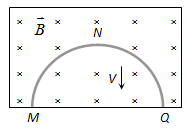
MCQ 1491 Mark
A thin semicircular conducting ring of radius $R$ is falling with its plane vertical in a horizontal magnetic induction $B$. At the position $\text{MNQ,}$ the speed of the ring is $V$ and the potential difference developed across the ring is
  • A
    Zero
  • $Bv^{R^2 / 2}$ and $M$ is at higher potential
  • C
    $\pi RBV$ and $Q$ is at higher potential
  • D
    $\text{2RBV}$ and $Q$ is at higher potential
Answer
Correct option: B.
$Bv^{R^2 / 2}$ and $M$ is at higher potential
View full question & answer
Question 1501 Mark
The transformation ratio in the step-up transformer is(a) 1(b) Greater than one(c) Less than one(d) The ratio greater or less than one depends on the other factors


Answer
(b) Greater than one
View full question & answer
M.C.Q (1 Marks) - Page 3 - Physics STD 12 Science Questions - Vidyadip