Volt $-$ second is unit of which physical quantity?
Answer
From $\varepsilon=\frac{\Delta \phi}{\Delta t }, \Delta \phi=\varepsilon \times \Delta t$
$ \text { Unit of magnetic flux }=\text { Unit of induced emf } \varepsilon \times \text { unit }\text {of time }$
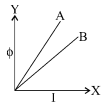
Graph between magnetic flux $\phi$ and electric current $I$ for two inductors $A$ and $B$ is given in the figure. The magnitude of self-inductance will be more for whom?
Answer
Since $\phi= LI \Rightarrow L =\phi / I$ and $\phi= LI \Rightarrow \phi \propto I$ Hence there is a linear graph between $\phi$ and $I$ and slope of $\phi / I$ will represent the self-inductance of the inductor. The slope of A is more than as compared to that of B , so selfinductance of A will be more.
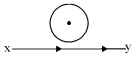
In the given figure, magnitude of current is increasing in the wire xy from x to y . Is there any induced current in a loop placed near the wire?
Answer
Yes, and direction of induced current will be clockwise. According to right hand thumb rule, due to current in wire xy, magnetic field passing through the loop will be perpendicularly outwards and according to Lenz's law, the direction will be such that it opposes the current from increasing in that surface.
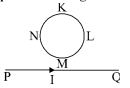
What will be the magnitude of induced current in circular loop KLMN of radius $r$ if constant current of $1 A$ is passed in straight wire $P Q$ ?
Answer
Zero, because when current is kept constant in PQ , then there is no change in magnetic flux in a coil placed near to it, hence no current will be induced.
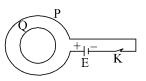
Two coils $P$ and $Q$ are shown in the figure given. What will be the direction of momentarily induced current in coil $Q$ when (i) switch $K$ is closed and (ii) switch $K$ is again opened after some time?
Two coils one of larger radius $R$ and other of smaller radius $r$ are kept near. If mutual induction coefficient for this pair is $1 mH$ what is the magnetic flux associated with the larger coil when a current of $0.5 A$ is flowing in the smaller coil? When current in smaller coil is zero then what is its effect on larger coil?
Answer
Given : $ M=1 m $ henry $=10^{-3} H$
$I_1=0.5 A $
$\therefore$ Magnetic flux related ot larger coil
$ \phi_2 =MI_1=10^{-3} \times 0.5$
$ =5.0 \times 10^{-4} Wb $
When current in the smaller coil becomes zero, then induced emf will be generated in larger coil due to decrease in magnetic flux.
Current obtained from a choke coil of 2 henry is decreasing at the rate of $5 A / s$. Calculate the electromotive force developed across the ends of the coil.
Answer
$\quad \frac{\Delta I }{\Delta t}=-5 A / s$ and $L =2 H$ $\varepsilon=- L \left(\frac{\Delta I }{\Delta t }\right)=-2 \times(-5)=10 volt$
An emf of 20 m volt is induced in the coil when the rate of change of current in the solenoid is $4 A / s$, then what is the self-inductance of the coil?
Answer
$|\varepsilon|= L \frac{\Delta I }{\Delta t } \Rightarrow L =\frac{|\varepsilon|}{\frac{\Delta I }{\Delta t }}$ $L =\frac{20 \times 10^{-3} \text { Volt }}{4 \text { Ampere } / \text { second }}$ $=5 \times 10^{-3} \frac{\text { Volt } / \text { second }}{\text { Ampere }}$ $=5 \times 10^{-3}$ Henry $=5 mH$
Write Faraday's laws of electromagnetic induction.
Answer
Faraday gave two important laws on the phenomenon of electromagnetic induction 1. First law of Faraday: When magnetic flux linked with a coil changes then induced emf and induced current is generated in the coil. Induced emf is developed only till the change in the magnetic flux is taking place. 2. Second law of Faraday: According to this law, emf induced in the coil is proportional to the rate of change of flux.
Why self-induction is called inertia of electricity?
Answer
Self-induction is that property of a coil by virtue of which it tries to maintain the magnetic flux associated with it which means it opposes any change in the flux. This property is similar to property of inertia in mechanics. Hence it is called inertia of electricity.
In the figure given below, on moving a magnet NS kept between two coils AB and CD in the direction of arrow, in which coil the direction of induced current will be anticlockwise when seen from left?
Current in any circuit decreases from 5.0 A to 1.0 A in 0.1 s. If average induced emf is 200 V, then analyze self-induction in the coil.
Answer
$I _1=5 A, I _2=0 A$ $d I = I _1- I _2=5-0=5 A$ $d t=0.1 s$ $e =200 Volt$ For self-inductance in the coil $L =\frac{ e }{d I / d t}=\frac{200}{\frac{5}{0.1}}$ $L =\frac{ e }{d L / d t}=\frac{200}{\frac{5}{0.1}}$ $L =5 H$
If magnitude of current is made twice in any inductor, then how many times will the stored energy become?
Answer
$U =\frac{1}{2} Lt _0^2$ On doubling the magnitude of current $\therefore \quad U ^{\prime}=\frac{1}{2} L\left(2 I _0\right)^2=4 \times \frac{1}{2} LI _0^2$ $U ^{\prime}=4 U$ Hence, the stored energy will become four times.
When the south pole of a bar magnet is taken close to a coil, then what is the direction of induced current in the coil? Explain with reason.
Answer
Clockwise because due to this south pole will be formed at the ends of coil which according to Lenz's law will oppose the motion of the magnet towards it.
In a rectangular wire, due to a source of emf, a constant current is flowing from left to right. When the switch of the source is off, then what will be the direction of induced current in the wire?
Answer
From left to right (on switching off, the direction of induced emf is same in which the current was flowing).
In two co-axial same circular coils, same current is flowing in the same direction. If both the coils are brought towards each other, then what will be the change in the current?
Answer
Current will decrease in both the coils (by Lenz's law).
Self-inductance of any coil is 1 H. What do you understand by this?
Answer
$\varepsilon=- L \frac{d I }{d t}$ Here $L =1$, then $\quad \varepsilon=-\frac{d I }{d t}$ Which means that when rate of change of electric current is $1 A / s$, then emf of 1 volt will be induced.
On what factors does magnetic flux associated with a coil kept in any magnetic field depends?
Answer
When a coil is kept in any external magnetic field, then magnetic flux associated with it depends on : $ \because \phi_{B}=NBA \cos \theta $ (i) the area of the plane A of the coil. (ii) intensity of magnetic field $B$. (iii) angle $\theta$ made by the axis of coil with the direction of magnetic field. (iv) number of turns N .
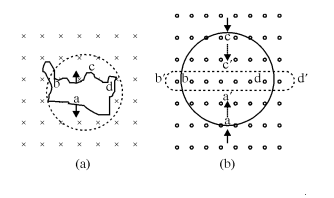
Use Lenz's law to determine the direction of induced current in the situations described in the given figure: (a) A wire of irregular shape turning into a circular shape. (b) A circular loop being deformed into a narrow straight wire.
Answer
(a) Along the direction adcb, during shape change flux passing through the surface increases. Hence, induced current generates opposing flux. (b) Along a'b'c'd' (flux decreases in this).