Questions

2 Marks Questions

Take a timed test

14 questions · self-marked practice — reveal the answer and mark yourself.

Question 12 Marks
A 5 m long straight horizontal conducting wire situated in the east to west direction is falling with a speed of $2 m / s$ perpendicular to the horizontal component of the earth magnetic field of $0.3 \times 10^{-4} T$. Find the instantaneous value of the emf induced between the ends of the wire.
Answer
$ \begin{aligned} l & =5 m \\ B_{E} & =0.3 \times 10^{-4} Tesla \\ v & =2 m / s \end{aligned} $
Instantaneous value of emf induced $ \begin{aligned} E & =B / v \sin \theta \\ E & =BE l v \sin \theta \\ \theta & =90^{\circ} \\ E & =\left(0.3 \times 10^{-4}\right) \times 5 \times 2 \times \sin 90^{\circ} \\ \sin 90^{\circ} & =1 \\ E & =3 \times 10^{-4} volt \end{aligned} $
View full question & answer
Question 22 Marks
State factors on which coefficient of mutualinductance between two coils depend.
Answer
Factors on which coefficient of mutual inductance of coils depend are :
(i) Size, shape, number of turns, cross-section of coils etc.
(ii) Distance between two coils.
(iii) Relative directions of two coils.
(iv) Substances of cores of two coils.
View full question & answer
Question 32 Marks
A lamp attached to a cycle glows by a dynamo. When cycle is moved at greater speed, the lamp glows brightly and when cycle moves with a lesser speed, it glows dimly. Why?
Answer
Dynamo works on the principle of electromagnetic induction. On riding a cycle with greater speed, the rate of change of magnetic flux $\left(\frac{\Delta \phi_{ B }}{\Delta t}\right)$ increases due to which magnitude of induced emf increases $\left\{\varepsilon \propto \frac{\Delta \phi_{ B }}{\Delta t}\right\}$ and the bulb glows brightly.
(Formula for induced emf in dynamo is $e = NBA \omega$. On riding the bicycle at greater speed, magnitude of $\omega$ increases and on riding slowly, the magnitude of $\omega$ decreases.)
View full question & answer
Question 42 Marks
Think over the experiment number 2 of Faraday and Henry and tell :
(a) What will you do to obtain more deflection in the galvanometer?
(b) How will you show the presence of current in the absence of a galvanometer?
Answer
(a) To obtain greater deflection, one or more of the following can be done :
(i) By using rod of soft iron inside the coil $C _2$, (ii) We will join a battery of high power to the coil. (iii) We will take the combination towards testing coil with more speed.
(b) We will change the galvanometer with small bulb used in the torch. Due to relative motion between the two coils, the bulb will glow for a moment which indicates the generation of induced current.
View full question & answer
Question 52 Marks
What will be the effect on induced charge and induced current when change in magnetic flux associated with it is either done with increased rate or decreased rate?
Answer
Induced charge, $q=\frac{ N \Delta \phi_{ B }}{ R }$ and
induced current $ I=\frac{N \Delta \phi_{B}}{R \Delta t}=\frac{N\left(\Delta \phi_{B} / \Delta t\right)}{R} . $
It is clear from above formulas that induced charge depends only on total change in flux $\Delta \phi_{ B }$, whereas induced current depends on the rate of change of magnetic flux $\left(\Delta \phi_{ B } /\right.$ $\Delta t$ ). There will be no change on increasing or decreasing the flux on induced charge but induced current will change. It will increase on increasing the speed and decrease on decreasing the speed.
View full question & answer
Question 62 Marks
What will be the effect on the magnetic flux associated with a coil located in any external magnetic field when
(i) Number of turns in the coil are increased?
(ii) Area of plane of the coil is increased?
(iii) Intensity of magnetic field of the coil is increased
Answer
(i) No effect on the magnetic flux as it does not depend on the number of the turns of the coil.
(ii) Magnitude of magnetic flux will increase as $\phi_{B} \propto A$
(iii) Magnitude of magnetic flux will increase as $\phi_{B} \propto B$
View full question & answer
Question 72 Marks
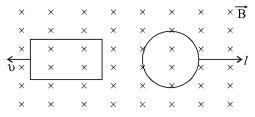
A rectangular loop and a circular loop are moving out of a uniform magnetic field with a constant velocity $v$ as shown in the figure :
Image
Magnetic field is perpendicular to the plane of loops. Explain in which loop, the magnitude of induced emf will remain constant while emerging out of magnetic field?
Answer
Rate of change of area $\left(\frac{d A}{d t}\right)$ of rectangular loop, while it is moving out of magnetic field with constant velocity $v$ will remain constant but not for circular loop. Hence according to the formula
$ \varepsilon=-\left(\frac{d \phi_{B}}{d t}\right)=\frac{-d}{d t}(BA)=-B\left(\frac{d A}{d t}\right) $
Induced emf in the rectangular loop will remain constant for $\vec{B}$.
View full question & answer
Question 82 Marks
Write statement of Lenz's law of electromagnetism. A 2 m long straight vertical wire is falling perpendicularly to horizontal component at speed of 5 $m / s$ in the magnetic field of earth of $0.3 \times 10^{-4} T$. Calculate the magnitude of instantaneous value of induced emf across the ends of the wire.
Answer
Lenz's law : Polarity of induced electromotive force in the phenomenon of electromagnetic induction is such that it always opposes the cause which produces it means it opposes the change in magnetic flux due to which it is generated.
$ E \propto-\frac{d \phi}{d t} \text { or } E=-\frac{k d \phi}{d t} $
Here, k is a constant of proportionality whose value is 1. Negative sign represents that induced emf always opposes change in flux.
Given : $l=2 m$ $ \begin{aligned} B_{E} & =0.3 \times 10^{-4} T \\ E & =B / v \sin \theta \\ E & =B / v 90^{\circ} \end{aligned} $
On putting the values, $ \begin{aligned} E & =\left(0.3 \times 10^{-4}\right) \times 2 \times 5 \times 1 \quad \therefore \sin 90^{\circ}=1 \\ & =3 \times 10^{-4} \text { volt. } \end{aligned} $
View full question & answer
Question 92 Marks
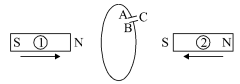
Two bar magnets are moving rapidly towards a metallic loop joined across a capacitor C as shown in the figure. What is the polarity of the capacitor?
Image
Answer
Plane of the loop towards the north pole of the magnet (1) should act like a north pole and the plane towards south pole of magnet (2) should behave as a south pole so that as per Lenz's law induced currents in the loop can repel the motion of the magnets towards it.
On seeing from magnet (1) the direction of current in the loop should be from A to B (anticlockwise) and when seen from magnet (2), the direction of current flow will be clockwise. Hence, plate A of capacitor C will be at positive potential with respect to plate B. Hence plate A will be at positive potential and plate $B$ will be at negative potential.
View full question & answer
Question 102 Marks
A square coil of 200 turns of size $\frac{50}{\pi}$ is rotated in a magnetic field of 2.0 weber/ at the speed of 1200 rotations/minute. Calculate the magnitude of maximum induced electromotive force in the coil.
Answer
Given : $A =\frac{50}{\pi} cm^2=\frac{50}{\pi} \times 10^{-4} m^2$
$N =200$ turns
$B =2.0$ weber $/ m ^2$
$f=\frac{1200}{60}=20$ rotations $/$ second
$\therefore \omega=2 \pi f=2 \times \pi \times 20=40 \pi rad / s$
Maximum value of induced $\operatorname{emf} \varepsilon_0= NBA \omega$
$\therefore \quad \varepsilon_0=200 \times 2 \times \frac{50}{\pi} \times 10^{-4} \times 40 \pi$
$=80 volt$
View full question & answer
Question 112 Marks
Magnetic flux passing through plane of any coil is changing with time according to the relation $\phi=$ $\left(5 t^3+4 t^2+2 t-5\right) Wb$. Find the induced current in the coil at $t=2$ seconds given that resistance of the coil is 5 ohms.
Answer
Magnitude of induced electromotive force
$\varepsilon=\frac{d \phi}{d t}=\frac{d}{d t}\left(5 t^3+4 t^2+2 t-5\right)$
$=5 \times 3 t^2+4 \times 2 t+2 \times 1-0$
$=\left(15 t^2+8 t+2\right)$ volt
At $t=2$ seconds
$\varepsilon=60+16+2=78$ volt
Since resistance of the coil $=5 \Omega$, So, induced current in the coil,
$ I=\frac{\varepsilon}{R}=\frac{78 Volt}{5 Ohm}=15.6 A $
View full question & answer
Question 122 Marks
A pair of adjacent coils have a mutual inductance of 1.5 H. If the current in one coil changes from 0 to 20 A in 0.5 s, what is the change of the flux linkage with the other coil?
View full question & answer
Question 132 Marks
Current in a circuit falls from 5.0 A to 0.0 A in 0.1 s. If an average emf of 200 V induced, give an estimate of the self-inductance of the coil.
Answer
Given :
$\begin{array}{l}I_1=5.0 A
\\I_2=0.0 A\end{array}$
Change in current $=d I = I _2- I _1=0.0 A-5.0 A$
$d I =-5 A$
Time in which current is changing $=d t=0.1 s$
Average induced emf $=\varepsilon=200 V$
Let self-inductance of the coil be $= L =$ ?
We know that formula$\varepsilon=-L \frac{d I}{d t}$
On putting the values, $\quad 200=- L \left(\frac{-5}{0.1}\right)=50 L$
$\therefore \quad L=\frac{200}{50}=4$ henry
$L =4 H$
View full question & answer
Question 142 Marks
A 1.0 m long metallic rod is rotated with an angular frequency of 400 rad$s ^{-1}$ about an axis normal to the rod passing through its one end. The other end of the rod is in contact with a circular metallic ring. A constant and uniform magnetic field of 0.5 T parallel to the axis exists everywhere. Calculate the emf developed between the centre and the ring.
Answer
Given : $\quad l=1.0 m$
$\begin{array}{l}\omega=400 rad / s
\\ B =0.5 T\end{array}$
Let emf between the centre and the ring $\varepsilon=$ ?
On using the relation,
$\varepsilon=\frac{1}{2} B l^2 \omega$
and on putting the values :
$\varepsilon=\frac{1}{2} \times 0.5 \times(1)^2 \times 400$
$=0.5 \times 200=100.0 V$
Hence, the emf between the centre and the ring will be
$\varepsilon=100.0 \text { volt }$
View full question & answer