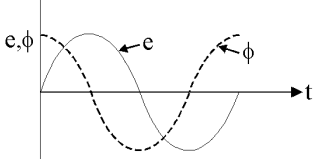
A rectangular coil is rotating with a uniform angular velocity between magnetic poles. The correct graph of change of magnetic flux $\phi$ passing through the coil and induced emf (c) with time is :
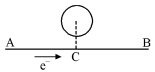
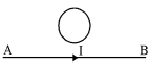
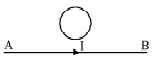
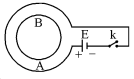
A coil of copper and a wire AB are located in the plane of the paper as shown in the figure. If current I flowing through the wire is increasing, then the direction of induced current in the coil is:
A square loop of side 22 cm is converted into circular loop of 0.45. If uniform magnetic field of 0.2 T is perpendicular to the loop, then induced electromotive force in the loop is:
A square coil of area $10^{-2} m^2$ is kept perpendicular in a magnetic field of intensity $10^3 Wb / m ^2$. The magnitude of magnetic flux passing through the square is :
A coil of 40 turns and area $4 cm^2$ is suddenly removed from a magnetic field. Charge of $2 \times 10^{-4} C$ flows through it. If its resistance is 80 ohms, then magnetic flux density is:
In a circuit of resistance $R$, magnetic flux $\Delta \phi$ changes in time $\Delta t$. Total charge $Q$ flowing through the circuit in time $\Delta r$ is :
Mutual inductance of two coils placed near is 4.0 H (Henry). If current in the primary coil decreases from 5 A to zero in $10^{-2}$ seconds, then magnitude of induced emf in secondary coil is :
A metallic rod of length $l$ is kept perpendicular to a magnetic field and it is rotated on a circular path with frequency $f$. The potential difference across the ends of the rod is :
The instantaneous magnitude of magnetic flux associated with a closed circuit of $5 \Omega$ resistance is given by $\phi_{ B }=6 t^2-5 t+1$, then magnitude of induced current (in A ) in the circuit at $t =0.25$ second is :
Coefficient of mutual inductance between two coils is 2.5 H . If current is changing in one coil at the rate of 1 $A / s$, then magnitude of induced emf in the secondary coil : $\quad \begin{array}{ll} & 0\end{array}$
A conducting loop is kept in a uniform magnetic field such that its plane is perpendicular to the magnetic field. Induced emf will be generated in the loop if:
A copper ring is kept horizontal and a bar of magnet is dropped in the direction of the axis of the ring. The acceleration of the falling magnet will be:
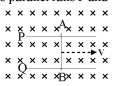
A square conducting loop of side L and resistance R is moving in its plane with a uniform velocity v perpendicular to its one side, where magnetic induction is B which is constant in space and time and is normal to the inwards of the plane. Induced current in the coil is:
According to the figure, a conducting wire AB (length $l)$ is moving with a velocity v on two parallel rails P and Q. A uniform magnetic field is applied normally inwards to the plane of rails. Essential force needed to keep the velocity of the bar constant is:
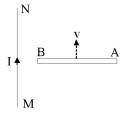
In the given figure, conducting rod AB is moved in the direction of magnetic field developed by the current carrying conductor MN. The direction of generated induced current will be: