Question 515 Marks
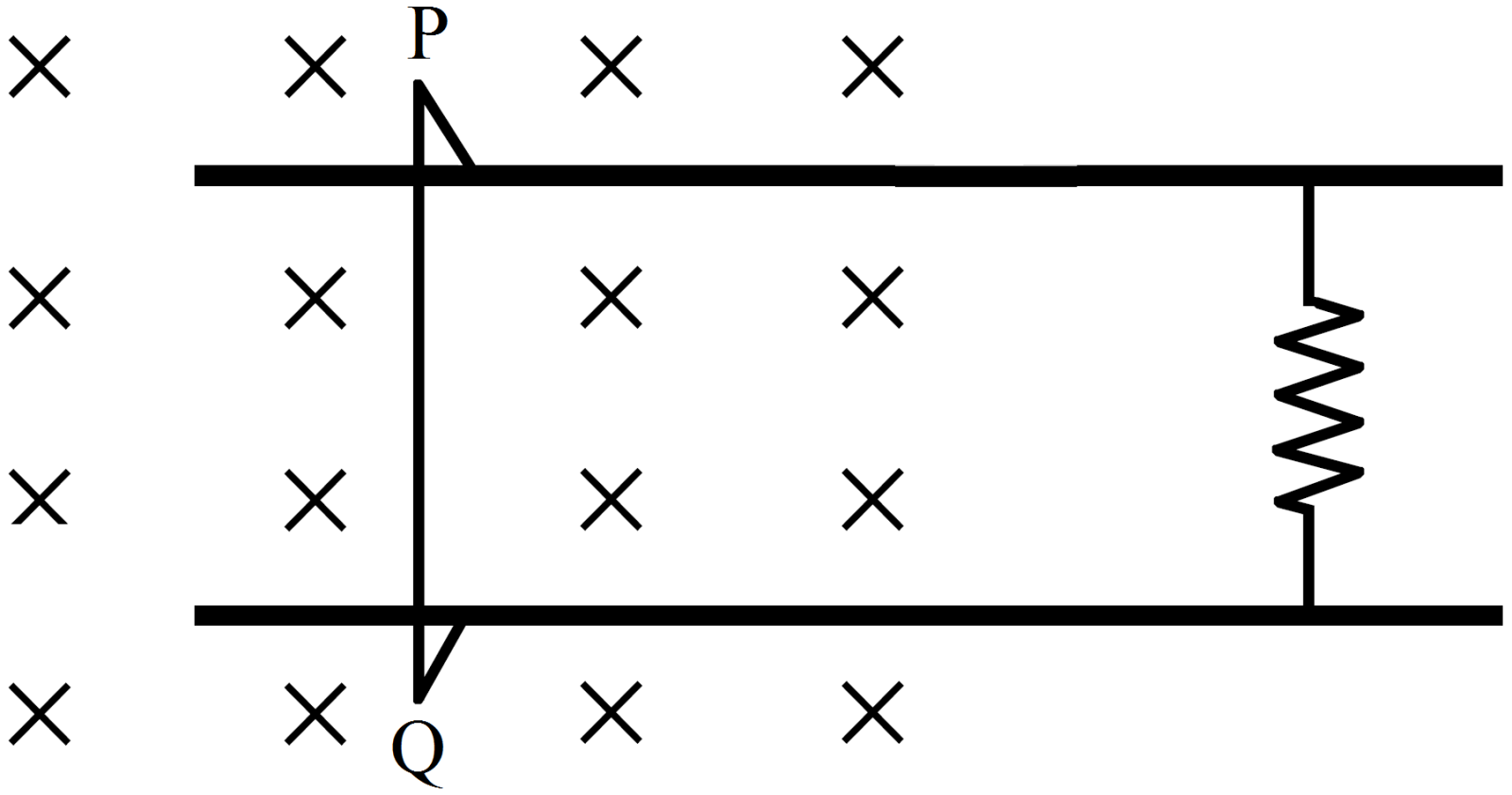
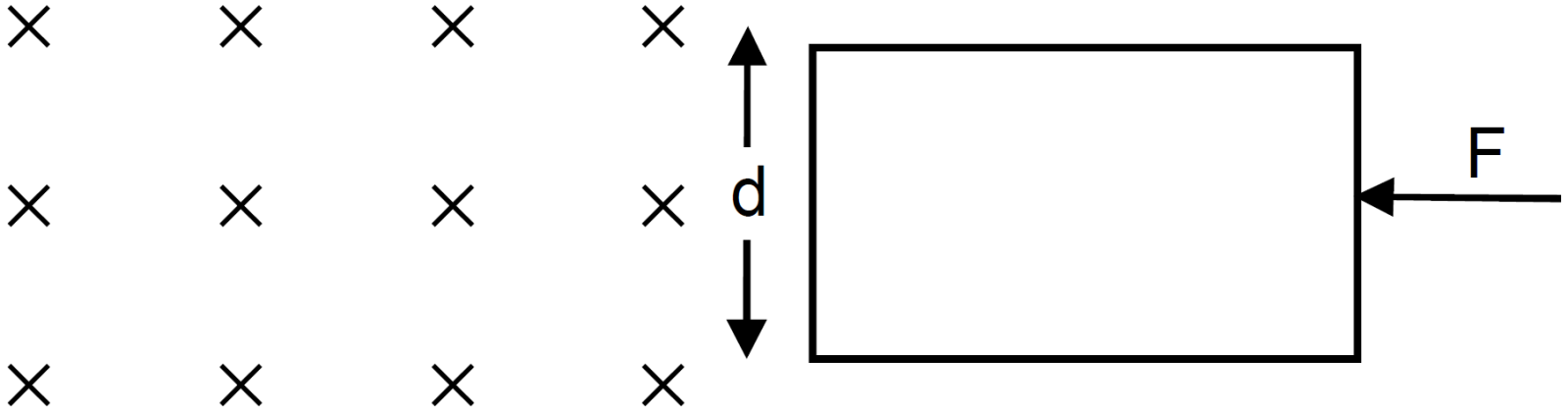
A rectangular frame of wire abcd has dimensions $32cm × 8.0cm$ and a total resistance of $2.0\Omega.$ It is pulled out of a magnetic field $B = 0.020T$ by applying a force of $3.2 \times 10^{-5}N$ (figure). It is found that the frame moves with constant speed. Find
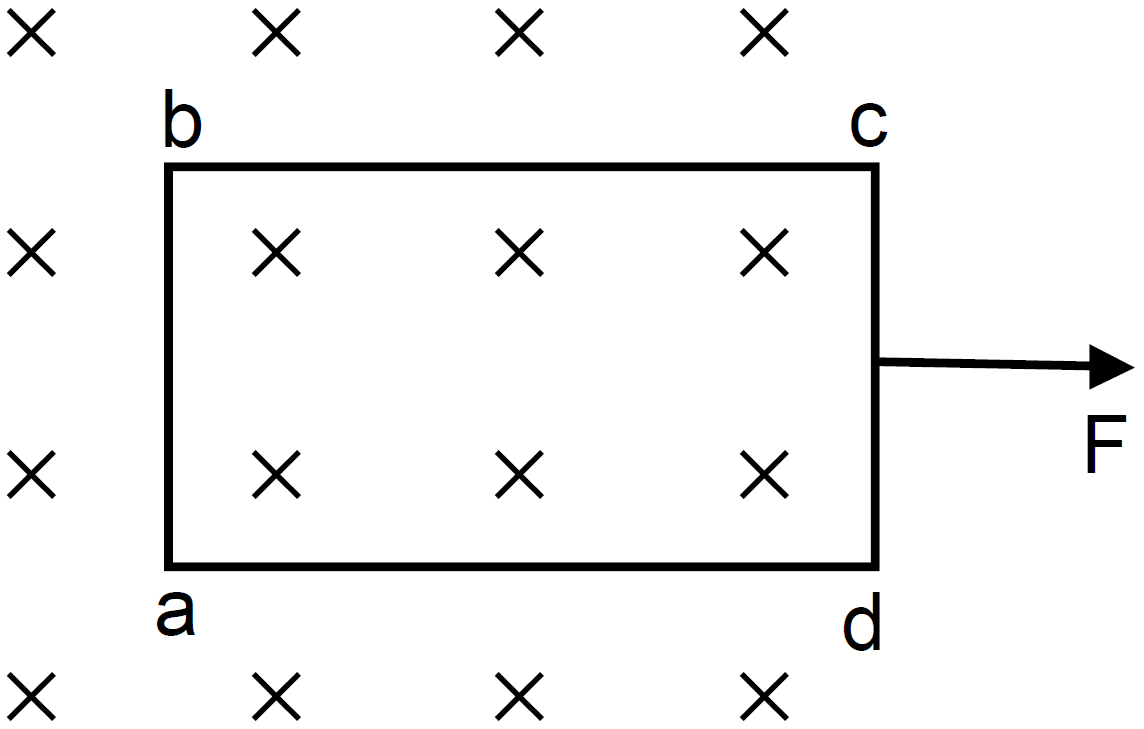
- This constant speed.
- The emf induced in the loop.
- The potential difference between the points a and b.
- The potential difference between the points c and d.
Answer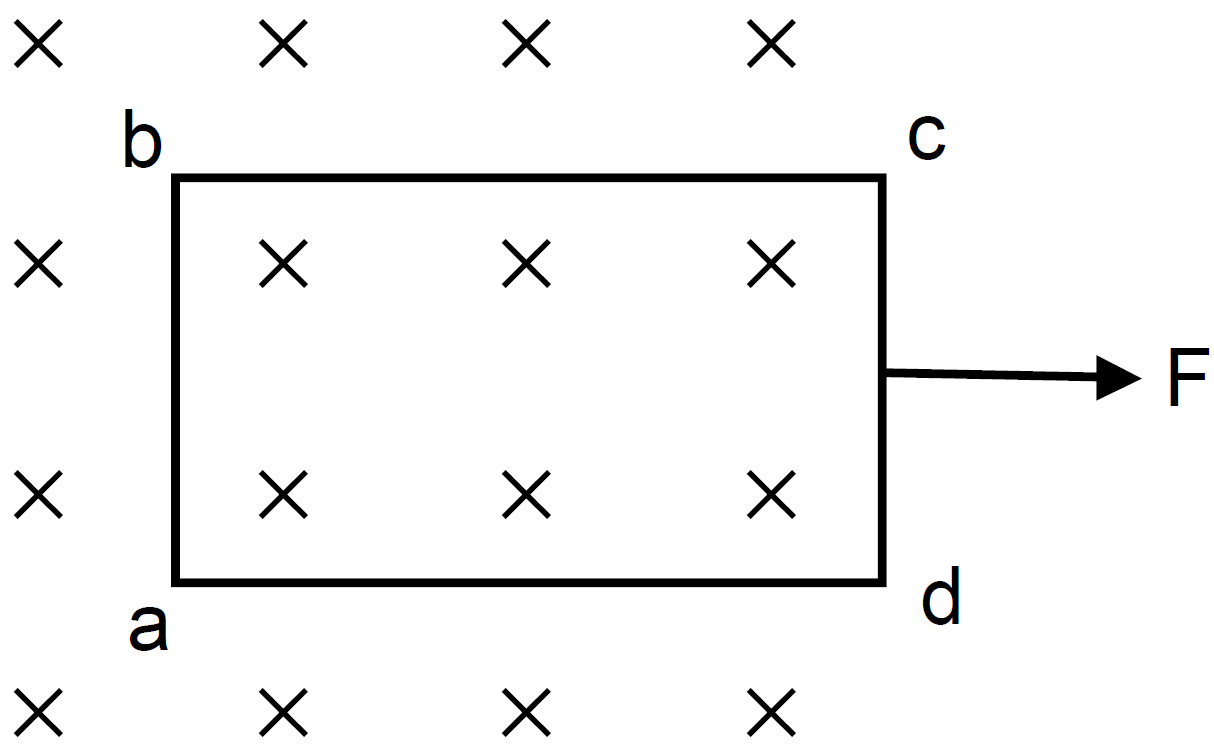
$\text{R}=2.0\Omega, \ \text{B}=0.020\text{T}, \ \text{I}=32\text{cm}=0.32\text{m}$
$\text{B}=8\text{cm}=0.08\text{m}$
$\Rightarrow\frac{(0.020)^2\times(0.08)^2\times\text{v}}{2}=3.2\times10^{-5}$
$\Rightarrow\text{v}=\frac{3.2\times10^{-5}\times2}{6.4\times10^{-3}\times4\times10^{-4}}=25\text{m}/\text{s}$
$\text{V}_{\text{ab}}=\text{iR}=\frac{\text{Blv}}{2}\times1.8=\frac{0.02\times0.08\times25\times1.8}{2}$
$=0.036\text{V}=3.6\times10^{-2}\text{V}$
View full question & answer→$\text{R}=2.0\Omega, \ \text{B}=0.020\text{T}, \ \text{I}=32\text{cm}=0.32\text{m}$
$\text{B}=8\text{cm}=0.08\text{m}$
- $\text{F}=\text{ilB}=3.2\times10^{-5}\text{N}$
$\Rightarrow\frac{(0.020)^2\times(0.08)^2\times\text{v}}{2}=3.2\times10^{-5}$
$\Rightarrow\text{v}=\frac{3.2\times10^{-5}\times2}{6.4\times10^{-3}\times4\times10^{-4}}=25\text{m}/\text{s}$
- Emf $\text{E}=\text{vBl}=25\times0.02\times0.08=4\times10^{-2}\text{V}$
- Resistance per unit length $=\frac{2}{0.8}$
$\text{V}_{\text{ab}}=\text{iR}=\frac{\text{Blv}}{2}\times1.8=\frac{0.02\times0.08\times25\times1.8}{2}$
$=0.036\text{V}=3.6\times10^{-2}\text{V}$
- Resistance of cd $=\frac{2\times0.08}{0.8}=0.2\Omega$
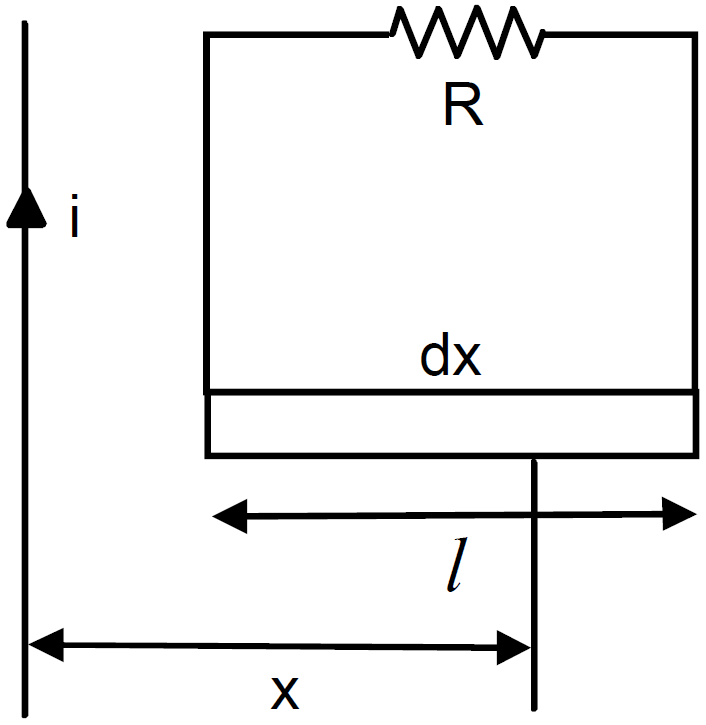
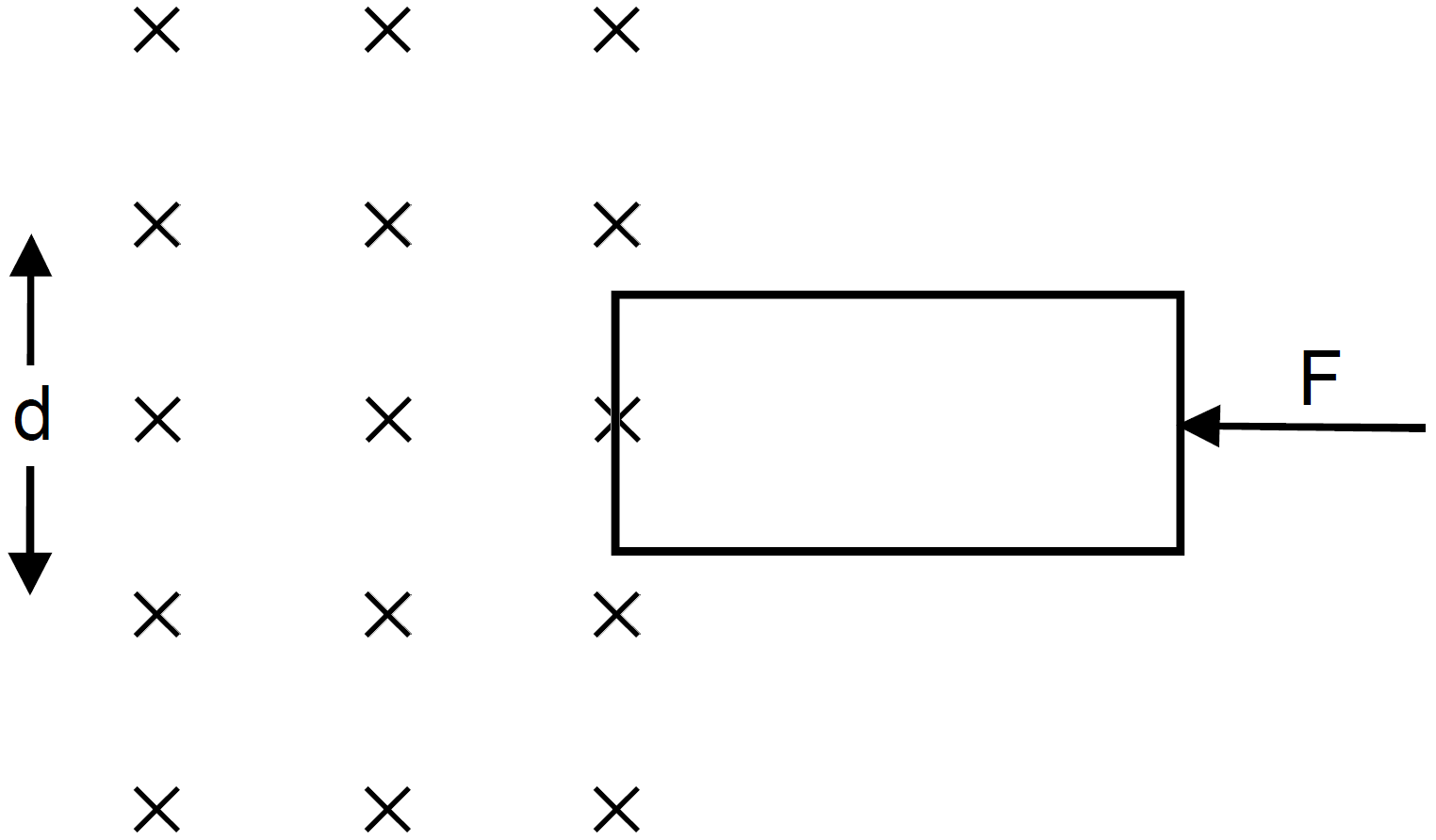
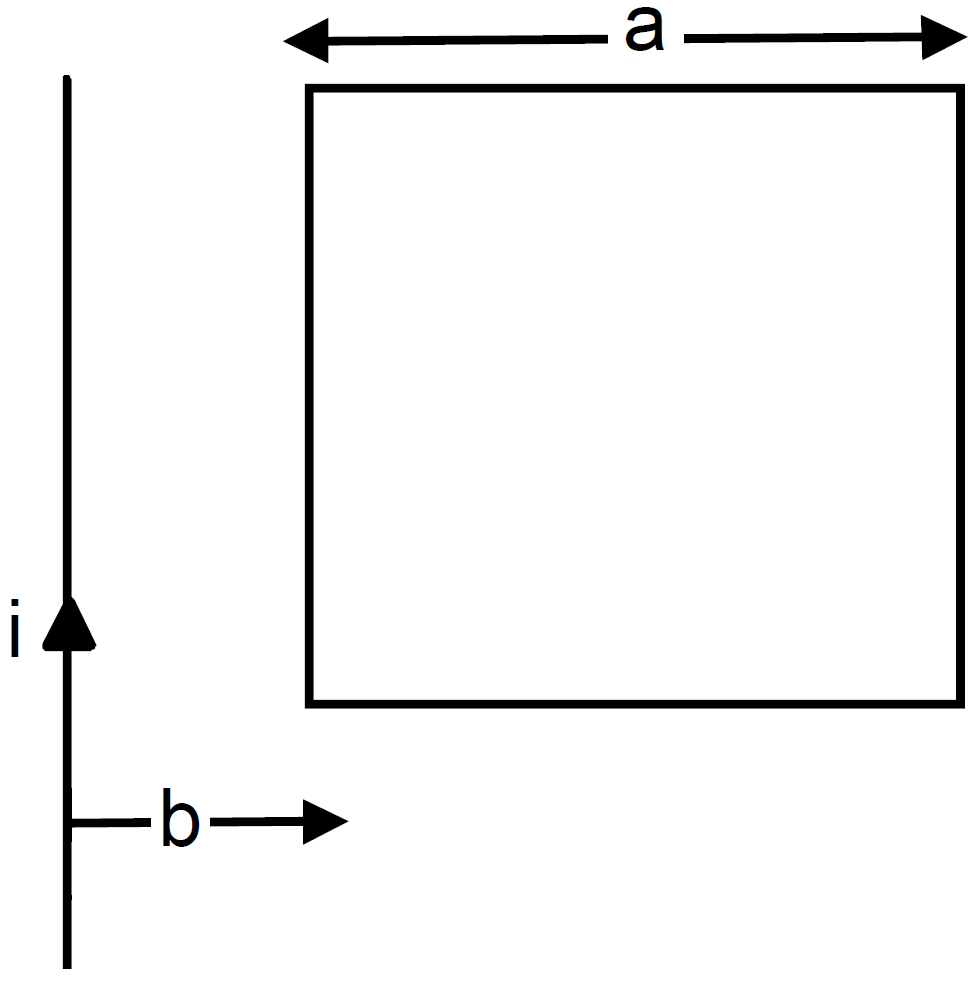
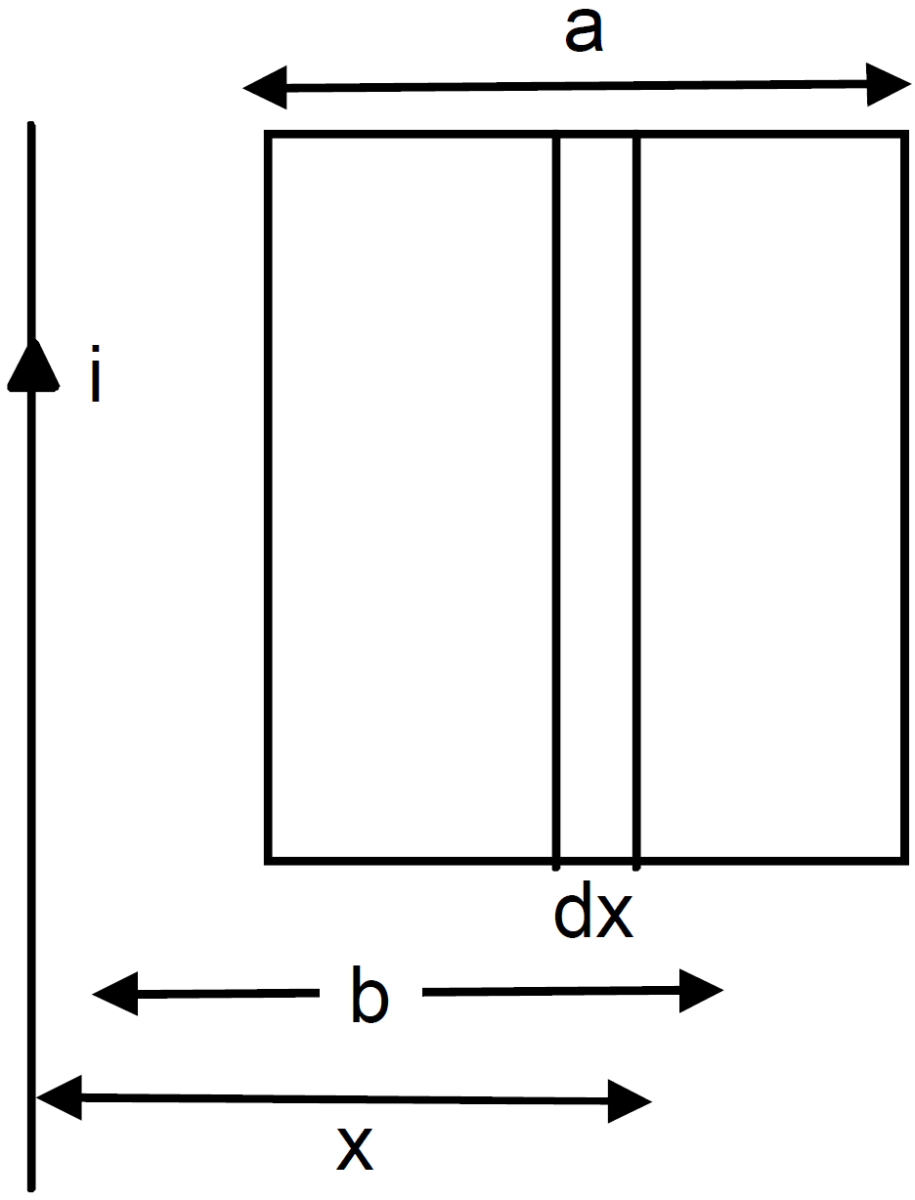 Considering an element dx at a dist x from the wire. We have
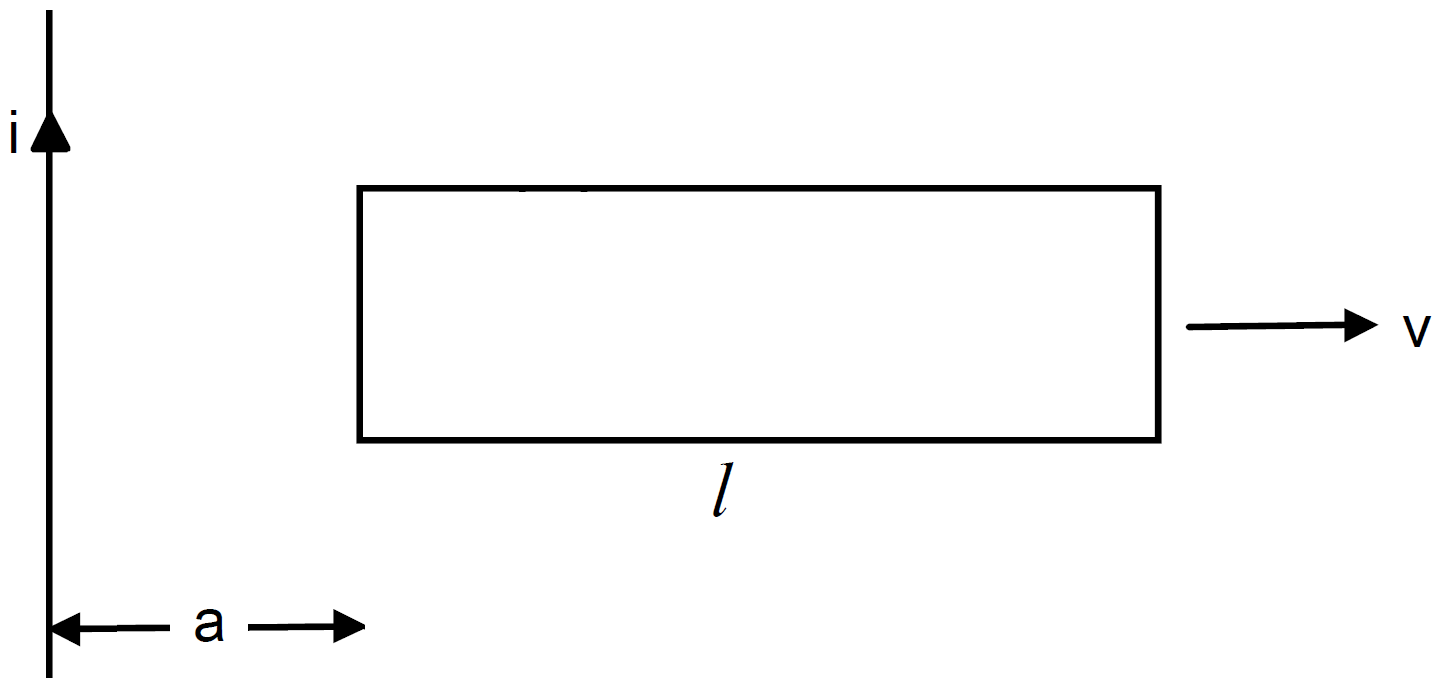
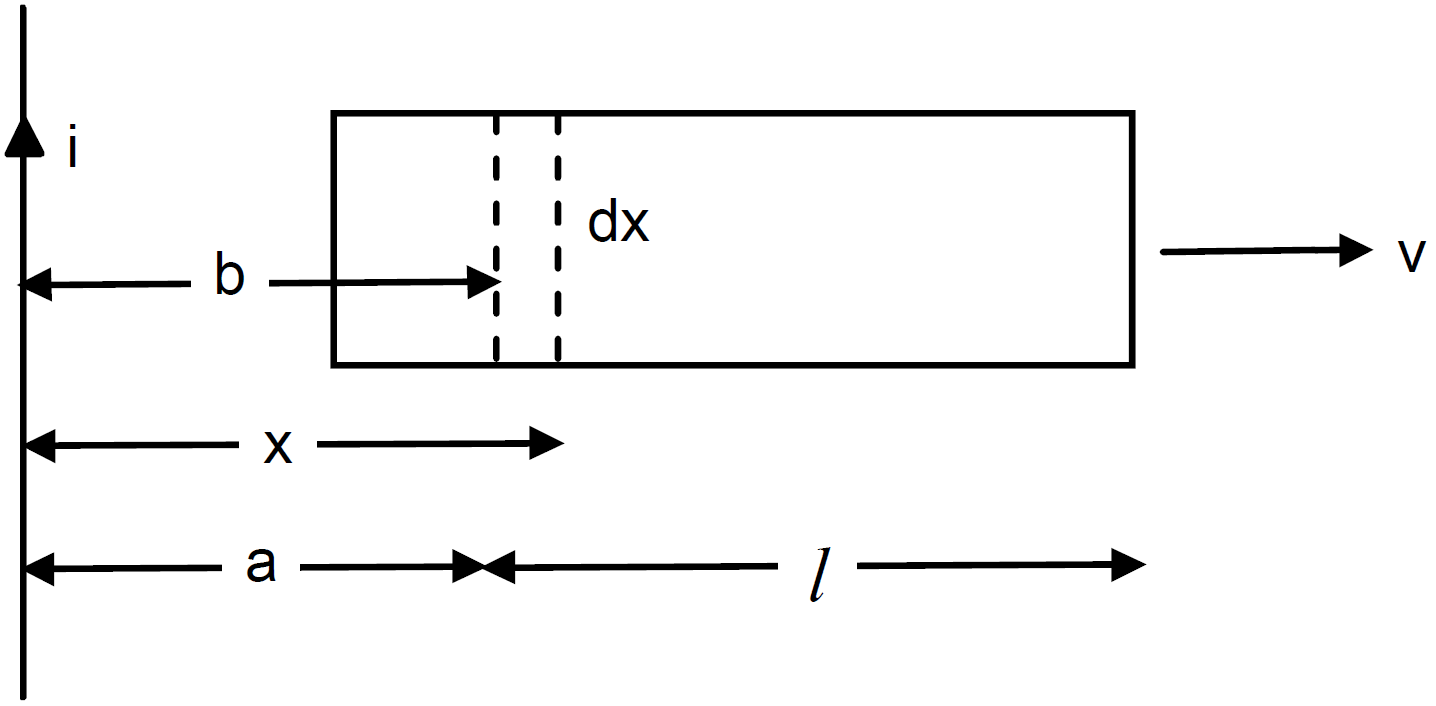 Using Faraday’' law Consider a unit length dx at a distance x $\text{B}=\frac{\mu_0\text{i}}{2\pi\text{x}}$ Area of strip $=\text{b} \ \text{dx}$ $\text{d}\phi=\frac{\mu_0\text{i}}{2\pi\text{x}}\text{dx}$ $\Rightarrow\phi=\int\limits^{\text{a}+1}_\text{a}\frac{\mu_0\text{i}}{2\pi\text{x}}\text{bdx}$ $=\frac{\mu_o\text{i}}{2\pi}\text{b}\int\limits^{\text{a}+1}_\text{a}\Big(\frac{\text{dx}}{\text{x}}\Big)=\frac{\mu_0\text{ib}}{2\pi}\log\Big(\frac{\text{a}+\text{l}}{\text{a}}\Big)$ $\text{Emf}=\frac{\text{d}\phi}{\text{dt}}=\text{dt}\Big[\frac{\mu_0\text{ib}}{2\pi}\text{log}\Big(\frac{\text{a}+\text{l}}{\text{a}}\Big)\Big]$ $=\frac{\mu_0\text{ib}}{2\pi}\frac{\text{a}}{\text{a}+\text{l}}\Big(\frac{\text{va}-(\text{a}+\text{l})\text{v}}{\text{a}^2}\Big)$ $\Big($ Where $\frac{\text{da}}{\text{dt}}=\text{V}\Big)$ $=\frac{\mu_0\text{ib}}{2\pi}\frac{\text{a}}{\text{a}+\text{l}}\frac{\text{vl}}{\text{a}^2}=\frac{\mu_0\text{ibvl}}{2\pi(\text{a}+\text{l})\text{a}}$ The velocity of AB and CD creates the emf. since the emf due to AD and BC are equal and opposite to each other.
 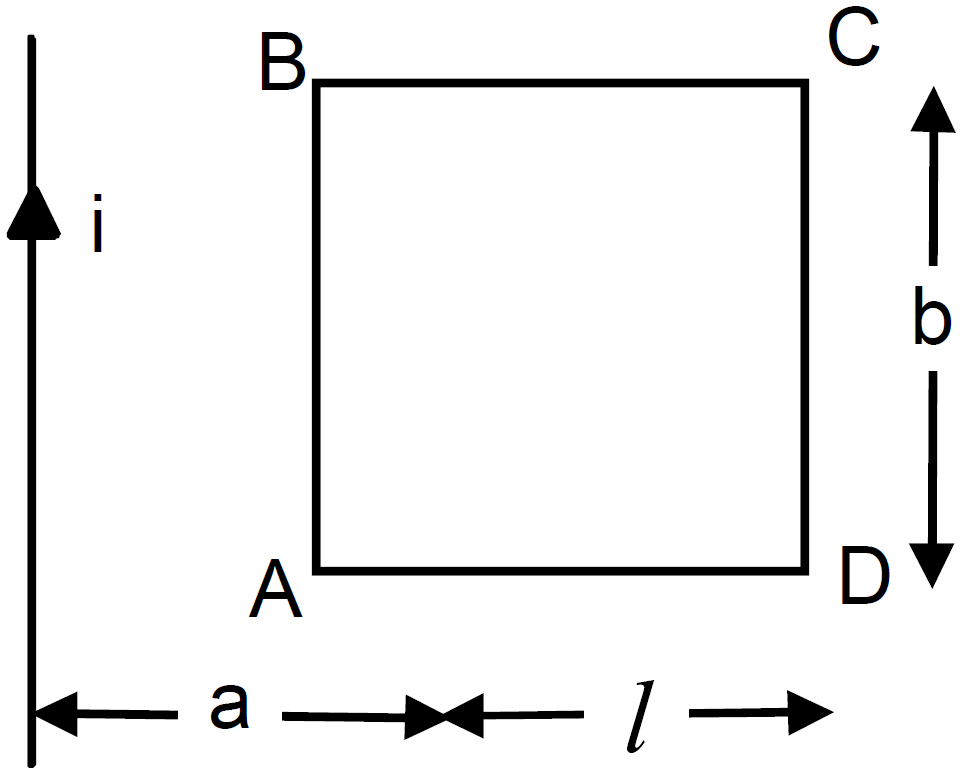 $\text{B}_{\text{AB}}=\frac{\mu_o\text{i}}{2\pi\text{a}} \ \Rightarrow \ \text{E.m.f.} \ \text{AB}=\frac{\mu_0\text{i}}{2\pi\text{a}}\text{bv}$ Length b, velocity v. $\text{B}_{\text{CD}}=\frac{\mu_0\text{i}}{2\pi(\text{a}+\text{l})}$ $\Rightarrow \text{E.m.f.} \ \text{CD}=\frac{\mu_0\text{ibv}}{2\pi(\text{a}+\text{l})}$ Length b, velocity v.Net emf $=\frac{\mu_0\text{i}}{2\pi\text{a}}\text{bv}-\frac{\mu_0\text{ibv}}{2\pi\text{a}(\text{a}+\text{l})}=\frac{\mu_0\text{ibvl}}{2\pi\text{a}(\text{a}+\text{l})}$