Explain Hertz experiment for communication of electromagnetic waves. Draw labelled diagram of apparatus used in the experiment. $(or)$ Explain Hertz experiment related with electromagnetic waves and also explain experiments of Jagdish Chandra Basu and Marconi. $(or)$ Critically evaluate Hertz experiment of production and communication of electromagnetic waves.
Source of magnetic field is not only electric current generated due to flow of charge but also rate of change of displacement vector or electric field vector with time. Justify the statement and prove that$i=i_c+i_d=i_c+\epsilon_0 \frac{d \phi_{E}}{d t}$
The terminology of different parts of the electromagnetic spectrum is given in the text. Use the formula E = hv (for energy of a quantum of radiation : photon) and obtain the photon energy in units of eV for different parts of the electromagnetic spectrum. In what way are the different scales of photon energies that you obtain related to the sources of electromagnetic radiation?
Answer
$\begin{array}{ll}\text { Formula }, & E =h \nu\end{array}$ We find the energy of photon by the above formula. or$E=\frac{h c}{\lambda}$ $\because \quad$ Frequency $v=\frac{c}{\lambda}$ Photon energy (For $\lambda=1 m$ ) $E=\frac{6.63 \times 10^{-34} \times 3 \times 10^8}{1 \times 1.6 \times 10^{-19}} eV$ $E =1.243 \times 10^{-6} eV$ For other values of $\lambda, E=\frac{1.243 \times 10^{-6}}{\lambda} eV$ (a) For gamma rays, $\lambda \rightarrow 10^{-12} m$ $\begin{aligned} \therefore \quad E =\frac{1.243 \times 10^{-6}}{10^{-12}} eV & =1.243 \times 10^6 eV \\ & =1.243 MeV \end{aligned}$ (b) For X-rays, $\lambda \rightarrow 10^{-9} m$ $\therefore \quad E =\frac{1.243 \times 10^{-6}}{10^{-9}} eV =1.243 keV$ (c) For visible light, $\lambda=0.5 \mu m\left(5 \times 10^{-7} m\right)$ $\therefore \quad E=\frac{1.243 \times 10^{-6}}{5 \times 10^{-7}}=2.48 eV$ (d) For micro-waves, $\lambda \rightarrow 1 cm=\left(10^{-2} m\right)$ $\therefore \quad E =\frac{1.243 \times 10^{-6}}{10^{-2}}=1.243 \times 10^{-4} eV$ (e) For radio-waves, $\lambda \rightarrow 100 m$ $\therefore \quad E=1.243 \times 10^{-8} eV$ Gamma rays are produced during nuclear reactions hence intervals in nuclear energy levels is of the order of 1 MeV. X-rays and visible light is produced due to transition of electrons in different levels. For X-rays, transition of electrons is from outer shells of heavy atoms in the inner shells in which energy gap is of the order of 1 keV. For light waves, transition is between levels of energy gaps of 2.5eV.
Suppose that the electric field amplitude of an electromagnetic wave is $E_0=120 N / C$ and that its frequency is v = 50.0MHz (a) Determine,$B _0, \omega, k$ and λ. (b) Find expressions for E and B. s
Answer
Given : $\quad E _0=120 N / C$ $v=50.0 MHz$ $=50 \times 10^6 Hz$ Speed of wave $=c=3 \times 10^8 m / s$ (a) Magnitudes of $B _0, \omega, k$ and $\lambda$ : (i) Magnitude of $B _0, c=\frac{ E _0}{B_0}$ $\therefore \quad B _0=\frac{ E _0}{c}$ Putting values, $\quad B _0=\frac{120}{3 \times 10^8} T$ $B _0=4 \times 10^{-7} T$ $=400 \times 10^{-7} T$ $=400 nT$ (ii) Magnitude of $\quad \omega=2 \pi v$ $=2 \pi \times 50 \times 10^6$ $=3.14 \times 10^8 radians / sec$. (iii) Magnitude of $k=\frac{2 \pi}{\lambda}=\frac{2 \pi v}{v \lambda}=\frac{2 \pi v}{c}=\frac{\omega}{c}$ $k=\frac{3.14 \times 10^8}{3 \times 10^8}$ $=1.05 radian / m$ (iv) Magnitude of $\lambda, c=v \lambda$ $\lambda=\frac{c}{v}=\frac{3 \times 10^8}{50 \times 10^6}=\frac{300}{50} m$ $\lambda=6 m$ (b) Let us suppose that the wave is travelling towards $x$-axis $\overrightarrow{ E }$ and $\overrightarrow{ B }$ are along $y$-axis and $z$-axis respectively. Then, $\overrightarrow{ E _{ y }}= E _0 \sin (k x-\omega t) \hat{ j }$ $=120 \sin \left(1.05 x-3.14 \times 10^8 t\right) \hat{ j } N / C$ $\begin{aligned} \overrightarrow{ B _{ z }} & = B _0 \sin (k x-\omega t) \hat{ k } \\ & =4 \times 10^{-7} \sin \left(1.05 x-3.14 \times 10^8 t\right) \hat{ k } T \end{aligned}$
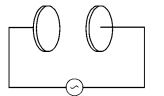
A parallel plate capacitor (Fig.) made of circular plates each of radius R = 6.0 cm has a capacitance C = 100 pF .The capacitor is connected to a 230 V ac supply with a (angular) frequency of 300 rad $s^{-1}$. (a) What is the rms value of the conduction current? (b) Is the conduction current equal to the displacement current? (c) Determine the amplitude of B at a point 3.0 cm from the axis between the plates.
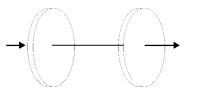
The given figure shows a capacitor made of two circular plates each of radius 12 cm, and separated by 5.0 cm. The capacitor is being charged by an external source (not shown in the figure). The charging current is constant and equal to 0.15 A. (a) Calculate the capacitance and the rate of change of potential difference between the plates. (b) Obtain the displacement current across the plates. (c) Is Kirchhoff's first rule (junction rule) valid at each plate of the capacitor? Explain.