Question 11 Mark
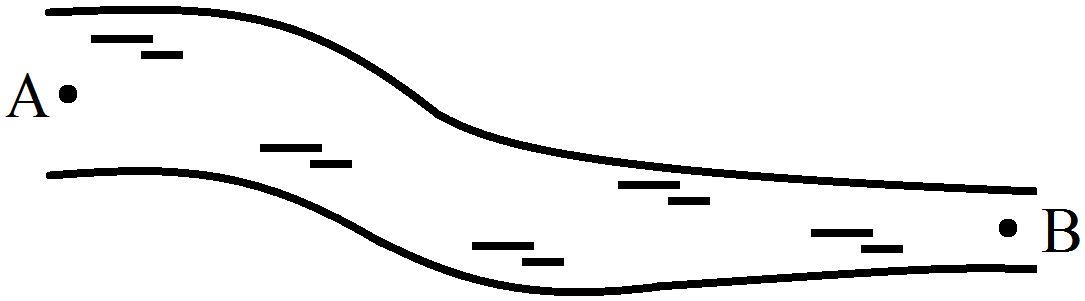
Suppose the tube in the previous problem is kept vertical with B upward. Water enters through B at the rate of $1cm^3/s$ . Repeat parts (a), (b) and (c). Note that the speed decreases as the water falls down.
Answer
View full question & answer→Since the discharge through the tube remains the same i.e. 1cm/s, the speeds at A and B will be the same.
$=\frac{15}{1600}\text{m}.$
From the Bernoulli's theorem
$\text{p}_\text{a}+\frac{1}{2}\rho\text{v}^2=\text{p}_\beta+\frac{1}{2}\rho\text{v}'^2+\rho\text{gh}$
$\Rightarrow\text{p}_\text{a}-\text{p}_\beta=\frac{1}{2}\text{p}\big(\text{v}^1-\text{v}^2\big)+\rho\text{gh}$
$=\frac{1}{2}\times1000\times\big(0.50^2-0.25^2\big)+1000\times10\times\frac{15}{1600}\text{N}/\text{m}^2$
$=\frac{1}{2}\times1000\times0.75\times0.25+\frac{1500}{16}\text{N}/\text{m}^2$
$=93.75+93.75\text{N}/\text{m}^2$
$=187.5\text{N}/\text{m}^2\approx188\text{N}/\text{m}^2$
- The speed at A,$\text{v}=\frac{1}{0.04}\text{cm}/\text{s}=\frac{100}{4}\text{cm}/\text{s}=25\text{cm}/\text{s}$
- The speed at B, $\text{v}'=\frac{1}{0.02}\text{cm}/\text{s}=\frac{100}{2}\text{cm}/\text{s}=50\text{cm}/\text{s}$
- Since the end B is upward, we take the end A as a reference level for the height. So the height of end A = 0 and the height of end B = h.
$=\frac{15}{1600}\text{m}.$
From the Bernoulli's theorem
$\text{p}_\text{a}+\frac{1}{2}\rho\text{v}^2=\text{p}_\beta+\frac{1}{2}\rho\text{v}'^2+\rho\text{gh}$
$\Rightarrow\text{p}_\text{a}-\text{p}_\beta=\frac{1}{2}\text{p}\big(\text{v}^1-\text{v}^2\big)+\rho\text{gh}$
$=\frac{1}{2}\times1000\times\big(0.50^2-0.25^2\big)+1000\times10\times\frac{15}{1600}\text{N}/\text{m}^2$
$=\frac{1}{2}\times1000\times0.75\times0.25+\frac{1500}{16}\text{N}/\text{m}^2$
$=93.75+93.75\text{N}/\text{m}^2$
$=187.5\text{N}/\text{m}^2\approx188\text{N}/\text{m}^2$
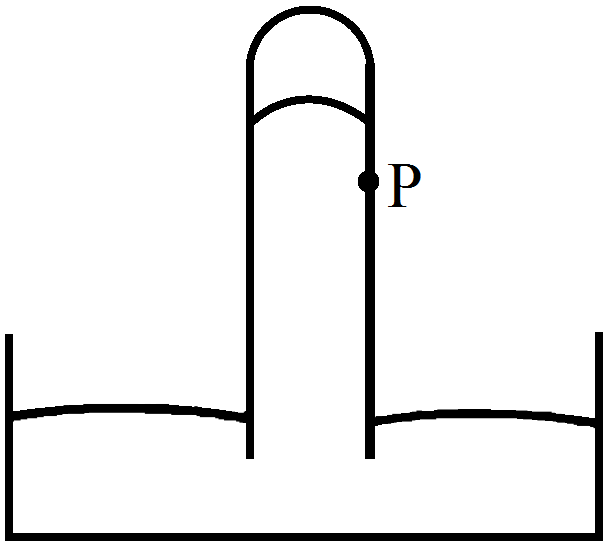
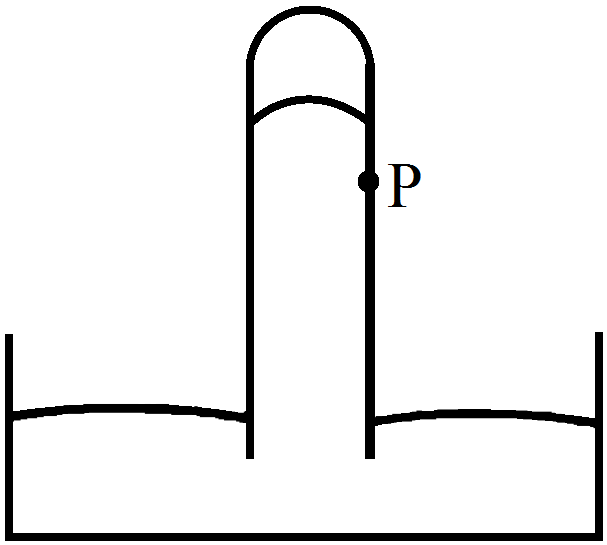 No, as pressure inside is less than atmospherise.