Questions

2 Marks Questions

Take a timed test

8 questions · self-marked practice — reveal the answer and mark yourself.

Question 12 Marks
A block of mass 2kg is pushed against a rough vertical wall with a force of 40N, coefficient of static friction being 0.5. Another horizontal force of 15N, is applied on the block in a direction parallel to the wall. Will the block move? If yes, in which direction? If no, find the frictional force exerted by the wall on the block.
Answer
Net force the block $=\sqrt{20^2+15^2}-(0.5)\times 40$$=25-20=5\text{N}$
$\therefore\tan\theta=\frac{20}{15}=\frac{4}{3}$
$\Rightarrow\mu=\tan^{-1}\Big(\frac{4}{3}\Big)=53^{\circ}$
So, the block will move at an angle 53° with an 15N force.
View full question & answer
Question 22 Marks
You are standing with your bag in your hands, on the ice in the middle of a pond. The ice is so slippery that it can offer no friction. How can you come out of the ice?
Answer
Throw the bag in opposite direction of lakeside from momentum conservation. You will gain velocity towards lakeside.
View full question & answer
Question 32 Marks
When two surfaces are polished, the friction coefficient between them decreases. But the friction coefficient increases and becomes very large if the surfaces are made highly smooth. Explain.
Answer
Because the number of bonds increases greatly between two surface if the surface is highly smooth.
View full question & answer
Question 42 Marks
A block of mass m is kept on a horizontal table. If the static friction coefficient is $\mu,$ find the frictional force acting on the block.
Answer

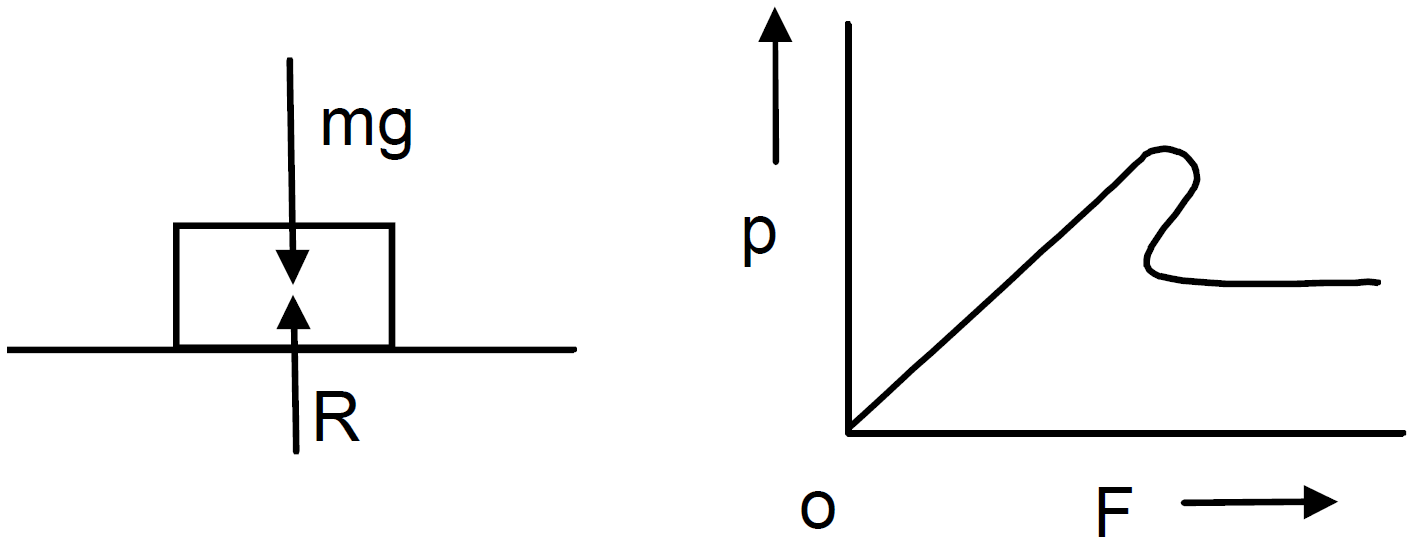
Body is kept on the horizontal table.
If no force is applied, no frictional force will be there
f → frictional force
F → Applied force
From grap it can be seen that when applied force is zero,
frictional force is zero.
View full question & answer
Question 52 Marks
A body slipping on a rough horizontal plane moves with a deceleration of $4.0m/s^2$. What is the coefficient of kinetic friction between the block and the plane?
Answer


Let $m =$ mass of the block
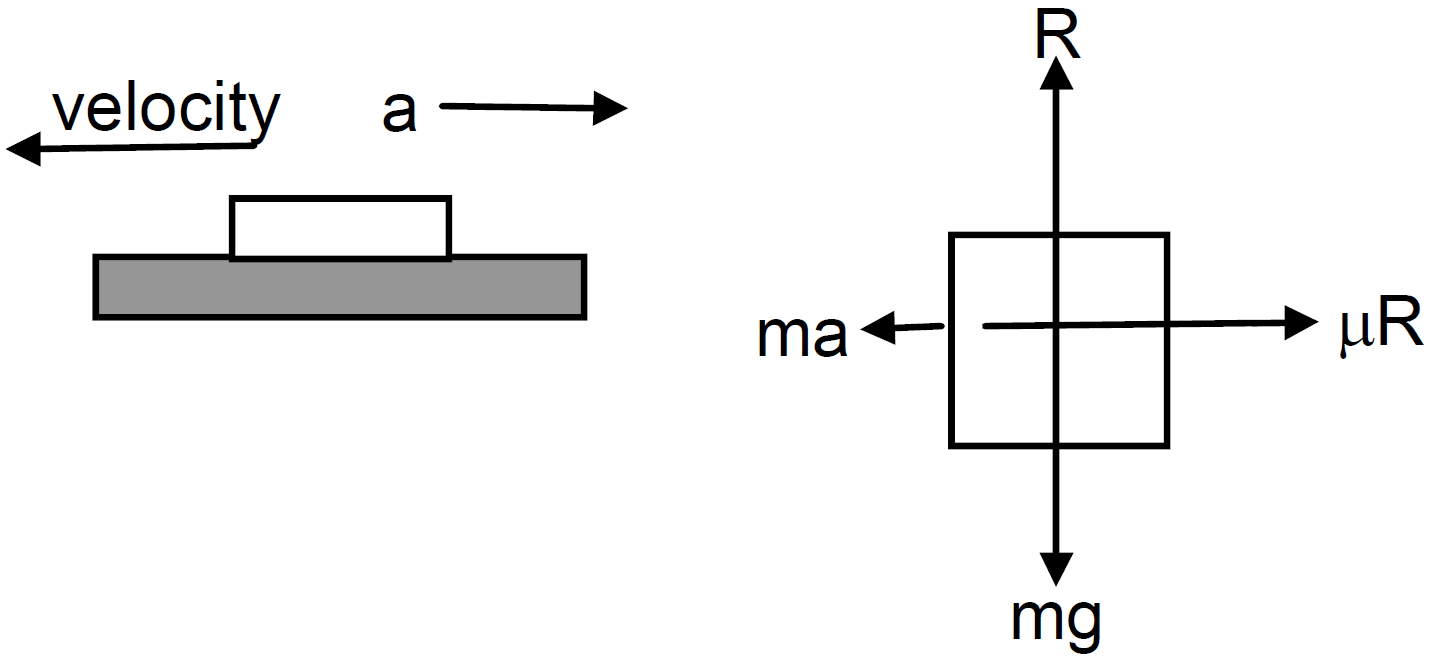
From the freebody diagram,
$\text{R}-\text{mg}=0\Rightarrow\text{mf} \ ...(1)$
Again $\text{ma}-\mu\text{R}=0\Rightarrow\text{ma}=\mu\text{R}=\mu\text{mg} ($from$(1))$
$\Rightarrow\text{a}=\mu\text{g}$
$\Rightarrow4=\mu\text{g}$
$\Rightarrow\mu=\frac{4}{\text{g}}=\frac{4}{10}=0.4$
The co$-$efficient of kinetic friction between the block and the plane is $0.4.$
View full question & answer
Question 62 Marks
Why do tyres have a better grip of the road while going on a level road than while going on an incline?
Answer
Normal on ground is mg but on incline it is mg $\cos\theta$ so on the incline $\mu_\text{N}$ will be less and hence less gripping.
View full question & answer
Question 72 Marks
Spring fitted doors close by themselves when released. You want to keep the door open for a long time, say for an hour. If you put a half kg stone in front of the open door, it does not help. The stone slides with the door and the door gets closed. However, if you sandwitch a 20g piece of wood in the small gap between the door and the floor, the door stays open. Explain why a much lighter piece of wood is able to keep the door open while the heavy stone fails.
Answer
In the initial case normal is equal to weight of body but in the second case as body is pressed so normal increases hence more normal more will be frictional force.
View full question & answer
Question 82 Marks
A classroom demonstration of Newton's first law is as follows: A glass is covered with a plastic card and a coin is placed on the card. The card is given a quick strike and the coin falls in the glass.
  1. Should the friction coefficient between the card and the coin be small or large?
  2. Should the coin be light or heavy?
  3. Why does the experiment fail if the card is gently pushed?
Answer
  1. Small.
  2. Heavy.
  3. If the card is pushed gently for more time frictional force will act on coin and it may gain more velocity and fall out.
View full question & answer