Questions

4 Marks Questions

Take a timed test

4 questions · self-marked practice — reveal the answer and mark yourself.

Question 14 Marks
A car starts from rest on a half kilometer long bridge. The coefficient of friction between the tyre and the road is $1.0$. Show that one cannot drive through the bridge in less than $10s.$
Answer
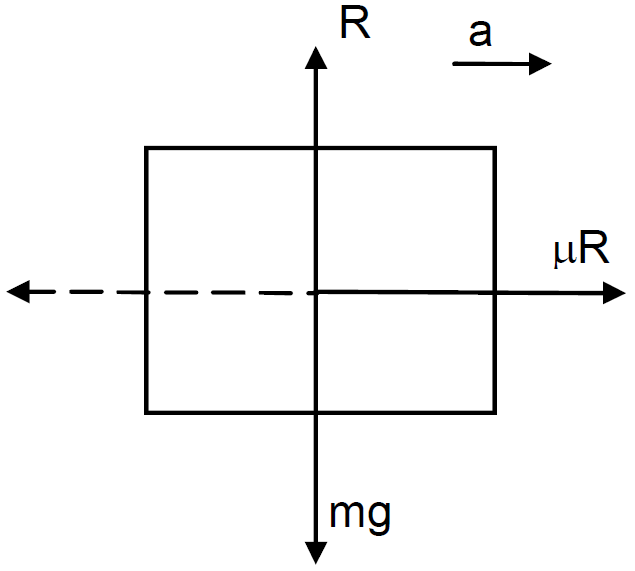
Let, a maximum acceleration produced in car.
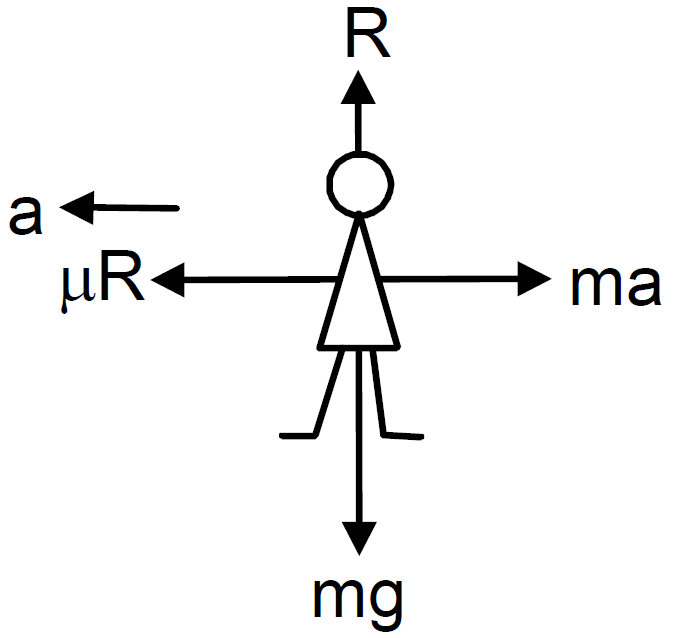
$\therefore\text{ma}=\mu\text{R} [$For more acceleration, the tyres will slip$]$
$\Rightarrow\text{ma}=\mu\text{mg}\Rightarrow\text{a}=\mu\text{g}=1\times10=10\text{m/s}^2$
For crossing the bridge in minimum time, it has to travel with maximum acceleration
$\text{u = 0, s = 500m, a = 10m/s}^2$
$\text{s = ut}+\frac{1}{2}\text{at}^2$
$\Rightarrow500=0+\Big(\frac{1}{2}\Big)10\text{t}^2\Rightarrow\text{t}=10\text{sec}.$
If acceleration is less than $10m/s^2$, time will be more than $10 \sec.$
So one can’t drive through the bridge in less than $10 \sec.$
View full question & answer
Question 24 Marks
The friction coefficient between an athelete's shoes and the ground is 0.90. Suppose a superman wears these shoes and races for 50m. There is no upper limit on his capacity of running at high speeds.
  1. Find the minimum time that he will have to take in completing the 50m starting from rest.
  2. Suppose he takes exactly this minimum time to complete the 50m, what minimum time will he take to stop?
Answer


To reach in minimum time, he has to move with maximum possible acceleration.
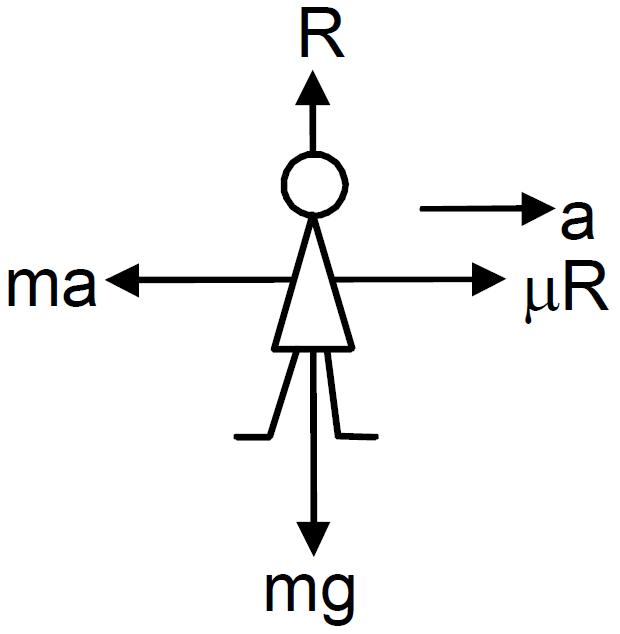
Let, the maximum acceleration is ‘a’
$\therefore\text{ma}-\mu\text{R}=0\Rightarrow\text{ma}=\mu\text{mg}$
$\Rightarrow\text{a}=\mu\text{g}=0.9\times10=9\text{m/s}^2$
  1. Initial velocity $\text{u = 0, t = ?}$
$\text{a}=9\text{m/s}^2,\text{s}=50\text{m}$
$\text{s = ut}+\frac{1}{2}\text{at}^2\Rightarrow50=0+\Big(\frac{1}{2}\Big)9\text{t}^2$
$\Rightarrow\text{t}=\sqrt{\frac{100}{9}}=\frac{10}{3}\text{sec}.$
  1. After overing 50m, velocity of the athelete is
$\text{V = u + at}=0+9\times\Big(\frac{10}{3}\Big)=30\text{m/s}$
He has to stop in minimum time. So deceleration ia $-\text{a}=-9\text{m/s}^2(\text{max})$
$\text{R = ma}$
$\text{ma}=\mu\text{R}$ (max frictional force)
$\Rightarrow\text{a}=\mu\text{g}=9\text{m/s}^2$ (Deceleration)
$\text{u}^1=30\text{m/s},\text{ v}^1=0$
$\text{t}=\frac{\text{v}^1-\text{u}^1}{\text{a}}=\frac{0-30}{-\text{a}}=\frac{-30}{-\text{a}}=\frac{10}{3}\text{sec}.$
View full question & answer
Question 34 Marks
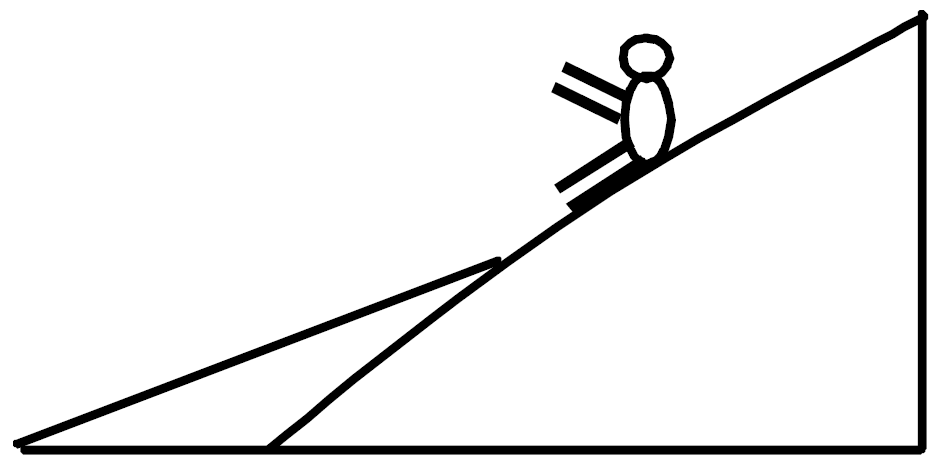
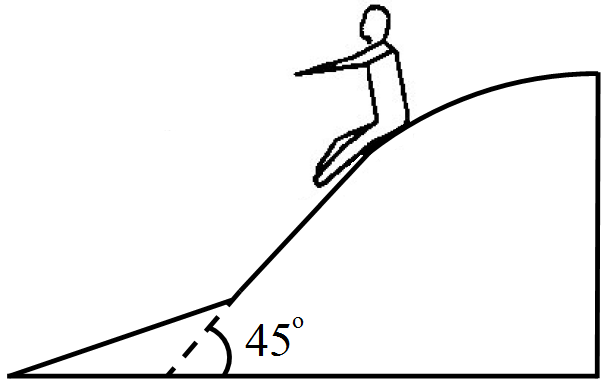
In a children$-$park an inclined plane is constructed with an angle of incline $45^\circ$ in the middle part. Find the acceleration of a boy sliding on it if the friction coefficient between the cloth of the boy and the incline is $0.6$ and $g = 10m/s^2$.
Answer


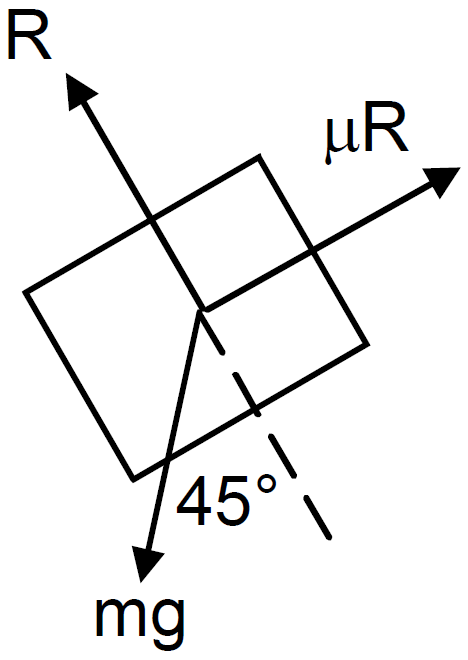
$m \rightarrow $ mass of child
$\text{R}-\text{mg}\cos45^{\circ}=0$
$\Rightarrow\text{R = mg}\cos45^{\circ}=\text{mg/v}^2 \ ..(1)$
Net force acting on the boy due to which it slides down is $\text{mg}\sin45^{\circ}-\mu\text{R}$
$=\text{mg}\sin45^{\circ}-\mu\text{mg}\cos45^{\circ}$
$=\text{m}\times10\Big(\frac{1}{\sqrt{2}}\Big)-0.6\times\text{m}\times10\times\Big(\frac{1}{\sqrt{2}}\Big)$
$=\text{m}\Big[\Big(\frac{5}{\sqrt{2}}\Big)-0.6\times\Big(\frac{5}{\sqrt{2}}\Big)\Big]$
$=\text{m}(2\sqrt{2})$
acceleration $=\frac{\text{Force}}{\text{mass}}=\frac{\text{m}(2\sqrt{2})}{\text{m}}=2\sqrt{2}\text{m/s}^2$
View full question & answer
Question 44 Marks
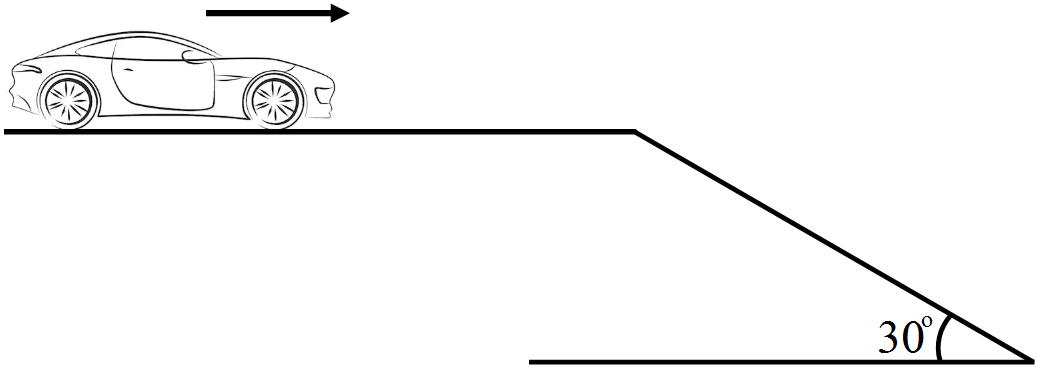
A car is going at a speed of $21.6\ km/hr $ when it encounters a $12.8m$ long slope of angle $30^\circ$ . The friction coefficient between the road and the tyre is $\frac{1}{2\sqrt{3}}.$ Show that no matter how hard the driver applies the brakes, the car will reach the bottom with a speed greater than $36\ km/hr$. Take $g = 10m/s^2.$​​​​​​​
Answer


Hardest brake means maximum force of friction is developed between car’s type road.
Max frictional force $=\mu\text{R}$
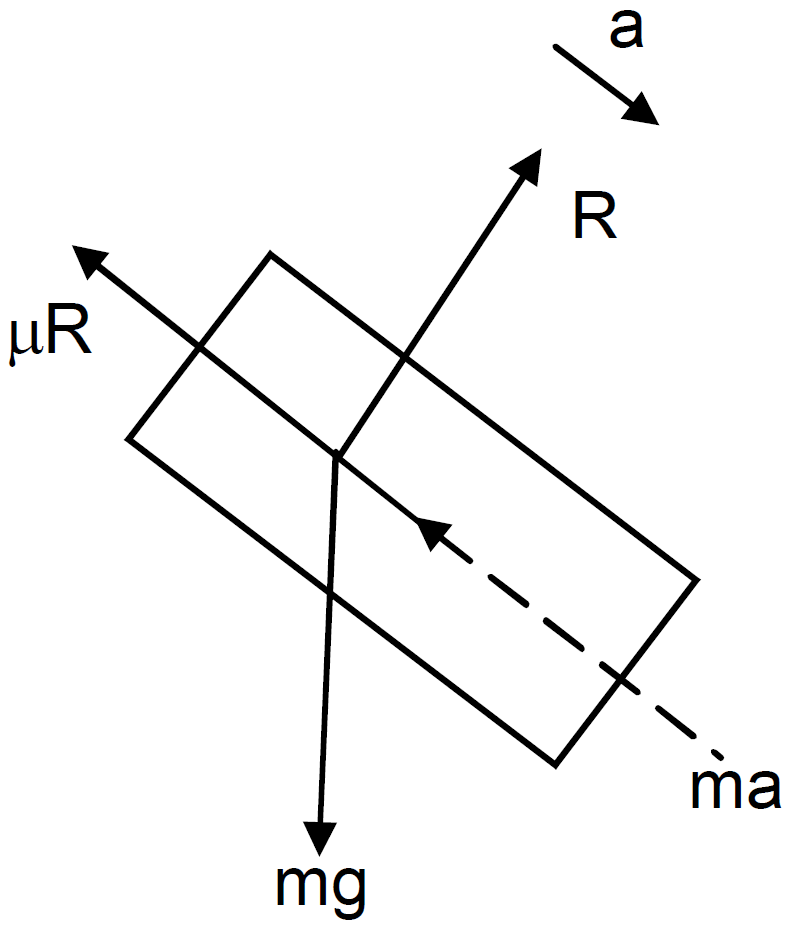
From the free body diagram
$\text{R}-\text{mg}\cos\theta=0$
$\Rightarrow\text{R}=\text{mg}\cos\theta \ ...(\text{i})$
and $(\mu\text{R + ma}-\text{mg}\sin)=0 \ ...(\text{ii})$
$\Rightarrow\mu\text{mg}\cos\theta+\text{ma}-\text{mg}\sin\theta=0$
$\Rightarrow\mu\text{g}\cos\theta+\text{a}-10\times\Big(\frac{1}{2}\Big)=0$
$\Rightarrow\text{a}=5-\{1-(2\sqrt{3})\}\times10\Big(\frac{\sqrt{3}}{2}\Big)=2.5\text{m/s}^2$
When, hardest brake is applied the car move with acceleration $2.5m/s^2$
$\text{S = 12.8m, u = 6m/s}$
So, velocity at the end of incline
$\text{V}=\sqrt{\text{u}^2+2\text{as}}=\sqrt{6^2+2(2.5)(12.8)}$
$=\sqrt{36+64}=10\text{m/s}=36\text{km/h}$
Hence how hard the driver applies the brakes, that car reaches the bottom with least velocity $36km/h.$
View full question & answer