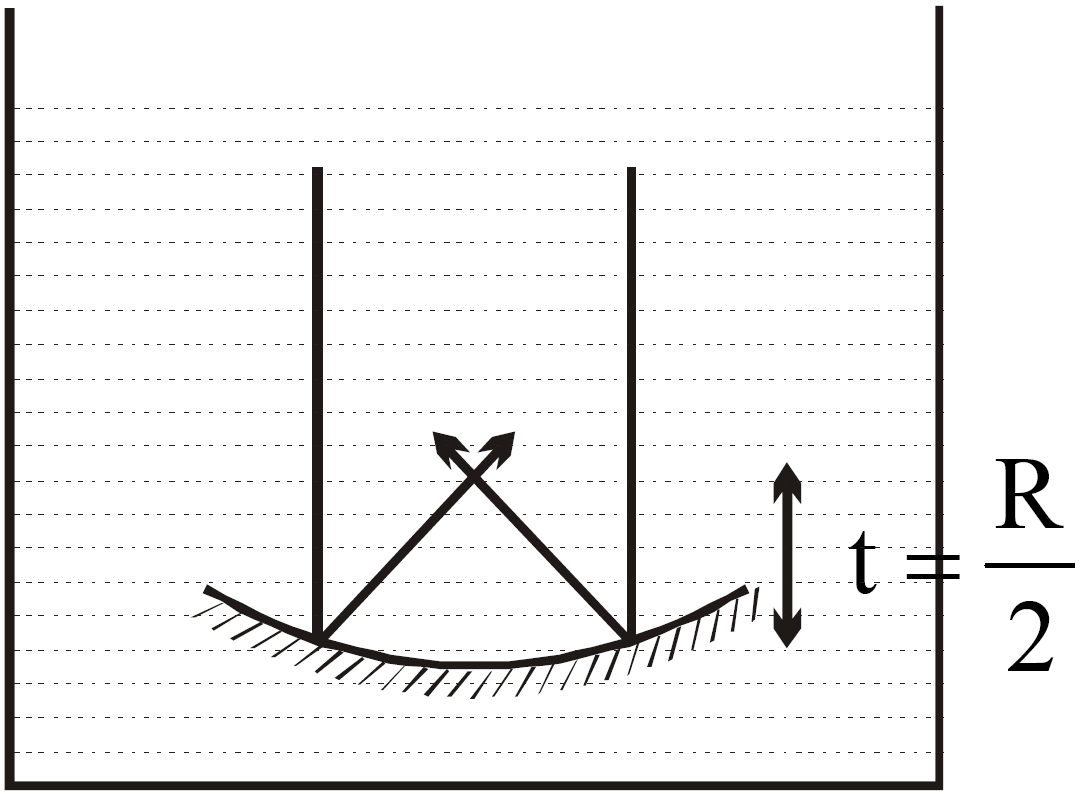
If a spherical mirror is dipped in water, does its focal length change?
Answer
No (offcourse we always take the thickness of mirror to be 3 to 4mm only)
If thickness of mirror is there then refraction through glass and water is to be considered.
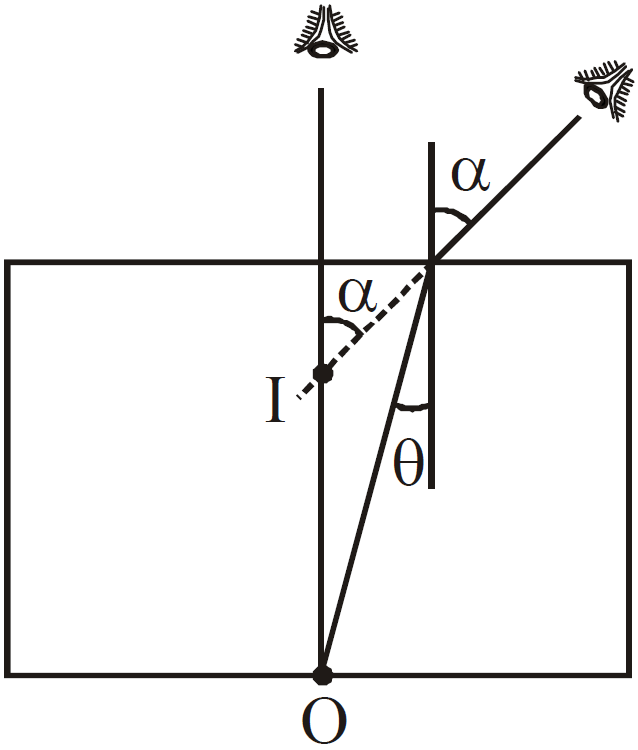
Is the formula "Real depth/ Apparent depth $=\mu$" valid if viewed from a position quite away from the normal?
Answer
No, In the derivation of above formulae $\sin\theta\approx\tan\theta$ this can be done only when angle is small. For eye 1 this approximation can be done but not for eye 2.
A converging lens of focal length $12\ cm$ and a diverging mirror of focal length $7.5\ cm$ are placed $5.0\ cm$ apart with their principal axes coinciding. Where should an object be placed so that its image falls on itself?
Answer
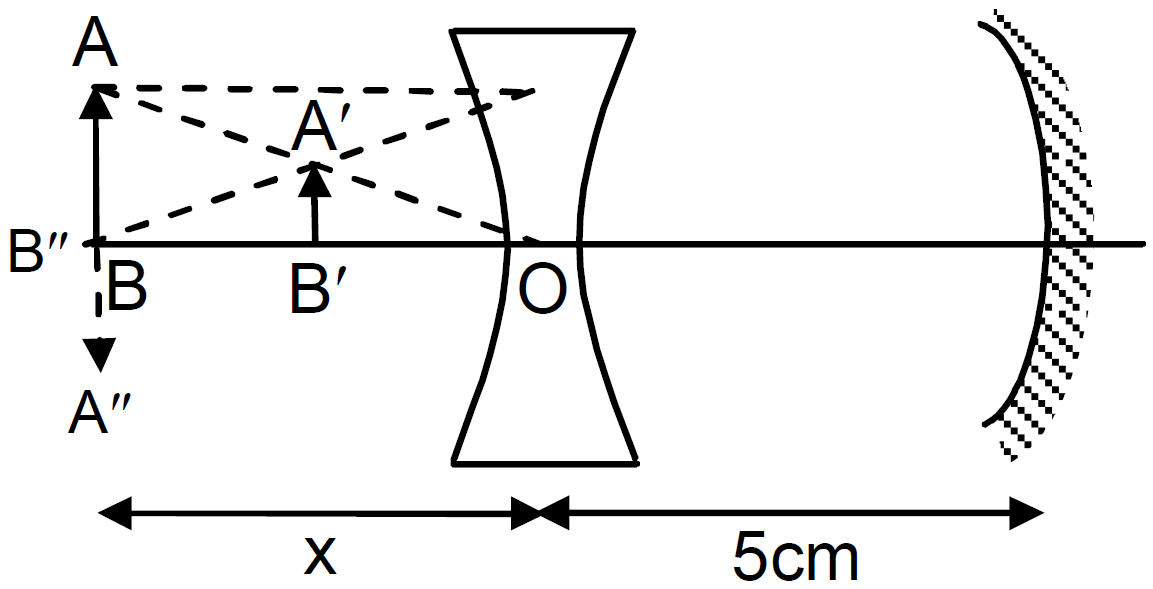
Let the object be placed at a distance $x$cm from the lens $($away from the mirror$).$
For the convex lens $(1^{st}$ refraction$) u = -x, f = -12\ cm$ From the lens formula:$\frac{1}{\text{v}}-\frac{1}{\text{u}}=\frac{1}{\text{f}}$
$\Rightarrow \frac{1}{\text{v}}=\frac{1}{(-12)}+\frac{1}{-\text{x}}$
$\Rightarrow \text{v}=-\Big(\frac{12\text{x}}{\text{x}+12}\Big)$
Thus, the virtual image due to the first refraction lies on the same side as that of object A'B'. This image becomes the object for the convex mirror, For the mirror,$\text{u}=-\Big(5+\frac{12\text{x}}{\text{x}+12}\Big)$
$=-\Big(\frac{17\text{x}+60}{\text{x}+12}\Big)$
$\text{f}=-7.5\text{cm}$
From mirror equation,$\frac{1}{\text{v}}+\frac{1}{\text{u}}=\frac{1}{\text{f}}$
$\Rightarrow \frac{1}{\text{v}}=\frac{1}{-7.5}+\frac{\text{x}+12}{17\text{x}+60}$
$\Rightarrow \frac{1}{\text{v}}=\frac{17\text{x}+60-7.5}{7.5(17\text{x}+60)}$
$\Rightarrow \text{v}=\frac{7.5(17\text{x}+60)}{52.5-127.5\text{x}}$
$\Rightarrow \text{v}=\frac{250(\text{x}+4)}{15\text{x}-100}$
$\Rightarrow \text{v}=\frac{50(\text{x}+4)}{(3\text{x}-20)}$
Thus, this image is formed towards the left of the mirror. Again for second refraction in concave lens,$\text{u}=-\Big[\frac{5-50(\text{x}+4)}{3\text{x}-20}\Big]$
$($assuming that the image of mirror formed between the lens and mirror is $3x - 20),\text{v}=\pm\text{x}$ (since, the final image is produced on the object $A"B")$
Using lens formula:$\frac{1}{\text{v}}-\frac{1}{\text{u}}=\frac{1}{\text{f}}$
$\Rightarrow \frac{1}{\text{x}}+\frac{1}{\frac{5-50(\text{x}\times4)}{3\text{x}-20}}=\frac{1}{-20}$
$\Rightarrow 25\text{x}^2-1400\text{x}-6000=0$
$\Rightarrow \text{x}^2-56\text{x}-240=0$
$\Rightarrow (\text{x}-60)(\text{x}+4)=0$
Thus, $\text{x}=60\text{m}$
If a thin lens is dipped in water, does its focal length change?
Answer
Yes,$\frac{1}{\text{f}_2}=\Big(\frac{\mu_2}{\mu_\text{m}}-1\Big)\Big[\frac{1}{\text{R}_1}-\frac{1}{\text{R}_2}\Big]$
Is $\mu_{\text{medium}}$ is changed focal length gets changed.
A thin converging lens is formed with one surface convex and the other plane. Does the position of image depend on whether the convex surface or the plane surface faces the object?
Answer
No, If it is a thin lens then focal length is not effected by from which side ray falls.
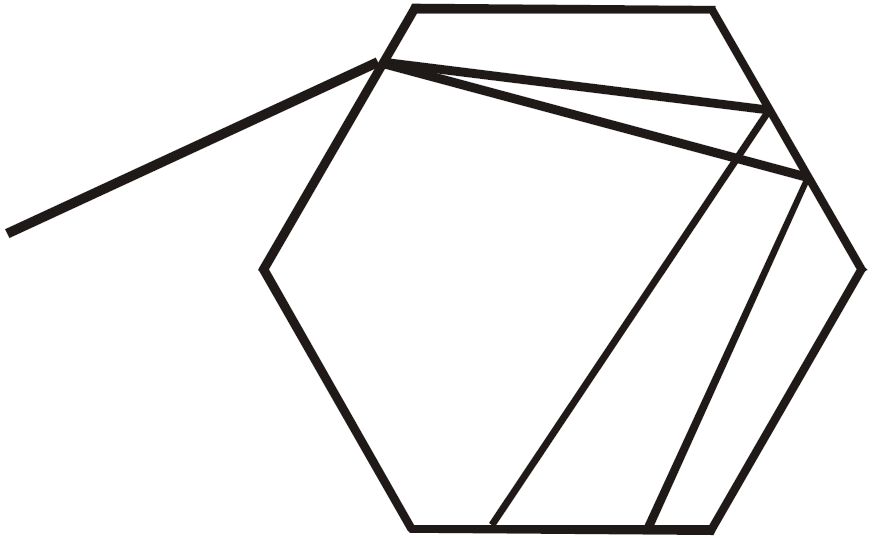
Why does a diamond shine more than a glass piece cut to the same shape?
Answer
M is concept: The ray get trapped inside the diamond and undergo multiple reflection and shine. Concept: When while light falls on diamond as critical angle is very small it undergo multiple TIR before coming out more is TIR more separation is between the different colours when this light comes out and fall on eye. It due to different colours it shines.
A diverging lens of focal length $20\ cm$ and a converging mirror of focal length $10\ cm$ are placed coaxially at a separation of $5\ cm.$ Where should an object be placed so that a real image is formed at the object itself?
Answer
Let the object to placed at a distance $x$ from the lens further away from the mirror.
For the concave lens $(1^{st}$ refraction$)$
$u = -x, f = -20\ cm$
From lens formula,
$\frac{1}{\text{v}}-\frac{1}{\text{u}}=\frac{1}{\text{f}}$
$\Rightarrow\frac{1}{\text{v}}=\frac{1}{-20}+\frac{1}{-\text{x}}$
$\Rightarrow\text{v}=-\Big(\frac{20\text{x}}{\text{x}+20}\Big)$
So, the virtual image due to fist refraction lies on the same side as that of object. $(A'B')$
This image becomes the object for the concave mirror.
For the mirror,
$\Rightarrow\text{u}=-\Big(5+\frac{20\text{x}}{\text{x}+20}\Big)=-\Big(\frac{25\text{x}+100}{\text{x}+20}\Big)$
$\text{f}=-10\text{ cm}$
From mirror equation,
$\frac{1}{\text{v}}-\frac{1}{\text{u}}=\frac{1}{\text{f}}\Rightarrow\frac{1}{\text{v}}=\frac{1}{-10}+\frac{\text{x}+20}{25\text{x}+100}$
$\Rightarrow\text{v}=\frac{50(\text{x}+4)}{3\text{x}-20}$
So, this image is formed towards left of the mirror.
Again for second refraction in concave lens,
$\text{u}=-\Big[5-\frac{50(\text{x}+4)}{3\text{x}-20}\Big]$ (assuming that image of mirror is formed between the lens and mirro $3x -20)$
$\text{v}=+\text{x}$ (Since, the final image is produced on the object $A"B")$
Using lens formula,
$\frac{1}{\text{v}}-\frac{1}{\text{u}}=\frac{1}{\text{f}}$
$\Rightarrow\frac{1}{\text{x}}+\frac{1}{\frac{5-50(\text{x}+4)}{3\text{x}-20}}=\frac{1}{-20}$
$\Rightarrow 25\text{x}^2-1400\text{x}-6000=0$
$\Rightarrow\text{x}^2-56\text{x} -240=0$
$\Rightarrow (\text{x}-60)(\text{x}+4)=0$
So, $\Rightarrow\text{x}=60\text{ cm}$
The object should be placed at a distance $60\ cm$ from the lens further away from the mirror.
So that the final image is formed on itself.
Two converging lenses of unequal focal lengths can be used to reduce the aperture of a parallel beam of light without losing the energy of the light. This increases the intensity. Describe how the converging lenses should be placed to do this.
Answer
Point p is focal length of lens 1 as well as lens 2.
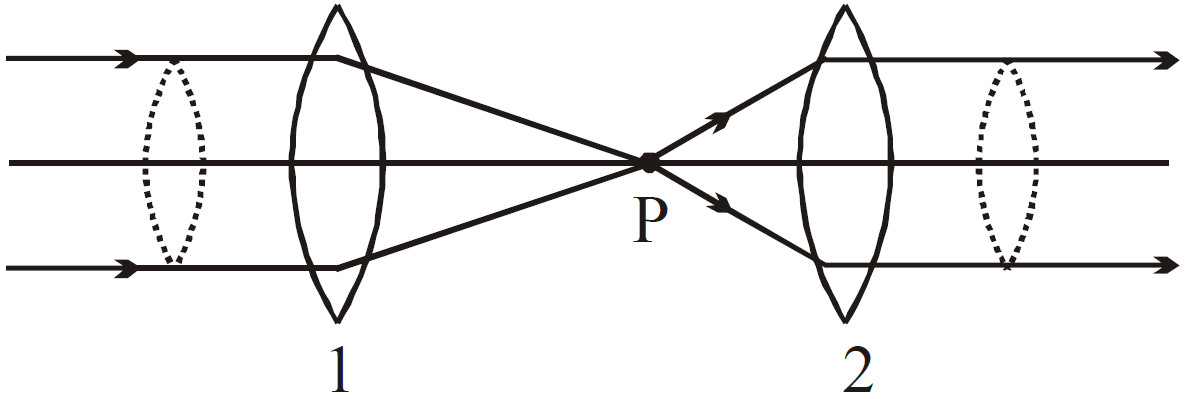 Point p is focal length of lens 1 as well as lens 2.