Question 13 Marks
A small piece of wood is floating on the surface of a 2.5m deep lake. Where does the shadow form on the bottom when the sun is just setting? Refractive index of water $=\frac{4}{3}.$
Answer
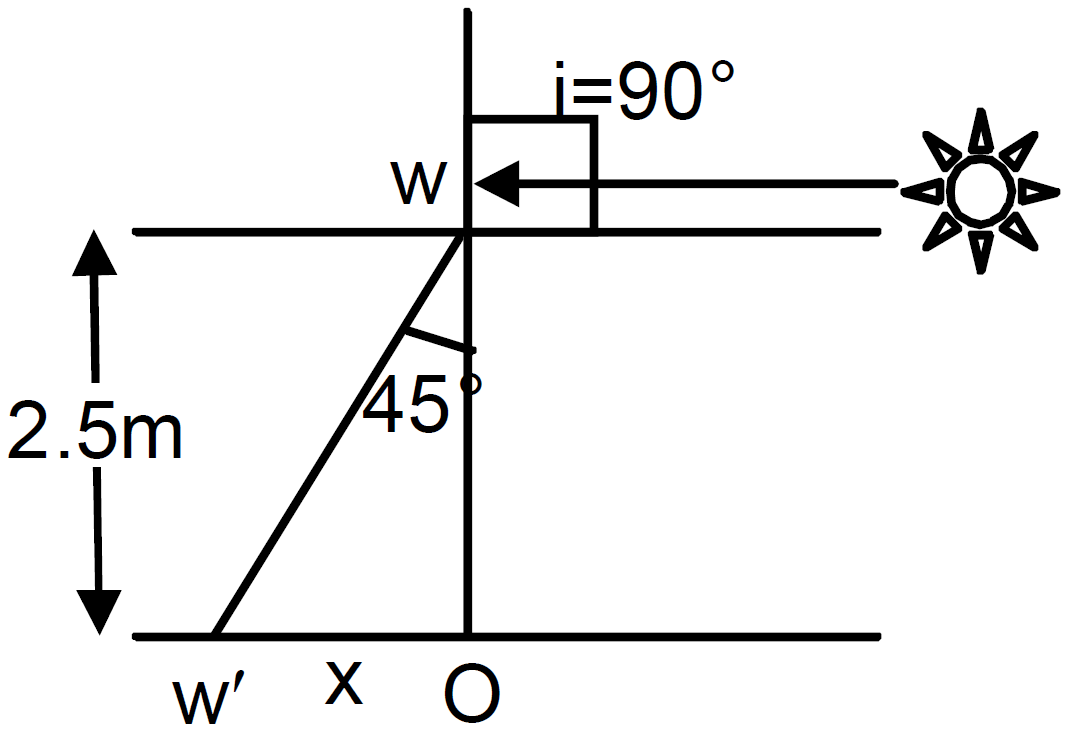 Height of the lake = 2.5m
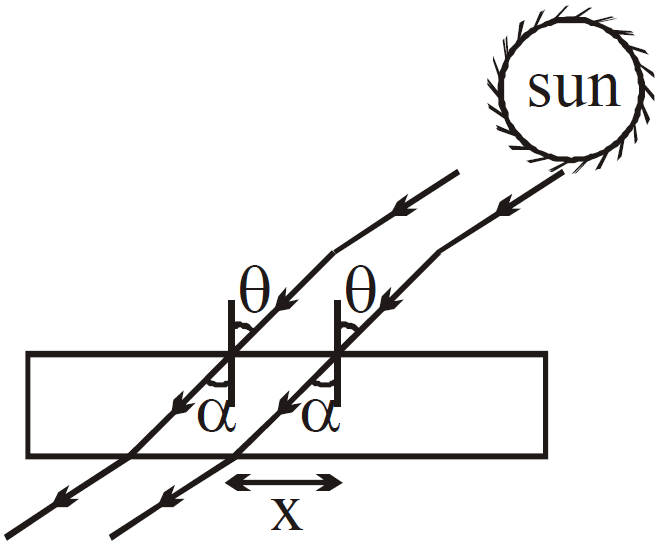
When the sun is just setting, $\theta$ is approximately = 90°
$\therefore \ \frac{\sin\text{i}}{\sin\text{r}}=\frac{\mu_2}{\mu_1}\Rightarrow\frac{1}{\sin\text{r}}=\frac{\frac{4}{3}}{1}\Rightarrow\sin\text{r}=\frac{3}{4}\Rightarrow\text{r}=49^{\circ}$
As shown in the figure, $\frac{\text{x}}{2.5}=\tan\text{r}=1.15$
$\Rightarrow\text{x}=2.5\times1.15=2.8\text{m}.$
View full question & answer→Height of the lake = 2.5mWhen the sun is just setting, $\theta$ is approximately = 90°
$\therefore \ \frac{\sin\text{i}}{\sin\text{r}}=\frac{\mu_2}{\mu_1}\Rightarrow\frac{1}{\sin\text{r}}=\frac{\frac{4}{3}}{1}\Rightarrow\sin\text{r}=\frac{3}{4}\Rightarrow\text{r}=49^{\circ}$
As shown in the figure, $\frac{\text{x}}{2.5}=\tan\text{r}=1.15$
$\Rightarrow\text{x}=2.5\times1.15=2.8\text{m}.$
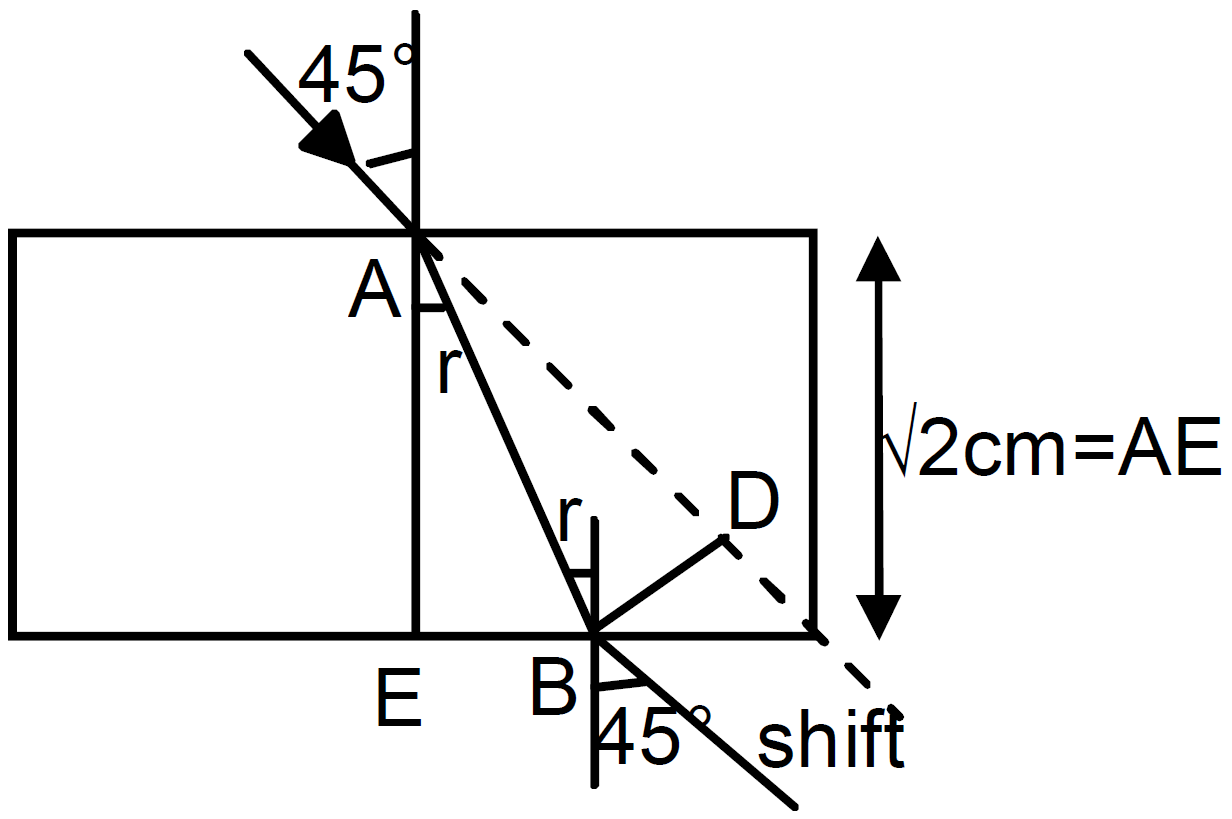 Applying snell's law,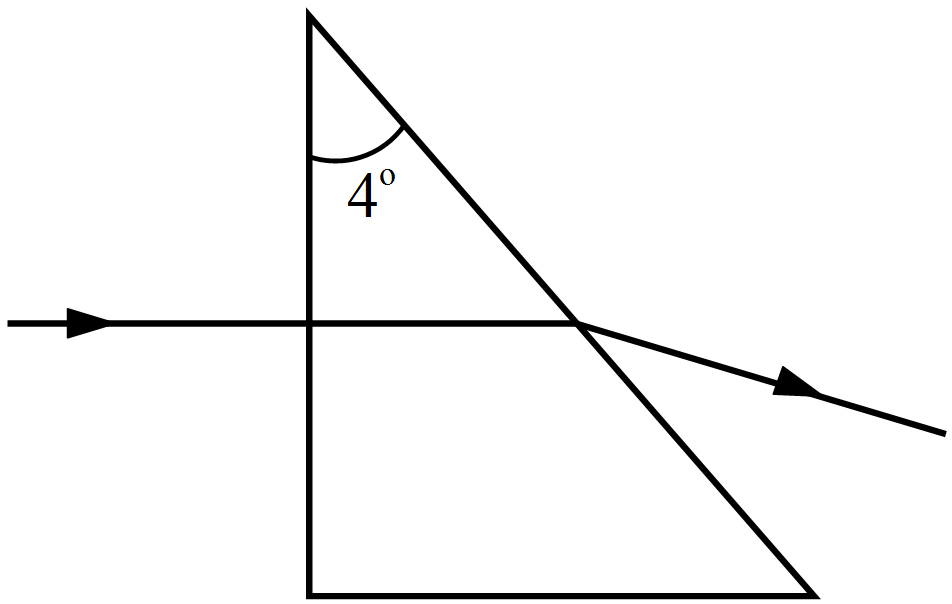
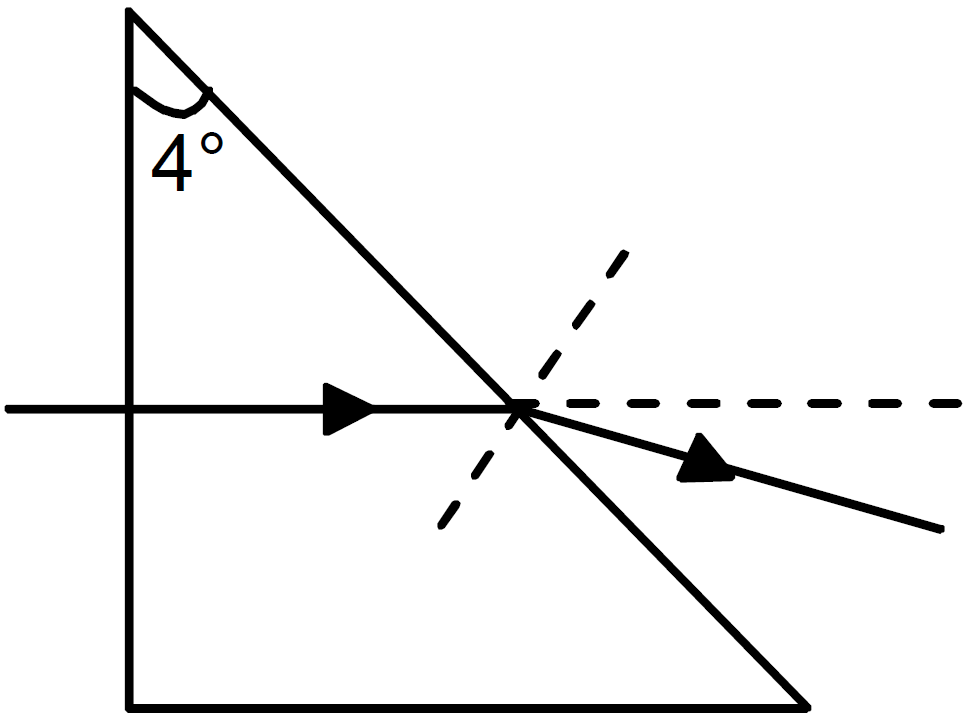 Given, $\mu=1.5$ And angle of prism $=4^{\circ}$$\therefore \ \mu=\frac{\sin\big(\frac{\text{A}+\delta_{\text{m}}}{2}\big)}{\frac{\sin\text{A}}{2}}=\frac{\big(\frac{\text{A}+\delta_{\text{m}}}{2}\big)}{\big(\frac{\text{A}}{2}\big)}$ $\big($for small angle $\sin\theta=\theta\big)$
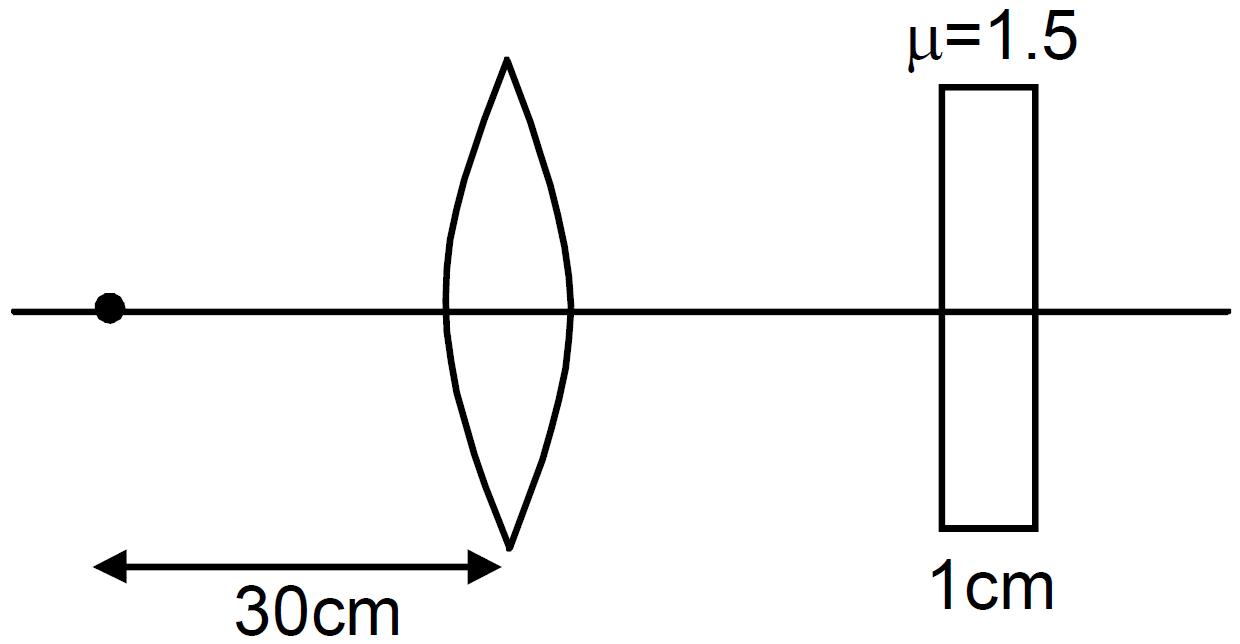 For the lens, f = 15cm, u = 30cm From lens formula $\frac{1}{\text{v}}-\frac{1}{\text{u}}=\frac{1}{\text{f}}$$\Rightarrow\frac{1}{\text{v}}=\frac{1}{15}-\frac{1}{30}=\frac{1}{30}\Rightarrow\text{v}=30\text{cm}$
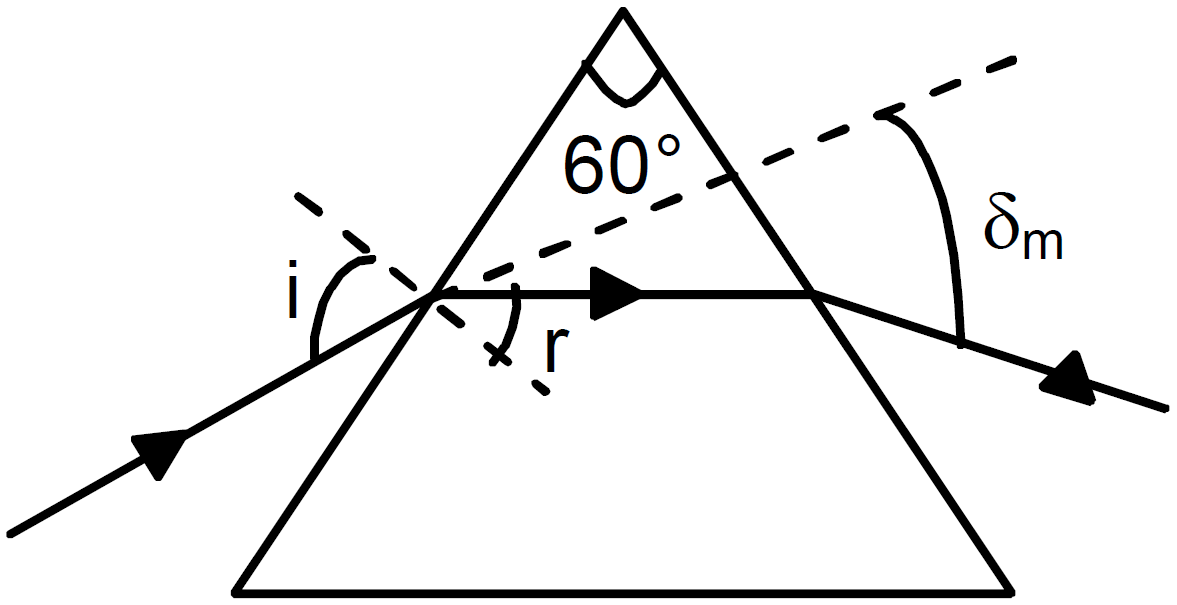 Where $\delta_{\text{min}}$ is the angleof minimum deviation and A is the angle of prism = 60º$\Rightarrow 1.732\times \sin(30^\circ)=\sin\Big(\frac{\delta_{\text{min}}+60^\circ}{2}\Big)$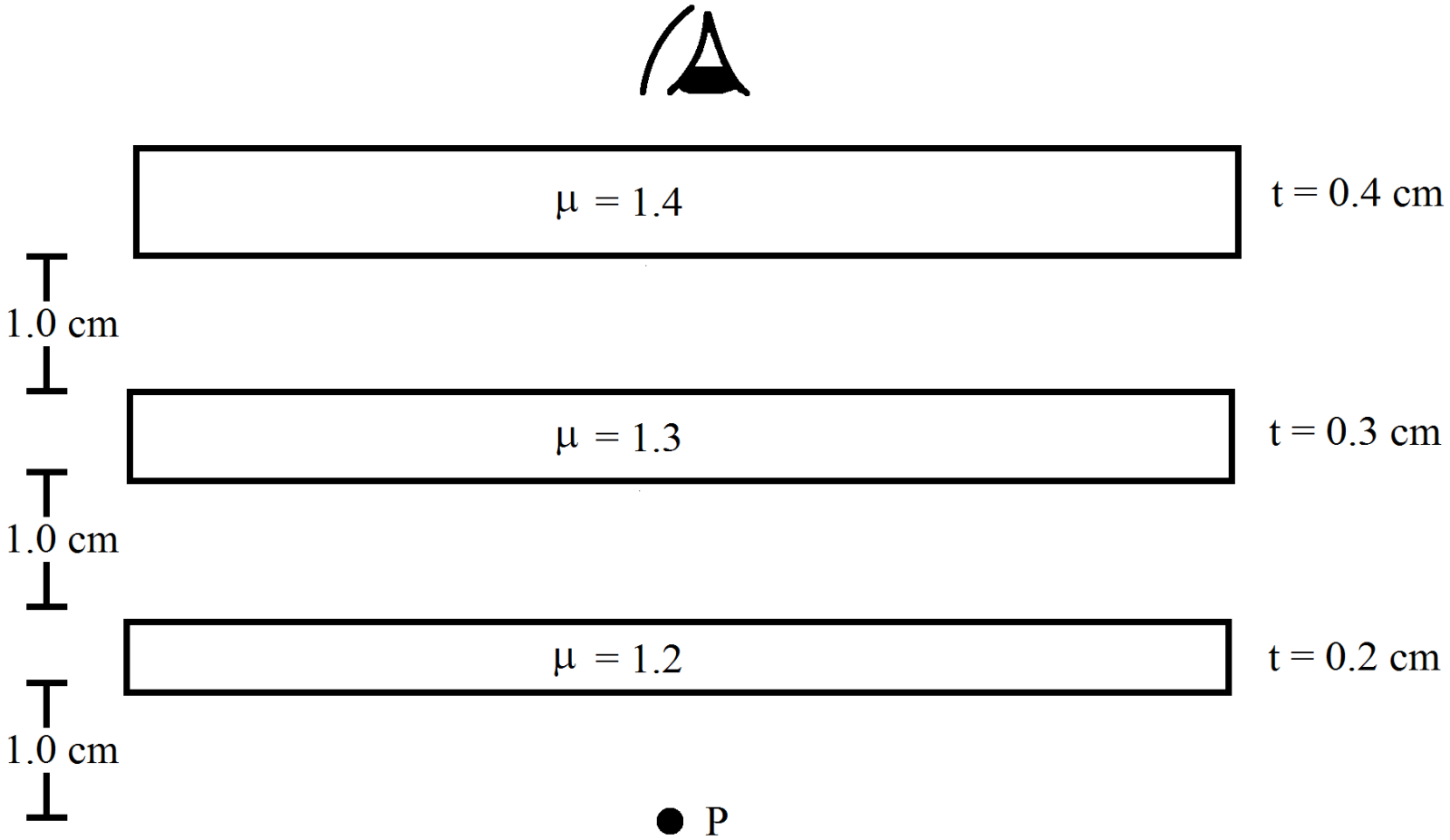
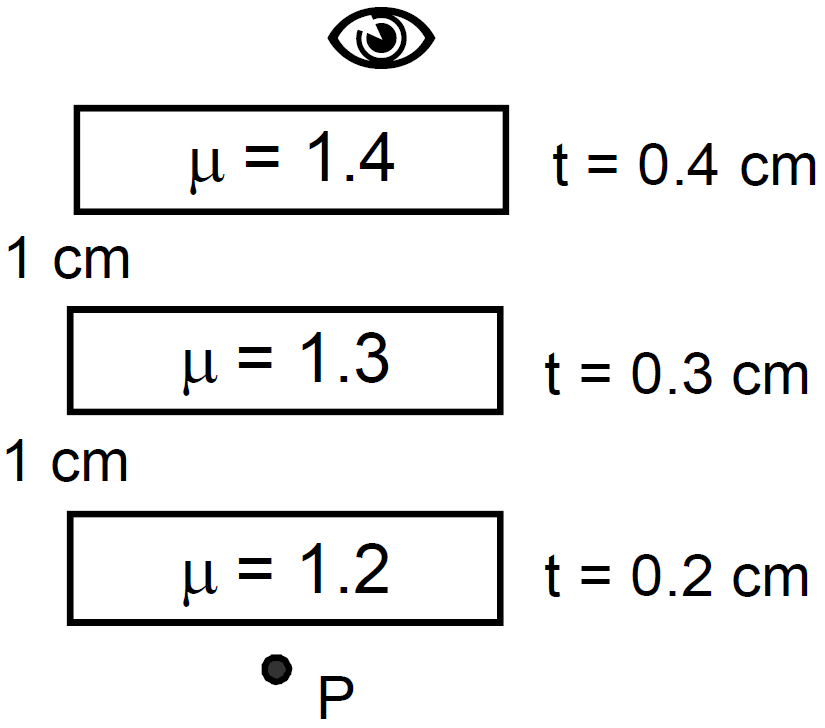 The presence of air medium in between the sheets does not affect the shift. The shift will be due to 3 sheets of different refractive index other than air.$\Delta \text{t}=\Big[1-\frac{1}{\mu_1}\Big]\text{t}_1+\Big[1-\frac{1}{\mu_2}\Big]\text{t}_2+\Big[1-\frac{1}{\mu_3}\Big]\text{t}_3$
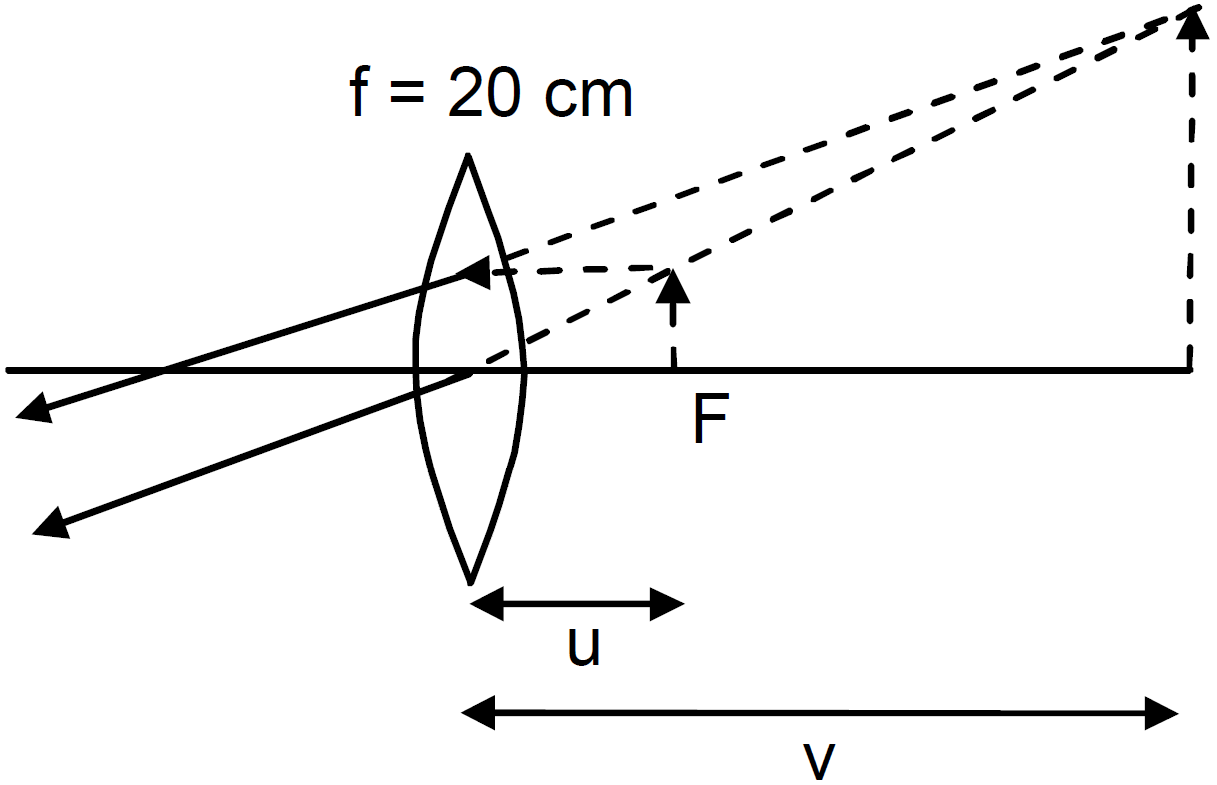 Given, P = 5 diopter (convex lens)$\Rightarrow\text{f}=\frac{1}{5}\text{m}=20\text{cm}$
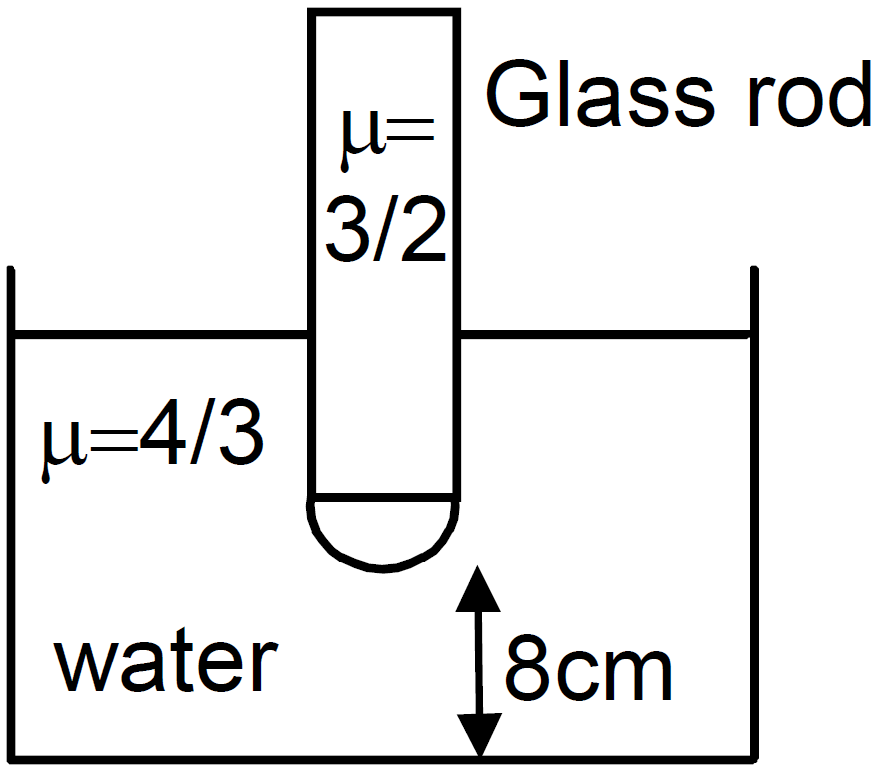 Radius of the cylindrical glass tube = 1cm We know, $\frac{\mu_2}{\text{v}}-\frac{\mu_1}{\text{u}}=\frac{\mu_2-\mu_1}{\text{R}}$ Here, $\text{u}=-8\text{cm}, \ \mu_2=\frac{3}{2},\mu_1=\frac{4}{3},\text{R}=+1\text{cm}$ So, $\frac{3}{2\text{v}}+\frac{4}{3\times8}\Rightarrow\frac{3}{2\text{v}}+\frac{1}{6}=\frac{1}{6}$$ \ \text{v}=\infty$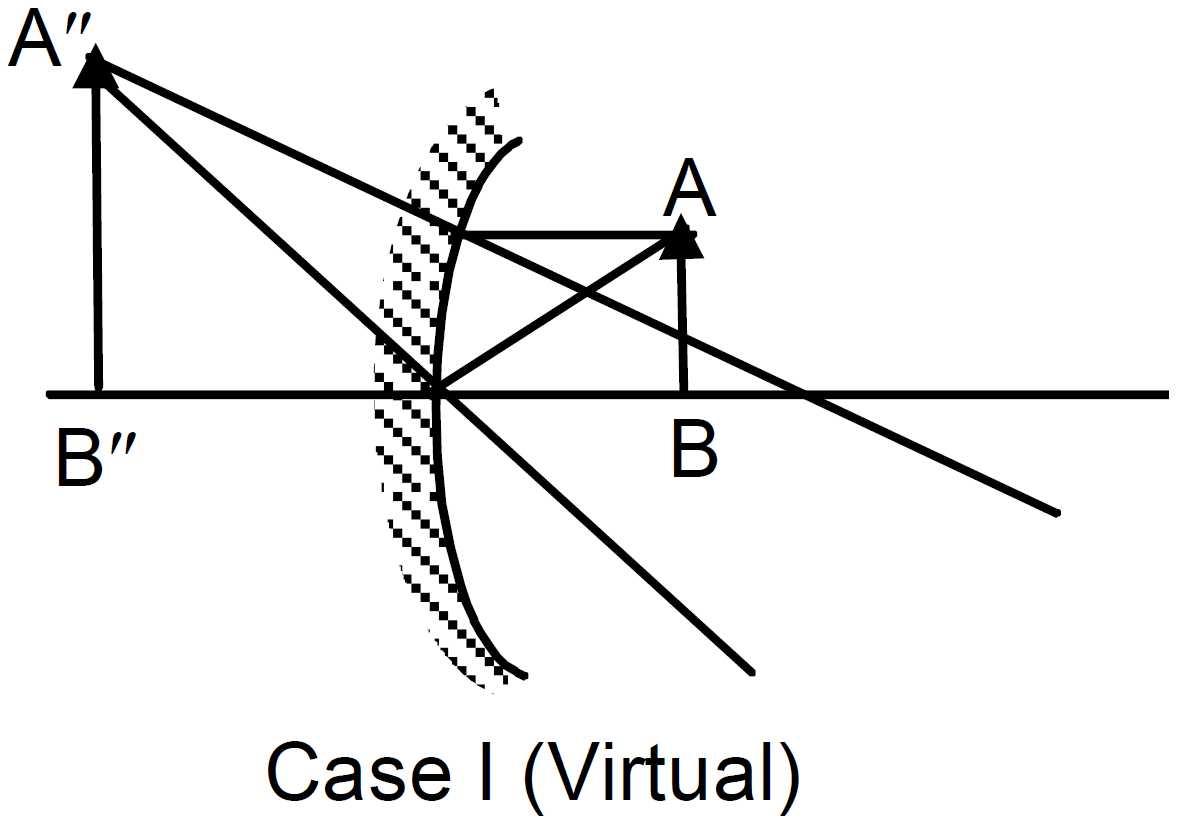
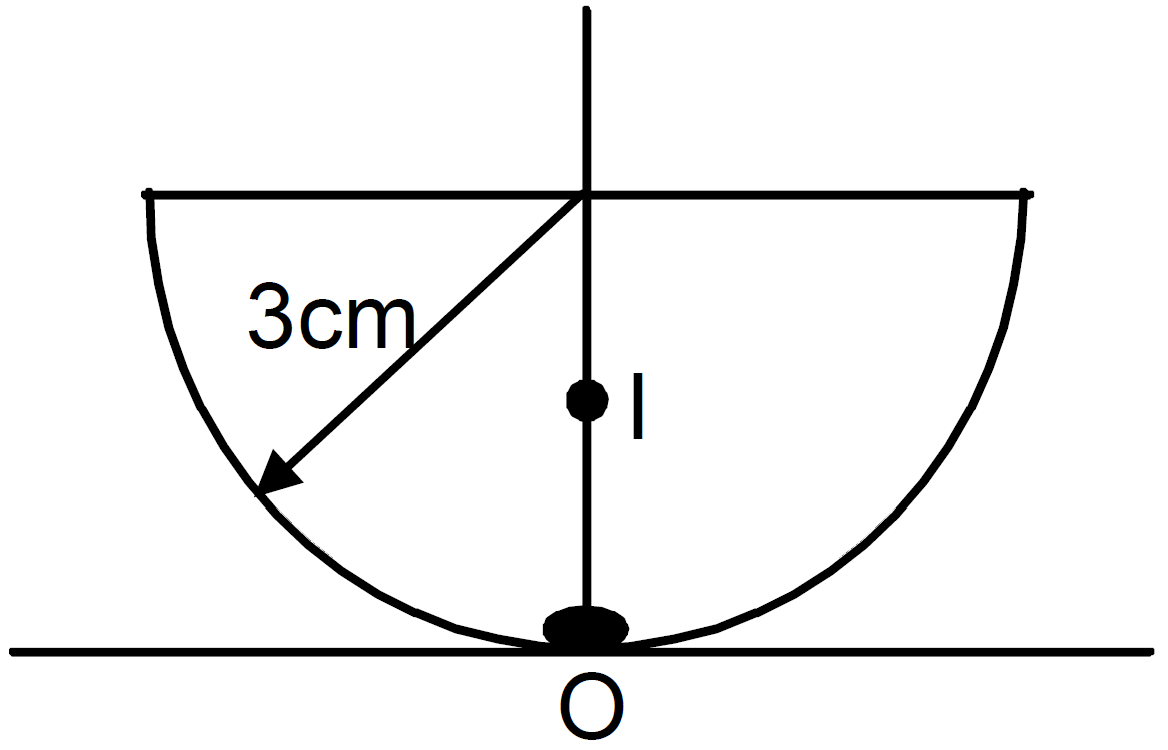 Thickness of glass $=3\text{cm}, \ \mu_{\text{g}}=1.5$ Image shif $=3\Big(1-\frac{1}{1.5}\Big)$ [Treating it as a simple refraction problem because the upper surface is flat and the spherical surface is in contact with the object]$=3\times\frac{0.5}{1.5}=1\text{cm}.$
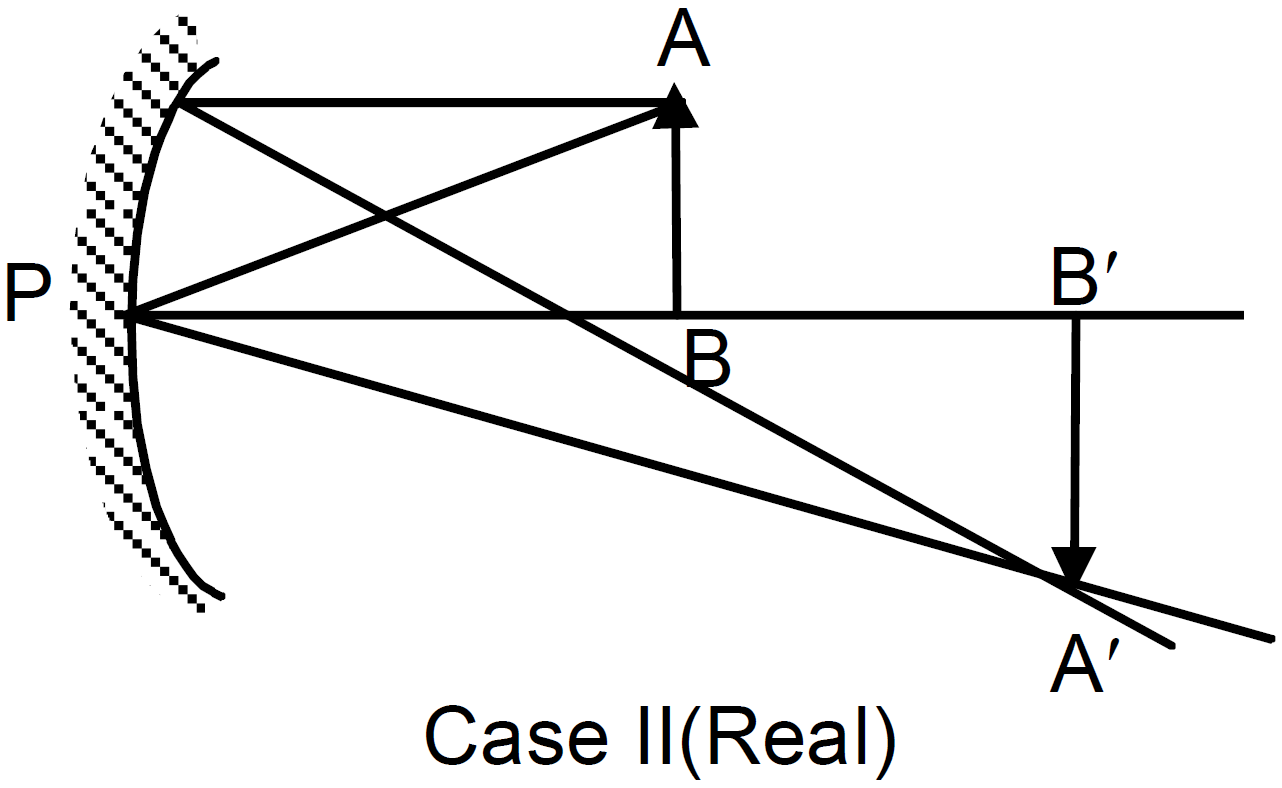
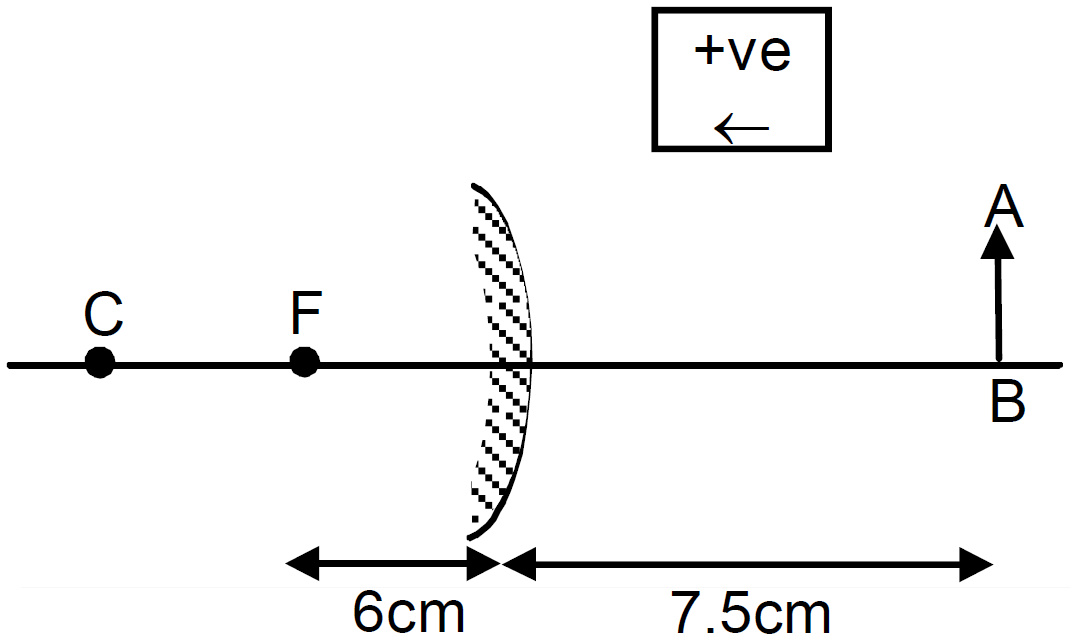 Given AB = 3cm, u = -7.5cm, f = 6cm. Using $\Rightarrow\frac{1}{\text{v}}+\frac{1}{\text{u}}=\frac{1}{\text{f}}\Rightarrow\frac{1}{\text{v}}=\frac{1}{\text{f}}-\frac{1}{\text{u}}$ Putting values according to sign conventions,$\frac{1}{\text{v}}=\frac{1}{6}-\frac{1}{-7.5}=\frac{3}{10}$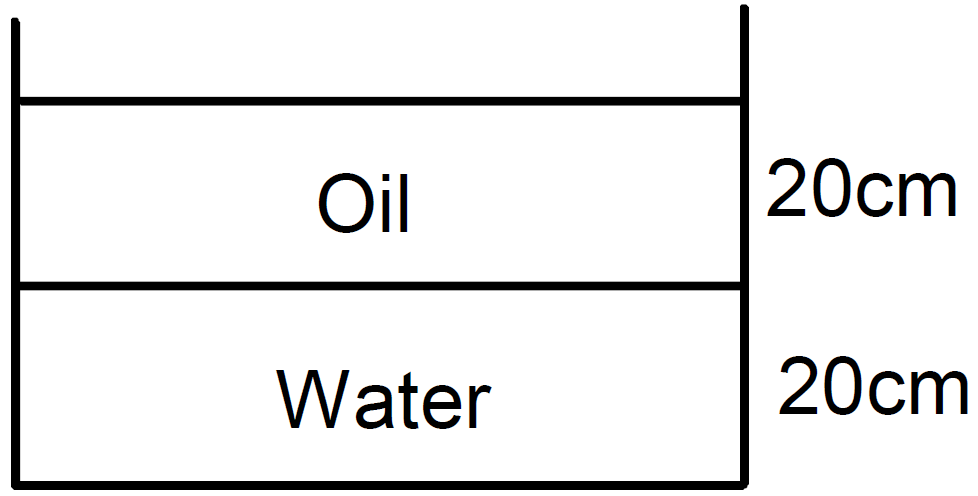
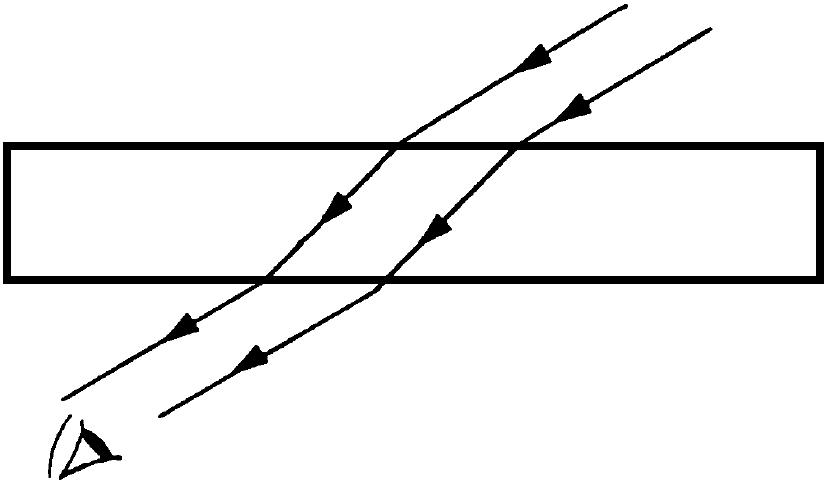
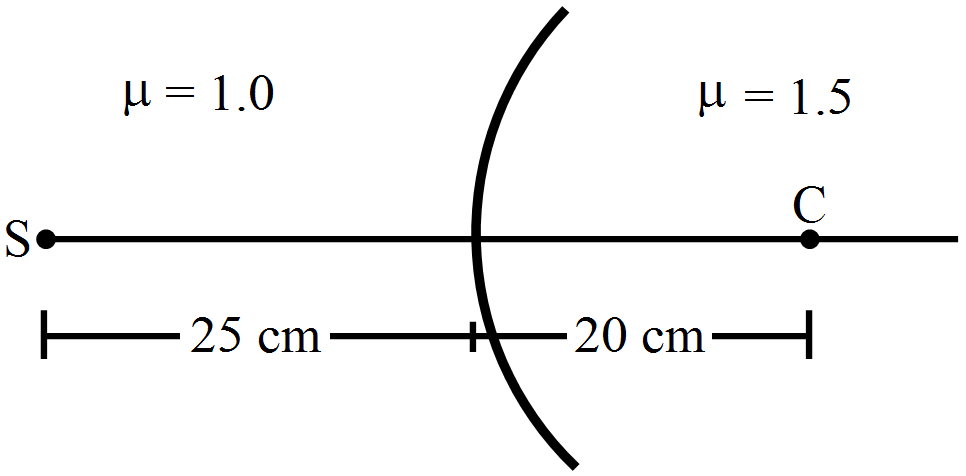
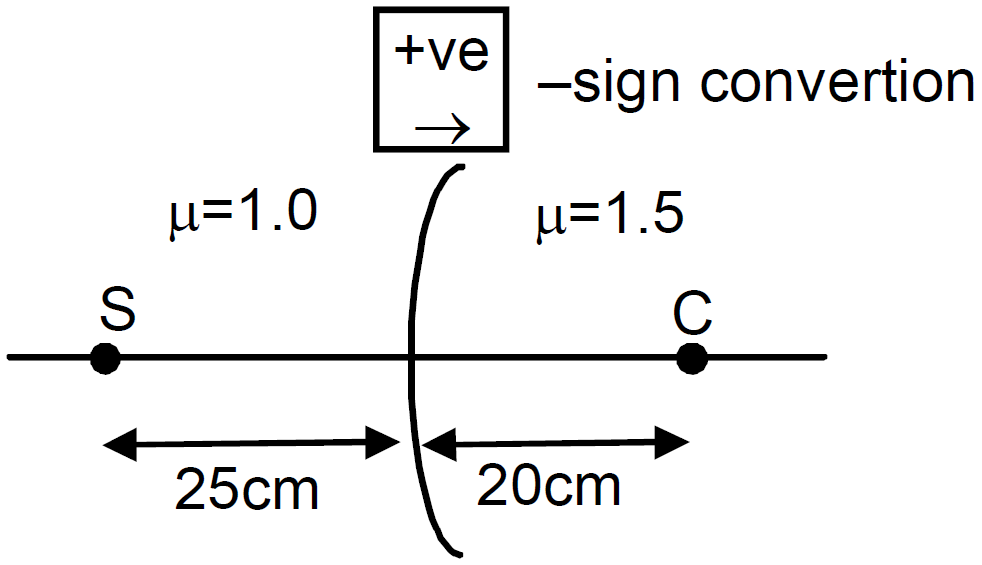 $\mu_1=1, \ \mu_2=1.5,$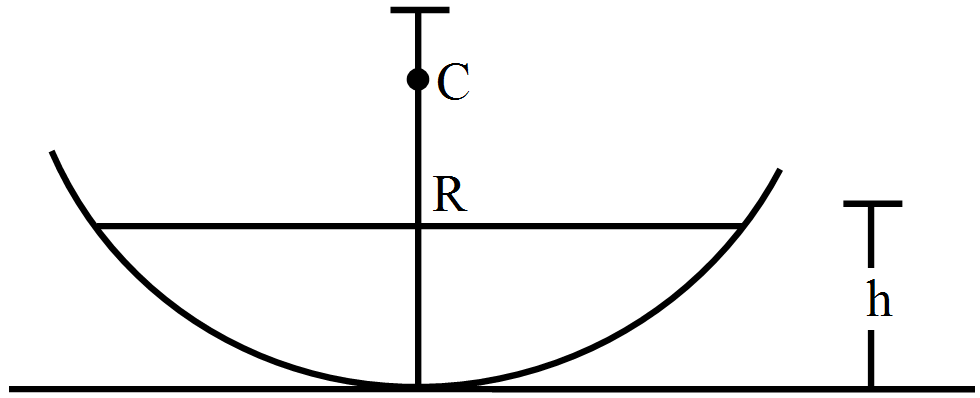
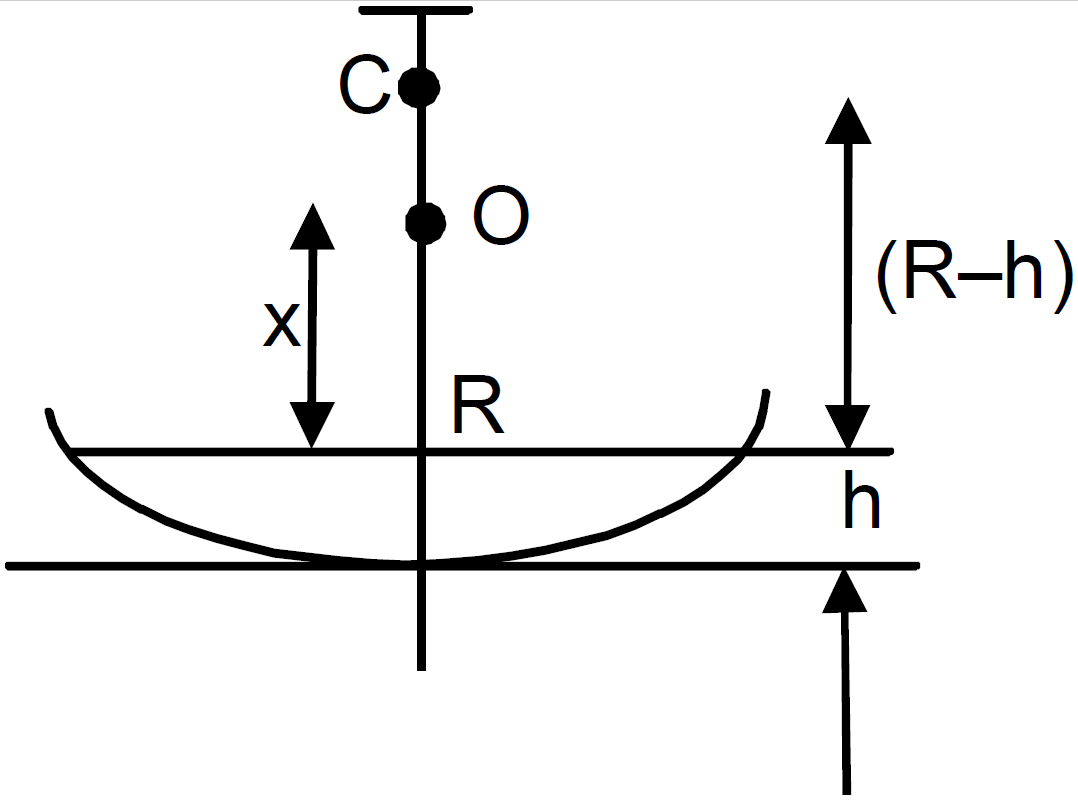 Let the object be placed at a height x above the surface of the water. The apparent position of the object with respect to mirror should be at the centre of curvature so that the image is formed at the same position. Since, $\frac{\text{Real depth}}{\text{Apparent depth}}=\frac{1}{\mu}$ (with respect to mirror) Now, $\frac{\text{x}}{\text{R}-\text{h}}=\frac{1}{\mu}$$\Rightarrow\text{x}=\frac{\text{R}-\text{h}}{\mu}$
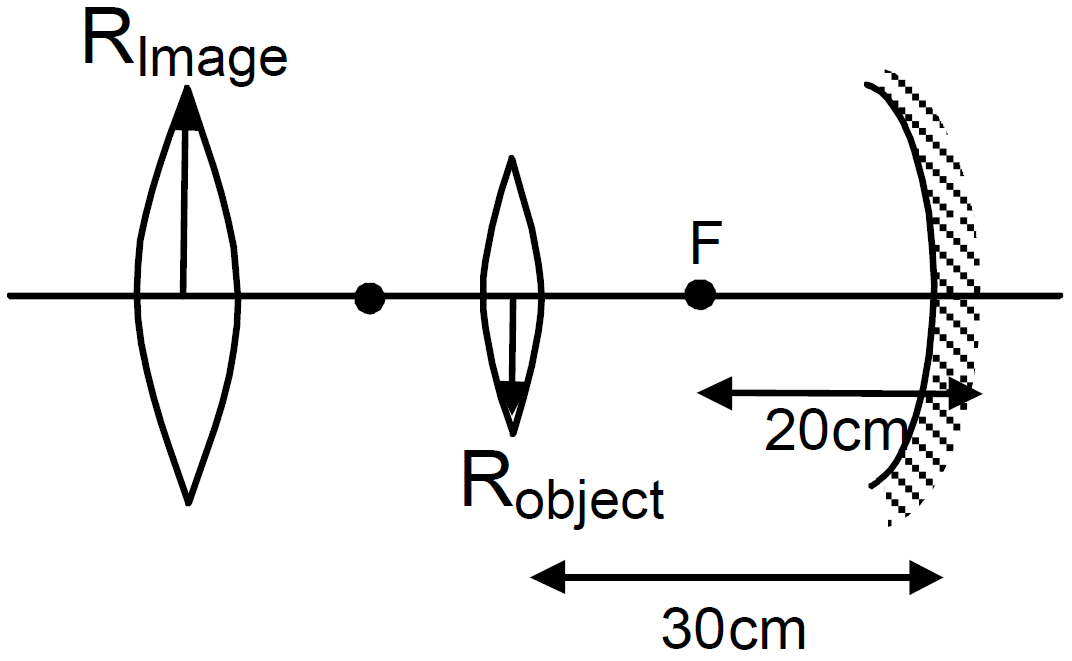 $\text{u}=-30\text{cm}, \ \text{f}=-20\text{cm}$
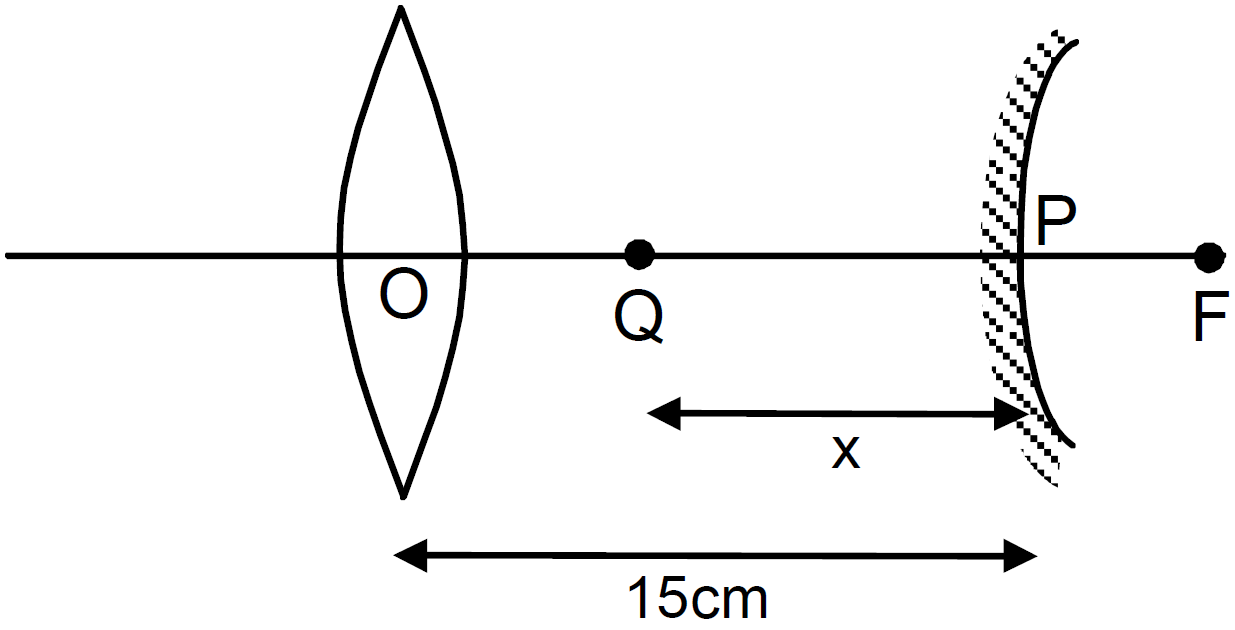 If the image in the mirror will form at the focus of the converging lens, then after transmission through the lens the rays of light will go parallel. Let the object is at a distance x cm from the mirror$\therefore$ u = -x cm; v = 25 - 15 = 10cm (because focal length of lens = 25cm)
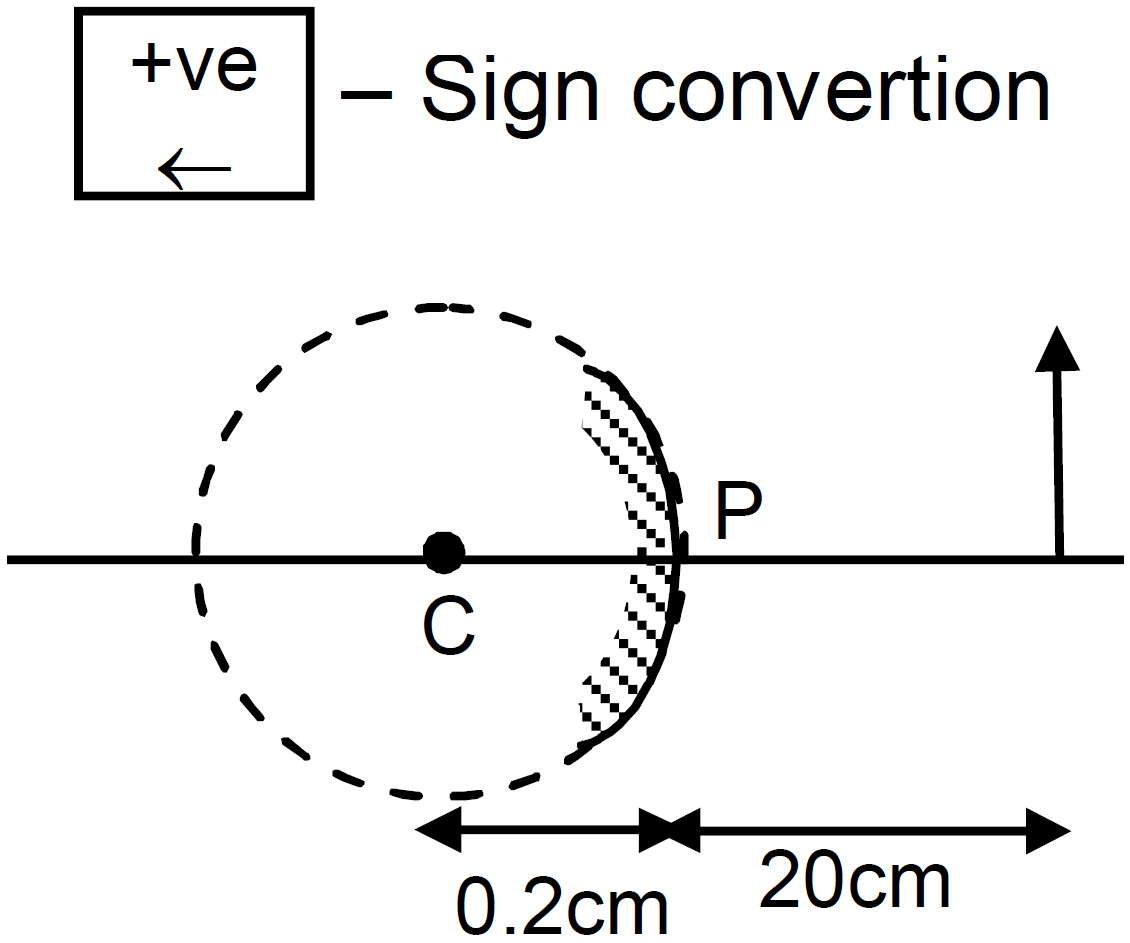 Height of the object AB = 1.6cm Diameter of the ball bearing = d = 0.4cm ⇒ R = 0.2cm Given, u = 20cm We know, $\frac{1}{\text{u}}+\frac{1}{\text{v}}=\frac{2}{\text{R}}$ Putting the values according to sign conventions $\frac{1}{-20}+\frac{1}{\text{v}}=\frac{2}{0.2}$$\Rightarrow\frac{1}{\text{v}}=\frac{1}{20}+10=\frac{201}{20}\Rightarrow\text{v}=0.1\text{cm}=1\text{mm}$ inside the ball bearing.
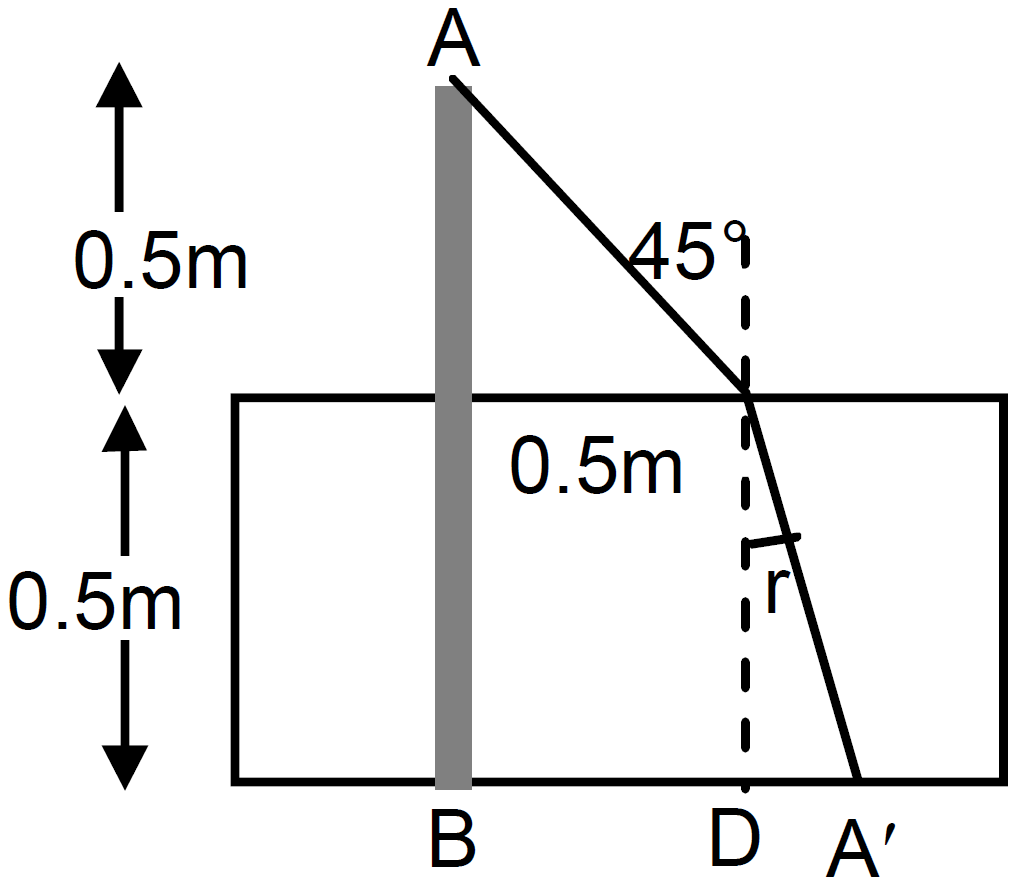 Shadow length $= \text{BA}' = \text{BD} + \text{A}'\text{D} = 0.5 + 0.5 \tan \text{r}$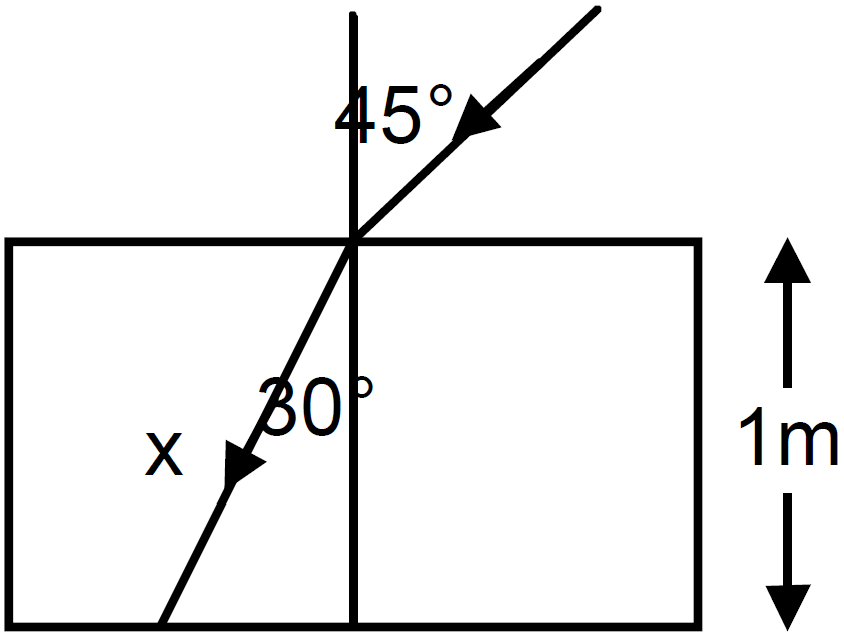
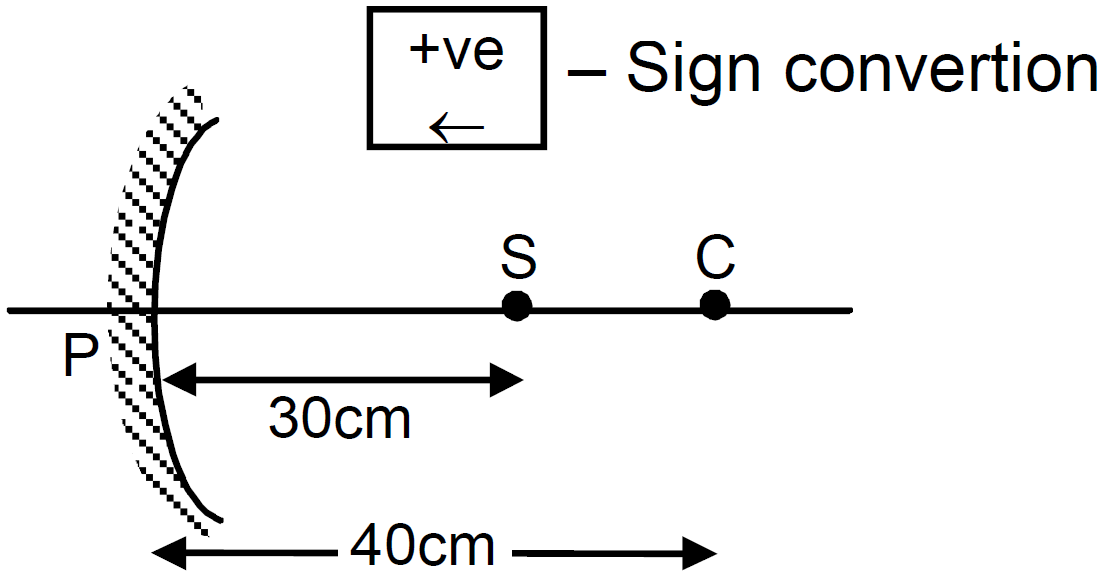 u = -30cm, R = -40cm