Questions

3 Marks Question

Take a timed test

19 questions · self-marked practice — reveal the answer and mark yourself.

Question 13 Marks
A body stretches a spring by a particular length at the earth's surface at equator. At what height above the south pole will it stretch the same spring by the same length? Assume the earth to be spherical.
Answer
At equator, $\text{g}'=\text{g}-\omega^2\text{R}\ ...(1)$ Let at ‘h’ height above the south pole, the acceleration due to gravity is same. Then, here $\text{g}'=\text{g}\Big(1-\frac{2\text{h}}{\text{R}}\Big)\ ...(2)$$\therefore\text{g}-\omega^2\text{R}=\text{g}\Big(1-\frac{2\text{h}}{\text{R}}\Big)$
or $1-\frac{\omega^2\text{R}}{\text{g}}=1-\frac{2\text{h}}{\text{R}}$ or $\text{h}=\frac{\omega^2\text{R}^2}{2\text{g}}=\frac{(7.3\times10^{-5})^2\times(6400\times10^3)^2}{2\times9.81}=11125$$\text{N}=10\text{km}$ (approximately)
View full question & answer
Question 23 Marks
The weight of an object is more at the poles than at the equator. Is it benificial to purchase goods at equator and sell them at the pole? Does it matter whether a spring balance is used or an equal-beam balance is used?
Answer
The weight of an object is more at the poles than that at the equator. In purchasing or selling goods, we measure the mass of the goods. The balance used to measure the mass is calibrated according to the place to give its correct reading. So, it is not beneficial to purchase goods at the equator and sell them at the poles. A beam balance measures the mass of an object, so it can be used here. For using a spring balance, we need to calibrate it according to the place to give the correct readings.
View full question & answer
Question 33 Marks
Can two particles be in equilibrium under the action of their mutual gravitational force? Can three particles be? Can one of the three particles be?
Answer
A particle will be in equilibrium when the net force acting on it is equal to zero. Two particles under the action of their mutual gravitational force will be in equilibrium when they revolve around a common point under the influence of their mutual gravitational force of attraction. In this case, the gravitational pull is used up in providing the necessary centripetal force. Hence, the net force on the particles is zero and they are in equilibrium. This is also true for a three particle system.
View full question & answer
Question 43 Marks
The weight of a body at the poles is greater than the weight at the equator. Is it the actual weight or the apparent weight we are talking about? Does your answer depend on whether only the earth's rotation is taken into account or the flattening of the earth at the poles is also taken into account?​​​​​
Answer
The weight of a body at the poles is greater than that at the equator. Here, we are talking about the actual weight of the body at that particular place.
Yes, If the rotation of the Earth is taken into account, then we are discussing the apparent weight of the body.
View full question & answer
Question 53 Marks
Is there any meaning of "Weight of the earth"?
Answer
Weight of a body is always because of its gravitational attraction with earth. As law of gravitational attraction is universal so it applies to any two bodies (earth and sun as well). So we can define the weight of earth w.r.t a body of mass comparable or heavier than earth because of its gravitational attraction between earth and that body.
But practically no body on earth has mass comparable to earth so weight of earth will be a meaningless concept w.r.t earth frame.
View full question & answer
Question 63 Marks
What is the true weight of an object in a geostationary satellite that weighed exactly $10.0N$ at the north pole?
Answer
For geo stationary satellite,$r = 4.2 \times 10^4\ km$
$h = 3.6 \times 10^4\ km$
Given $mg = 10N$
$\text{mgh}=\text{Mg}\Big(\frac{\text{R}^2}{(\text{R}+\text{h})^2}\Big)$
$=10\Bigg[\frac{\big(6400\times10^3\big)^2}{\big(6400\times10^3+3600\times10^3\big)^2}\Bigg]=\frac{4096}{17980}=0.23\text{N}$
View full question & answer
Question 73 Marks
A spacecraft consumes more fuel in going from the earth to the moon than it takes for a return trip. Comment on this statement.
Answer
Yes, a spacecraft consumes more fuel in going from the Earth to the Moon than it takes for the return trip. In going from the Earth to the Moon, the spacecraft has to overcome the gravitational pull of the earth. So, more fuel is consumed in going from the Earth to Moon. However, in the return trip, this gravitation pull helps the spacecraft to come back to the Earth.
View full question & answer
Question 83 Marks
As the earth rotates about its axis, a person living in his house at the equator goes in a circular orbit of radius equal to the radius of the earth. Why does he/ she not feel weightless as a satellite passenger does?
Answer
A person living in a house at the equator will not feel weightlessness because he is not in a free fall motion. Satellites are in free fall motion under the gravitational pull of the earth, but, due to the curved surface of the Earth, they move in a circular path. The gravitational force on the satellite due to the Sun provides the centripetal force for its revolution. Therefore, net force on the satellite is zero and, thus, a person feels weightless in a satellite orbiting the earth.
View full question & answer
Question 93 Marks
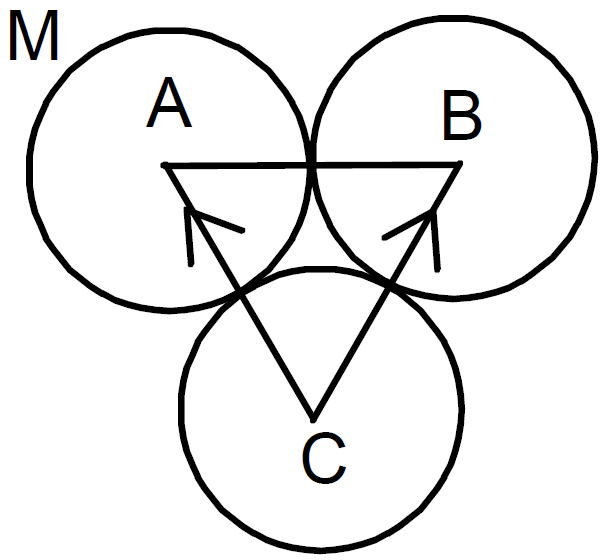
Three uniform spheres each having a mass M and radius a are kept in such a way that each touches the other two. Find the magnitude of the gravitational force on any of the spheres due to the other two.
Answer
$\overrightarrow{\text{F}_{\text{CB}}}=\frac{\text{Gm}^2}{4\text{a}^2}\cos60\hat{\text{i}}-\frac{\text{Gm}^2}{4\text{a}^2}\sin60\hat{\text{j}}$$\overrightarrow{\text{F}_{\text{CA}}}=\frac{\text{Gm}^2}{-4\text{a}^2}\cos60\hat{\text{i}}-\frac{\text{Gm}^2}{4\text{a}^2}\sin60\hat{\text{j}}$
$\overrightarrow{\text{F}}=\overrightarrow{\text{F}_{\text{CB}}}=\overrightarrow{\text{F}_{\text{CA}}}$
$=\frac{-2\text{Gm}^2}{4\text{a}^2}\sin60\hat{\text{j}}=\frac{-2\text{Gm}^2}{4\text{a}^2}\frac{\text{r}_3}{2}=\frac{\text{r}_3\text{Gm}^2}{4\text{a}^2}$
View full question & answer
Question 103 Marks
The moon takes about $27.3$ days to revolve round the earth in a nearly circular orbit of radius $3.84 \times 10^5\ km.$ Calculate the mass of the earth from these data.
Answer
$\text{T}=2\pi\sqrt{\frac{\text{r}^3}{\text{GM}}}$$27.3$
$=2\times3.14\sqrt{\frac{(3.84\times10^5)^3}{6.67\times10^{-11}\times\text{M}}}$
or $2.73\times2.73=\frac{2\times3.14\times(3.84\times10^5)^3}{6.67\times10^{-11}\times\text{M}}$
or $\text{M}=\frac{2\times(3.14)^2\times(3.84)^3\times10^{15}}{3.335\times10^{11}(27.3)^2}$
$=6.02\times10^{24}\text{ kg}$
$\therefore$ mass of earth is found to be $6.02 \times 10^{24}kg.$
View full question & answer
Question 113 Marks
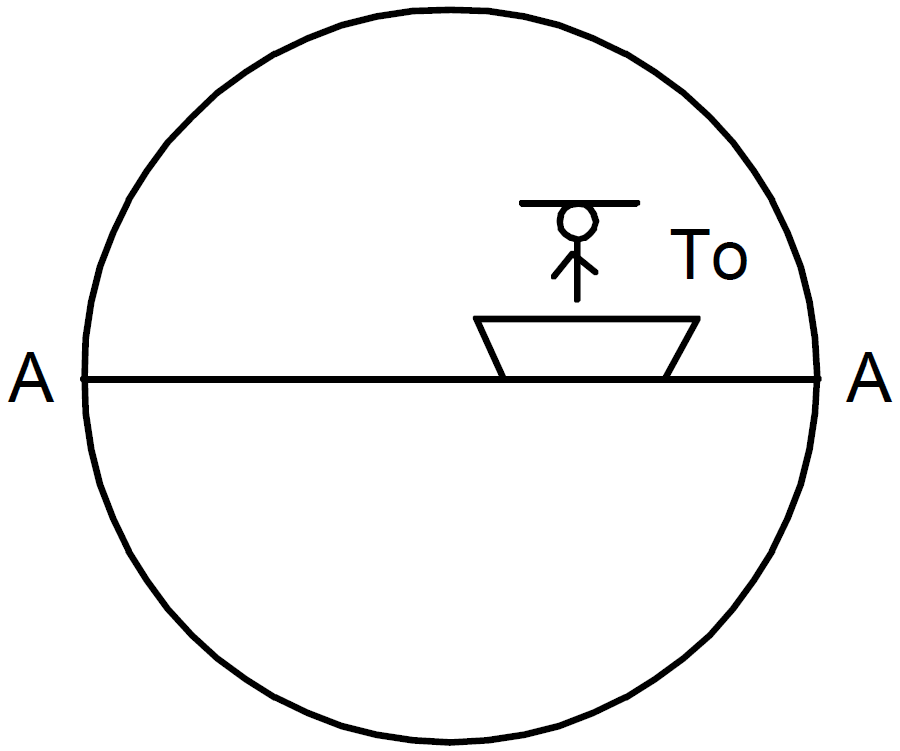
A pendulum having a bob of mass $m$ is hanging in a ship sailing along the equator from east to west. When the ship is stationary with respect to water the tension in the string is $T_0.$
  1. Find the speed of the ship due to rotation of the earth about its axis.
  2. Find the difference between $T_0$ and the earth's attraction on the bob.
  3. If the ship sails at speed $v,$ what is the tension in the string? Angular speed of earth's rotation is $\omega$ and radius of the earth is $R.$
Answer

  1. Spee of the ship due to rotation of earth $\text{v}=\omega\text{R}$
  2. $\text{T}_0=\text{mgr}=\text{mg}-\text{m}\omega^2\text{R}$
$\therefore\text{T}_0-\text{mg}=\text{m}\omega^2\text{R}$
  1. If the ship shifts at speed $'v\ ’$
$\text{T}=\text{mg}-\text{m}\omega_1^2\text{R}$
$=\text{T}_0-\Big(\frac{(\text{v}-\omega\text{R})^2}{\text{R}^2}\Big)\text{R}$
$=\text{T}_\text{0}-\Big(\frac{\text{v}^2+\omega^2\text{R}^2-2\omega\text{R}\text{v}}{\text{R}}\Big)\text{m}$
$\therefore\text{T}=\text{T}_0+2\omega\text{v}\ \text{m}$
View full question & answer
Question 123 Marks
Consider earth satellites in circular orbits. A geostationary satellite must be at a height of about 36000km from the earth's surface. Will any satellite moving at this height be a geostationary satellite? Will any satellite moving at this height have a time period of 24 hours?
Answer
$\text{T}=\Big(\frac{\text{g}\text{R}^2\text{T}^2}{4\pi^2}\Big)^{\frac{1}{3}}-\text{R}$$\text{T}=\frac{4\pi^2(\text{h}+\text{R})^3}{\text{g}\text{R}^2}$
$=\frac{4\times3.14^2\times(36000+6400)^3\times10^9}{9.8\times(6400\times10^3)^2}$
$=24.097\text{Hr}$
Which implies that it is a geostationary sattelite with time period = 24Hrs.
View full question & answer
Question 133 Marks
The gravitational potential energy of a two particle system is derived in this chapter as $\text{U}=-\frac{\text{Gm}_1\text{m}_2}{\text{r}}.$ Does it follow from this equation that the potential energy for $\text{r}=\infty$ must be zero? Can we choose the potential energy for $\text{r}=\infty.$ to be 20J and still use this formula? If no, what formula should be used to calculate the gravitational potential energy at separation r?
Answer
The gravitational potential energy of a two-particle system is given by $\text{U}=-\frac{\text{Gm}_1\text{m}_2}{\text{r}}.$
This relation does not tell that the gravitational potential energy is zero at infinity. For our convenience, we choose the potential energies of the two particles to be zero when the separation between them is infinity. No, if we suppose that the potential energy for $\text{r}=\infty$ is 20J, then we need to modify the formula.  Now, potential energy of the two-particle system separated by a distance r is given by$\text{U}\Big(\text{r'}\Big)=\text{U}\Big(\text{r}\Big)-\text{U}\Big(\infty\Big)$
Given: $\text{U}\Big(\infty\Big)=20\text{J}$$\therefore\text{U}\Big(\text{r}\Big)=-\text{G}\frac{\text{m}_1\text{m}_2}{\text{r}^2}-20$
This formula should be used to calculate the gravitational potential energy at separation r.
View full question & answer
Question 143 Marks
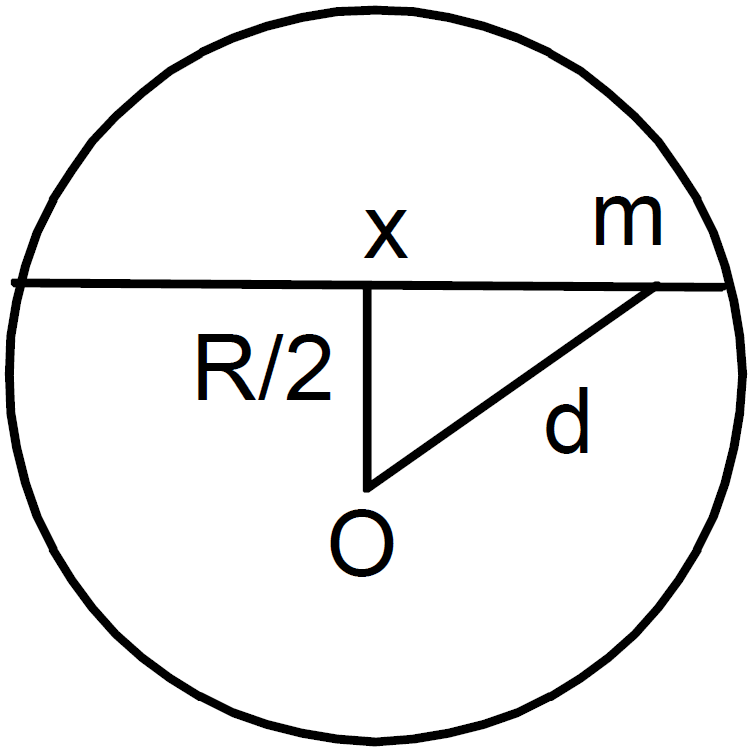
A tunnel is dug along a chord of the earth at a perpendicular distance $\frac{\text{R}}{2}$ from the earth's centre. The wall of the tunnel may be assumed to be frictionless. Find the force exerted by the wall on a particle of mass m when it is at a distance x from the centre of the tunnel.
Answer
Let d be the distance from centre of earth to man ‘m’ then$\text{D}=\sqrt{\text{x}^2+\Big(\frac{\text{R}^2}{4}\Big)}=\Big(\frac{1}{2}\Big)\sqrt{4\text{x}^2+\text{R}^2}$
M be the mass of the earth, M' the mass of the sphere of radius $\frac{\text{d}}{2}.$ Then $\text{M}=\Big(\frac{4}{3}\Big)\pi\text{R}^2\rho$$\text{M'}=\Big(\frac{4}{3}\Big)\pi\text{d}^3\tau$
or $\frac{\text{M'}}{\text{M}}=\frac{\text{d}^3}{\text{R}^3}$$\therefore$ Gravitational force is m,
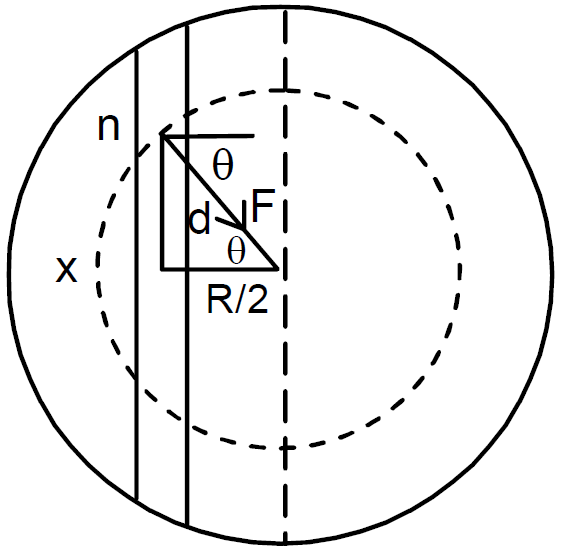
$\text{F}=\frac{\text{Gm'm}}{\text{d}^2}=\frac{\text{Gd}^3\text{Mm}}{\text{R}^3\text{d}^2}=\frac{\text{GMmd}}{\text{R}^3}$
So, Normal force exerted by the wall $=\text{F}\cos\theta.$$=\frac{\text{GMmd}}{\text{R}^3}\times\frac{\text{R}}{2\text{d}}=\frac{\text{GMm}}{\text{2R}^3}$ (therefore I think normal force does not depend on x)
View full question & answer
Question 153 Marks
Two small bodies of masses $10\ kg$ and $20\ kg$ are kept a distance $1.0m$ apart and released, Assuming that only mutual gravitational forces are acting, find the speeds of the particles when the separation decreases to $0.5m$.
Answer
The linear momentum of $2$ bodies is $0$ initially.
Since gravitational force is internal, final momentum is also zero.
So $(10\ kg)v_1 = (20\ kg)v_2$ Or $v_1 = v_2 ...(1)$
Since $P.E.$ is conserved Initial $P.E. =\frac{-6.67\times10^{-11}\times10\times20}{1}=-13.34\times10^{-9}\text{J}$
When separation is $0.5m,-13.34\times10^{–9}+0 = \frac{-13.34\times10^{-9}}{\big(\frac{1}{2}\big)} +\Big(\frac{1}{2}\Big)\times10\text{v}_{1}^2+\Big(\frac{1}{2}\Big)\times20\text{v}_2^2\ ...(2)$
$\Rightarrow-13.34\times10^{-9}=-26.68\times10^{-9}+5\text{v}_1^2+10\text{v}_2^2$
$\Rightarrow-13.34\times10^{-9}=-26.68\times10^{-9}+30\text{v}^2_2$
$\Rightarrow\text{v}^2_2=\frac{13.34\times10^{-9}}{30}=4.44\times10^{-10}$
$\Rightarrow\text{v}_2=2.1\times10^{-5}\text{m/s}.$
So, $\text{v}_1=4.2\times10^{-5}\text{m/s}.$
View full question & answer
Question 163 Marks
If heavier bodies are attracted more strongly by the earth, why don't they fall faster than the lighter bodies?
Answer
We know that acceleration due to a force on a body of mass in given by $\text{a}=\frac{\text{F}}{\text{m}}.$ If F is the gravitational force acting on a body of mass m, then a is the acceleration of a free falling body. This force is given as $\text{F}=\text{G}\frac{\text{Mm}}{\text{R}^2}.$ Here, M is the mass of the Earth; G is the universal gravitational constant and R is the radius of the Earth.$\therefore$ Acceleration due to gravity, $\text{a}=\frac{\text{F}}{\text{m}}=\frac{\text{GM}}{\text{R}^2}$
From the above relation, we can see that acceleration produced in a body does not depend on the mass of the body. So, acceleration due to gravity is the same for all bodies. 
View full question & answer
Question 173 Marks
The time taken by Mars to revolve round the sun is 1.88 years. Find the ratio of average distance between Mars and the sun to that between the earth and the sun.
Answer
According to Kepler’s laws of planetary motion,$\text{T}^2\alpha\text{R}^3$
$\frac{\text{T}_{\text{m}}^2}{\text{T}_\text{e}^2}=\frac{\text{R}_{\text{ms}}^3}{\text{R}_{\text{es}}^3}$
$\Big(\frac{\text{R}_{\text{ms}}}{\text{R}_{\text{es}}}\Big)^3=\Big(\frac{1.88}{1}\Big)^2$
$\therefore\frac{\text{R}_{\text{ms}}}{\text{R}_\text{es}}=(1.88)^{\frac{2}{3}}=1.52$
View full question & answer
Question 183 Marks
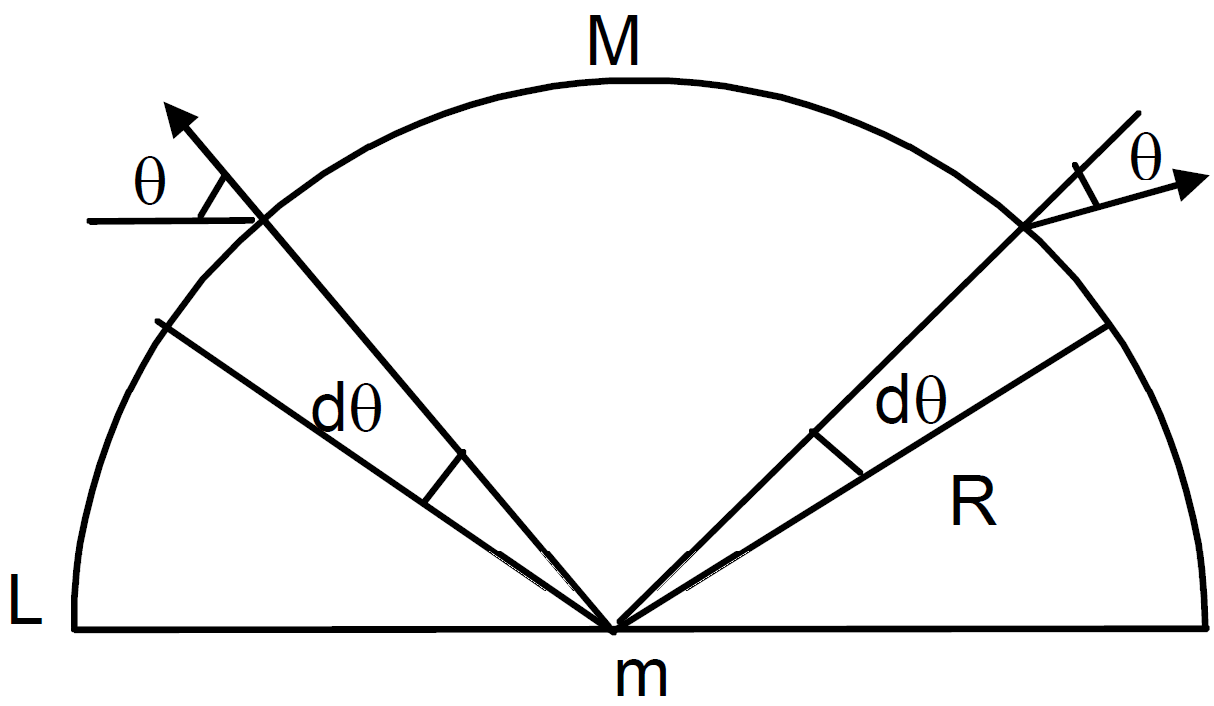
A semicircular wire has a length $L$ and mass $M.A$ particle of mass $m$ is placed at the centre of the circle. Find the gravitational attraction on the particle due to the wire.
Answer
In the semicircle, we can consider, $a$ small element of $d,$ then $\text{Rd}\theta=\Big(\frac{\text{M}}{\text{L}}\Big)\text{Rd}\theta=\text{dM}.$$\text{F}=\frac{\text{GMRd}\theta\text{m}}{\text{LR}^2}$
$dF_3 = 2$ since $=\frac{2\text{GMm}}{\text{LR}}\sin\theta\text{d}\theta.$
$\therefore\text{F}=\int\limits^{\frac{\pi}{2}}_0\frac{2\text{GMm}}{\text{LR}}\sin\theta\text{d}\theta=\frac{2\text{GMm}}{\text{LR}}\Big[-\cos\theta\Big]^{\frac{\pi}{2}}_0$
$\therefore=-2\frac{\text{GMm}}{\text{LR}}(-1)=\frac{2\text{GMm}}{\text{LR}}=\frac{2\text{GMm}}{\text{L}\times\frac{\text{L}}{\text{A}}}=\frac{2\pi\text{GMm}}{\text{L}^2}$
View full question & answer
Question 193 Marks
Two small bodies of masses 2.00kg and 4.00kg are kept at rest at a separation of 2.0m. Where should a particle of mass 0.10kg be placed to experience no net gravitational force from these bodies? The particle is placed at this point. What is the gravitational potential energy of the system of three particles with usual reference level?
Answer
Let 0.1kg man is x m from 2kg mass and (2 - x) m from 4kg mass.$\therefore\frac{2\times0.1}{\text{x}^2}=-\frac{4\times0.1}{(2-\text{x})^2}$
or $\frac{0.2}{\text{x}^2}=\frac{2}{(2-\text{x})^2}$ or $(2-\text{x})^2=2\text{x}^2$ or $\frac{1}{\text{x}^2}=\frac{2}{2\text{x}^2}$ or $(2-\text{x})^2=\text{2x}^2$ or $2-\text{x}=\sqrt{2}$ or $\text{x}(\text{r}_2+1)=2$ or $\text{x}=\frac{2}{2.414}=0.83\text{m}$ from 2kg mass.
View full question & answer