Questions

M.C.Q (1 Marks)

Take a timed test

16 questions · 8 auto-graded MCQ + 8 self-marked written.

MCQ 11 Mark
A heated body emits radiation which has maximum intensity near the frequency $v_0$. The emissivity of the material is $0.5$. If the absolute temperature of the body is doubled:
  • A
    The maximum intensity of radiation will be near the frequency $2v_0$
  • B
    The maximum intensity of radiation will be near the frequency $\frac{\text{v}_0}{2}$
  • The total energy emitted will increase by a factor of $16.$
  • D
    The total energy emitted will increase by a factor of $8.$
Answer
Correct option: C.
The total energy emitted will increase by a factor of $16.$
$\lambda_\text{m}\text{T}=\text{b}$ (a constant)
$\frac{\text{cT}}{\text{v}_\text{m}}=\text{b}$
Here, T is the absolute temperature of the body.
So, as the temperature is doubled to keep the product on the left hand constant, frequency is also doubled.
From stefan's law, we know that the rate of energy emission is proportional to $T^4.$
This implies that total energy emitted will increase by a factor of $(2)^4$, which is equal to $16.$
View full question & answer
Question 21 Mark
One end of a metal rod is dipped in boiling water and the other is dipped in melting ice:
  1. All parts of the rod are in thermal equilibrium with each other.
  2. We can assign a temperature to the rod.
  3. We can assign a temperature to the rod after steady state is reached.
  4. The state of the rod does not change after steady state is reached.
Answer
  1. The state of the rod does not change after steady state is reached.
Explanation:
The heat transfer will take place from the hot end to the cold end of the rod via conduction. So, with time, the temperature of the rod will increase from the end dipped in boiling water to the end dipped in melting, until it comes in equilibrium with its surroundings. In steady state, the temperature of the rod is non uniform and constant, maximum at the end dipped in boiling water and minimum at the end dipped in melting ice.
Equilibrium means that the system is stable. So, all the macroscopic variables describing the system will not change with time.
Hence, the temperature of the rod will become constant once equilibrium is reached, but its value is different at different positions of the rod.
View full question & answer
Question 31 Mark
In a room containing air, heat can go from one place to another:
  1. By conduction only.
  2. By convection only.
  3. By radiation only.
  4. By all the three modes.
Answer
  1. By all the three modes.
Explanation:
In conduction, heat is transferred from one place to other by vibration of the molecules. In this process, the average position of a molecule does not change. Hence, there is no mass movement of matter.
In convection, heat is transferred from one place to other by actual motion of particles of the medium. When water is heated, hot water moves upwards and cool water moves downwards.
In radiation process, transfer of heat does not require any material medium. For a room containing air, heat can be transferred via radiation (no medium required) and convection (by the movement of air molecules) and by conduction (due to collision of hot air molecules with other molecules).
View full question & answer
Question 41 Mark
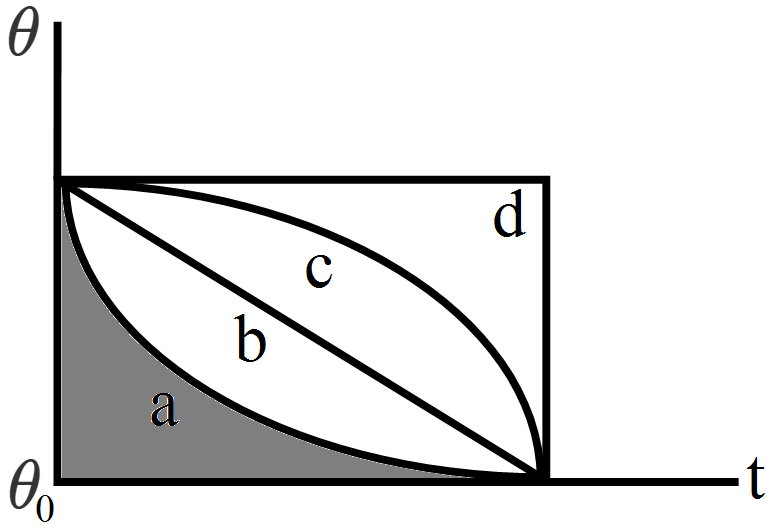
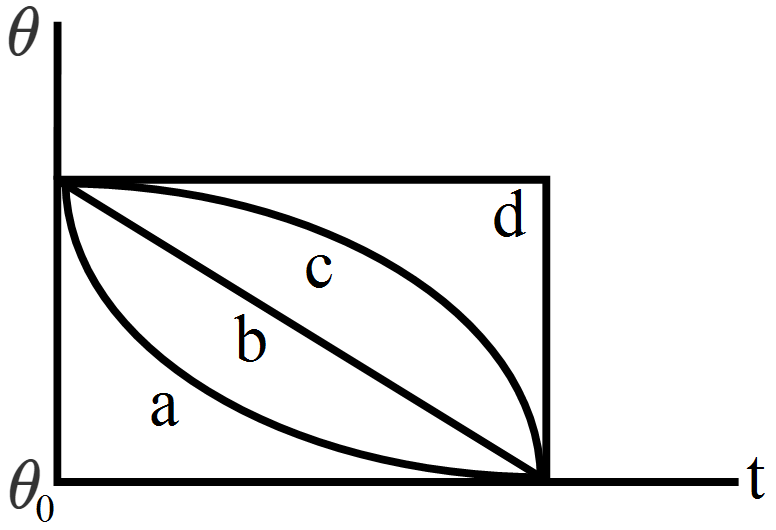
A hot liquid is kept in a big room. Its temperature is plotted as a function of time. Which of the following curves may represent the plot?
Answer
When a hot liquid is kept in a big room, the liquid will loose its temperature with time. The thermal energy emitted by the liquid will be gained by the walls of the room. As the room is big, we can assume that the temperature difference between the room and the liquid is large. From Stephen's law, the liquid emits thermal energy in proportion to $T_4$, where $T$ is the initial temperature of the liquid.
As the temperature decreases, the rate of loss of thermal energy will also decrease. So, the slope of the curve will also decrease.
Therefore, the plot of temperature with time is best represented by the curve in option $(a).$
View full question & answer
Question 51 Mark
The thermal conductivity of a rod depends on:
  1. Length.
  2. Mass.
  3. Area of cross section.
  4. Material of the rod.
Answer
  1. Material of the rod.
Explanation:
The thermal conductivity of a rod depends only on the material of the rod. For example, metals are much better conductors than non-metals because metals have large number of free electron that can move freely anywhere in the body of the metal and carry thermal energy from one place to other.
Also, 2 copper rods having different lengths and areas of cross-section have same thermal conductivity that depends only on the number of free electrons in copper.
View full question & answer
MCQ 61 Mark
A solid sphere and a hollow sphere of the same material and of equal radii are heated to the same temperature:
  • A
    Both will emit equal amount of radiation per unit time in the biginning.
  • B
    Both will absorb equal amount of radiation from the surrounding in the biginning.
  • C
    The initial rate of cooling $\Big(\frac{\text{dT}}{\text{dt}}\Big)$ will be the same for the two spheres.
  • $A$ and $B$ both
Answer
Correct option: D.
$A$ and $B$ both
Let the temperature of the surroundings be $T_0.$
From the Stefan$-$Boltzmann law, the energy of thermal radiation emitted per unit time by a blackbody of surface area $A$ is given by,
$\text{u}=\sigma\text{AT}_4$
Here, $\sigma$ is Stephen's constant.
Also, the energy absorbed per unit time by the body is given by,
$\text{u}_0=\text{e}\sigma\text{AT}_0^4$
As the two spheres have equal radii and temperatures, their rate of absorption and emission will be equal in the beginning.
View full question & answer
Question 71 Mark
In summer, a mild wind is often found on the shore of a calm river. This is caused due to,
  1. Difference in thermal conductivity of water and soil.
  2. Convection currents.
  3. Conduction between air and the soil.
  4. Radiation from the soil.
Answer
  1. Convection currents.
Explanation:
Convection current is the movement of air (or any fluid) due to the difference in the temperatures. During summer days, there is temperature difference of air above the land and river. Due to this, a convection current is set from the river to the land during daytime. On the other hand, during night, a convection current is set from the land to the river.
Therefore, a mild air always flows on the shore of a calm river due to the convection current.
View full question & answer
MCQ 81 Mark
A hot liquid is kept in a big room. The logarithm of the numerical value of the temperature difference between the liquid and the room is plotted against time. The plot will be very nearly:
  • A straight line.
  • B
    A circular are.
  • C
    A parabola.
  • D
    An ellipse.
Answer
Correct option: A.
A straight line.
When a hot liquid is kept in a big room, then the liquid will loose temperature with time. The thermal energy emitted by the liquid will be gained by the walls of the room.
As the room is big, we can assume that the temperature difference between the room and the liquid is large. From Stephen's law, the liquid emits thermal energy in proportion to $T_4,$
where $T$ is the initial temperature of the liquid.
As the temperature decreases, the rate of loss will also decrease.
So, the slope of the curve will also decrease. Finally, at equilibrium, the temperature of the room will become equal to the new temperature of the liquid.
So, in steady state, the difference between the temperatures of the two will become zero.
A graph is plotted between the logarithm of the numerical value of the temperature difference between the liquid and the room is plotted against time. The logarithm converts the fourth power dependence into a linear dependence with some coefficient $($property of $\log).$
So, the plot satisfying all the above properties will be a straight line.
View full question & answer
MCQ 91 Mark
Newton's law of cooling is a special case of:
  • A
    Wien's displacement law.
  • B
    Kirchhoff's law.
  • Stefan's law.
  • D
    Planck's law.
Answer
Correct option: C.
Stefan's law.
From Stefan$-$Boltzman's law, the energy of the thermal radiation emitted per unit time by a blackbody of surface area $A$ is given by,
$\text{u}=\sigma\text{AT}^4$
Where $\sigma$ is Stefan's constant.
Suppose a body at temperature $T$ is kept in a room at temperature $T_0.$
According to Stefan's law, energy of the thermal radiation emitted by the body per unit time is.
$\text{u}=\text{e}\sigma\text{AT}^4$
Here, $e$ is the emissivity of the body.
The energy absorbed per unit time by the body is $($due to the radiation emitted by the walls of the room$)$
$\text{u}_0=\text{e}\sigma\text{AT}^4_0$
Thus, the net loss of thermal energy per unit time is.
$\triangle\text{u}=\text{u}-\text{u}_0$
$\triangle\text{u}=\text{e}\sigma\text{A}(\text{T}^4-\text{T}_0^4)\ \dots(1)$
Newton law of cooling is given by,
$\frac{\text{dT}}{\text{dt}}=-\text{bA}(\text{T}-\text{T}_0)$
This can be obtained from equation $(i)$ by considering the temperature difference to be small and doing the binomial expansion.
View full question & answer
MCQ 101 Mark
A body cools down from $65^\circ C$ to $60^\circ C$ in $5$ minutes. It will cool down from $60^\circ C$ to $55^\circ C$ in:
  • A
    $5$ Minutes.
  • B
    Less than $5$ minutes.
  • More than $5$ minutes.
  • D
    Less than or more than $5$ minutes depending on whether its mass is more than or less than $1\ kg.$
Answer
Correct option: C.
More than $5$ minutes.
Let the temperature of the surrounding be $T^\circ C.$
Average temperature of the liquid in first case $= 62.5^\circ C$
From newton law of cooling,
$1^\circ\text{C}\ \text{min}^-1=-\text{b}\text{A}(62.5-\text{T})^\circ\text{c}$
$\Rightarrow-\text{bA}=\frac{1}{62.5\text{T}}\text{min}^-1\ \dots(1)$
From Newton's law of cooling and equation $(1),$
$5^\circ\text{C}=-\text{bA}(57.5-\text{T})^\circ\text{C}$
$\Rightarrow\frac{5^\circ\text{C}}{\text{t}}=\frac{1}{62.5-\text{T}}(57.5-\text{T})^\circ\text{C}$
$\Rightarrow\text{t}=\frac{5(62.5-\text{T})}{(57.5-\text{T})}$
$\text{t}>5$ minutes.
View full question & answer
Question 111 Mark
A blackbody does not:
  1. Emit radiation.
  2. Absorb radiation.
  3. Reflect radiation.
  4. Refract radiation.
Answer
  1. Refract radiation.
Explanation:
A black body is an ideal concept. A black body is the one that absorbs all the radiation incident on it.
So, a black body does not reflect and refract radiation.
View full question & answer
MCQ 121 Mark
A solid at temperature $T_1$ is kept in an evacuated chamber at temperature $\text{T}_2>\text{T}1.$ The rate of increase of temperature of the body is proportional to:
  • A
    $\text{T}_2-\text{T}_1$
  • B
    $\text{T}_2^2-\text{T}_1^2$
  • C
    $\text{T}_2^3-\text{T}_1^3$
  • $\text{T}_2^4-\text{T}_1^4$
Answer
Correct option: D.
$\text{T}_2^4-\text{T}_1^4$
From stefan$-$Boltzmann law, the energy of thermal radiation per unit time by a blackbody of surface are $A$ is given by,
$\text{u}-\sigma\text{AT}^4$
Here, $\sigma$ is stefan$-$Boltzmann constant.
Since the temperature of the solid is less than the surrouncings, the temperature of the solid will increase with time until it reaches equilibrium with the surroundings.
The rate of emission from the soild will be proportional to $\text{T}_1^4$ and rate of emission from the surroundings will be proportional to $\text{T}_2^4.$
So, the net rate of increase in temperature will be proportional to $\text{T}_2^4-\text{T}^4_1.$
View full question & answer
MCQ 131 Mark
The thermal radiation emitted by a body is proportional to $T^n$ where Tis its absolute temperature. The value of $n$ is exactly $4$ for:
  • A
    A blackbody.
  • All bodies.
  • C
    Bodies painted black only.
  • D
    Polished bodies only.
Answer
Correct option: B.
All bodies.
From Stefan$-$Boltzmann law, the energy of the thermal radiation emitted per unit time by a blackbody of surface area $A$ is given by,
$\text{u}=\sigma\text{AT}^4$
Here, $\sigma$ is Stefan$-$Boltzmann constant.
This law holds true for all the bodies.
View full question & answer
Question 141 Mark
A piece of charcoal and a piece of shining steel of the same surface area are kept for a long time in an open lawn in bright sun:
  1. The steel will absorb more heat than the charcoal.
  2. The temperature of the steel will be higher than that of the charcoal.
  3. If both are picked up by bare hands, the steel will be felt hotter than the charcoal.
  4. If the two are picked up from the lawn and kept in a cold chamber, the charcoal will lose heat at a faster rate than the steel.
Answer
  1. If both are picked up by bare hands, the steel will be felt hotter than the charcoal.
  2. If the two are picked up from the lawn and kept in a cold chamber, the charcoal will lose heat at a faster rate than the steel.
Explanation:
In steel, conductivity is higher than charcoal. So, if both are picked up by bare hands, then heat transfer from the body (steel or charcoal) to our hand will be larger in case of steel. Hence, steel will be hotter than the charcoal.
On the other hand, emissivity of charcoal is higher as compared to steel. So, if the two are picked up from the lawn and kept in a cold chamber, charcoal will lose heat at a faster rate than steel.
View full question & answer
MCQ 151 Mark
Two bodies $A$ and $B$ having equal surface areas are maintained at temperatures $10^\circ C$ and $20^\circ C$. The thermal radiation emitted in a given time by $A$ and $B$ are in the ratio:
  • $1 : 1.15$
  • B
    $1 : 2$
  • C
    $1 : 4$
  • D
    $1 : 16$
Answer
Correct option: A.
$1 : 1.15$
From Stefan $-$ Boltzmann law, energy of the thermal radiation emitted per unit time by a blackbody of surface area $A$ is given by,
$\text{u}=\sigma\text{AT}^4$
Here, $\sigma$ is Stefan $-$ Boltzmann constant.
The thermal radiation emitted in a given time by $A$ and $B$ will be in the ratio.
$\frac{\text{u}_\text{A}}{\text{u}_\text{B}}=\frac{\text{T}_\text{A}^4}{\text{T}_\text{n}^4}$
$\frac{\text{u}_\text{A}}{\text{u}_\text{B}}=\frac{(273+10)^4}{(273+20)^4}$
$\frac{\text{u}_\text{A}}{\text{u}_\text{B}}=\frac{1}{1.15}$
View full question & answer
Question 161 Mark
One end of a metal rod is kept in a furnace. In steady state, the temperature of the rod:
  1. Increases.
  2. Decreases.
  3. Remains constant.
  4. Is nonuniform.
Answer
  1. Is nonuniform.
Explanation:
In steady state, the temperature of the rod is nonuniform maximum at the end near the furnace and minimum at the end that is away from the furnace.
View full question & answer