Questions

3 Marks Question

Take a timed test

17 questions · self-marked practice — reveal the answer and mark yourself.

Question 13 Marks
Water is boiled in a container having a bottom of surface area $25cm^2$, thickness 1.0mm and thermal conductivity $50\text{wm}^{-1}{^{\circ}}\text{C}^{-1}.$ 100g of water is converted into steam per minute in the steady state after the boiling starts. Assuming that no heat is lost to the atmosphere, calculate the temperature of the lower surface of the bottom. Latent heat of vaporization of water $=0.26\times10^6\text{Jkg}^{-1}.$
Answer
Area of the bottom of the container, $A = 25cm = 25 \times 10^{-4}m^2$
Thickness of the bottom of the container, $l = 1mm = 10^{-3}m$
Latent heat of vaporisation of water, $L = 2.26 \times 10^6J-kg^{-1}$
Thermal conductivity of the container, ${K = 50Wm^{-1}}{^\circ C^{-1}}$​​​​​​​
Mass = 100g = 0.1kg
Rate of heat transfer from the base of the container is given by,
$\Rightarrow\frac{\Delta\text{Q}}{\Delta\text{t}}=\frac{\text{mL}}{\Delta\text{t}}=\frac{(0.1)\times2.26\times10^{5}}{1\text{min}}$
$\Rightarrow\frac{\Delta\text{Q}}{\Delta\text{t}}=0.376\times10^{4}\text{J/s}$
Also,
$\Rightarrow\frac{\Delta\text{Q}}{\Delta\text{t}}=\frac{\Delta\text{T}}{\frac{\text{l}}{\text{kA}}}$
$\Rightarrow0.376\times10^{4}=\frac{\frac{\text{T}-100}{10^{-3}}}{50\times25\times10^{-4}}$
$\Rightarrow0.376\times10^{4}=\frac{50\times25\times10^{-4}(\text{T}-100)}{10^{-3}}$
$\Rightarrow(\text{T}-100)=3.008\times10$
$\Rightarrow\text{T}=130^\circ\text{C}$
View full question & answer
Question 23 Marks
The heat current is written as $\frac{\triangle\text{Q}}{\triangle\text{t}}.$ Why don't we write $\frac{\text{dQ}}{\text{dt}}?$
Answer
The amount of heat crossing through any cross-section of a slab in time $\triangle\text{t}$ is called heat current.
It is written as $\frac{\triangle\text{Q}}{\triangle\text{t}}$ and not as complete derivative $\frac{\text{dQ}}{\text{dt}}.$
This is because the amount of heat crossing through any cross section is a function of many variables like temperature difference, area of cross-section, etc.
So, we cannot write it as a complete derivative with respect to time.
View full question & answer
Question 33 Marks
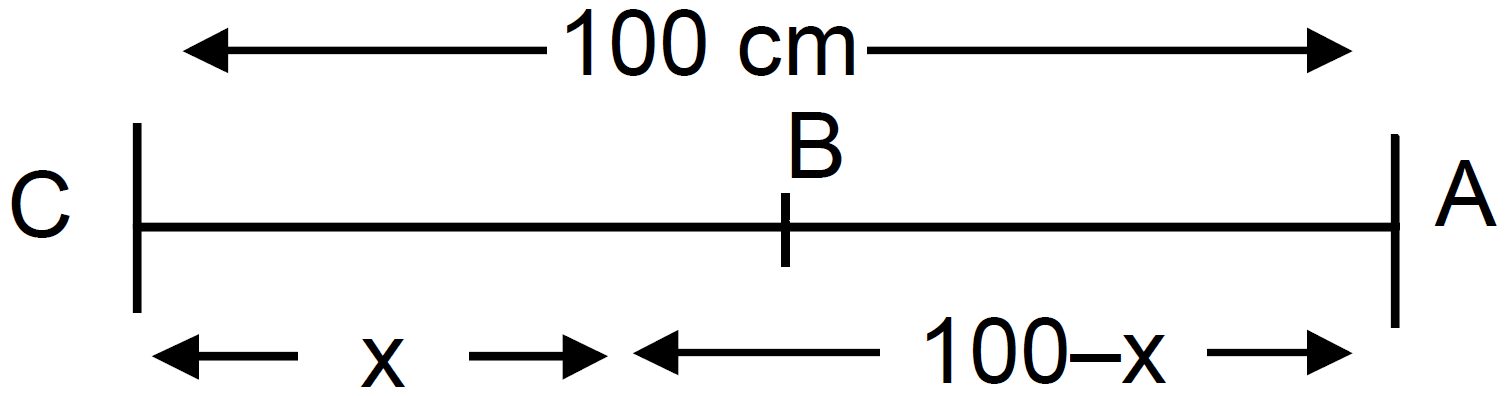
The ends of a metre stick a.re maintained at 100°C and 0°C. One end of a rod is maintained at 25°C. Where should its other end be touched on the metre stick so that there is no heat current in the rod in steady state?
Answer

Let the point to be touched be ‘B’

No heat will flow when, the temp at that point is also 25°C
i.e. $\text{Q}_\text{AB}=\text{Q}_\text{BC}$
So, $\frac{\text{KA}(100-25)}{100-\text{x}}=\frac{\text{KA}(25-0)}{\text{x}}$
$\Rightarrow75\times=2500-25\text{x}$
$\Rightarrow100\text{x}=2500$
$\Rightarrow\text{x}=25\text{cm}$ From the end with 0°C.
View full question & answer
Question 43 Marks
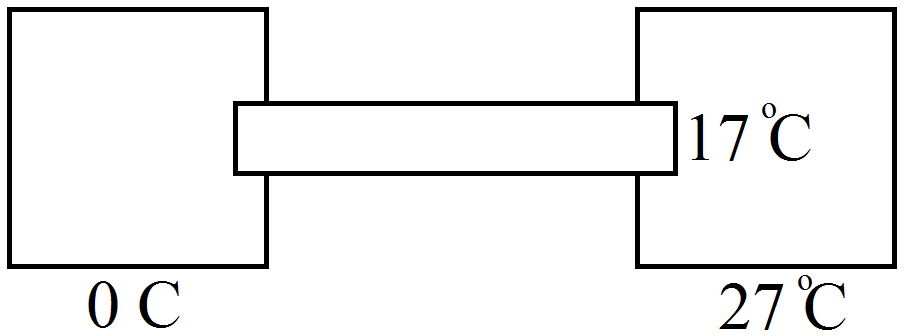
A cylindrical rod of length 50cm and cross sectional area $1cm^2$ is fitted between a large ice chamber at 0°C and an evacuated chamber maintained at 27°C as shown in figure. Only small portions of the rod are inside the chambers and the rest is thermally insulated from the surrounding. The cross section going into the evacuated chamber is blackened so that it completely absorbs any radiation falling on it. The temperature of the blackened end is 17°C when steady state is reached. Stefan constant $\sigma=6\times10^{-8}\text{W/m}^{-2}\text{K}^{-4}.$ Find the thermal conductivity of the material of the rod.
Answer
$\frac{\text{Q}}{\text{t}}=\text{eAe}\big(\text{T}_2^4-\text{T}_1^4\big)$
$\Rightarrow\frac{\text{Q}}{\text{At}}=1\times6\times10^{-8}\big[(300)^4-(290)^4\big]$
$=6\times10^{-8}(81\times10^8-70.7\times10^8)$
$=6\times10.3$
$\frac{\text{Q}}{\text{t}}=\frac{\text{KA}(\theta_1-\theta_2)}{\text{l}}$
$\Rightarrow\frac{\text{Q}}{\text{tA}}=\frac{\text{K}(\theta_1-\theta_2)}{\text{l}}=\frac{\text{K}\times17}{0.5}\\=6\times10.3=\frac{\text{K}\times17}{0.5}$
$\Rightarrow\text{K}=\frac{6\times10.3\times0.5}{17}$
$=1.8$
View full question & answer
Question 53 Marks
A cubical box of volume $216cm^3$ is made up of 0.1cm thick wood. The inside is heated electrically by a 100W heater. It is found that the temperature difference between the inside and the outside surface is 5°C in steady state. Assuming that the entire electrical energy spent appears as heat, find the thermal conductivity of the material of the box.
Answer


$\text{V}=216\text{cm}^3$
$\text{a}=6\text{cm},$ Surface area $= 6a^2 = 6 \times 36m^2$​​​​​​​
$\text{t}=0.1\text{cm},\ \frac{\text{Q}}{\text{t}}=10\text{w},$
$\frac{\text{Q}}{\text{t}}=\frac{\text{KA}(\theta_1-\theta_2)}{\ell}$
$\Rightarrow\text{K}=\frac{100}{6\times36\times5\times10^{-1}}$
$=0.9259\text{w/m}^\circ\text{C}\approx0.92\text{w/m}^\circ\text{C}$
View full question & answer
Question 63 Marks
A uniform slab of dimension $10cm × 10cm × 1cm$ is kept between two heat reservoirs at temperatures $10°C$ and $90°C.$ The larger surface areas touch the reservoirs. The thermal conductivity of the material is $ 0.80\text{wm}^{-1}{^{\circ}}\text{C}^{-1}.$ Find the amount of heat flowing through the slab per minute.
Answer
Given:
Thermal conductivity of the material, ${k = 0.80W-m^{-1}}{^\circ C^{-1}}$
Area of the cross section of the slab, $ A= 100cm^2 = 10^{-2}m^2$
Thickness of the slab, $\Delta\text{x}=1\text{cm}=10^{-2}\text{m}$
Rate of flow of heat $=\frac{\text{Temperature difference}}{\text{Thermal resistance}}$
$\Rightarrow\frac{\Delta\text{Q}}{\Delta\text{t}}=\frac{\Delta\text{T}}{\frac{\Delta\text{x}}{\text{K}\cdot\text{A}}}$
$\Rightarrow\frac{\Delta\text{Q}}{\Delta\text{t}}=\frac{(90-10)\text{K}\cdot\text{A}}{\Delta\text{x}}$
$\Rightarrow\frac{\Delta\text{Q}}{\Delta\text{t}}=\frac{(80)\times0.8\times10^{-2}}{10^{-2}}$
$\Rightarrow\frac{\Delta\text{Q}}{\Delta\text{t}}=64\text{J/s}$
$\Rightarrow\frac{\Delta\text{Q}}{\Delta\text{t}}=64\times60$
$\Rightarrow\frac{\Delta\text{Q}}{\Delta\text{t}}=3840\text{J/min}$
View full question & answer
Question 73 Marks
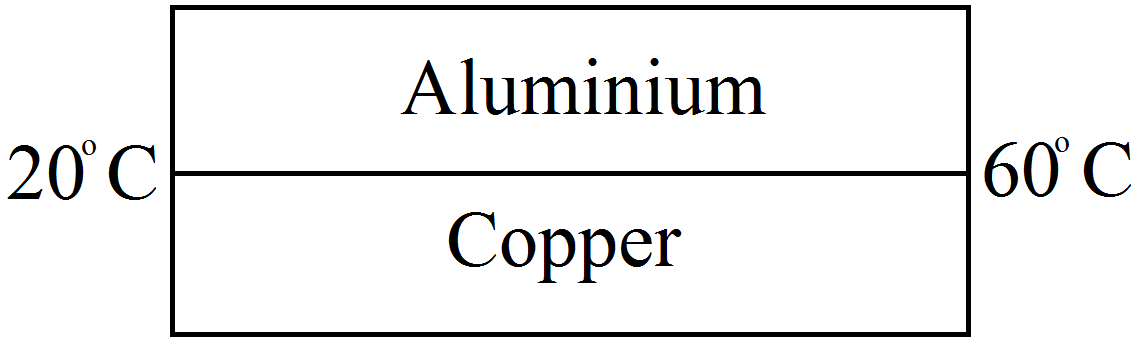
An aluminium rod and a copper rod of equal length 1.0m and cross-sectional area $1cm^2$ are welded together as shown in figure. One end is kept at a temperature of $20^\circ C$ and the other at $60^\circ C$. Calculate the amount of heat taken out per second from the hot end. Thermal conductivity of aluminium ${= 200Wm^{-1}}{^\circ C^{-1}}$ and of copper ${= 390Wm^{-1}}{^\circ C^{-1}.}$
Answer
As the Aluminum rod and Copper rod joined are in parallel

$\frac{\text{Q}}{\text{t}}=\Big(\frac{\text{Q}}{\text{t}_1}\Big)+\Big(\frac{\text{Q}}{\text{t}}\Big)_\text{Cu}$
$\Rightarrow\frac{\text{KA}(\theta_1-\theta_2)}{\text{l}}=\frac{\text{K}_1\text{A}(\theta_1-\theta_2)}{\text{l}}+\frac{\text{K}_2\text{A}(\theta_1-\theta_2)}{\text{l}}$
$\Rightarrow\text{K}=\text{K}_1+\text{K}_2=(390+200)=590$
$\frac{\text{Q}}{\text{t}}=\frac{\text{KA}(\theta_1-\theta_2)}{\text{l}}$
$=\frac{590\times1\times10^{-4}\times(60-20)}{1}$
$=590\times10^{-4}\times40=2.36\ \text{Watt}$
View full question & answer
Question 83 Marks
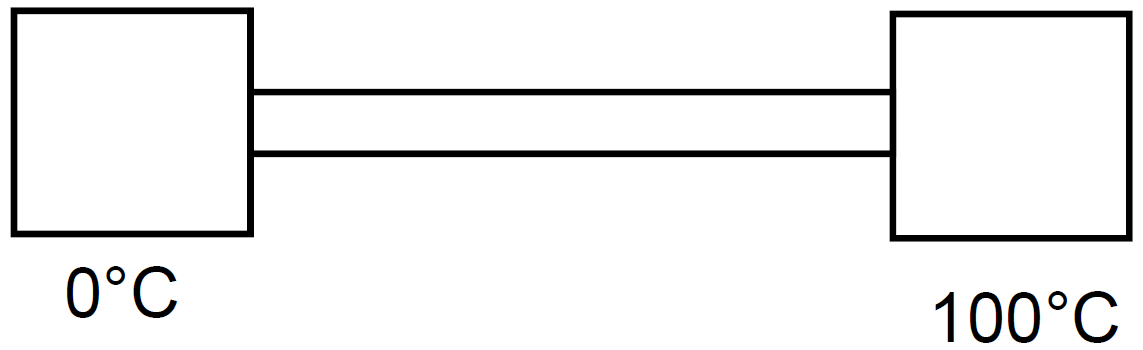
One end of a steel rod $(\text{K}=46\text{Js}^{-1}\text{m}^{-1}{^{\circ}}\text{C}^{-1})$ of length 1.0m is kept in ice at 0°C and the other end is kept in boiling water at 100°bC. The area of cross section of the rod is $0.04cm^2$. Assuming no heat loss to the atmosphere, find the mass of the ice melting per second. Latent heat of fusion of ice $=3.36\times10^5\text{Jkg}^{-1}.$
Answer


$\text{K}=46\text{w/m-s}^\circ\text{C}$
$\text{l}=1\text{m}$
$\text{A}=0.04\text{cm}^2=4\times10^6\text{m}^2$
$\text{L}_\text{fussion ice}=3.36\times10^5\text{j/kg}$
$\frac{\text{Q}}{\text{t}}=\frac{46\times4\times10^{-6}\times100}{1}$
$=5.4\times10^{-8}\text{kg}\approx5.4\times10^{-5}\text{g}.$
View full question & answer
Question 93 Marks
The normal body-temperature of a person is 97°F. Calculate the rate at which heat is flowing out of his body through the clothes assuming the following values. Room temperature = 47°F, surface of the body under clothes $= 1.6m^2,$ conductivity of the cloth $= 0.04\text{Js}^{-1}\text{m}^{-1}{^{\circ}}\text{C}^{-1},$ thickness of the cloth = 0.5cm.
Answer
$\text{K}=0.04\text{J/s-}5^\circ\text{C},\ \text{A}=1.6\text{m}^2$
$\text{t}_1=97^\circ\text{F}=36.1^\circ\text{C},\ \text{t}_2=47^\circ\text{F}=8.33^\circ\text{C}$
$\text{l}=0.5\text{cm}=0.005\text{m}$
$\frac{\text{Q}}{\text{t}}=\frac{\text{KA}(\theta_1-\theta_2)}{\text{l}}$
$=\frac{4\times10^{-2}\times1.6\times27.78}{5\times10^{-3}}$
$=356\text{J/s}$
View full question & answer
Question 103 Marks
Figure, shows an aluminium rod joined to a copper rod. Each of the rods has a length of 20cm and area of cross section $0.20cm^2$. The junction is maintained at a constant temperature $40^\circ C$ and the two ends are maintained at $80^\circ C.$ Calculate the amount of heat taken out from the cold junction in one minute after the steady state is reached. The conductivities are KAI ${= 200wm^{-1}}{^\circ C^{-1}}$ and ${K_{cu} = 400wm^{-1}}^\circ C^{-1}.$
Answer
$\text{K}_\text{Al}=200\text{w/m-}^\circ\text{C},\ \text{K}_\text{Cu}=400\text{w/m-}^\circ\text{C}$
$\text{A}=0.2\text{cm}^2=2\times10^{-5}\text{m}^2$
$\text{l}=20\text{cm}=2\times10^{-1}\text{m}$
Heat drawn per second
$=\text{Q}_\text{Al}+\text{Q}_\text{Cu}=\frac{\text{K}_\text{Al}\times\text{A}(80-40)}{\text{l}}+\frac{\text{K}_\text{Cu}\times\text{A}(80-40)}{\text{l}}$
$=\frac{2\times10^{-5}\times40}{2\times10^{-1}}\big[200+400\big]=2.4\text{J}$
Heat drawn per min $=2.4\times60=144\text{J}$
View full question & answer
Question 113 Marks
A 100W bulb has tungsten filament of total length 1.0m and radius $4 \times 10^{-5}m$. The emissivity of the filament is 0.8 and $\sigma=6.0\times10^{-8}\text{Wm}^{-2}\text{K}^4.$ Calculate the temperature of the filament when the bulb is operating at correct wattage.
Answer
$\frac{\text{Q}}{\text{t}}=\text{Ae}\sigma\text{T}^4$
$\Rightarrow\text{T}^4=\frac{\theta}{\text{teA}\sigma}$
$\Rightarrow\text{T}^4=\frac{100}{0.8\times2\times3.14\times4\times10^{-5}\times1\times6\times10^{-8}}$
$\Rightarrow\text{T}=1697.0\approx1700\text{K}$
View full question & answer
Question 123 Marks
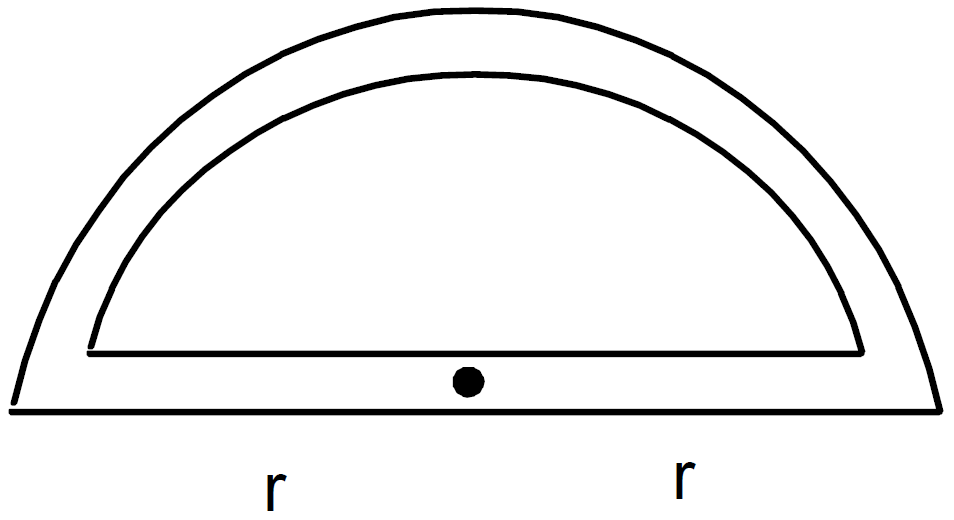
A semicircular rod is joined at its end to a straight rod of the same material and the same cross-sectional area. The straight rod forms a diameter of the other rod. The junctions are maintained at different temperatures. Find the ratio of the heat transferred through a cross section of the semicircular rod to the heat transferred through a cross section of the straight rod in a given time.
Answer

We know $\text{Q}=\frac{\text{KA}(\theta_1-\theta_2)}{\text{d}}$


$\text{Q}_1=\frac{\text{KA}(\theta_1-\theta_2)}{\text{d}_1},\ \text{Q}_2=\frac{\text{KA}(\theta_1-\theta_2)}{\text{d}_2}$
$\frac{\text{Q}_1}{\text{Q}_2}=\frac{\frac{\text{KA}(\theta_1-\theta_2)}{\pi\text{r}}}{\frac{\text{KA}(\theta_1-\theta_1)}{2\text{r}}}$
$=\frac{2\pi}{\pi\text{r}}$ $\big[\text{d}_1=\pi\text{r},\ \text{d}_2=2\text{r}\big]$
$=\frac{2}{\pi}$
View full question & answer
Question 133 Marks
Figure, shows a copper rod joined to a steel rod. The rods have equal length and equal cross sectional area. The free end of the copper rod is kept at $0^\circ C$ and that of the steel rod is kept at $100^\circ C.$ Find the temperature at the junction of the rods. Conductivity of copper ${= 390Wm^{-1}}{^\circ C^{-1}.}$ and that of steel ${= 46Wm^{-1}}{^\circ c^{-1}.}$
Answer
$\text{K}_\text{Cu}=390\text{w/m-}^\circ\text{C},\ \text{K}_\text{St}=46\text{w/m-}^\circ\text{C}$
Now, Since they are in series connection,
So, the heat passed through the crossections in the same.

So, $\text{Q}_1=\text{Q}_2$
$\Rightarrow\frac{\text{K}_\text{Cu}\times\text{A}\times(\theta-0)}{\text{l}}=\frac{\text{K}_\text{st}\times\text{A}\times(100-\theta)}{\text{l}}$
$\Rightarrow390(\theta-0)=46\times100-46\theta$
$\Rightarrow436\theta=4600$
$\Rightarrow\theta=\frac{4600}{436}$
$10.55\approx10.6^\circ\text{C}$
View full question & answer
Question 143 Marks
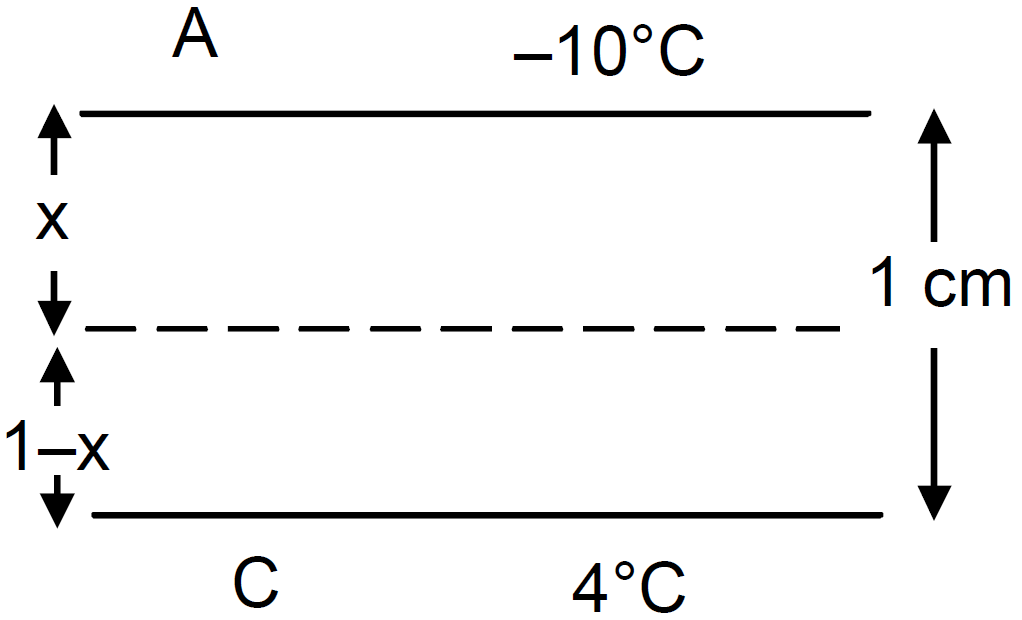
Consider the situation of the previous problem. Assume that the temperature of the water at the bottom of the lake remains constant at $4^\circ C$ as the ice forms on the surface (the heat required to maintain the temperature of the bottom layer may come from the bed of the lake). The depth of the lake is 1.0m. Show that the thickness of the ice formed attains a steady state maximum value. Find this value. The thermal conductivity of water $=0.50\text{Wm}^{-1}{^{\circ}}\text{C}^{-1}.$ Take other relevant data from the previous problem.
Answer
let ‘B’ be the maximum level upto which ice is formed. Hence the heat conducted at that point from both the levels is the same.

Let $\text{AB}=\text{x}$
i.e., $\frac{\text{Q}}{\text{t}}\text{ice}=\frac{\text{Q}}{\text{t}}\text{water}$
$\Rightarrow\frac{\text{K}_\text{ice}\times\text{A}\times10}{\text{x}}=\frac{\text{K}_\text{water}\times\text{A}\times4}{(1-\text{x})}$
$\Rightarrow\frac{1.7\times10}{\text{x}}=\frac{5\times10^{-1}\times4}{1-\text{x}}$
$\Rightarrow\frac{17}{\text{x}}=\frac{2}{1-\text{x}}$
$\Rightarrow17-17\text{x}=2\text{x}$
$\Rightarrow19\text{x}=17$
$\Rightarrow\text{x}=\frac{17}{19}$
$=0.894\approx89\text{cm}.$
View full question & answer
Question 153 Marks
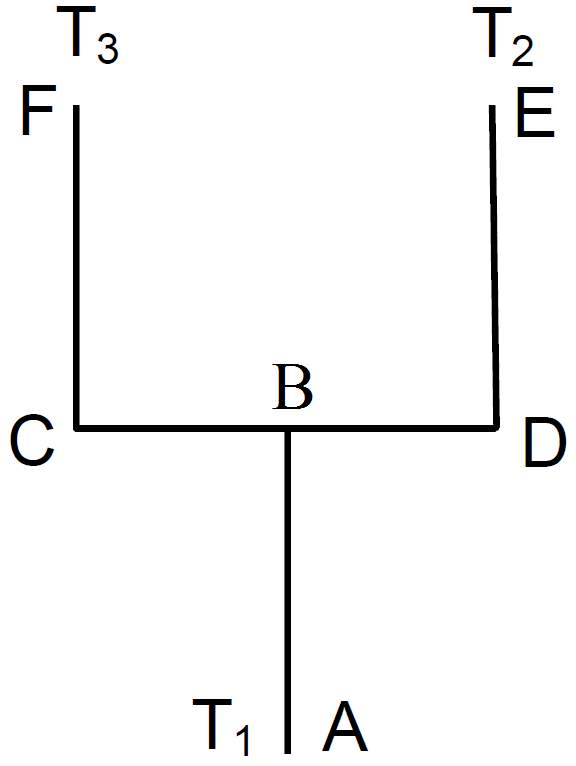
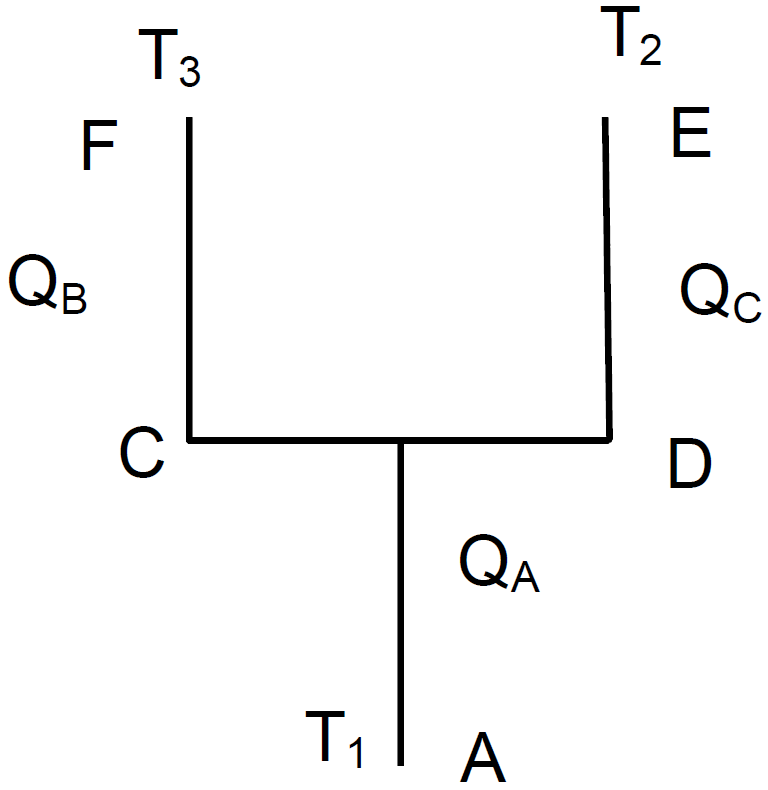
Four identical rods AB, CD, CF and DE are joined as shown in figure. The length, cross-sectional area and thermal conductivity of each rod are l, A and K respectively. The ends A, E and F are maintained at temperatures $T_1, T_2$ and $T_3$ respectively. Assuming no loss of heat to the atmosphere, find the temperature at B.
Answer


Let the temp. at B be T
$\frac{\text{Q}_\text{A}}{\text{t}}=\frac{\text{Q}_\text{B}}{\text{t}}+\frac{\text{Q}_\text{c}}{\text{t}}$
$\Rightarrow\frac{\text{KA}(\text{T}_1-\text{T})}{\text{l}}=\frac{\text{KA}(\text{T}-\text{T}_3)}{\text{l}+\Big(\frac{1}{2}\Big)}+\frac{\text{KA}(\text{T}-\text{T}_2)}{\text{l}+\Big(\frac{1}{2}\Big)}$
$\Rightarrow\frac{\text{T}_1-\text{T}}{\text{l}}=\frac{\text{T}-\text{T}_3}{\frac{3\text{l}}{2}}+\frac{\text{T}-\text{T}_2}{\frac{3\text{l}}{2}}$
$\Rightarrow3\text{T}_1-3\text{T}=4\text{T}-2(\text{T}_2+\text{T}_3)$
$\Rightarrow-7\text{T}=-3\text{T}_1-2(\text{T}_2+\text{T}_3)$
$\Rightarrow\text{T}=\frac{3\text{T}_1+2(\text{T}_2+\text{T}_3)}{7}$
View full question & answer
Question 163 Marks
A liquid-nitrogen container is made of a 1cm thick styrofoam sheet having thermal conductivity $0.025\text{Js}^{-1}\text{m}^{-1}{^\circ}\text{C}^{-1}.$ Liquid nitrogen at 80K is kept in it. A total area of $0.80m^2$ is in contact with the liquid nitrogen. The atmospheric temperature is 300K. Calculate the rate of heat flow from the atmosphere to the liquid nitrogen.
Answer
$\text{t}=1\text{cm}=0.01\text{m},\ \text{A}=0.8\text{m}^2$
$\theta_1=300,\ \theta_2=80$
$\text{K}=0.025,$
$\frac{\text{Q}}{\text{t}}=\frac{\text{KA}(\theta_1-\theta_2)}{\text{l}}$
$=\frac{0.025\times0.8\times(30030)}{0.01}$
$=440\text{watt}.$
View full question & answer
Question 173 Marks
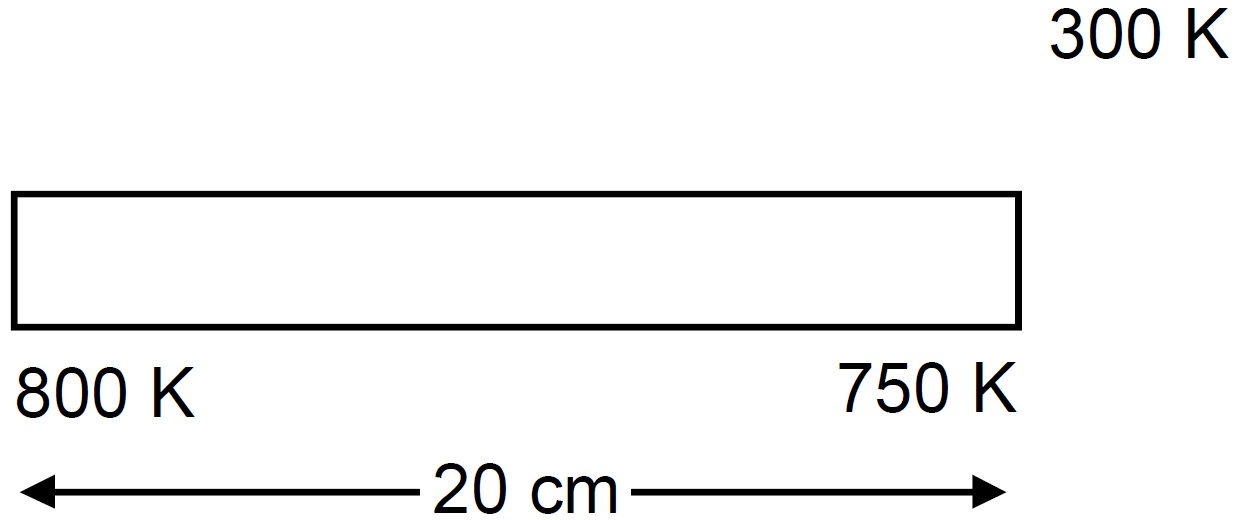
One end of a rod of length 20cm is inserted in a furnace at 800K The sides of the rod are covered with an insulating material and the other end emits radiation like a blackbody. The temperature of this end is 750K in the steady state. The temperature of the surrounding air is 300K. Assuming radiation to be the only important mode of energy transfer between the surrounding and the open end of the rod, find the thermal conductivity of the rod. Stefan constant $\sigma=6.0\times10^{-8}\text{Wm}^{-2}\text{K}^{-4}.$
Answer

$\sigma=6\times10^{-8}\text{w/m}^2\text{-k}^4$
$\text{L}=20\text{cm}=0.2\text{m},\ \text{K}=?$
$\Rightarrow\text{E}=\frac{\text{KA}(\theta_1-\theta_2)}{\text{d}}=\text{A}\sigma\big(\text{T}_1^4-\text{T}_2^4\big)$
$\Rightarrow\text{K}=\frac{\text{s}(\text{T}_1-\text{T}_2)\times\text{d}}{\theta_1-\theta_2}=\frac{6\times10^{-8}\times(750^4-300^4)\times2\times10^{-1}}{50}$
$\Rightarrow\text{K}=73.993\approx74.$
View full question & answer