Questions

3 Marks Question

Take a timed test

8 questions · self-marked practice — reveal the answer and mark yourself.

Question 13 Marks
In a Young's double experiment, the slits are $1.5 \ mm$ apart. When the slits are illuminated by a monochromatic light source and the screen is kept $1 \ m$ apart from the slits, width of $10$ fringes is measured as $3.93\ mm$.
Calculate the wavelength of light used. What will be the width of $10$ fringes when the distance between the slits and the screen is increased by $0.5\ m$. The source of light used remains the same.
Answer
In first case :
$d =1.5 mm=1.5 \times 10^{-3} m, D =1 m$
Width of $10$ fringes $= 3.93\ mm$
$\therefore$ Fringe width,
$\beta=\frac{3.93}{10}=0.393\ mm$
$=0.393 \times 10^{-3} m$
Wavelength,
$\lambda=\frac{\beta d}{D}=\frac{0.393 \times 10^{-3} \times 1.5 \times 10^{-3}}{1}$
$=5.895 \times 10^{-7} m$
In second case :
$ D ^{\prime}=1+0.5=1.5\ m$
$d =1.5 \times 10^{-3} m, \lambda$
$=5.895 \times 10^{-7} m$
Width of $10 $ fringes $=10 \beta^{\prime}$
$=\frac{10 D^{\prime} \lambda}{d}$
$=\frac{10 \times 1.5 \times 5.895 \times 10^{-7}}{1.5 \times 10^{-3}}$
$=5.895 \times 10^{-3} m$
View full question & answer
Question 23 Marks
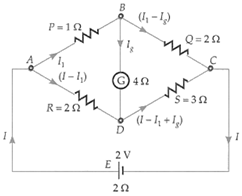
In a Wheatstone bridge $, P =1 \Omega, Q =2 \Omega, R =2 \Omega, S=3 \Omega$ and $R _{ g }=4 \Omega$. Find the current through the galvanometer in the unbalanced position of the bridge, when a battery of $2 V$ and internal resistance $2 \Omega$ is used.
Answer
The circuit for the given Wheatstone bridge is shown in Figure.
Let $I , I _1$ and $I _{ g }, $ be the currents as shown.
Image
Applying Kirchhoff's second law to loop $\text {ABDA,}$ we get,
$ I _1 \times I + I _{ g } \times 4-\left( I - I _1\right) \times 2  =0 $
or  $3 I _1-2 I +4 I _{ g }=0 \ldots \text { (i) }$
Applying Kirchhoff's second law to loop $\text {BCDB,}$ we get
$\left( I _1- I _{ g }\right) \times 2-\left( I - I _1+ I _{ g }\right) \times 3- I _{ g } \times 4=$
$5 I _1-3 I -9 I _{ g }=0 \ldots( ii )$
Applying Kirchhoff's second law to loop $\text {ADCEA,}$ we get
$2\left( I - I _1\right)+3\left( I - I _1+ I _{ g }\right)+2 I =2$
or $-5 I _1+7 I +3 I _{ g }=2 \ldots \text { (iii) }$
Adding $(ii)$ and $(iii),$
$4 I -6 I _{ g }=2 \ldots( iv )$
Multiplying $(i)$ by $5$ and $(ii)$ by $3$ and Subtracting, we get
$- I +47 I _{ g }=0$ or $I =47 I _{ g }$
From $(iv),$
$4 \times 47 I _{ g }-6 I _{ g }=2 $ or  $182 I _{ g }=2$
$\therefore I_g=\frac{2}{182}=\frac{1}{91} A $
View full question & answer
Question 33 Marks
State Lenz's law. Give one example to illustrate this law. "The Lenz's law is a consequence of the principle of conservation of energy." Justify this statement.
Answer
According to Lenz's law, the direction of the induced current (caused by induced emf) is always such as to oppose the change causing it.
$\varepsilon=-k \frac{d \phi}{d t}$
where k is a positive constant. The negative sign expresses Lenz's law. It means that the induced emf is such that, if the circuit is closed, the induced current opposes the change in flux.
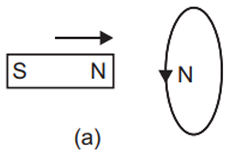
Example: When the north pole of a coil is brought near a closed coil, the direction of current induced in the coil is such as to oppose the approach of north pole. For this the nearer face of coil behaves as north pole. This necessitates an anticlockwise current in the coil, when seen from the magnet side [fig. (a)]
Image

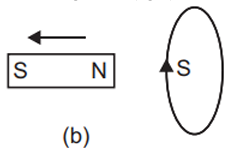
Similarly when north pole of the magnet is moved away from the coil, the direction of current in the coil will be such as to attract the magnet. For this the nearer face of coil behaves as south pole. This necessitates a clockwise current in the coil, when seen from the magnet side (fig. b).
Image

Thus, in each case whenever there is a relative motion between a coil and the magnet, a force begins to act which opposes the relative motion. Therefore to maintain the relative motion, a mechanical work must be done. This work appears in the form of electric energy of coil. Thus Lenz’s law is based on conservation of energy.
View full question & answer
Question 43 Marks
A metallic rod of length l and resistance R is rotated with a frequency $\nu$ , with one end hinged at the centre and the other end at the circumference of a circular metallic ring of radius l, about an axis passing through the centre and perpendicular to the plane of the ring. A constant and uniform magnetic field B parallel to the axis is present everywhere.
i. Derive the expression for the induced emf and the current in the rod.
ii. Due to the presence of the current in the rod and of the magnetic field, find the expression for the magnitude and direction of the force acting on this rod.
iii. Hence obtain the expression for the power required to rotate the rod.
Answer
i. In the one revolution, change of area,
$d A=\pi l^2$
$\therefore$ Change of magnetic flux in one revolution of the rod,
$d \phi_B=\vec{B} \cdot d \vec{A}=B d A \cos 0^{\circ}=B \pi l^2$
(Given, magnetic field intensity, $\vec{B}$ is parallel to change in area, $d \vec{A}$ )
If period of revolution is T,
a. Induced emf $( e )=\frac{d \phi}{d t}=\frac{B \pi l^2}{T}=B \pi l^2 \nu\left(\because \nu=\frac{1}{T}\right)$
b. Induced current in the rod,
$I=\frac{\epsilon}{R}=\frac{\pi \nu R^2}{R}$
(Given R = resistance of the rod)
ii. Magnitude of force acting on the rod,
$|\vec{F}|=|I(\vec{l} \times \vec{B})|=$ BIlsin $90^0=\frac{\pi \nu B^2 l^3}{R}$
The external force required to rotate the rod opposes the Lorentz force acting on the rod, i.e external force acts in the direction opposite to the Lorentz force.
iii. Power required to rotate the rod,
$P=\vec{F} \cdot \vec{v}=F v \cos 0^0=\frac{\pi \nu B^2 \rho^3 v}{R}$
View full question & answer
Question 53 Marks
The radionuclide ${ }^{11} C$ decays according to ${ }_6^{11} C \rightarrow{ }_5^{11} B+ e ^{+}+ v : T _{1 / 2}=20.3$ min. The maximum energy of the emitted positron is $0.960\ MeV$ . Given the mass values: $m \left({ }_6^{11} C \right)=11.011434 u$ and $m \left({ }_5^{11} B\right)=11.009305 u$, calculate $Q$ and compare it with the maximum energy of the positron emitted.
Answer
Important: We must consider electron mass in decays, this mass is no more negligible.
The nuclear reaction is given by:
${ }_6^{11} C \rightarrow{ }_5^{11} B+ e ^{+}+ v : T _{1 / 2}=20.3$ min
Hence $Q$ value for this reaction is given by $=\left[11.011434-\left(11.009305+2 \times m_e\right)\right] \times c^2$
We know, $m _{ e }=0.000548 u$
$ Q =[11.011434-(11.009305+2 \times 0.000548)] \times c ^2$
$=0.001033 u \times c ^2, \text { as }\left(1 u =931.5 MeV / c ^2\right)$
$=0.962\ MeV$ maximum energy of emitted positron. 
Hence the $Q$ value is comparable with the maximum energy of the positron emitted.
View full question & answer
Question 63 Marks
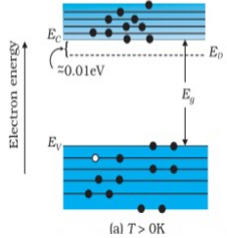
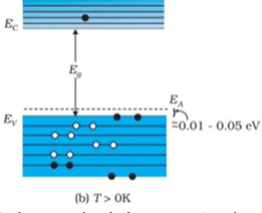
Draw the energy band diagrams $($at $T >$ 0K$)$ for $n-$type and $p-$type semiconductors. Using diagram, explain why in $n-$type semiconductor the conduction band has most electrons from the donor impurities.
Answer
Energy Band Diagram of $n-$type
Image

Energy Band Diagram of $p-$type
Image

In the energy band of n-type semiconductors, donor energy level $E_D$ is
formed slightly below the bottom of $E_C$ of the conduction band. Hence electrons from this level move into the conduction band easily.
View full question & answer
Question 73 Marks
The photon emitted during the de-excitation from the first excited level to the ground state of hydrogen atom is used to irradiate a photocathode of a photocell, in which stopping potential of 5 V is used. Calculate the work function of the cathode used.
Answer
Energy of incident photon $=E_2-E_1=-3.4-(13.6)=10.2 eV$
K.E. of photo electron $= eV _0=5 eV$
By conservation of energy,
Energy of incident photon = K.E. of photo electron + Work function
$\begin{array}{c}10.2 eV =5 eV + W _0 \\ \therefore W_0=5.2 eV \end{array}$
View full question & answer
Question 83 Marks
The energy flux of sunlight reaching the surface of the earth is $1.388 \times 10^3 W / m ^2$. How many photons $($nearly$)$ per square metre are incident on the Earth per second? Assume that the photons in the sunlight have an average wavelength of $550\ nm$ .
Answer
Energy flux of sunlight reaching the surface of earth, $\phi=1.388 \times 10^3 W / m ^2$
Hence, power of sunlight per square metre $,P =1.388 \times 10^3 W$
Speed of light $,c =3 \times 10^8 m / s$
Planck's constant $,h =6.626 \times 10^{-34} Js$
Average wavelength of photons present in sunlight $,\lambda=550 nm$
$=550 \times 10^{-9} m$
Hence, the equation for power can be written as:
$P = nE$
Number of photos incident on earth's surface per second per square metre is given by: $-$
$\therefore n=\frac{P}{E}=\frac{P \lambda}{h c}$
$=\frac{1.388 \times 10^3 \times 550 \times 10^{-9}}{6.626 \times 10^{-34} \times 3 \times 10^8}$
$=3.84 \times 10^{21} \text { photons } m ^2 / s $
View full question & answer