Questions

4 Marks Questions

Take a timed test

2 questions · self-marked practice — reveal the answer and mark yourself.

Question 14 Marks
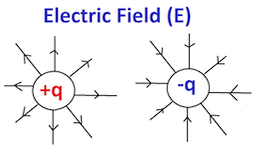
Electric field intensity at any point is the strength of the electric field at that point. It is also defined as the force experienced by unit positive charge placed at that point. Electric Field Intensity is a vector quantity. It is denoted by E. When placed within the electric field, the test charge will experience an electric force - either attractive or repulsive.
Image
(i) The Electric field at a point is
(a) discontinuous only if there is a negative charge at that point
(b) always continuous
(c) continuous if there is charge at that point
(d) continuous if there is no charge at that point

(ii) A charge is distributed uniformly over a ring of radius a. Obtain an expression for the electric intensity E at a point on the axis of the ring. Hence the points at large distances from the ring, it behaves like a point charge is:
(a) $E =\frac{1}{4 \pi \varepsilon_0} \cdot \frac{q}{x}$
(b) $E =\frac{1}{2 \pi \varepsilon_0} \cdot \frac{Q}{x^2}$
(c) $E =\frac{1}{4 \pi \varepsilon_0} \cdot \frac{q}{x^4}$
(d) $E =\frac{1}{4 \pi \varepsilon_0} \cdot \frac{Q}{x^2}$

(iii) Force acting on an electron in a uniform electric field of $5 \times 10^4 N / C$ is:
(a) $8 \times 10^{-15} N$
(b) $-7 \times 10^{-15} N$
(c) $-8 \times 10^{-15} N$
(d) $7 \times 10^{-15} N$

(iv) At a particular point, the electric field depends upon:
(a) source charge Q only
(b) both Q and q
(c) test charge $q_0$ only
(d) neither Q nor q

OR

Four charges of the same magnitude and same sign are placed at the corners of a square, of each side 0.1 m. then electric field intensity at the centre of the square is:
(a) $0.01 N / C$
(b) $0.25 N / C$
(c) zero
(d) $0.1 N / C$

Answer
Electric field intensity at any point is the strength of the electric field at that point. It is also defined as the force experienced by unit positive charge placed at that point. Electric Field Intensity is a vector quantity. It is denoted by E. When placed within the electric field, the test charge will experience an electric force - either attractive or repulsive.
Image
(i) (d) continuous if there is no charge at that point
Explanation: continuous if there is no charge at that point

(ii) (d) $E =\frac{1}{4 \pi \varepsilon_0} \cdot \frac{Q}{x^2}$
Explanation: $E =\frac{1}{4 \pi \varepsilon_0} \cdot \frac{Q}{x^2}$

(iii) (a) $8 \times 10^{-15} N$
Explanation: $8 \times 10^{-15} N$

(iv) (a) source charge Q only
Explanation: source charge Q only

OR

(c) zero
Explanation: zero
View full question & answer
Question 24 Marks
Maxwell showed that the speed of an electromagnetic wave depends on the permeability and permittivity of the medium through which it travels. The speed of an electromagnetic wave in free space is given by  $C=\frac{1}{\sqrt{\mu_0 \varepsilon_0}}$ The fact led Maxwell to predict that light is an electromagnetic wave. The emergence of the speed of light from purely electromagnetic considerations is the crowning achievement of Maxwell’s electromagnetic theory. The The fact led Maxwell to predict that light is an electromagnetic wave. The emergence of the speed of light from purely electromagnetic considerations is the crowning achievement of Maxwell’s electromagnetic theory. The speed of an electromagnetic wave in any medium of permeability $\mu$ and permittivity $\varepsilon$ will be$\frac{c}{\sqrt{K \mu_r}}$ where K is the dielectric constant of the medium and $\mu_r$ is the relative permeability.

(i) The dimensions of $\frac{1}{2} \varepsilon_0 E^2$ ( $\varepsilon_0$ : permittivity of free space; $E =$ electric field $)$ is
(a) $MLT ^{-1}$ (b) $ML ^{-1} T^{-2}$ (c) $ML ^2 T^{-2}$ (d) $ML ^2 T^{-1}$

(ii) Let $\left[\varepsilon_0\right]$ denote the dimensional formula of the permittivity of the vacuum. If $M =$ mass, $L =$ length, $T =$ time and $A =$ electric current, then
(a) $\left[\varepsilon_0\right]= ML ^2 T^{-1}$
(b) $\left[\varepsilon_0\right]= MLT ^{-2} A^{-2}$
(c) $\left[\varepsilon_0\right]= M ^{-1} L^{-3} T^4 A^2$
(d) $\left[\varepsilon_0\right]= M ^{-1} L^{-3} T^2 A$

(iii) An electromagnetic wave of frequency 3 MHz passes from vacuum into a dielectric medium with permittivity $\varepsilon=4$. Then
(a) wavelength is halved and the frequency remains unchanged.
(b) wavelength and frequency both remain unchanged
(c) wavelength is doubled and the frequency remains unchanged
(d) wavelength is doubled and the frequency becomes half

OR

The electromagnetic waves travel with
(a) the speed of light $c =3 \times 10^8 m s ^{-1}$ in
(b) the speed of light $c =3 \times 10 m s ^{-1}$ in fluid medium. solid medium
(c) the speed of light $c =3 \times 10^8 m s ^{-1}$ in
(d) the same speed in all media free space

(iv) Which of the following are not electromagnetic waves?
cosmic rays, $\gamma$-rays, $\beta$-rays, X-rays
(a) $\beta$-rays (b) X-rays (c) $\gamma$-rays (d) cosmic rays
Answer
Maxwell showed that the speed of an electromagnetic wave depends on the permeability and permittivity of the medium through which it travels. The speed of an electromagnetic wave in free space is given by $c =\frac{1}{\sqrt{\mu_0 \varepsilon_0}}$. The fact led Maxwell to predict that light is an electromagnetic wave. The emergence of the speed of light from purely electromagnetic considerations is the crowning achievement of Maxwell's electromagnetic theory. The speed of an electromagnetic wave in any medium of permeability $\mu$ and permittivity $\varepsilon$ will be $\frac{c}{\sqrt{K \mu_r}}$ where K is the dielectric constant of the medium and $\mu_r$ is the relative permeability.

(i) (b) $ML ^{-1} T^{-2}$
Explanation: $\frac{1}{2} \varepsilon_0 E^2=$ energy density $=\frac{\text { Energy }}{\text { Volume }}$
$\therefore\left[\frac{1}{2} \varepsilon_0 E^2\right]=\frac{ ML ^2 T^{-2}}{L^3}=\left[ ML ^{-1} T^{-2}\right]$

(ii) (c) $\left[\varepsilon_0\right]= M ^{-1} L^{-3} T^4 A^2$
Explanation: As $\varepsilon_0=\frac{q_1 q_2}{4 \pi F R^2}$ (from Coulomb's law)
$\varepsilon_0=\frac{ C ^2}{ Nm ^2} \frac{[ AT ]^2}{ MLT ^{-2} L^2}= M ^{-1} L^{-3} T^4 A^2$

(iii) (a) wavelength is halved and the frequency remains unchanged.
Explanation: The frequency of the electromagnetic wave remains same when it passes from one medium to another. Refractive index of the medium, $n =\sqrt{\frac{\varepsilon}{\varepsilon_0}}=\sqrt{\frac{4}{1}}=2$
Wavelength of the electromagnetic wave in the medium,
$\lambda_{\text {med }}=\frac{\lambda}{n}=\frac{\lambda}{2}$

OR

(c) the speed of light $c =3 \times 10^8 m s ^{-1}$ in free space
Explanation: The velocity of electromagnetic waves in free space (vacuum) is equal to velocity of light in vacuum (i.e., $3 \times 10^8 m s ^{-1}$ ).

(iv) (a) $\beta$-rays
Explanation: $\beta$-rays consists of electrons which are not electromagnetic in nature.
View full question & answer