Questions

M.C.Q (1 Marks)

Take a timed test

12 questions · self-marked practice — reveal the answer and mark yourself.

Question 11 Mark
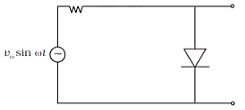
The output of the given circuit in Figure.
Image
Answer
(a) would be like a half-wave rectifier with negative cycles in output
Explanation: When the positive cycle is at A, the diode will be in forwarding bias, and resistance due to diode is approximately zero the current in the circuit is maximum so potential across the diode will be about zero. Similarly, when there is a negative half cycle at A, the diode will be in reverse bias and resistance will be maximum so potential difference across the diode is $V_m \sin \omega t$ with negative at A.
View full question & answer
Question 21 Mark
The dielectric constant K of an insulator will be-
Answer
(b) 4
Explanation: Dielectric constant of air is 1. All dielectrics generally have a value of the dielectric constant greater than 1. $K=\frac{F}{F_m}$
where Fm is the force between two charged particles in a medium of dielectric constant K and F is the force between the two charges when placed in air.The force between two charges is greatest in air or vacuum and it decreases when any medium is placed between the charges. K cannot have negative, fractional or zero values.
View full question & answer
Question 31 Mark
The arrangement fo two magnetic poles of equal and opposite strengths separated by a finite distance is called:
Answer
(a) Magnetic dipole
Explanation: Magnetic dipole
View full question & answer
Question 41 Mark
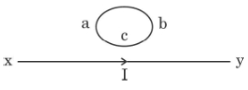
The direction of induced current in the loop abc is:
Image
Answer
(b) along abc if I increases
Explanation: In accordance with Lenz law.
View full question & answer
Question 51 Mark
The universal property among all substances is
Answer
(c) diamagnetism
Explanation: Diamagnetism is a universal property among all substances.
View full question & answer
Question 61 Mark
An equi $-$ convex crown glass lens has a focal length $20 \ cm$ for violet rays. Here $\mu_{ v }=1.5 \ \mu_{ r }=1.47$. Its focal length for red rays is
Answer
$(c) \ 21.28 \ cm$
Explanation:
$\frac{1}{f}=\left(\frac{\mu_2}{\mu_1}-1\right)\left(\frac{1}{R_1}-\frac{1}{R_2}\right)$
For violet light,
$\frac{1}{f_v}=(1.5-1)\left(\frac{1}{R_1}-\frac{1}{R_2}\right)$
$=0.5\left(\frac{1}{R_1}-\frac{1}{R_2}\right)$
For red light,
$\frac{1}{f_r}=(1.47-1)\left(\frac{1}{R_1}-\frac{1}{R_2}\right)$
$=0.47\left(\frac{1}{R_1}-\frac{1}{R_2}\right)$
Hence $,  f_r=\frac{0.5}{0.47} f_v=1.064 \times 20$
$=21.28 \ cm$
View full question & answer
Question 71 Mark
The magnitude of the electric field due to a point charge object at a distance of 4.0 m is $9 N / C$. From the same charged object the electric field of magnitude, $16 \frac{N}{ C }$ will be at a distance of
Answer
(a) 3m
Explanation: 3m
View full question & answer
Question 81 Mark
Phenomenon of bending of waves around corners of obstacle without a change in medium is called _________.
Answer
(a) diffraction
Explanation: The phenomenon of bending of waves around corners of obstacle without a change in medium is known as diffraction.
View full question & answer
Question 91 Mark
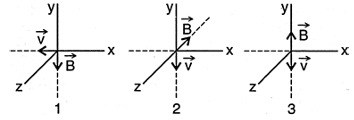
The following figure shows three situations when an electron with velocity $\vec{v}$ travels through a uniform magnetic field $\vec{B}$. In each case, what is the direction of magnetic force on the electron?
Image
Answer
(a) -ve z-axis, -ve x-axis and zero
Explanation: -ve z-axis, -ve x-axis and zero
View full question & answer
Question 101 Mark
Which of the following is used in optical fibers?
Answer
(d) Total internal reflection
Explanation: When light travelling in an optically dense medium hits a boundary at a steep angle, the light is completely reflected. This is called total internal reflection. This effect is used in optical fibres to confine light in the core.
View full question & answer
Question 111 Mark
How many coulombs of electricity must pass through acidulated water to liberate 22.4 litres of hydrogen at N.T.P.?
Answer
(a) 193000 C
Explanation: Reduction equation taking place at the cathode is as follow:
$2 H^{+}+2 e^{-} \rightarrow H_2(g)$
It implies that 2 moles of electrons are required to produce 1 mole (= 22.4 liters) of Hydrogen. Hence,
1 mole of electron is = 1 Faraday
and 1 Faraday = 96500 Coulombs of charge
$\therefore 2$ moles of electrons $=193000$ Coulombs of charge.
View full question & answer
Question 121 Mark
When a p-n diode is reverse biased, then
Answer
(b) the depletion region is increased
Explanation: When a p-n junction is reverse biased, its depletion region is widened.
View full question & answer