Questions

3 Marks Question

Take a timed test

8 questions · self-marked practice — reveal the answer and mark yourself.

Question 13 Marks
The absolute refractive index of air is 1.0003 and the wavelength of yellow light in a vacuum is $6000 \stackrel{\circ}{A}$ . Find the thickness of air column which will contain one more wavelength of yellow light than in the same thickness of vacuum.
Answer
Wavelength of yellow light in vacuum,
$\lambda=6000 \stackrel{\circ}{A}$
Wavelength of yellow light in air
$\lambda^{\prime}=\frac{\lambda}{\mu}=\frac{6000}{1.0003} \stackrel{\circ}{A}$
Let a thickness t of vacuum contain n waves and the same thickness t of air contain n + 1 waves.
Then $n =\frac{t}{\lambda}=\frac{t}{6000 \stackrel{\circ}{A}}$
and $n +1=\frac{t}{\lambda^{\prime}}=\frac{1.0003 t}{6000 \stackrel{\circ}{A}}$
$n +1=\frac{t}{\lambda^{\prime}}=\frac{1.0003 t}{6000 \stackrel{\circ}{A}}$
$\frac{t}{6000 \stackrel{\circ}{A}}+1=\frac{1.003 t}{0.0003}$ or $t +6000 \stackrel{\circ}{A}=1.0003 t$
or $t =\frac{6000}{0.0003}=2 \times 10^7 \stackrel{\circ}{A}=2 mm$.
View full question & answer
Question 23 Marks
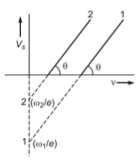
Write Einstein's photoelectric equation in terms of the stopping potential and the threshold frequency for a given photosensitive material. Draw a plot showing the variation of stopping potential $vs$. the frequency of incident radiation.
Answer
Einstein's photoelectric equation,
$\text{K.E.}$ of photo electron $=$ incident energy of photons $-$ Work function
or $K.E. = hv - W _0$
or $K.E. = hv - hv _0$
where $v_0$ is called threshold frequency.
$i.$ Threshold Frequency: For a given metal, there exists a certain minimum frequency of the incident radiation below which no emission of photo electrons takes place.
This frequency is called threshold frequency.
$ii.$ Threshold Frequency: For a given metal, there exists a certain minimum frequency of the incident radiation below which no emission of photo electrons takes place.
This frequency is called threshold frequency.
Image
View full question & answer
Question 33 Marks
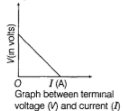
$A$ cell of emf $E$ and internal resistance $r$ is connected across a variable load resistor $R$. Draw the plots of the terminal voltage $V$ versus $(i)$ resistance $R$ and $(ii)$ current $I$.
It is found that when $R=4 \Omega$, the current is $1 A$ and when $R$ is increased to $9 \Omega$, the current reduces to $0.5 A$ .Find the values of the emf $E$ and internal resistance $r$.
Answer
Internal resistance usually means the electrical resistance inside batteries and power supplies that can limit the potential difference that can be supplied to an external load
$\because V=\left(\frac{E}{R+r}\right) R=\frac{E}{1+r / R}$
$\Rightarrow$ with the increase of $R , V$ increases
Graph between terminal voltage $(V)$ and Current $(I)$
Image
When $R=4 \Omega$ and $I =1 A$.
We know that, terminal voltage $, V = E - Ir.$
$\Rightarrow V=I R=4=E-I r$
$\Rightarrow E-r=4 \ldots \text { (i) }$
When $R=9 \Omega$ and $I =0.5 A$, then
$V=I R=0.5 \times 9=E-0.5 r$
$\Rightarrow E-05 r=4.5 \ldots(i i)$
On solving Eqs. $(i)$ and $(ii),$ we get
$r=1 \Omega$ and $E =5 V$
So from the above calculation, it was found that the internal resistance of the cell is $1 \text { ohm}$ and emf is $5$ volt.
View full question & answer
Question 43 Marks
Define the term self-inductance. Write its SI unit. Give two factors on which self inductance of an air-core coil depends.
Answer
Self-inductance of a coil is equal to the total magnetic flux linked with the coil, when unit current passes through it. SI unit of self-inductance is Henry (H).
i. number of turns of the coil
ii. area of cross section and length (geometry)
View full question & answer
Question 53 Marks
A horizontal straight wire $10 m$ long extending from east to west is falling with a speed of $5.0 ms^{-1}$, at right angles to the horizontal component of the earth's magnetic field, $0.30 \times 10^{-4} Wb m ^{-2}$.
$a$. What is the instantaneous value of the emf induced in the wire?
$b$. What is the direction of the emf?
$c$. Which end of the wire is at the higher electrical potential?
Answer
Length of the wire $, l = 10 m$
Falling speed of the wire $, v = 5.0 m/s$
Magnetic field strength, $B=0.3 \times 10^{-4} wb m ^{-2}$
$a$. the instantaneous value of $\text {Emf}$ induced in the wire,
$ e =\text { Blv }$
$=0.3 \times 10^{-4} \times 5 \times 10$
$=1.5 \times 10^{-3} V$
$b$. Using Fleming's right $-$ hand rule, it can be inferred that the direction of the induced emf is from
West to East.
$c$. The eastern end of the wire is at a higher potential.
View full question & answer
Question 63 Marks
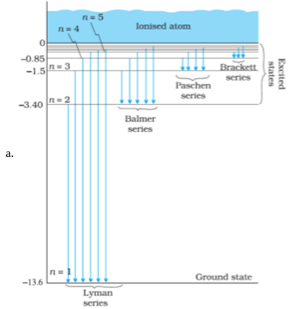
$a$. Draw the energy level diagram for the line spectra representing Lyman series and Balmer series in the spectrum of hydrogen atom.
$b$. Using the Rydberg formula for the spectrum of hydrogen atom, calculate the largest and shortest wavelengths of the emission lines of the Balmer series in the spectrum of hydrogen atom. $($Use the value of Rydberg constant $\left.R =1.1 \times 10^7 m^{-1}\right)$
Answer
Image
$b$.
$\frac{1}{\lambda_{\text {segget }}}=R\left\{\frac{1}{n_f^2}-\frac{1}{n_C^2}\right\}=R \frac{5}{36}$
$\lambda \max =\frac{36}{5 R}$
$=\frac{36}{5 \times 1.1 \times 10^7} m$
$=6.5 \times 10^{-7} m$
$\frac{1}{\lambda_{\text {Smilut }}}=R\left\{\frac{1}{2^2}-\frac{1}{\infty^2}\right\}$
$=\frac{R}{4}$
$\lambda_{\operatorname{mm}}=\frac{4}{R}=\frac{4}{1.1 \times 10^7} m$
$=3.6 \times 10^{-7} m$
 
View full question & answer
Question 73 Marks
i. What characteristic property of nuclear force explains the constancy of binding energy per nucleon (BE/A) in the range of mass number $A$ lying $30<A<170$ ?
ii. Show that the density of nucleus over a wide range of nuclei is constant and independent of mass number A
Answer
i. The characteristic property of nuclear force that explains the constancy of binding energy per nucleon is the saturation or short range nature of nuclear forces.
Let, m be the mass of a nucleon,
therefore,
density, $\rho=\frac{ mA }{\frac{4}{3} \pi\left( R _0 A^{1 / 3}\right)^3}=\frac{ mA }{\frac{4}{3} \pi R _0^3 A}=\frac{ m }{\frac{4}{3} \pi R _0^3}$
Thus, we can see that density is constant and independent of mass number A.
View full question & answer
Question 83 Marks
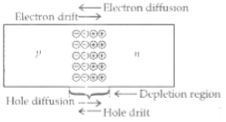
Explain with the help of a diagram, how a depletion layer and barrier potential are formed in a junction diode.
Answer
Image

Due to the diffusion of electrons and holes, from their majority to minority zone, a layer of positive and negative space charge region on either side on the junction is formed. This is called the depletion region. The loss of electrons, from the n-region and the gain of electrons by the p-region, cause a difference of potential across the junction formed. This tends to prevent the further movement of charge carriers across the junction and is, therefore, termed as barrier potential.
View full question & answer