Question 14 Marks
Coulomb's law states that the electrostatic force of attraction or repulsion acting between two stationary point charges is given by
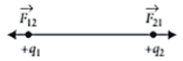
where $F$ denotes the force between two charges $q _1$ and $q _2$ separated by a distance r in free space, $\varepsilon_0$ is a constant known as the permittivity of free space.
Free space is a vacuum and may be taken to be air practically.
If free space is replaced by a medium, then $\varepsilon_0$ is replaced by $\left(\varepsilon_0 k\right)$ or $\left(\varepsilon_0 \varepsilon_r\right)$ where $k$ is known as dielectric constant or relative permittivity.
$(i)$ In coulomb's law, $F =k \frac{q_1 q_2}{r^2}$, then on which of the following factors does the proportionality constant k depends?
$(a)$ Nature of the medium between the two charges
$(b)$ Distance between the two charges
$(c)$ Electrostatic force acting between the two charges
$(d)$ Magnitude of the two charges
$(ii)$ Dimensional formula for the permittivity constant $\varepsilon_0$ of free space is
$(a) \left[ M ^{-1} L^3 T^2 A^2\right]$
$(b) \left[ ML ^{-3} T^4 A^2\right]$
$(c) \left[ M ^{-1} L^{-3} T^4 A^2\right]$
$(d) \left[ ML ^{-3} T^4 A^{-2}\right]$
$(iii)$ The force of repulsion between two charges of $1 C$ each, kept $1m$ apart in vaccum is
$(a) \frac{1}{9 \times 10^9} N$
$(b) \frac{1}{9 \times 10^{12}} N$
$(c) 9 \times 10^7 N$
$(d) 9 \times 10^9 N$
$(iv)$ Two identical charges repel each other with a force equal to $10$ mgwt when they are $0.6 m$ apart in air. ( $g =$ $10 m s ^{-2} )$. The value of each charge is
$(a) 2 mC$
$(b) 2 \times 10^{-7} mC$
$(c) 2 \mu C$
$(d) 2 nC$
OR
Coulomb's law for the force between electric charges most closely resembles with
$(a)$ law of conservation of energy
$(b)$ Newton's $2^{nd}$ law of motion
$(c)$ law of conservation of charge .
$(d)$ Newton's law of gravitation
where $F$ denotes the force between two charges $q _1$ and $q _2$ separated by a distance r in free space, $\varepsilon_0$ is a constant known as the permittivity of free space.
Free space is a vacuum and may be taken to be air practically.
If free space is replaced by a medium, then $\varepsilon_0$ is replaced by $\left(\varepsilon_0 k\right)$ or $\left(\varepsilon_0 \varepsilon_r\right)$ where $k$ is known as dielectric constant or relative permittivity.
$(i)$ In coulomb's law, $F =k \frac{q_1 q_2}{r^2}$, then on which of the following factors does the proportionality constant k depends?
$(a)$ Nature of the medium between the two charges
$(b)$ Distance between the two charges
$(c)$ Electrostatic force acting between the two charges
$(d)$ Magnitude of the two charges
$(ii)$ Dimensional formula for the permittivity constant $\varepsilon_0$ of free space is
$(a) \left[ M ^{-1} L^3 T^2 A^2\right]$
$(b) \left[ ML ^{-3} T^4 A^2\right]$
$(c) \left[ M ^{-1} L^{-3} T^4 A^2\right]$
$(d) \left[ ML ^{-3} T^4 A^{-2}\right]$
$(iii)$ The force of repulsion between two charges of $1 C$ each, kept $1m$ apart in vaccum is
$(a) \frac{1}{9 \times 10^9} N$
$(b) \frac{1}{9 \times 10^{12}} N$
$(c) 9 \times 10^7 N$
$(d) 9 \times 10^9 N$
$(iv)$ Two identical charges repel each other with a force equal to $10$ mgwt when they are $0.6 m$ apart in air. ( $g =$ $10 m s ^{-2} )$. The value of each charge is
$(a) 2 mC$
$(b) 2 \times 10^{-7} mC$
$(c) 2 \mu C$
$(d) 2 nC$
OR
Coulomb's law for the force between electric charges most closely resembles with
$(a)$ law of conservation of energy
$(b)$ Newton's $2^{nd}$ law of motion
$(c)$ law of conservation of charge .
$(d)$ Newton's law of gravitation
Answer
View full question & answer→Coulomb's law states that the electrostatic force of attraction or repulsion acting between two stationary point charges is given by $F =\frac{1}{4 \pi \varepsilon_0} \frac{q_1 q_2}{r^2}$
where $F$ denotes the force between two charges $q _1$ and $q _2$ separated by a distance $r$ in free space, $\varepsilon_0$ is a constant known as the permittivity of free space.
Free space is a vacuum and may be taken to be air practically. If free space is replaced by a medium, then $\varepsilon_0$ is replaced by $\left(\varepsilon_0 k\right)$ or $\left(\varepsilon_0 \varepsilon_r\right)$ where $k$ is known as dielectric constant or relative permittivity.
$(i) \ (a)$ Nature of the medium between the two charges
Explanation: The proportionality constant $k$ depends on the nature of the medium between the two charges.
$(ii) (b) \left[ ML ^{-3} T^4 A^2\right]$
Explanation: $\left[ ML ^{-3} T^4 A^2\right]$
$(iii) (d) 9 \times 10^9 N$
Explanation: $9 \times 10^9 N$
$(iv) (c) 2 \mu C$
Explanation: $F =\frac{1}{4 \pi \varepsilon_0} \frac{q_1 q_2}{d^2}$
$\therefore\left(10 \times 10^{-3}\right) \times 10=\frac{\left(9 \times 10^9\right) \times q^2}{(0.6)^2}$
or $ q ^2=\frac{10^{-1} \times 0.36}{9 \times 10^9}=4 \times 10^{-12}$
or $ q =2 \times 10^{-6} C =2 \mu C $
OR
$(d)$ Newton's law of gravitation
Explanation: Newton's law of gravitation
where $F$ denotes the force between two charges $q _1$ and $q _2$ separated by a distance $r$ in free space, $\varepsilon_0$ is a constant known as the permittivity of free space.
Free space is a vacuum and may be taken to be air practically. If free space is replaced by a medium, then $\varepsilon_0$ is replaced by $\left(\varepsilon_0 k\right)$ or $\left(\varepsilon_0 \varepsilon_r\right)$ where $k$ is known as dielectric constant or relative permittivity.
$(i) \ (a)$ Nature of the medium between the two charges
Explanation: The proportionality constant $k$ depends on the nature of the medium between the two charges.
$(ii) (b) \left[ ML ^{-3} T^4 A^2\right]$
Explanation: $\left[ ML ^{-3} T^4 A^2\right]$
$(iii) (d) 9 \times 10^9 N$
Explanation: $9 \times 10^9 N$
$(iv) (c) 2 \mu C$
Explanation: $F =\frac{1}{4 \pi \varepsilon_0} \frac{q_1 q_2}{d^2}$
$\therefore\left(10 \times 10^{-3}\right) \times 10=\frac{\left(9 \times 10^9\right) \times q^2}{(0.6)^2}$
or $ q ^2=\frac{10^{-1} \times 0.36}{9 \times 10^9}=4 \times 10^{-12}$
or $ q =2 \times 10^{-6} C =2 \mu C $
OR
$(d)$ Newton's law of gravitation
Explanation: Newton's law of gravitation