Question 15 Marks
$i$. Draw a ray diagram showing the image formation by a compound microscope. Hence obtain the expression for total magnification when the image is formed at least distance of distinct vision.
$ii$. A compound microscope consists of an objective lens of focal length $2.0 \ cm$ and an eyepiece of focal length $6.0 \ cm$. If they are separated by a distance of $24 \ cm,$ find the total magnification when the image is formed at infinity.
$ii$. A compound microscope consists of an objective lens of focal length $2.0 \ cm$ and an eyepiece of focal length $6.0 \ cm$. If they are separated by a distance of $24 \ cm,$ find the total magnification when the image is formed at infinity.
Answer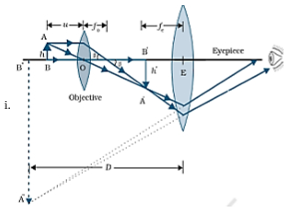
Magnification due to objective
$m_0=\frac{h^{\prime}}{h}=\frac{L}{f_0}\left(\because \tan \beta=\frac{h}{f_0}=\frac{h}{L}\right)$
Magnification due to eye piece when final image is formed at the near point
$m _{ e }=1+\frac{D}{f_{ e }}$
Total magnification
$ m = m _0 m_{ e }$
$m =\frac{L}{f_0}\left(1+\frac{D}{f_{ e }}\right)$
$ii. 4$
$m=\frac{L D}{f_o f_e}$
$m=\frac{24 \times 25}{2 \times 6}$
$=\frac{600}{12}$
$=50$
Hence, the total magnification when the image is formed at infinity is $50$.
View full question & answer→Magnification due to objective
$m_0=\frac{h^{\prime}}{h}=\frac{L}{f_0}\left(\because \tan \beta=\frac{h}{f_0}=\frac{h}{L}\right)$
Magnification due to eye piece when final image is formed at the near point
$m _{ e }=1+\frac{D}{f_{ e }}$
Total magnification
$ m = m _0 m_{ e }$
$m =\frac{L}{f_0}\left(1+\frac{D}{f_{ e }}\right)$
$ii. 4$
$m=\frac{L D}{f_o f_e}$
$m=\frac{24 \times 25}{2 \times 6}$
$=\frac{600}{12}$
$=50$
Hence, the total magnification when the image is formed at infinity is $50$.